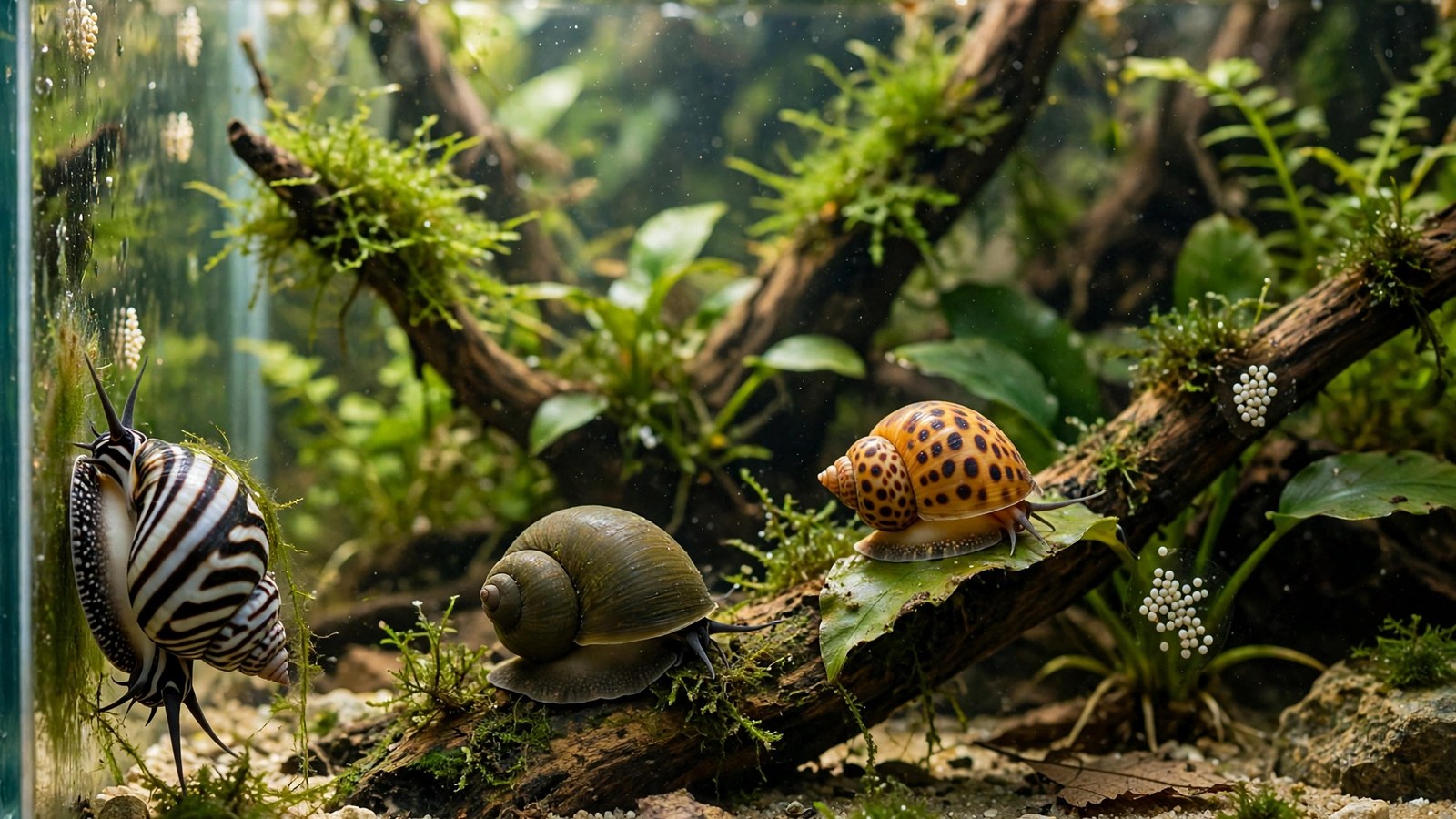
You'll spot the white sesame-seed dots on your driftwood long before you spot the snail that laid them. That's the strange trade every nerite owner makes: the single best algae-eating invertebrate in the hobby, and in return, an artist who decorates your hardscape with tiny, near-indestructible eggs. Proper nerite snail care is easy once you grasp three things: what they eat, what their shells need, and why they keep climbing out of your tank.
Popular Nerite Snail Types Compared
Shop-bought nerites are closely related species in the genus Neritina with identical care — pick on looks and size:
| Type | Shell pattern | Size | Notes |
|---|---|---|---|
| Zebra nerite | Bold black-and-gold stripes | ~1 in | The classic; cheapest and most available |
| Tiger nerite | Orange-brown with black zigzag bands | ~1 in | Striking under warm light |
| Horned nerite | Olive with small black spikes | ~0.5 in | Stays small — ideal for nano tanks; the "horns" are harmless |
| Olive nerite | Plain olive-green shell | ~1 in | Understated; cleanup without the flash |
| Racer / red racer | Red-orange with fine black striping | ~1 in | Flashier and pricier; slightly more active |
For a 20-gallon community, two or three zebras or tigers handle most algae early. Acclimate new snails like shrimp: float the bag 15 minutes, then drip-acclimate for an hour — they're more sensitive to sudden parameter swings than their hardy reputation suggests.
Nerite Snail Care: Water, Feeding, and Tank Size
Nerite snail care starts with water chemistry, because the shell is the health report. Snails build shells from calcium carbonate, so water below pH 7.0 slowly pits and erodes the shell — damage that never repairs. Aim for pH 7.0–8.5 with GH 6–12 dGH and KH 4–8 dKH. In soft-water regions, a bag of crushed coral in the filter or a cuttlebone behind the hardscape keeps minerals available; recheck your planted tank water parameters seasonally, since tap water can drift.
Temperature is forgiving: 72–78°F (22–26°C) is ideal. Keep ammonia and nitrite at zero and nitrates under 20 ppm, and add nerites only to a mature, cycled planted tank — never during the cycle.
One nerite per 5 gallons of a planted community tank with live plants usually finds enough algae and biofilm. If snails park at the waterline for hours, the tank is too clean: supplement twice a week with half an algae wafer per three snails, or a blanched zucchini slice removed in the morning. They graze algae off easy beginner aquarium plants without damaging leaves.
The White Eggs Problem (and How to Handle It)
Every nerite owner asks this within a month: small white oval dots glued to driftwood, rocks, and glass — what are they? Nerite eggs, laid mostly by females (even a lone female lays infertile ones). Larvae need brackish or saltwater to develop, so in freshwater the eggs will never hatch. They just sit there for weeks.
A males-only tank produces no eggs, but sexing snails at the shop is impractical — assume any group will lay. You can simply wait: the eggs wear down and vanish over a month or two. Or remove them: a single-edge razor blade scrapes them off glass, and an old toothbrush takes them off driftwood and textured rock during your weekly planted tank maintenance. Don't reach for chemistry — "egg remover" products risk your plants, shrimp, and the snails themselves.
Algae-Eating Strengths: What They Actually Clean
Their rasping radula scrapes surfaces other cleaners can't touch: green spot algae (the hard dots on glass and Anubias leaves), brown diatoms in new tanks, green dust algae, and soft film algae. One snail can clear a palm-sized patch of green spot algae overnight. See our best algae eaters for planted tanks for how they compare with amanos and otos.
But know their limits: nerites do not eat black beard algae, staghorn, or hair algae, and they don't eat uneaten fish food. If algae outpaces three snails, shorten the photoperiod or fix nutrients — don't buy more snails. In a planted tank cleanup crew, nerites are the glass-and-hardscape specialists — pair them with Amano shrimp for soft algae on leaves.
Escape-Proofing: They Will Climb Out
Nerites are the Houdinis of the invertebrate world: they graze above the waterline, climb filter cords and heater cables, and leave the tank through any gap. A dried snail on the floor is the leading cause of nerite death at home, and it's entirely preventable.
The fix is a tight lid with no gaps around filter and cable cutouts — plug cable holes with filter floss. Keep the waterline an inch below the rim so grazing snails meet a dry band that sends them back down. If you prefer open-top, read our open-top vs. lid guide and check the floor behind the tank each morning; escaped nerites often land nearby and can survive hours out of water.
Tank Mates: What Works and What Eats Them
They're peaceful to the point of defenselessness, so the question is what won't hurt them: tetras, rasboras, gouramis, corydoras, most bettas, and all dwarf shrimp are safe. A snail alongside a betta tank with live plants is a classic pairing.
The danger list is short but absolute: puffers, loaches (clown, yoyo, even kuhlis), assassin snails, and large cichlids. Even "peaceful" loaches learn to flip a nerite and eat it.
Beginner trap: adding nerites to a brand-new, algae-free tank "in advance" of algae. Without biofilm they starve quietly — introduce them only once you can see a light film on the glass, a classic entry in our beginner planted tank mistakes list.
Frequently Asked Questions
How many nerite snails do I need for my tank?
Plan on one nerite per 5 gallons — two for a 10-gallon, three to four for a 20-gallon. More snails won't fix a serious outbreak; they handle maintenance-level algae. If algae outpaces them, shorten your lighting period or fix excess nutrients first.
Will nerite snail eggs hatch in my freshwater tank?
No — larvae need brackish or saltwater, so freshwater eggs never hatch. The dots are harmless but stubborn, fading on their own over weeks. Scrape glass with a razor blade and scrub driftwood with a toothbrush during water changes. Avoid chemical "egg removers," which risk your plants and shrimp.
Do nerite snails eat aquarium plants?
Healthy plants are safe — nerites eat only algae, biofilm, and decaying matter, never live leaf tissue. A snail on a plant is grazing the algae film on the leaf, which benefits the plant. Only severely rotting leaves get eaten — this plant-safe grazing is why nerites suit planted aquariums.
Why does my nerite snail keep climbing above the waterline?
Occasional waterline cruising is normal — nerites graze the damp zone. Constant above-water behavior can signal poor water quality, low oxygen, or too little food: test ammonia, nitrite, and nitrates, confirm there's algae to graze, and check the lid for escape gaps. FishLore's community Nerite Snail Care Guide has a useful parameter and behavior checklist.
Can nerite snails live with betta fish?
Usually, yes — most bettas ignore nerites. A 5-gallon planted tank with one horned or zebra nerite is a classic pairing. Watch the betta for the first few days, since some nip at the snail's antennae. Keep the tank lidded at 76–78°F for both.
The Quiet Workhorses of the Planted Tank
A nerite won't beg at the glass — it patrols glass, driftwood, and plant leaves around the clock, removing the algae you'd otherwise scrape every weekend, without touching a live plant. Give it mineral-rich water, food when the tank runs clean, and a lid it can't defeat, and you'll get two to four years of the hobby's most reliable cleanup.