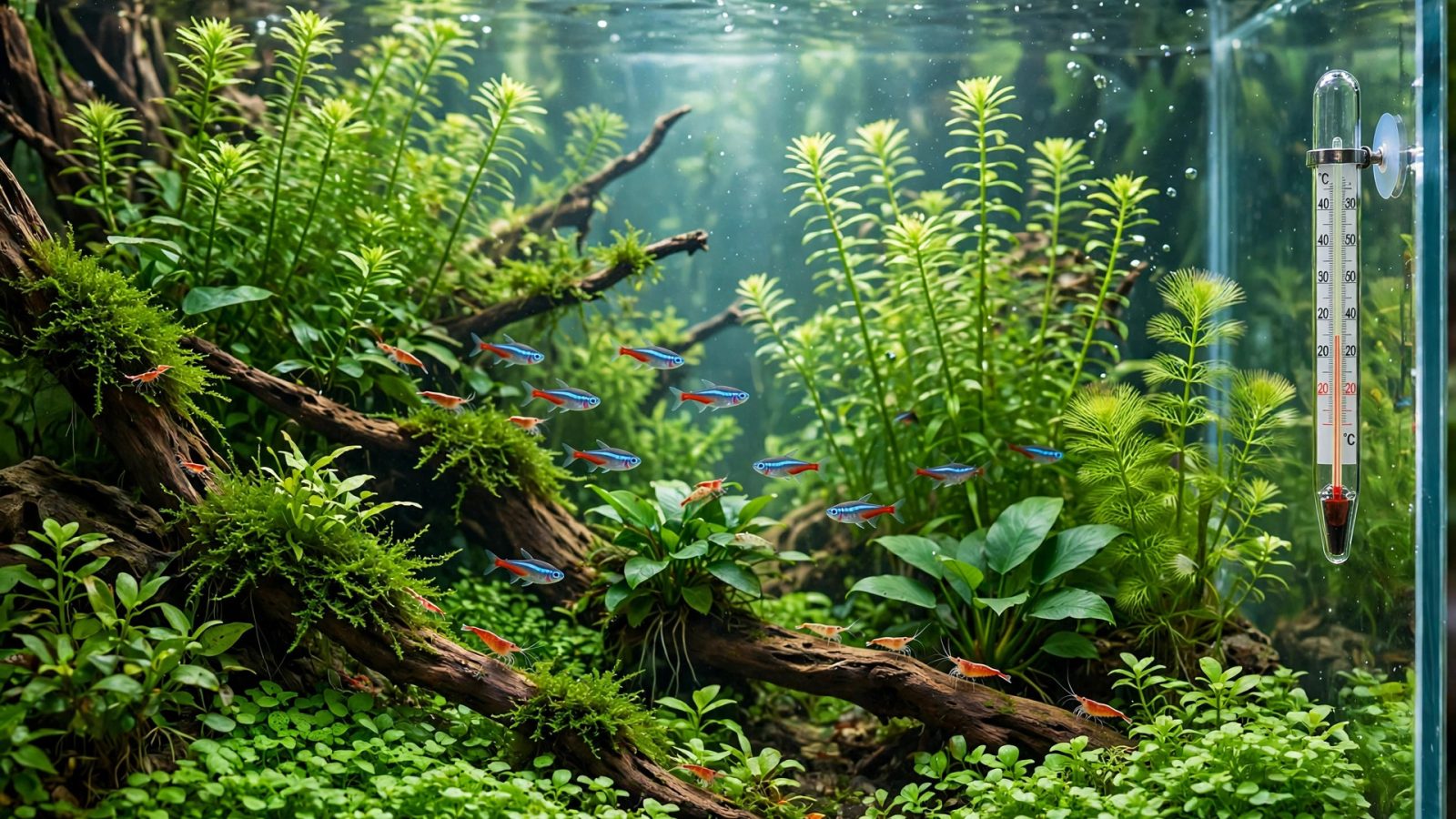
Plants don’t read test kits — but they respond to what’s in the water with total honesty. Yellow leaves, stalled growth, sudden melting: most “plant problems” are water parameter problems wearing a disguise. This planted tank water parameters guide gives you the target ranges, what each parameter actually does, how to test, and how to adjust without destabilizing the tank.
The Five Parameters That Matter
1. pH (Acidity/Alkalinity)
Target: 6.5–7.5 for most planted tanks. The majority of aquarium plants evolved in slightly acidic to neutral water and grow best there. That said, plenty of plants (vallisneria, anubias, java fern) thrive at pH 8.0+ — pH matters less than stability. Plants adapt to a wide pH range; they suffer from pH swings.
What moves pH: driftwood and aquasoil lower it; limestone, seiryu stone, and crushed coral raise it. CO2 injection lowers pH during the photoperiod (normal — a 1-point daily swing from CO2 is fine and distinct from unstable KH).
2. KH (Carbonate Hardness)
Target: 3–8 dKH. KH is your pH buffer — it prevents pH crashes. Below 2 dKH, pH can swing dangerously; above 10, it locks pH high and some plants struggle with nutrient uptake. If your pH is unstable, test KH first — it’s usually the culprit. Baking soda raises KH (1 tsp per 10 gallons ≈ +2 dKH); RO water or driftwood lowers it gradually.
3. GH (General Hardness)
Target: 4–10 dGH. GH measures calcium and magnesium — both are plant macronutrients. Too soft (below 3) and plants show calcium/magnesium deficiencies (twisted new growth, pinholes). Too hard (above 12) and some soft-water species struggle with iron uptake. Most tap water sits in the usable range. GH booster (calcium/magnesium powder) fixes soft water; mixing with RO dilutes hard water.
4. Temperature
Target: 72–78°F (22–26°C) for most planted communities. Warm water holds less CO2 and oxygen; cold slows metabolism. The plant-fish overlap matters: cardinals want 78–82°F, white clouds prefer it cool. Pick livestock and plants with overlapping comfort zones — our schooling fish guide notes temperature needs per species.
5. Nitrogen Compounds (Ammonia/Nitrite/Nitrate)
Targets: ammonia 0, nitrite 0, nitrate 5–20 ppm. In planted tanks, nitrate is nuanced — it’s plant food. Zero nitrate with hungry plants means under-fertilization; 40+ ppm means overfeeding or under-planting. The sweet spot feeds plants without stressing fish. If nitrates won’t stay down, add fast growers or floaters — see our planting density guide.
Parameters by Plant Group
- Bulletproof generalists (anubias, java fern, hornwort, anacharis): pH 6.0–8.0, any reasonable hardness. These don’t care.
- Soft-water lovers (most delicate stems, toninas, eriocaulon): pH 6.0–6.8, GH 3–6, KH 1–4. The high-tech crowd’s palette.
- Hard-water champions (vallisneria, many crypts): pH 7.0–8.5, GH 8–15. African cichlid tank plants live here.
- Red plants: slightly acidic pH (6.5–7.0) improves iron availability; strong light matters more than exact pH.
How to Test (Without Going Overboard)
Liquid test kits (API Master Kit class) are the standard — accurate enough, cheap per test. Test strips are convenient but imprecise; fine for quick checks, not for diagnosing problems. Digital pH pens are nice but need calibration.
Testing schedule: weekly during the first two months (you’re learning your water), monthly once stable, and anytime something looks wrong — melting, algae bloom, fish behavior change. Test before adjusting, always. Most parameter disasters come from “fixing” something that wasn’t broken.
Adjusting Parameters Safely
The golden rule: small changes, slowly. Plants and fish tolerate a wide range but hate rapid shifts.
- Lowering pH: driftwood, aquasoil, Indian almond leaves (tannins), or RO water dilution. Avoid “pH down” chemicals — they cause crashes.
- Raising pH/KH: crushed coral in the filter (slow, self-limiting), limestone rock, baking soda (fast — dose carefully).
- Raising GH: GH booster powders (calcium/magnesium). Needed mainly for RO users and very soft tap water.
- Lowering hardness: mix tap with RO/distilled water. There’s no safe chemical shortcut.
Never chase a “perfect” number from the internet. If your tap water grows plants well at pH 7.6, that’s your perfect number. Stability beats textbook ideals every time.
The Tap Water Question
Most municipal tap water grows aquarium plants fine after dechlorination. Test it once — pH, GH, KH — and you’ll know your baseline forever. The only common tap problems: chloramine (neutralized by any decent dechlorinator), extreme hardness (workable — choose hard-water plants), and ammonia in the tap itself (rare; test if you suspect it).
RO water is for specialists: very soft-water species, precise high-tech setups, or truly awful tap water. It must be remineralized (GH/KH+) before use — pure RO is too empty for plants or fish. For 90% of planted tanks, dechlorinated tap is the right answer.
Frequently Asked Questions
My pH is 8.2. Can I keep plants? Yes — anubias, java fern, vallisneria, hornwort, and many more thrive at 8+. Choose plants for your water instead of fighting your water.
Do water changes reset parameters? They restore baseline (your tap’s parameters). Large, frequent changes on a tank adjusted away from tap parameters cause swings — another reason to work with your tap water.
Why did my pH crash overnight? Usually KH exhausted (below 2 dKH) combined with CO2 or organic acids. Test KH, restore buffering with crushed coral or baking soda, and investigate the acid source.
The Bottom Line
Test your tap once, learn its personality, pick plants that like it, and prioritize stability over ideals. pH 6.5–7.5, KH 3–8, GH 4–10, 72–78°F, nitrates 5–20 ppm covers nearly every planted community. The parameter that matters most is the one you test when something looks wrong — because by then, the plants have already told you.
Diagnosing Problems from Parameters
When plants look wrong, parameters are the first suspect. The diagnostic sequence:
- All plants stalling simultaneously: Test everything — usually temperature shock, untreated chloramine, or a crashed cycle. Systemic cause, systemic onset.
- New growth pale/twisted, old leaves fine: Immobile nutrient deficiency (iron, calcium) — the plant can’t move these to new tissue. Check GH (calcium/magnesium) and iron supplementation.
- Old leaves yellowing/pinholes, new growth fine: Mobile nutrient deficiency (nitrogen, potassium, magnesium) — the plant cannibalizes old leaves to feed new ones. Increase comprehensive fertilizer.
- Sudden melting after a water change: Parameter mismatch — usually temperature or pH swing from the new water. Match replacement water temperature; check pH of tap vs. tank.
- Algae bloom with no other changes: Test nitrates and phosphates. Often: overfeeding raised phosphates, or a dead fish spiked ammonia. Find the source, don’t just treat the algae.
For visual plant-problem diagnosis beyond parameters, see our anubias yellow-leaves guide — the diagnostic method transfers to all species.
CO2 and pH: Understanding the Relationship
CO2 injection lowers pH — typically 0.8–1.2 points during the photoperiod. This is normal and harmless; fish and plants evolved with daily CO2/pH rhythms. What matters: the pH returns to baseline overnight (proving the swing is CO2-driven, not KH collapse). If morning pH keeps dropping day after day, your KH is depleted — add buffering. A drop checker (green = ~30ppm CO2) is more useful than chasing pH numbers in CO2 tanks.
Seasonal Tap Water Changes
Municipal water changes seasonally — spring runoff, summer algae treatments, winter road salt. If your tank was stable for months and suddenly isn’t, test your tap: pH, GH, KH, and chlorine. Cities don’t announce water-source switches, but your plants will tell you. Keep a log of tap parameters 2–3x yearly; it turns mysteries into patterns. During known transition periods (spring thaw in northern cities), slightly larger water conditioner doses and smaller, more frequent changes add safety margin.
RO Water: The Full Guide
When RO makes sense: keeping soft-water specialists (toninas, certain eriocaulon), breeding sensitive species, or tap water that’s genuinely unusable (extreme hardness, ammonia, heavy metals).
Remineralization is mandatory. Pure RO (0 TDS) kills plants and fish — it leaches minerals from living tissue. Use GH booster to reach 4–6 dGH and a KH buffer to 2–4 dKH. Commercial remineralizers (Salty Shrimp, Seachem Equilibrium + Alkaline Buffer) make this foolproof: dose per instructions to hit target TDS (~120–150 for most planted communities).
The RO routine: Mix and heat the night before water changes (cold RO shocks tanks), aerate it, verify TDS with a $15 meter. It’s a commitment — which is why most hobbyists should exhaust tap-water options first. Our low-tech guide proves what’s possible on plain dechlorinated tap.
Parameter Logging: The Habit That Pays
Keep a simple log — notebook, spreadsheet, phone notes: date, pH, ammonia, nitrite, nitrate, GH/KH occasionally, temperature, and what you did (water change %, fertilizer dose, new additions). When problems appear, the log reveals patterns invisible to memory: “nitrates climb every third week” (feeding creep), “pH drops after filter cleaning” (disturbed media), “growth stalled when I switched fertilizer brands.” Six months of logs makes you the expert on your water — which beats any internet advice.
Fertilizers and Parameters: The Interaction
Fertilizing changes water chemistry — understanding how prevents surprises:
- Comprehensive liquid ferts barely move pH/GH/KH at normal doses. They’re the safe default.
- EI macro dosing (KNO3, KH2PO4) adds potassium and phosphate measurably — that’s the point. Nitrate readings will run higher; interpret them as “dosed” not “dirty.”
- GH boosters raise GH by design — don’t confuse a GH rise from your booster with tap-water changes.
- Root tabs affect the substrate, not the water column — which is why they’re ideal for targeted feeding without parameter shifts.
- Liquid carbon (glutaraldehyde) can lower pH slightly and stresses some plants (vallisneria, mosses) — another reason it’s not a true CO2 substitute.
Water Changes: The Science of the Reset
Water changes do four things simultaneously: dilute nitrates and organics, replenish carbonates (KH) and minerals, remove algae spores and dissolved organics, and reset fertilizer accumulation. The standard 25–30% weekly suits most planted tanks. High-tech EI tanks need 50% weekly (the method’s designed reset). Walstad-style tanks can go monthly once mature (the ecosystem handles more internally).
Technique matters: match temperature within 2°F, dose dechlorinator for the full tank volume (not just the replacement water) when using Python-style changers, and pour gently to avoid disturbing substrate. Cold-water shock and chlorine exposure are the two water-change injuries — both entirely preventable.
Emergency Parameters: Quick Reference
- Ammonia >0.5 ppm: 50% water change immediately, add bottled bacteria, stop feeding for 24h, find the source (dead fish, filter failure, overfeeding).
- pH crash (dropped >1 point suddenly): Test KH — if near zero, add baking soda (1 tsp/10 gal) to restore buffering, then investigate the acid source.
- Temperature spike (>84°F): Float frozen water bottles, increase surface agitation, reduce lighting. Act fast — heat kills quicker than cold.
- Chlorine exposure (forgot dechlorinator): Dose double dechlorinator immediately — it neutralizes chlorine on contact even after the fact. Watch fish for gasping; add an airstone.
Print this section and tape it inside your stand. Emergencies don’t wait for Google.
Parameter Cheat Sheet
- pH: 6.5–7.5 (most planted communities); stability > exact value
- KH: 3–8 dKH (buffering); below 2 = crash risk
- GH: 4–10 dGH (calcium/magnesium for plants)
- Temperature: 72–78°F (check fish/plant overlap)
- Ammonia: 0 ppm (always)
- Nitrite: 0 ppm (always)
- Nitrate: 5–20 ppm (plant food, not just waste)
- Phosphate: 0.5–2 ppm (deficiency causes green spot algae)
- TDS: 150–250 ppm (general sanity check)
Tape this inside your stand next to the emergency procedures. Between the cheat sheet and the log habit, you’ll diagnose 90% of problems before they become crises — because the numbers will tell you the story before the plants have to.
When to Ignore the Numbers
Here’s the advanced lesson: if your tank is thriving — plants growing, fish colorful, no algae — and a test shows a “wrong” number, trust the tank. Test kits expire, strips lie, and local conditions vary. The numbers are a diagnostic tool, not a report card. Chase changes (a parameter moving over time), not absolutes. A stable pH of 7.8 that grows plants beautifully beats a “perfect” 6.8 that swings weekly. The tank is the truth; the kit is just one witness.