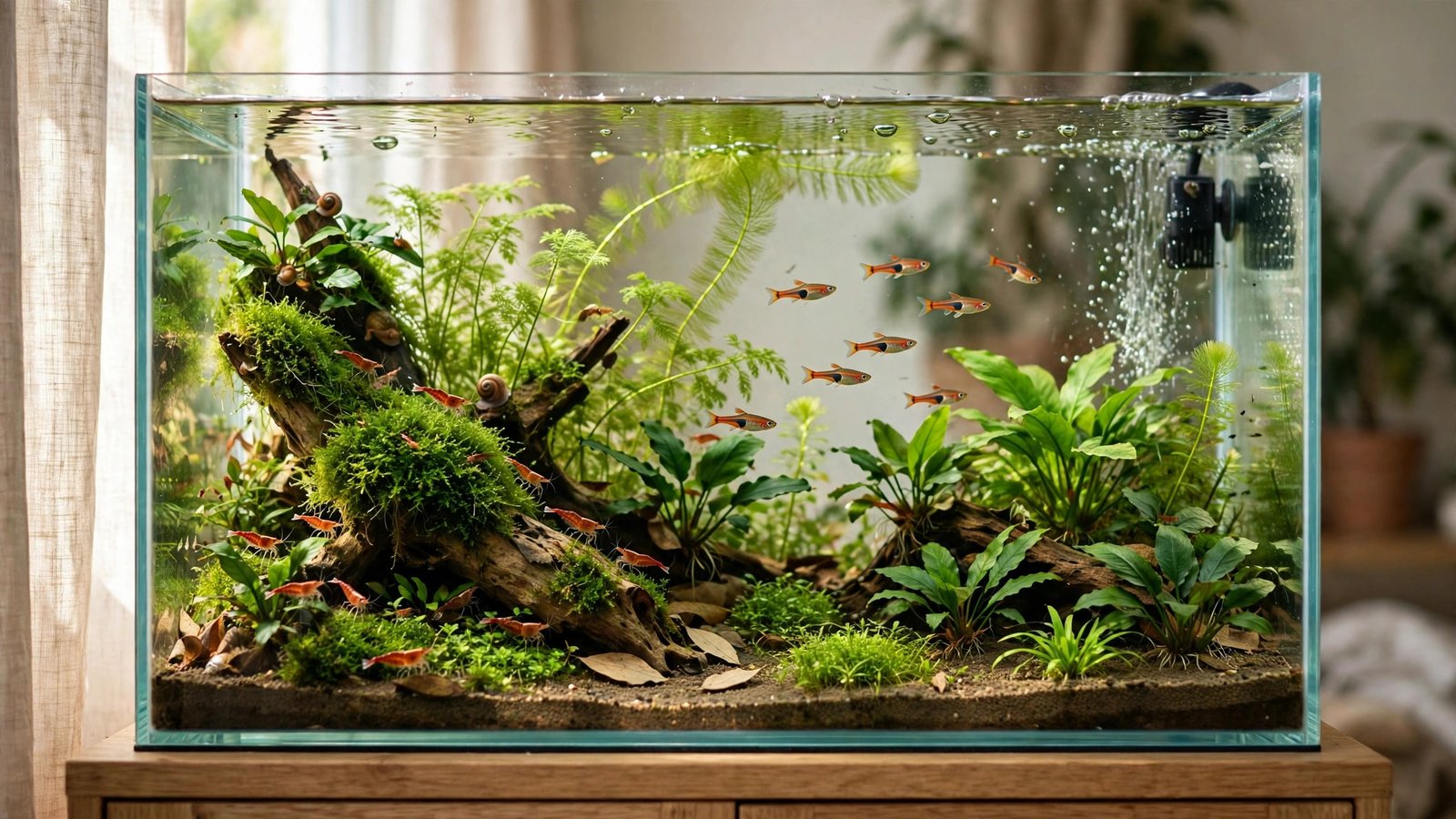
Learning how to cycle a planted tank is the single most important skill a new aquarist can pick up — and the step most people rush or skip. A planted aquarium is a living ecosystem, and before any fish or shrimp move in, its invisible filtration system (beneficial bacteria plus the plants themselves) needs weeks to establish. Cycle properly and you get clear water, thriving plants, and healthy livestock. Rush it and you get cloudy water, melting plants, and emergency water changes.
This guide covers the full nitrogen cycle for planted tanks: the classic fishless ammonia method, the plant-only "silent cycle," how to read test kits, realistic timelines, common stalls and their fixes, and a genuinely new development from late 2026 — Tropic Marin's Eco-Start Freshwater 24-hour "rock marinating" bacteria protocol, explained in our own words.
How to Cycle a Planted Tank: What "Cycling" Actually Means
"Cycling" is shorthand for establishing the nitrogen cycle. Fish food and waste produce ammonia, which is highly toxic. Two groups of nitrifying bacteria convert ammonia into nitrite (also toxic) and then nitrate (far less harmful, and absorbed by plants as fertilizer). A cycled tank is one whose bacterial colonies are large and stable enough to process all the ammonia its inhabitants produce, every day.
Planted tanks add a twist: live plants absorb ammonia directly through leaves and roots, often before bacteria touch it. A heavily planted tank can read zero ammonia and zero nitrite even while bacterial colonies are still tiny. That is good news — plants buffer mistakes — and a subtle trap, because tests can look perfect during the early weeks while the biology underneath is immature. For the full biology, see our beneficial bacteria in planted tanks guide.
Throughout this guide, "fully cycled" means one testable thing: the tank converts a 2 ppm ammonia dose into nitrate with no detectable ammonia or nitrite remaining within 24 hours.
Why Planted Tanks Cycle Differently
- Plants smooth out spikes. Fast growers like hornwort, water sprite, and floating plants can pull ammonia from the water column fast enough to keep levels near zero from day one — protecting future livestock but masking how much bacterial colonization has actually happened.
- Nutrient competition is real. Bacteria need phosphate, iron, and traces to multiply; plants compete for the same nutrients. In lean, nutrient-poor setups, colonization can stall until dissolved waste builds up.
- Early organic load is higher. Melting transition leaves, unsettled substrate, and fresh wood release organics that feed ammonia-producing decay. Expect a dirtier first two weeks than in a sterile fish-only setup — one reason a solid first planted tank shopping list includes a reliable liquid test kit from day one.
- CO2 and pH swings matter. Nitrifying bacteria slow below pH 6.5 and nearly stall below 6.0. In high-tech tanks running CO2, watch pH during cycling — a tank sitting at 6.2 may look "stuck" when the biology is simply sluggish.
Fishless Cycling: The Classic Ammonia Method, Step by Step
- Set up everything first. Substrate, hardscape, filter, heater, lighting — then fill. A dechlorinator is mandatory; chlorine and chloramine kill the bacteria you are trying to grow.
- Plant heavily on day one. Fast growers act as a safety net while bacteria colonize. If you are unsure how dense to go, our how many plants for a new aquarium guide gives concrete density targets.
- Run everything normally. Filter on, lights on a regular 6–8 hour schedule, heater at your target temperature (bacteria colonize fastest at 77–86°F / 25–30°C).
- Dose ammonia to 2–4 ppm. Use pure ammonium chloride made for aquarium cycling — no surfactants, no fragrances. Target ~2 ppm for a lightly stocked future tank, 4 ppm for a heavy bioload.
- Test ammonia and nitrite every 2–3 days. Little happens for the first week or two. Then ammonia starts dropping and nitrite rises (ammonia-oxidizers establishing); later, nitrite drops and nitrate climbs (nitrite-oxidizers arriving).
- Re-dose ammonia to 2 ppm when it hits zero. If nitrite exceeds 5 ppm, do a partial water change — very high nitrite can stall the second bacterial group.
- Confirm the full conversion, twice. Dose to 2 ppm; 24 hours later, ammonia and nitrite both read zero and nitrate has risen. For method variations, compare notes with our fishless planted tank guide.
- Big water change, then stock slowly. Drop nitrates with a large water change, then add livestock gradually over several weeks — a cycled filter still needs time to adjust to each new ammonia source.
Three Cycling Methods Compared
| Method | Typical timeline | Best for | Watch out for |
|---|---|---|---|
| Fishless ammonia dosing | 3–6 weeks | Most planted tanks; predictable and humane | Ammonia overdosing; pH below 6.5 stalling bacteria |
| Silent cycle (plants only) | 2–4 weeks | Heavily planted, lightly stocked tanks | Tests read clean before bacteria are ready — stock very slowly |
| Seeded media / bacterial starter | 1–3 weeks | Speeding things up alongside another method | Quality varies wildly; it boosts, not replaces, the cycle |
The silent cycle needs a word of caution. With enough fast-growing plants, ammonia and nitrite may never register on a test kit, and beginners mistake this for a finished cycle. The plants are doing the filtering, not bacteria — fine until the plants slow down or you add a full fish load at once. Silent cycling works, but stock at a snail's pace and keep testing for the first month after adding livestock.
The bottled-bacteria method, compared honestly against fishless and silent cycling: API Quick Start.
When to Add Plants During Cycling
- Day one. Planted tanks should be planted before cycling begins. Plants belong in the tank from the start — they are part of the cycling machinery, not livestock that must wait.
- Fast growers first. Stem plants (rotala, ludwigia, hygrophila), floaters (frogbit, salvinia), and water sprite are your cycling workhorses. Slow growers like anubias contribute little filtration early on.
- Expect some melting. Tissue-culture and emersed-grown plants often shed old leaves in the first two weeks. Remove rotting material promptly — decay is an ammonia source you do not need.
- Fertilize lightly. Decaying melt and substrate leaching already load the water with organics; a full fertilizer regimen on day one often just feeds algae.
- Early algae is normal. A light dusting of diatoms or green algae in weeks 2–4 is the ecosystem balancing itself. Stable light and patience resolve it — resist blackouts and algaecides.
Reading Your Test Kit Like a Pro
A liquid reagent test kit (API Freshwater Master Kit or equivalent) is non-negotiable. Test strips are too imprecise for the small swings that matter.
Ammonia
Target: 0 ppm finished; 2–4 ppm during active dosing. Read colors in daylight against white — charts are hard to read under warm LEDs. If ammonia will not drop after two weeks of dosing, check pH and temperature before assuming the cycle is broken.
Nitrite
Target: 0 ppm at the end; a rising-then-falling spike mid-cycle is the sign of progress. Keep it under 5 ppm during cycling with water changes if needed — very high nitrite can stall the bacteria that consume it.
Nitrate
Target: under 40 ppm before adding livestock (under 20 for shrimp). Rising nitrate with falling nitrite proves the full conversion chain works. In heavily planted tanks nitrate may stay near zero — the plants are eating it. That is healthy, not a problem.
pH, GH, KH
Cycling's silent saboteurs. Bacteria slow dramatically under pH 6.5; KH buffers pH and prevents the "pH crash" that stalls cycles in soft-water tanks. If a cycle stalls for no apparent reason, test KH — exhausted buffering is the most common hidden cause. Our planted tank water parameters guide covers ideal ranges.
The cycling bible's core tool: read ammonia, nitrite, and nitrate like a pro: API Freshwater Master Test Kit.
Timelines: What to Expect Week by Week
| Phase | Typical window | What you will see |
|---|---|---|
| Quiet phase | Days 1–10 | Ammonia steady; plants may melt; possible diatom dusting |
| Ammonia drop | Days 10–20 | Ammonia falls between doses; nitrite begins to climb |
| Nitrite spike | Days 18–30 | Nitrite peaks, possibly high; ammonia converts quickly now |
| Nitrite fall | Days 25–40 | Nitrite drops toward zero; nitrate climbs steadily |
| Confirmation | Days 35–45 | 2 ppm ammonia clears to zero ammonia/nitrite in 24 hours |
Warm water, seeded media, and moderate pH push toward the fast end; cold, soft, acidic water pushes toward the slow end. For legitimate shortcuts, see how to cycle a planted tank faster.
New in 2026: Tropic Marin's 24-Hour "Rock Marinating" Protocol
At InterZoo 2026, Tropic Marin unveiled a cycling concept that departs from the familiar "dose and wait" routine: the Eco-Start Freshwater protocol, built around what the company calls rock marinating. In one sentence: you soak your hardscape rocks in a concentrated bacterial and mineral solution for 24 hours before they go into the tank. The reasoning is genuinely interesting.
Conventional bottled bacteria go straight into aquarium water, where they face an immediate problem: the tank is sterile and nutrient-thin, and the bacteria have nothing to cling to but clean filter foam and bare glass. A large fraction never attach — they wash out or die. Rock marinating flips this around. By steeping porous hardscape in a mineral-rich bacterial bath first, the rocks themselves become pre-colonized habitat: biofilm-friendly surfaces loaded with both the bacteria and the trace elements they need to multiply. When those rocks enter the tank, the colonies arrive already anchored to real estate instead of drifting in the water column hoping to settle.
Early reporting frames the protocol as compressing the front end of the cycle — the long "quiet phase" where nothing seems to happen — rather than eliminating cycling. That framing matters: no honest product makes a tank instantly ready for a full fish load. What pre-colonized rock can plausibly do is shorten the wait before ammonia-oxidizing bacteria establish, because they skip the hardest step (finding a home) and start already attached.
For planted-tank keepers the logic is appealing: hardscape rocks are already the centerpiece of most aquascapes, so marinating them adds no extra equipment — you are treating a step you were doing anyway. Two cautions, though. Mineral-rich baths can shift water chemistry, so test KH, GH, and pH after adding marinated rock, especially in soft-water setups. And treat this as an accelerator for a proper fishless cycle, not a replacement — confirm the full 24-hour ammonia conversion with your test kit before adding livestock. ReefBuilders covered the InterZoo announcement for readers who want the deeper science.
Common Cycling Stalls and How to Fix Them
A stalled cycle is almost always one of these six problems — work through them in order:
| Symptom | Likely cause | Fix |
|---|---|---|
| Ammonia never drops after 3+ weeks | pH below 6.5; cold water; chloramine in tap water | Raise pH toward 7.0–7.6; heat to 80–86°F; double-check dechlorinator dose |
| Nitrite stuck high for weeks | Nitrite over 5 ppm inhibiting the second bacterial group | 30–50% water change; re-dose ammonia lightly |
| pH crashes mid-cycle | Exhausted KH buffering in soft water | Add KH buffer; keep KH above 3 dKH during cycling |
| Everything reads zero from day one | Heavy planting absorbing all ammonia (silent cycle) | Not a stall — keep dosing small ammonia amounts, stock very slowly |
| Nitrate never rises | Plants consuming it; or test-kit misread | Shake nitrate reagents 30+ seconds; low nitrate in planted tanks is normal |
| Sudden ammonia spike weeks in | Something died, or the filter was disturbed | Remove the source; water change; the colony recovers in days |
Detoxify ammonia and nitrite while an uncycled tank stabilizes: Seachem Prime.
Signs Your Planted Tank Is Fully Cycled
- A 2 ppm ammonia dose converts to zero ammonia and zero nitrite within 24 hours, confirmed twice.
- pH is stable day to day — no crashes after water changes.
- Plants show new growth: fresh leaves, extending stems, pearling under light.
- Water is clear with no persistent haze; early algae is stable or receding.
- Nitrates are under 40 ppm after a final water change.
Even then, stock gradually — a small group of hardy fish or a few shrimp first, then test and continue. Once livestock are in, the routine shifts to long-term care; our planted tank maintenance schedule guide picks up exactly where this guide ends.
Frequently Asked Questions
How long does it take to cycle a planted tank?
Most planted tanks finish a fishless ammonia cycle in 3–6 weeks. Heavily planted silent-cycle tanks can look ready sooner, but the bacterial colonies underneath are still maturing — so the safe answer is 4+ weeks either way. Warm water (80–86°F), seeded filter media, and stable pH near 7.0–7.6 push toward the faster end.
Can I add plants before the tank is cycled?
Yes — you should. Plants belong in the tank from day one of the cycle. Fast-growing stem plants and floaters absorb ammonia directly, buffering the toxic spikes that make cycling dangerous in fish-only setups. Only livestock must wait; plants are part of the cycling machinery itself.
Do I need water changes while cycling a planted tank?
Strategically, yes. Change water if nitrite exceeds 5 ppm, if pH crashes, or to remove heavy plant melt. Otherwise leave the tank alone — each water change dilutes the ammonia feeding the colony. Finish with one large water change to drop nitrates before livestock arrive.
Why is my ammonia at zero but the tank isn't cycled?
In a planted tank, zero ammonia with zero nitrite often means plants are absorbing everything — not that bacteria are established. This is the silent-cycle trap: tests look perfect while colonies remain tiny. Confirm with the 24-hour conversion test: dose 2 ppm, and if it does not fully clear within a day, the cycle is not done.
Should I use a bacterial starter product?
They can help but vary enormously in quality. Fresh, refrigerated, well-reviewed products genuinely shorten the cycle; old or heat-damaged bottles are expensive water. Use a starter as an accelerator alongside fishless ammonia dosing — never as a substitute for testing. Newer approaches like Tropic Marin's 2026 rock-marinating protocol target the same goal through pre-colonized hardscape.
Can I cycle a planted tank with fish in it?
You can, but you should not. Fish-in cycling exposes livestock to ammonia and nitrite for weeks, demands daily water changes, and risks algae explosions from constant disturbance. Fishless ammonia cycling is faster, safer, and builds a stronger bacterial colony at the end.
Your Planted Tank Is an Ecosystem — Treat It Like One
Cycling is not really about waiting; it is about building. Every ammonia dose, every water test, every new leaf is the ecosystem assembling itself — bacteria colonizing filter media, plants rooting into substrate, chemistry settling into rhythm. The patience cycling teaches is the same patience that grows a great aquascape.
So dose your ammonia, test your water, and resist the beautiful fish at the shop for just a few more weeks. When that 2 ppm dose vanishes overnight and the tank sits at zero ammonia, zero nitrite, with plants visibly thriving — that is not just a cycled tank. That is a living system you built. If you want the low-tech path from here, our low-tech planted tank setup guide shows how to keep that balance thriving without CO2 injection.