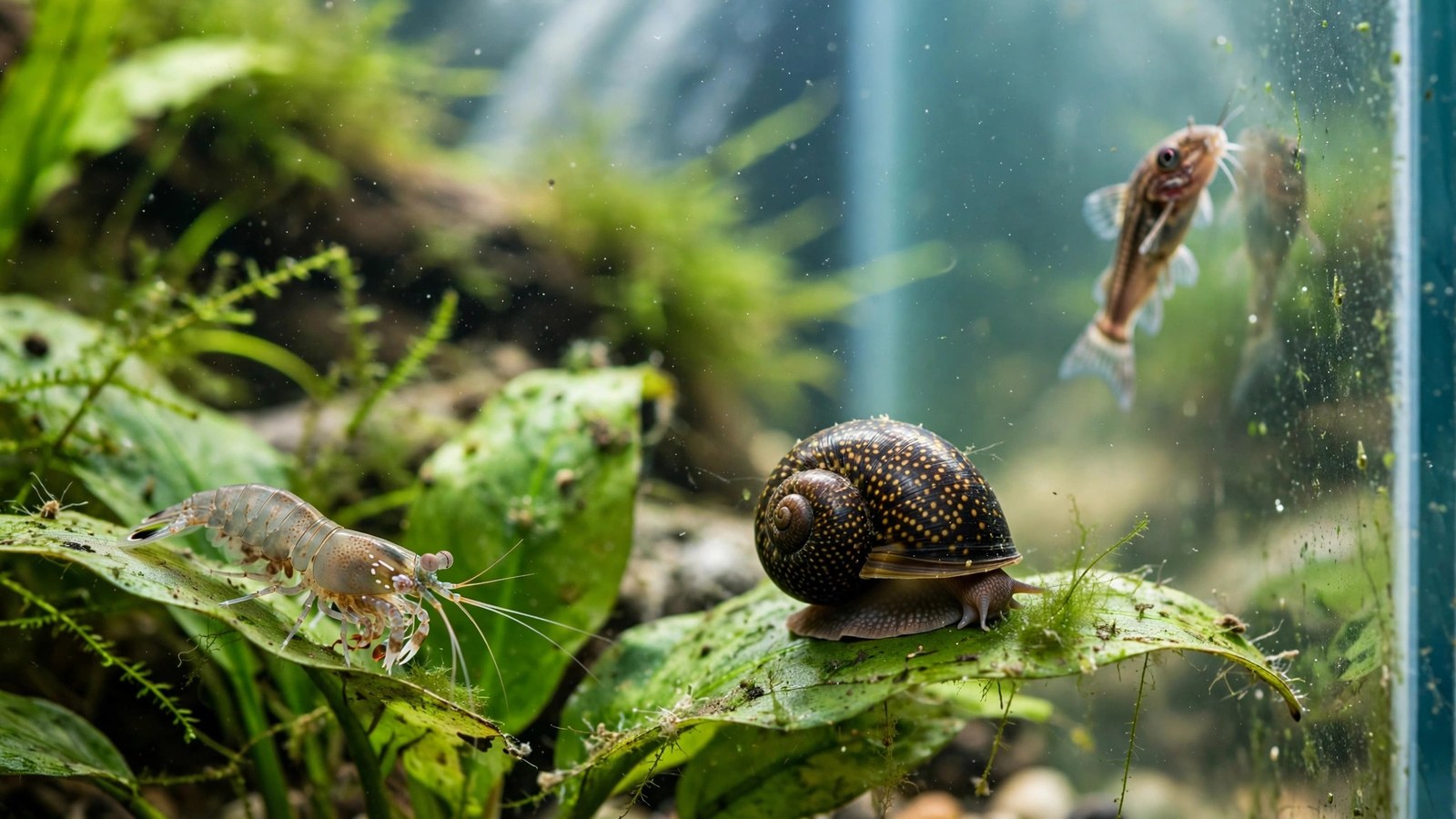
A cleanup crew planted tank owners can actually rely on is not a box of miracle animals — it is a carefully assembled team of shrimp, snails, and algae-eating fish that grazes where algae grows and keeps surfaces clean between maintenance sessions. Choose the wrong mix, and your crew starves, eats your plants, or becomes lunch for a betta. This guide covers which species handle glass, leaves, and substrate, how many to add for your tank size, and how to keep the crew fed and safe long after the early algae blooms fade.
What a Cleanup Crew Can (and Can't) Do
Before buying anything, calibrate your expectations. A cleanup crew manages algae — it does not fix the causes of algae. If your light runs too long, your water parameters are off, or your plants are starved of nutrients, algae will outgrow whatever your animals can eat.
Algae is a symptom, not the disease
Algae appears whenever conditions favor it over plants: too much light relative to CO₂ and nutrients, ammonia spikes, or inconsistent dosing. Grazers scrape away the growth, but the excess light or nutrients remain. Think of the crew as maintenance staff, not remediation contractors. If your tank is cycling, sort out the chemistry first: our guide on how to cycle a planted tank faster covers the ammonia side of the equation.
Where a crew genuinely shines
In a balanced tank, a good crew handles the small, constant chores: polishing diatom dust off glass, picking soft green algae off leaves, sifting detritus from the substrate, and eating uneaten food before it decays. The result is a tank that looks cared for between maintenance sessions — and less organic waste decaying into the water, which itself slows new algae growth.
The Core Team: Shrimp, Snails, and Grazing Fish
The classic mistake is stocking five species that all graze the same glass panel while nobody touches the substrate. Build your team by zones instead: glass, plant leaves, and substrate.
Amano shrimp — the heavy lifters
Amano shrimp (Caridina multidentata) are the most voracious algae grazers available to hobbyists. A handful will strip a hair-algae bloom, polish plant leaves, and comb detritus from the substrate. They are relatively large (up to 5 cm), peaceful, and too big for most small fish to eat.
Neocaridina (cherry shrimp) — the breeding colony
Cherry shrimp (Neocaridina davidi) are smaller than Amanos and less aggressive grazers, but they breed readily in freshwater, so a starting group of 10–15 becomes a self-sustaining colony that works every surface around the clock. Their grazing style suits soft biofilm, dust algae on leaves, and leftover food. The trade-off: they are bite-sized.
Nerite snails — the glass polishers
Nerite snails are the best glass cleaners in the hobby. They rasp diatoms, brown algae, and green spot algae off hard surfaces with a relentlessness no fish can match. They cannot breed in freshwater, so their numbers stay exactly where you set them. The catch is cosmetic: females lay tiny white eggs on hardscape and glass that never hatch but take months to dissolve. One nerite per 20–40 liters is plenty for glass duty.
Mystery snails — the gentle giants
Mystery snails (Pomacea bridgesii) are charming, active scavengers that eat uneaten food, soft algae films, and decaying plant matter, while ignoring healthy live plants. Two cautions: they can breed in freshwater if you keep a mixed-sex pair, and they are regulated in some regions as invasive-species risks. Check your local regulations before acquiring mystery snails, and never release aquarium animals into local waterways under any circumstances.
Otocinclus — the leaf specialists
Otocinclus catfish ("otos") are the premier leaf cleaners: schooling fish that vacuum soft algae and diatoms off plant leaves without damaging them, essential on broad-leaf plants like Anubias where shrimp claws struggle to grip. Two non-negotiable requirements: a mature tank with established algae and biofilm — most deaths come from starving otos added to spotless new tanks — and slow drip acclimation, since they are fragile at import. Keep them in groups of 6 or more.
Siamese algae eaters — the hair-algae crew
True Siamese algae eaters (Crossocheilus oblongus) are among the few fish that eat hair algae and black beard algae — the algae most crews ignore. The caveats matter. Buy the true species: flying foxes and Chinese algae eaters are often mislabeled, and Chinese algae eaters turn aggressive and stop eating algae as adults. True SAEs have a ragged black stripe continuing onto the tail and a single pair of barbels. They also grow to 15 cm, so skip them in nano tanks, and older individuals get lazy about grazing. Stock juveniles in groups of 3–5 for medium and larger tanks.
Twig catfish (Farlowella) — the twig grazers
Farlowella, or twig catfish, look like camouflaged sticks and graze soft algae and biofilm off wood, leaves, and glass with unusual delicacy. They suit peaceful community planted tanks and mature setups with real driftwood — new driftwood often grows a soft white biofilm they happily graze. They are sensitive to water-quality swings, so add them only to stable, mature tanks, and avoid boisterous tank mates that outcompete them for food.
Stocking Your Crew: Numbers by Tank Size
Stocking a cleanup crew is less about formulas and more about grazing pressure vs. food supply. These starting points assume an average stocked planted tank — adjust down for lightly stocked or brand-new tanks, and up only after observing whether algae keeps ahead of the crew.
Starting numbers for common tank sizes
| Species | Nano (20–40 L) | Medium (60–120 L) | Large (180 L+) |
|---|---|---|---|
| Amano shrimp | 3–5 | 6–10 | 12–20 |
| Cherry shrimp (breeding colony) | 10–15 | 20–30 | 30–50 |
| Nerite snails | 1–2 | 3–5 | 6–10 |
| Mystery snails | 1 | 1–2 | 2–4 |
| Otocinclus (min 6) | 6–8 | 8–12 | 12–20 |
| Siamese algae eaters | 0 | 3–5 | 5–8 |
| Twig catfish | 0–1 | 1–3 | 3–5 |
SAEs and twig catfish are listed as zero for nano tanks deliberately: SAEs outgrow them, and twig catfish need the stability a larger volume provides. A nano tank with Amanos, a cherry colony, and a nerite is already a strong crew.
Add in waves, not all at once
Introduce the crew in two or three additions spaced a week or two apart. Shrimp first (hardy, immediate grazers), then snails, then the fish. Each wave adds bioload, and a planted tank's bacteria and plants need time to absorb it. Dumping the whole crew into a new tank on day one is one of the most common causes of mysterious crew deaths that get blamed on bad shop stock.
Compatibility: Who Eats Whom
The number-one reason cleanup crews fail is predation, not water chemistry. Every crew species sits somewhere on someone's menu, so plan the team around the centerpiece fish, not the other way around.
Bettas and shrimp
Bettas are individualists: some ignore adult shrimp entirely, others hunt a cherry colony to extinction in a week. Amanos are usually large enough to survive a curious betta, but cherry shrimp are rarely safe long-term. Start with Amanos and dense plant cover, observe for a week, and treat any cherry colony as a gamble. A planted betta tank setup with heavy cover gives shrimp their best chance, but it is still the betta's decision.
Loaches and snails
Most loaches — yoyo, zebra, clown — are snail predators and will crush nerites and mysteries once large enough. If you love loaches, lean on shrimp and otos instead and skip the snails. Kuhli loaches are snail-safe and coexist fine. Never add a loach "to eat pest snails" and a decorative nerite in the same week; the nerite loses.
SAEs in small tanks and otos in new tanks
Two stocking errors shops encourage. Siamese algae eaters do not belong in tanks under about 60 liters — they grow, they school, and a cramped SAE becomes a stressed, plant-uprooting adult. Otocinclus do not belong in brand-new tanks — there is simply nothing for them to eat, and they arrive from importers already half-starved. Both species reward patience: mature tank, correct tank size, correct group size.
Species that never join the crew
Chinese algae eaters (Gyrinocheilus aymonieri) are often sold as SAEs and deserve permanent exclusion: as adults they harass sleeping fish, become territorial, and largely stop eating algae. Common plecos sold as "algae cleaners" grow enormous, produce enormous waste, and rasp holes in soft leaves. A true cleanup crew is deliberate; the fish-store generic "algae eater" label is a warning sign.
Quarantine and Acclimation Basics
Crew animals carry the same disease and pest risks as any fish — ich, flukes, and pest snails or hydra hitchhiking on shells. Quarantine new arrivals for 2–4 weeks in a bare tank with a sponge filter before anything touches your display tank. Shrimp and snails are sensitive to most fish medications (especially copper-based treatments), so quarantine fish and invertebrates separately and never dose copper near shrimp or snails. For species-by-species care parameters, the Tropical Fish Keeping care-sheet library is a solid reference.
Drip acclimation for sensitive species
Otos, twig catfish, and shrimp arrive stressed and parameter-shocked. Drip-acclimate them over 60–90 minutes: float the bag, then drip tank water in at 1–2 drops per second until the volume has tripled. Rushing this step is the leading cause of deaths in the first 48 hours.
Feeding the Crew When Algae Runs Out
The sign of a successful crew is a tank with nothing left to eat — and then the crew starts starving. Once the tank matures and algae subsides, supplement the crew or watch your cleaners waste away.
- Algae wafers and sinking pellets for otos, SAEs, twig catfish, and snails — feed after lights out so other fish do not steal everything first.
- Blanched vegetables (zucchini, cucumber, spinach) weighed down with a fork or veggie clip — nerites and mysteries swarm them, and it doubles as enrichment.
- Shrimp-specific food and biofilm powders for cherry colonies, which graze continuously and need fine-particle food between feedings.
- Repashy-style gel foods for mixed crews — one gel feeds shrimp, snails, and grazing fish simultaneously.
Feed lightly and remove uneaten vegetables within 24 hours so leftovers do not foul the water. A supplemented crew keeps grazing at full enthusiasm; a starving crew eats your plants instead — mystery snails and hungry SAEs both turn to soft plants when desperate.
Signs You Overstocked the Crew
More cleaners is not always better — every crew member adds bioload, and the point of algae management is reducing waste, not adding it. Watch for these signs:
- Persistent nitrate climb despite water changes — the crew's waste outpaces the plants' uptake. Test your water parameters before assuming more water changes are the answer.
- Grazing marks on healthy plants — crews that have run out of algae turn to soft new leaves, a clear signal to supplement food or thin the team.
- Shell erosion on snails — too many snails competing for limited calcium, or water too soft for the headcount. Supplement calcium-rich foods and verify water hardness.
- Shrimp deaths with no disease signs — often starvation in a spotless mature tank; start supplemental feeding rather than buying replacements.
- Fish gasping at the surface — an overstocked crew consumes meaningful oxygen at night, when plants respire instead of photosynthesizing.
Low-Tech vs High-Tech Considerations
The crew that suits your tank depends on how you run it. A low-tech planted tank setup carries leaner algae loads, so a modest crew of shrimp and nerites is usually enough — and feed them sooner, because algae is scarce. A high-tech planted tank setup grows algae fast when CO₂ or nutrients wobble, so it rewards the heavy hitters: Amanos, otos, and a school of SAEs. High-tech tanks also swing parameters faster, which sensitive species like twig catfish dislike — keep them in the stable tank. For both styles, the best schooling fish for planted tanks are chosen for temperament as well as looks — peaceful shoalers that ignore shrimp are exactly what a crew needs as neighbors.
Frequently Asked Questions
How many Amano shrimp do I need for a 60-liter planted tank?
Start with six to eight Amanos for a 60-liter tank with a moderate algae load. That density handles most hair and film algae within a week or two. If algae persists after the crew settles in, check your lighting duration and nutrient balance first — adding more shrimp only treats the symptom.
Will a cleanup crew get rid of black beard algae?
Only young Siamese algae eaters reliably eat black beard algae, and even they prefer younger, softer growth. No shrimp or snail makes a dent in established BBA tufts. The permanent fix is correcting the cause — typically fluctuating CO₂ or poor circulation — then removing the dead tufts manually once conditions stabilize.
Can I keep shrimp with angelfish or gouramis?
Adult Amano shrimp usually survive with peaceful angelfish and gouramis because of their size, though shrimplets will be eaten. Cherry shrimp colonies are not viable with either — both fish hunt small invertebrates. If your goal is a breeding cherry colony, keep shrimp-only or pair them with confirmed shrimp-safe species like small rasboras or ember tetras.
Do snails reproduce out of control in planted tanks?
It depends on the species. Nerite snails cannot reproduce in freshwater at all. Mystery snails need a mate and lay eggs above the waterline, so populations stay controlled if you remove clutches. The "pest" reputation belongs to bladder and ramshorn snails, which hitchhike in on plants and breed explosively when overfed — a good reason to quarantine plants and feed sparingly.
Why did my otocinclus die within days of adding them?
The most common cause is starvation: otos are added to tanks too new to have biofilm and algae, and they arrive from importers already weakened. Other causes include skipping drip acclimation and adding them before the tank is fully cycled. Wait until the tank has visible algae and stable parameters, drip-acclimate for over an hour, and keep them in groups of six or more.
Should I buy a cleanup crew "pack" from the fish store?
Usually not. Pre-packaged crew deals often include species you do not need — like Chinese algae eaters mislabeled as Siamese algae eaters — or stocking levels suited to a much larger tank. Build your crew species by species against the zones of your tank (glass, leaves, substrate), buy true species by scientific name where confusion is common, and check local regulations for restricted species before purchasing.
Assembling Your Crew, Step by Step
A cleanup crew planted tank owners keep for years is built deliberately, not bought in a bag. Start with the zones of your tank, add shrimp and snails in waves once the tank is cycled, match the fish to your centerpiece stock, and feed the crew once the algae fades. Get the fundamentals right — light, nutrients, and patience — and your crew will keep the glass polished, the leaves clean, and the substrate tidy for as long as the tank runs.
Tissue-culture plants are the exception — they’re grown in sterile gel and adapt with minimal melting, which is part of what you’re paying for. Plants bought submersed from another hobbyist’s tank also transition with little melt, since they’re already in the right form.
Which Plants Melt Most (and Least)
Heavy melters (expect significant leaf loss)
- Cryptocorynes — infamous for “crypt melt,” sometimes dropping every leaf after any disturbance. They almost always recover from the roots within weeks.
- Stem plants grown emersed — rotala, ludwigia, and hygrophila often shed lower emersed leaves while the growing tips transition.
- Amazon swords — emersed-grown swords typically lose their broad oval aerial leaves and replace them with longer submersed ribbon leaves.
Light melters
- Anubias, java fern, bucephalandra — slow-growing rhizome plants transition gradually; occasional old-leaf melt but rarely dramatic.
- Vallisneria — usually transitions well, though it dislikes the move itself and may sulk for a week.
- Floating plants — minimal melt since their leaves were already at the air-water interface.
The Acclimation Protocol
Step 1: Quarantine or dip first
Before acclimating to your tank’s conditions, make sure you’re not acclimating pests along with the plant. Run new arrivals through our quarantine and dip protocol — it adds days upfront but prevents months of regret.
Step 2: Float to temperature-match (30 minutes)
Float the bag or container in your tank for 20–30 minutes to equalize temperature. Plants are less temperature-sensitive than fish, but a 10°F shock on top of transplant stress is an avoidable insult.
Step 3: Trim before planting
Remove any leaves that are already damaged, yellowing, or heavily algae-covered — they won’t recover and they’ll rot in your tank, feeding algae. For stem plants, trim off the bottom inch and any emersed leaves that look unlikely to adapt; the plant wastes energy maintaining leaves it’s going to shed anyway. Keep the healthy growing tips — that’s where recovery starts.
Step 4: Plant correctly the first time
Follow our planting guide — right depth, crown exposed on rosettes, rhizomes unburied on epiphytes. Every uprooting and replanting restarts the acclimation clock, so get placement right on the first attempt. Decide where each plant goes before it goes in the water.
Step 5: Run a gentle first week
For the first 7 days after planting:
- Moderate light — run your normal photoperiod but consider dropping intensity 20–30% if your light is dimmable. Blast-level light on a melting plant grows algae on the dying leaves, not recovery.
- Stable CO2 — if you inject CO2, keep it consistent. Fluctuating CO2 during acclimation is a melt accelerator. If you’re low-tech, this doesn’t apply — see growing without CO2.
- Half-strength fertilizer — new plants with damaged leaves can’t use full dosing, and the excess feeds algae. Ramp to full strength over 2–3 weeks per our fertilizer schedule.
- No disturbance — don’t move, trim, or “check on” new plants for at least two weeks. Every touch resets root establishment. This is especially critical for crypts.
Step 6: Remove melt, keep the base
As emersed leaves melt, remove the mushy material promptly — decaying leaves release ammonia and grow fungus that can spread to healthy tissue. But never discard the plant while the crown, rhizome, or roots are firm and alive. A crypt that’s lost every leaf but has firm roots is a plant that’s about to recover, not a dead plant. Give it 3–4 weeks before judging.
Telling Normal Melt From Real Problems
Normal transition melt:
- Affects oldest/emersed leaves first, newest growth last
- New submersed leaves emerge even as old ones dissolve
- Roots and crown stay firm and white/green
- Timeline: 1–4 weeks, then obvious new growth
Concerning melt (see our full melting diagnosis guide):
- New growth also melts or emerges deformed
- Rhizome or crown turns mushy and brown — this is rot, not transition
- Entire plant dissolves within days with no new growth after 4+ weeks
- Melting spreads to established plants that weren’t recently moved
Buying Tips to Minimize Melt
- Buy submersed-grown when available — hobbyist-grown cuttings transition with almost no melt.
- Choose tissue culture for sensitive species — crypts and delicate stems establish far more reliably from sterile cups.
- Avoid plants already melting in the store tank — some melt is normal, but a plant that’s mostly mush at purchase has less energy for recovery.
- Transport carefully — keep plants damp and out of direct sun/heat. A plant that dries out or cooks in a hot car melts far worse than one transported properly.
The First-Month Timeline: What to Expect Week by Week
Knowing what’s normal when removes most acclimation anxiety. Here’s the typical timeline for a healthy plant adapting to a new tank:
Week 1: The quiet week
Almost nothing visible happens. The plant is growing roots you can’t see and assessing its new environment. Some species (vallisneria, stem plants) may start shedding their lowest leaves. This is normal. Resist the urge to “help” — no moving, no extra fertilizer, no light changes. The most common beginner mistake is intervening during a week when the correct action is nothing.
Week 2: Melt peaks
This is when emersed leaves give up in earnest. Crypts may drop everything; swords shed their broad aerial leaves; stem plants lose lower foliage. It looks catastrophic and it’s usually fine. Keep removing mushy material, keep conditions stable, and watch the crown and growing tips — if those are firm and green, recovery is already underway.
Week 3: The turn
New submersed-adapted leaves emerge — smaller, thinner, often a slightly different shade of green than the emersed foliage. Stem plant tips start growing visibly; crypts push tiny curled leaves from the crown; swords unfurl narrow ribbon leaves. This is the moment most beginners exhale for the first time.
Week 4+: Established
New growth outpaces melt, and the plant is functionally yours. You can resume full-strength fertilizer, normal trimming, and stop treating it as fragile. Some slow growers (anubias, bucephalandra) take 6–8 weeks to show obvious progress — that’s their normal speed, not a problem.
Acclimating Different Plant Formats
Tissue-culture cups
Sterile, pest-free, and already adapted to high-humidity (not emersed) growth — tissue cultures melt the least of any format. Rinse the agar gel off gently (leftover gel rots and feeds fungus), split the portion into small plantlets, and plant per our planting guide. They establish slowly for the first two weeks, then accelerate. No dip needed, minimal acclimation stress — this is the premium experience you’re paying for.
Potted plants
Remove the pot and strip away the rockwool completely — leftover rockwool traps debris and rots. Tease the root mass apart gently; if it’s a dense mat, splitting it into 2–3 smaller portions actually establishes faster than planting one big clump (more growing points, better water flow around roots). Potted plants are usually emersed-grown, so expect the standard 2–4 week melt cycle.
Bare-root / bunched stems
Typically sold as weighted bunches. Remove any bands, foam, or weights, strip the lower leaves, and plant stems individually or in small groups. Bunched stems from the store are often already transitioning — check for new submersed growth at the tips, which tells you the plant is mid-adaptation and will settle quickly.
Hobbyist cuttings
Already submersed-grown and the fastest to establish — often showing new growth within days. The main acclimation factor is water-parameter difference between the two tanks. Float to temperature-match, plant promptly, and they’ll usually take off with minimal melt. This is why experienced hobbyists prefer trading cuttings over buying potted plants.
Frequently Asked Questions
Should I use a “plant starter” or transplant fertilizer?
Products marketed for transplant shock are mostly B-vitamins and mild hormones. They don’t hurt, but there’s no strong evidence they help aquarium plants specifically. Stable conditions and patience outperform any bottle. Save the money for more plants.
My new plant melted completely — bare crown, no leaves. Is it dead?
Probably not, if the crown or rhizome is firm. Crypts and swords routinely lose 100% of their leaves and regrow from the base within a month. The test is firmness: firm and pale/green means alive; mushy and brown/black means rot. Give firm-but-leafless plants a full 4 weeks before declaring them dead.
Can I speed up acclimation with extra light or CO2?
No — and trying usually backfires. A melting plant can’t use extra light; the excess just grows algae on its dying leaves. Keep light moderate and CO2 stable (not boosted) during acclimation. Growth speed comes from the plant’s own adaptation timeline, which you can’t rush, only avoid delaying.
Should new plants go straight into my main display tank?
After quarantine/dipping, yes — there’s no benefit to a separate “growing-in” tank for most plants. They acclimate to your water fastest in the tank they’ll live in. The exception is very delicate species going into a tank with boisterous fish; give those a few weeks in a calm corner or breeder box first.
The Patience Rule
The single most important acclimation skill is restraint: plant it right, set gentle conditions, remove decay, and then leave it alone for a month. The hobbyists with the best plant growth aren’t doing something clever in week one — they’re simply not interfering in weeks two through four while the plants do what they’ve evolved to do. Melt looks like failure and feels like failure, but in most cases it’s the visible part of a plant successfully becoming yours.