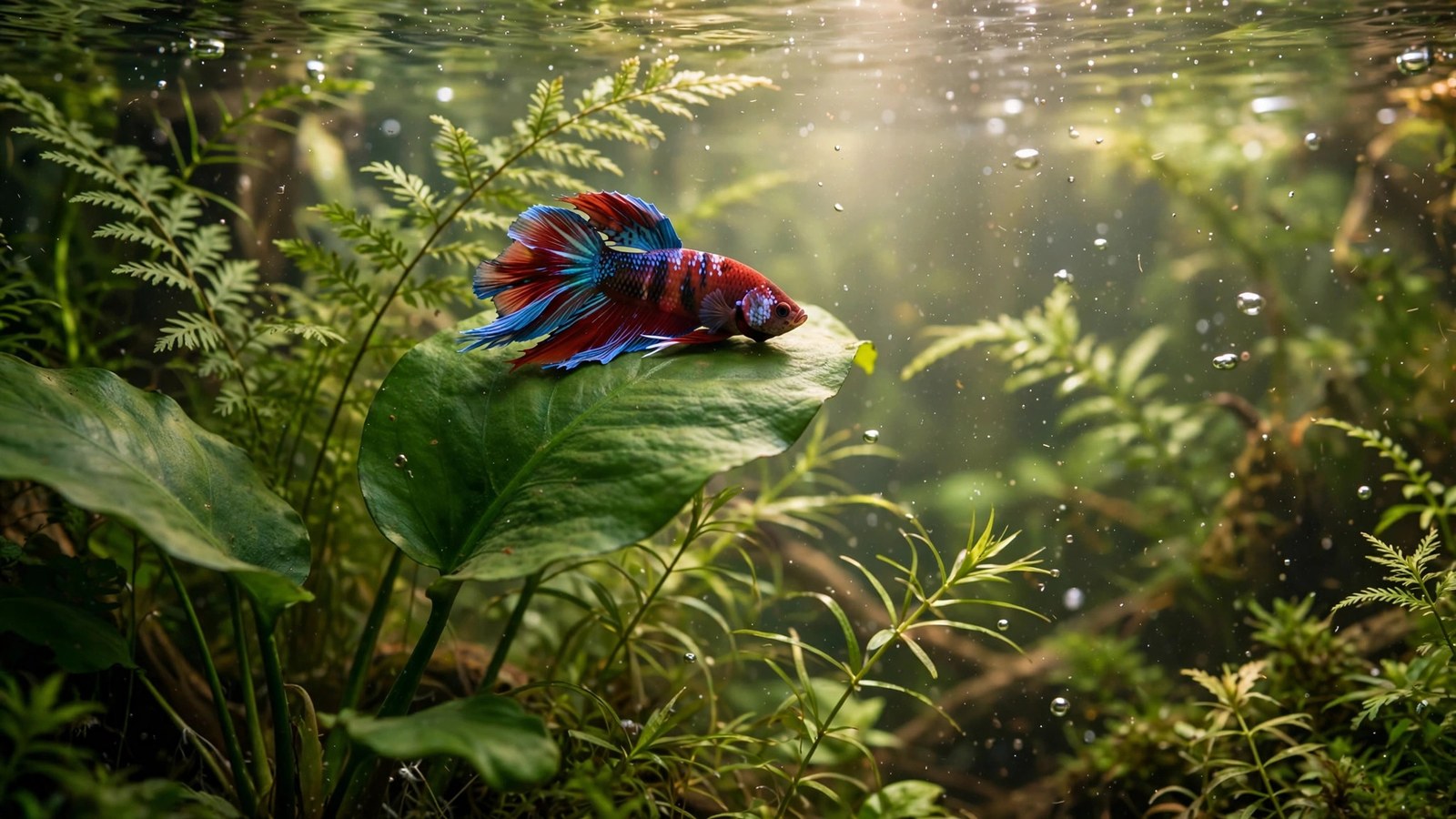
If you keep a betta, you already know the best plants for betta fish are not just decoration — they are furniture, security, and peace of mind rolled into one. A well-planted betta tank gives your fish broad leaves to lounge on near the surface, soft foliage that cannot snag flowing fins, and dense hiding cover that turns a nervous newcomer into a confident explorer. But not every aquarium plant earns a place in a betta tank. This guide walks you through nine species that do, judged by betta-specific criteria: fin-safe softness, resting spots, sightline-breaking cover, and forgiving care for ordinary low-tech tanks.
What Makes a Plant Betta-Safe? Four Criteria
Bettas are not like schooling tetras that weave through any green bush. Their long fins tear easily, they breathe air from the surface, and they stress when they feel exposed. Judge every candidate plant by these four tests:
1. Soft, snag-free leaves
Run your fingertip across a leaf before planting. Papery, leathery, or silky is safe; serrated edges, stiff points, or woody stems are not. This matters most for long-finned halfmoons and rosetails, whose fins can rip on surprisingly modest obstacles. A rough live plant damages fins just as surely as rough plastic decor. For the softest textures in the hobby, compare the options in our guide to the best aquarium mosses.
2. Broad leaves near the surface
Wild bettas rest on broad leaves close to the waterline, and domestic bettas do the same — you will often find yours parked on a wide leaf a few centimeters under the surface at lights-out. A few sturdy leaves near the top act as a natural "betta hammock" and reduce the need for artificial resting spots. If surface cover appeals to you, our floating aquarium plants for beginners covers the gentle options for small tanks.
3. Dense cover that breaks sightlines
A betta that can see every corner of its tank at all times feels watched, not safe. Bushy plants along the back and sides break up sightlines and give a startled fish somewhere to retreat, which dramatically reduces stress flaring. Shy new bettas often refuse to eat until they have plant cover — adding it is one of the fastest fixes for a skittish fish.
4. Low-tech tolerance
Most betta keepers run simple setups: a 5–10 gallon tank, gentle filtration, a basic LED, no CO₂, often dimmer lighting. Plants that demand high light, CO₂, or heavy fertilizing will melt in those conditions and can foul the water. Every plant below thrives in exactly the kind of tank bettas already live in — see also our roundup of the easiest aquarium plants that need no CO₂.
The 9 Best Plants for Betta Tanks: Quick Comparison
| Plant | Leaf texture | Betta superpower | Light needed | Difficulty |
|---|---|---|---|---|
| Anubias nana | Thick, smooth | Surface resting leaf | Low | Very easy |
| Java fern | Soft, leathery | Mid-tank sightline breaker | Low | Very easy |
| Amazon sword | Broad, flexible | Backdrop cover + rest leaves | Low–medium | Easy |
| Water wisteria | Soft, feathery | Fast cover + floating mat | Low–medium | Easy |
| Water sprite | Fine, soft | Instant floating refuge | Low–medium | Easy |
| Java moss | Ultra-soft, pillowy | Napping nooks | Low | Very easy |
| Cryptocoryne wendtii | Ruffled, soft | Midground hideout | Low | Easy |
| Italian vallisneria | Soft ribbons | Background privacy curtain | Low–medium | Easy |
| Amazon frogbit | Smooth, floating | Shade canopy for shy bettas | Any (floats) | Very easy |
The 9 Best Plants for Betta Fish, One by One
1. Anubias nana — the classic betta resting leaf
Anubias barteri var. nana is the closest thing to a purpose-built betta plant. Its thick, dark-green leaves are perfectly smooth — genuinely snag-proof even for delicate rosetail fins — and they grow horizontally, forming a natural platform where your betta can rest near the surface. Tie it to driftwood or rock with thread (never bury the rhizome or it rots), and it asks for almost nothing: low light, no CO₂, standard betta-tank water. Growth is slow, which suits small tanks. Many keepers report their betta adopts the anubias leaf as a nightly sleeping spot. Check the Tropica plant database entry for Anubias nana for its exact care parameters.
2. Java fern — the indestructible sightline breaker
Microsorum pterotoides is another rhizome plant that thrives tied to wood or stone. Its long, lance-shaped leaves grow upward and outward, making ideal midground or background cover that breaks up sightlines across the tank. The leaf surface is soft and flexible — a betta brushing past feels nothing — and it tolerates the low light and warm 76–82°F (24–28°C) water bettas prefer. It needs no substrate and no CO₂. For more rhizome species that attach to hardscape, see the best epiphyte aquarium plants.
3. Amazon sword — the backdrop that doubles as furniture
Echinodorus amazonicus grows tall, broad leaves from a central rosette, making it the classic background plant for betta tanks. The leaves are flexible enough to be fin-safe but sturdy enough to support a resting betta. A mature sword in the back corner gives a shy betta a solid green wall to disappear behind — exactly what reduces stress in the first weeks. One caveat: swords are root feeders, so give them a nutrient-rich substrate or root tabs and moderate light. One root tab at planting plus light monthly fertilization yields lush, framing growth.
4. Water wisteria — fast cover for impatient setups
Hygrophila difformis is the plant to buy when your betta arrives tomorrow and the tank looks bare. It grows astonishingly fast in low-tech conditions, producing lacy, soft leaves on upright stems that quickly form a sightline-breaking thicket. It also absorbs nutrients aggressively, helping keep nitrates down in small tanks.
5. Water sprite — the floating refuge
Ceratopteris thalictroides may be the fastest way to make a betta feel at home. Left floating, its fine, soft fronds spread into a dense green raft within days, creating shaded, protected surface water — exactly the habitat wild bettas occupy. The dangling roots shelter small fish, and an adult betta treats the underside of the raft as a private lounge. Planted in substrate it also grows into a handsome feathery bush, but floating is where it earns its place here. Keep the mat to about a third of the surface so your betta can still reach clear water to breathe, and thin it weekly since it grows relentlessly.
6. Java moss — the softest texture in the hobby
Taxiphyllum barbieri is the pillow of the plant world. Attached to driftwood, rocks, or tank walls, it forms a dense, springy carpet that no fin can snag on. Bettas nap on moss mounds, and the dense fronds host microscopic life that gives curious bettas something to inspect. Tie it down firmly with thread and keep light moderate; java moss survives nearly any conditions but thrives in stable, clean water with gentle flow. One responsibility note: buy hobbyist- or nursery-grown moss, never collect plants from local waterways — wild material can carry pests and invasive organisms. Dispose of trimmings in the trash, never down a drain or into nature.
7. Cryptocoryne wendtii — the forgiving midground bush
Cryptocoryne wendtii, especially the bronze and brown varieties, fills the awkward midground zone between foreground and background. Its ruffled leaves are completely soft, and its modest 6–10 inch height suits 5–10 gallon betta tanks perfectly. Crypts are famous for "crypt melt" — dropping leaves after transplanting — which alarms beginners, but the roots survive and regrow tougher leaves adapted to your water within a couple of weeks. Plant them once, resist the urge to move them, and let them settle into a dense thicket that bottom-resting bettas will patrol at night.
8. Italian vallisneria — the background privacy curtain
Vallisneria spiralis (sold as Italian val) sends up long, soft ribbons from runner-spreading roots, forming a gently swaying green curtain along the back glass. The leaves are flexible and smooth — glide a finger along one and you will feel why no fin tears here — and they reach the surface in most betta tanks, where bettas slip between the blades near the top. Val spreads by runners, so a few bunches become a full background in months. It prefers moderate light and benefits from a root tab or two, but needs no CO₂.
9. Amazon frogbit — the shade canopy
Limnobium laevigatum floats with smooth, round lily-pad leaves and dangling roots, forming a dappled canopy that softens harsh aquarium lighting. Shy bettas that hide from bright light often transform under frogbit shade — they venture out, explore, and show color, because they feel covered from above just like in their wild habitats. The hanging roots make excellent soft grazing and resting structure. Frogbit multiplies by runners, so a handful of plants covers a small tank's surface quickly; corral it with airline tubing so it never blocks the entire surface and impede your betta's access to air. Thin weekly and never compost trimmings near waterways.
How to Arrange Plants in a Betta Tank
A 5-gallon betta tank is a small canvas, so placement matters more than plant count. Think in three zones:
- Background: Italian val or an Amazon sword along the back wall. One tall element creates the green backdrop that makes a betta feel sheltered — more than that becomes a thicket.
- Midground: Crypt wendtii or java fern tied to a small piece of driftwood. This breaks sightlines across the tank's width so your betta cannot see end-to-end and stays relaxed.
- Surface: Frogbit or floating water sprite covering about a third of the top, plus an anubias positioned so its leaves sit just under the waterline as a resting platform. Leave open surface elsewhere — bettas breathe atmospheric air, and a fully covered surface stresses them more than no cover.
Java moss can go anywhere: a moss mound on a low rock in a front corner gives the tank a finishing touch and the betta a soft spot. Resist planting every square inch — open swimming space in the middle is part of what makes a betta tank feel right. Note that many of these species also suit other gentle livestock, as covered in our guide to aquarium plants for shrimp tanks, since betta-safe softness and shrimp-safe softness are nearly the same thing.
Planting and Care Basics for Betta Keepers
- Lighting: A basic LED run 6–8 hours daily is plenty for every plant on this list. A simple timer prevents algae and keeps growth steady.
- Planting depth: Rhizome plants (anubias, java fern) must sit on top of the substrate — tie or glue them to hardscape. Stem and rosette plants (wisteria, swords, crypts, val) go into the substrate with roots buried but crowns exposed.
- Fertilizer: Start minimal — a half-dose of a comprehensive liquid fertilizer once or twice a week. Start low, observe your livestock, and increase only if plants show deficiency. Over-dosing harms more bettas than under-dosing ever has.
- Snails and quarantine: New plants can carry pest snails and algae. Rinse, inspect, and consider tissue-culture plants, which arrive snail-free. If you are weighing the options, read tissue culture vs potted plants before your next order.
- No substrate at all? Bare-bottom betta tanks work fine with these plants: anubias, java fern, java moss, frogbit, and floating water sprite all thrive with no substrate whatsoever — see aquarium plants without substrate for the full approach.
- Night oxygen: Plants consume oxygen in the dark, so keep gentle surface agitation from a sponge filter — which also keeps your betta's low-flow water calm and stable.
Frequently Asked Questions
Do betta fish actually need live plants, or are silk plants fine?
Bettas do not biologically require live plants, and high-quality silk plants are fin-safe decor. But live plants offer things silk cannot: they absorb nitrates, grow new soft resting surfaces, and create the dappled, living environment bettas evolved in. Most keepers who switch from silk to live notice calmer, more exploratory fish within weeks. That said, a few good silk plants beat a rotting live plant every time.
How many plants should I put in a 5-gallon betta tank?
Aim for five to eight plant groupings covering roughly 50–60% of the tank volume, leaving open swimming space in the center. One background plant, one or two midground elements, a resting-leaf anubias, a patch of moss, and floating cover for about a third of the surface is a complete setup. Start modest and let things fill in over a month or two — it is easier to add plants than to remove overgrown ones.
Will plants survive without CO₂ injection in a betta tank?
Absolutely — every plant on this list was chosen partly for that reason. Bettas prefer warm, calm, low-tech water, and these species thrive in exactly those conditions. They grow slower without CO₂, which is an advantage in small tanks. If growth stalls, improve light or add a half-dose of liquid fertilizer before ever considering CO₂; most no-CO₂ plants need nothing more.
Are any of these plants risky for bettas?
These nine species are widely considered betta-safe by the hobby community, with one shared caveat: decaying plant matter fouls small tanks quickly, so remove dead leaves promptly and quarantine new arrivals. Frogbit and water sprite need weekly thinning so they never seal the surface shut — your betta must always have open water to breathe from. Beyond that, these are among the most forgiving plants in the hobby.
What is the single best plant if I only buy one?
Anubias nana, without hesitation. It is fin-safe, gives your betta a resting leaf near the surface, needs no substrate and no CO₂, survives dim kit lighting, and grows slowly enough never to become a problem. Tie one to a small rock or piece of driftwood, drop it in, and you have given your betta its favorite piece of furniture for years.
Can I keep plants with a betta in an unfiltered or unheated setup?
Live plants cannot replace a heater — bettas need stable tropical temperatures of 76–82°F (24–28°C) and suffer in cold water regardless of plants. Nor do plants make an unfiltered tank reliably safe long-term; a gentle sponge filter plus plants plus regular water changes is the dependable formula. Plants help process waste, but they are a supplement to equipment, not a substitute.
Bringing It All Together
The best plants for betta fish all share one trait: they turn a bare glass box into somewhere a betta actually wants to live. Soft leaves protect fins, broad foliage near the surface offers rest, and dense cover transforms stress into confidence. You do not need all nine — start with an anubias and a handful of frogbit, add a background sword or val cluster when you are ready, and watch how differently your betta behaves. Planted well, a betta tank becomes what the fish was built for: warm, calm, sheltered water with green places to explore and soft leaves to sleep on.
Tissue-culture plants are the exception — they’re grown in sterile gel and adapt with minimal melting, which is part of what you’re paying for. Plants bought submersed from another hobbyist’s tank also transition with little melt, since they’re already in the right form.
Which Plants Melt Most (and Least)
Heavy melters (expect significant leaf loss)
- Cryptocorynes — infamous for “crypt melt,” sometimes dropping every leaf after any disturbance. They almost always recover from the roots within weeks.
- Stem plants grown emersed — rotala, ludwigia, and hygrophila often shed lower emersed leaves while the growing tips transition.
- Amazon swords — emersed-grown swords typically lose their broad oval aerial leaves and replace them with longer submersed ribbon leaves.
Light melters
- Anubias, java fern, bucephalandra — slow-growing rhizome plants transition gradually; occasional old-leaf melt but rarely dramatic.
- Vallisneria — usually transitions well, though it dislikes the move itself and may sulk for a week.
- Floating plants — minimal melt since their leaves were already at the air-water interface.
The Acclimation Protocol
Step 1: Quarantine or dip first
Before acclimating to your tank’s conditions, make sure you’re not acclimating pests along with the plant. Run new arrivals through our quarantine and dip protocol — it adds days upfront but prevents months of regret.
Step 2: Float to temperature-match (30 minutes)
Float the bag or container in your tank for 20–30 minutes to equalize temperature. Plants are less temperature-sensitive than fish, but a 10°F shock on top of transplant stress is an avoidable insult.
Step 3: Trim before planting
Remove any leaves that are already damaged, yellowing, or heavily algae-covered — they won’t recover and they’ll rot in your tank, feeding algae. For stem plants, trim off the bottom inch and any emersed leaves that look unlikely to adapt; the plant wastes energy maintaining leaves it’s going to shed anyway. Keep the healthy growing tips — that’s where recovery starts.
Step 4: Plant correctly the first time
Follow our planting guide — right depth, crown exposed on rosettes, rhizomes unburied on epiphytes. Every uprooting and replanting restarts the acclimation clock, so get placement right on the first attempt. Decide where each plant goes before it goes in the water.
Step 5: Run a gentle first week
For the first 7 days after planting:
- Moderate light — run your normal photoperiod but consider dropping intensity 20–30% if your light is dimmable. Blast-level light on a melting plant grows algae on the dying leaves, not recovery.
- Stable CO2 — if you inject CO2, keep it consistent. Fluctuating CO2 during acclimation is a melt accelerator. If you’re low-tech, this doesn’t apply — see growing without CO2.
- Half-strength fertilizer — new plants with damaged leaves can’t use full dosing, and the excess feeds algae. Ramp to full strength over 2–3 weeks per our fertilizer schedule.
- No disturbance — don’t move, trim, or “check on” new plants for at least two weeks. Every touch resets root establishment. This is especially critical for crypts.
Step 6: Remove melt, keep the base
As emersed leaves melt, remove the mushy material promptly — decaying leaves release ammonia and grow fungus that can spread to healthy tissue. But never discard the plant while the crown, rhizome, or roots are firm and alive. A crypt that’s lost every leaf but has firm roots is a plant that’s about to recover, not a dead plant. Give it 3–4 weeks before judging.
Telling Normal Melt From Real Problems
Normal transition melt:
- Affects oldest/emersed leaves first, newest growth last
- New submersed leaves emerge even as old ones dissolve
- Roots and crown stay firm and white/green
- Timeline: 1–4 weeks, then obvious new growth
Concerning melt (see our full melting diagnosis guide):
- New growth also melts or emerges deformed
- Rhizome or crown turns mushy and brown — this is rot, not transition
- Entire plant dissolves within days with no new growth after 4+ weeks
- Melting spreads to established plants that weren’t recently moved
Buying Tips to Minimize Melt
- Buy submersed-grown when available — hobbyist-grown cuttings transition with almost no melt.
- Choose tissue culture for sensitive species — crypts and delicate stems establish far more reliably from sterile cups.
- Avoid plants already melting in the store tank — some melt is normal, but a plant that’s mostly mush at purchase has less energy for recovery.
- Transport carefully — keep plants damp and out of direct sun/heat. A plant that dries out or cooks in a hot car melts far worse than one transported properly.
The First-Month Timeline: What to Expect Week by Week
Knowing what’s normal when removes most acclimation anxiety. Here’s the typical timeline for a healthy plant adapting to a new tank:
Week 1: The quiet week
Almost nothing visible happens. The plant is growing roots you can’t see and assessing its new environment. Some species (vallisneria, stem plants) may start shedding their lowest leaves. This is normal. Resist the urge to “help” — no moving, no extra fertilizer, no light changes. The most common beginner mistake is intervening during a week when the correct action is nothing.
Week 2: Melt peaks
This is when emersed leaves give up in earnest. Crypts may drop everything; swords shed their broad aerial leaves; stem plants lose lower foliage. It looks catastrophic and it’s usually fine. Keep removing mushy material, keep conditions stable, and watch the crown and growing tips — if those are firm and green, recovery is already underway.
Week 3: The turn
New submersed-adapted leaves emerge — smaller, thinner, often a slightly different shade of green than the emersed foliage. Stem plant tips start growing visibly; crypts push tiny curled leaves from the crown; swords unfurl narrow ribbon leaves. This is the moment most beginners exhale for the first time.
Week 4+: Established
New growth outpaces melt, and the plant is functionally yours. You can resume full-strength fertilizer, normal trimming, and stop treating it as fragile. Some slow growers (anubias, bucephalandra) take 6–8 weeks to show obvious progress — that’s their normal speed, not a problem.
Acclimating Different Plant Formats
Tissue-culture cups
Sterile, pest-free, and already adapted to high-humidity (not emersed) growth — tissue cultures melt the least of any format. Rinse the agar gel off gently (leftover gel rots and feeds fungus), split the portion into small plantlets, and plant per our planting guide. They establish slowly for the first two weeks, then accelerate. No dip needed, minimal acclimation stress — this is the premium experience you’re paying for.
Potted plants
Remove the pot and strip away the rockwool completely — leftover rockwool traps debris and rots. Tease the root mass apart gently; if it’s a dense mat, splitting it into 2–3 smaller portions actually establishes faster than planting one big clump (more growing points, better water flow around roots). Potted plants are usually emersed-grown, so expect the standard 2–4 week melt cycle.
Bare-root / bunched stems
Typically sold as weighted bunches. Remove any bands, foam, or weights, strip the lower leaves, and plant stems individually or in small groups. Bunched stems from the store are often already transitioning — check for new submersed growth at the tips, which tells you the plant is mid-adaptation and will settle quickly.
Hobbyist cuttings
Already submersed-grown and the fastest to establish — often showing new growth within days. The main acclimation factor is water-parameter difference between the two tanks. Float to temperature-match, plant promptly, and they’ll usually take off with minimal melt. This is why experienced hobbyists prefer trading cuttings over buying potted plants.
Frequently Asked Questions
Should I use a “plant starter” or transplant fertilizer?
Products marketed for transplant shock are mostly B-vitamins and mild hormones. They don’t hurt, but there’s no strong evidence they help aquarium plants specifically. Stable conditions and patience outperform any bottle. Save the money for more plants.
My new plant melted completely — bare crown, no leaves. Is it dead?
Probably not, if the crown or rhizome is firm. Crypts and swords routinely lose 100% of their leaves and regrow from the base within a month. The test is firmness: firm and pale/green means alive; mushy and brown/black means rot. Give firm-but-leafless plants a full 4 weeks before declaring them dead.
Can I speed up acclimation with extra light or CO2?
No — and trying usually backfires. A melting plant can’t use extra light; the excess just grows algae on its dying leaves. Keep light moderate and CO2 stable (not boosted) during acclimation. Growth speed comes from the plant’s own adaptation timeline, which you can’t rush, only avoid delaying.
Should new plants go straight into my main display tank?
After quarantine/dipping, yes — there’s no benefit to a separate “growing-in” tank for most plants. They acclimate to your water fastest in the tank they’ll live in. The exception is very delicate species going into a tank with boisterous fish; give those a few weeks in a calm corner or breeder box first.
The Patience Rule
The single most important acclimation skill is restraint: plant it right, set gentle conditions, remove decay, and then leave it alone for a month. The hobbyists with the best plant growth aren’t doing something clever in week one — they’re simply not interfering in weeks two through four while the plants do what they’ve evolved to do. Melt looks like failure and feels like failure, but in most cases it’s the visible part of a plant successfully becoming yours.