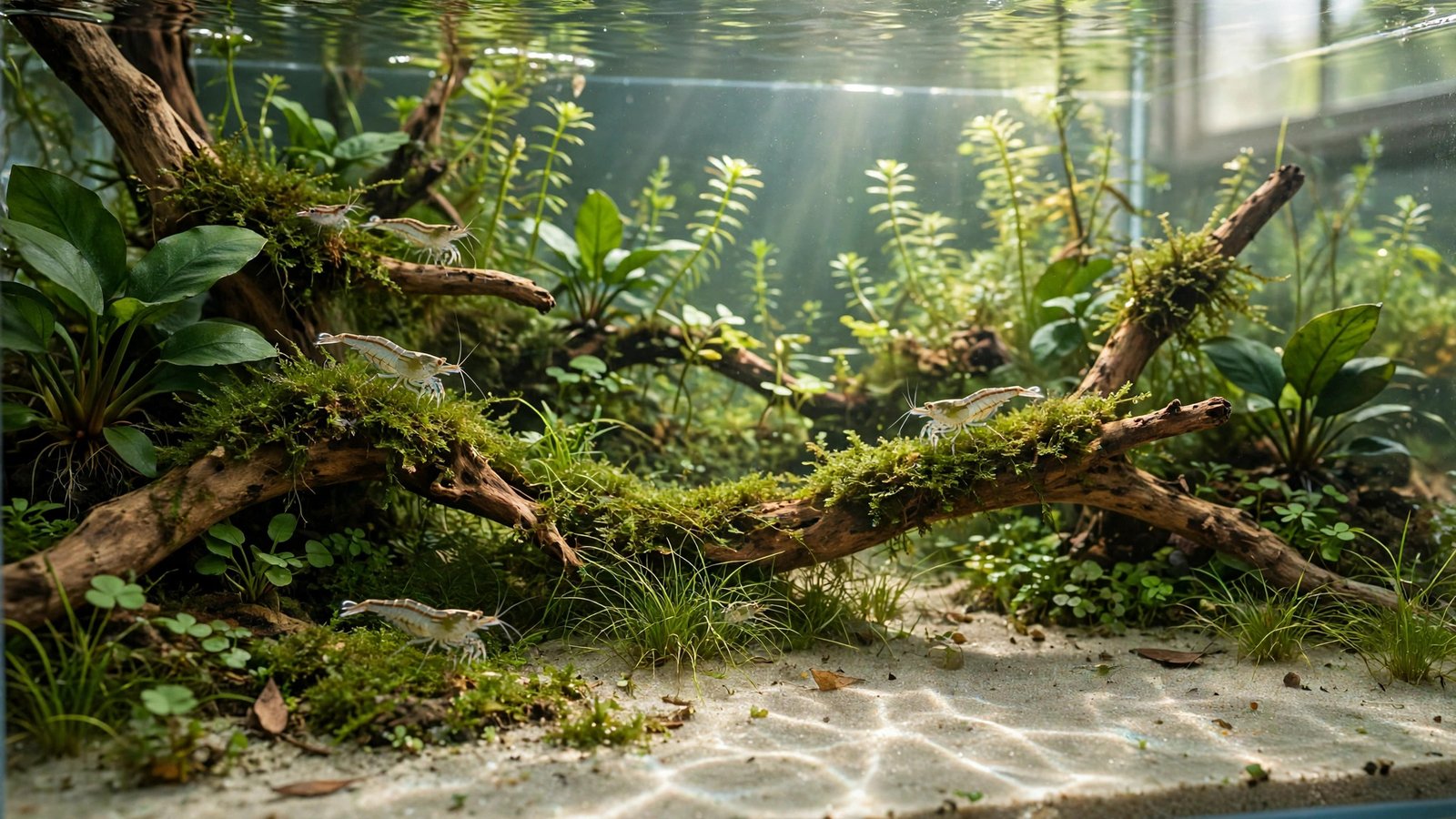
If your planted tank grows hair algae faster than you can scrape it off, Amano shrimp will look like the answer — and they are, but only if you get their amano shrimp care right. Most first batches die within a fortnight, not because the shrimp are fragile but because they're dumped into an uncycled tank, too fast, with nothing to eat. Understand that and they'll graze algae off your leaves for years.
amano shrimp care: the tank setup that works
Start with a cycled tank. Amanos tolerate a wide temperature and pH range, but ammonia and nitrite swings kill them outright — a fully cycled planted tank with stable water parameters is non-negotiable. Most losses blamed on "weak shrimp" are really uncycled tanks.
Ten gallons is the practical minimum for 3–6 shrimp, dense with plants for grazing and hiding. Put a prefilter sponge over every filter intake, and use a tight lid — Amanos are escape artists. For the full build, see the planted shrimp tank setup guide.
Anchor the scape with proven aquarium plants for a fish tank from the cornerstone guide — Amanos do their best work where established plants are outcompeting algae for nutrients. Shrimp graze the symptom; healthy plants handle the cause.
Parameters that matter
| Parameter | Ideal range | Why it matters |
|---|---|---|
| Temperature | 22–25 °C (72–77 °F) | Best balance of activity and lifespan; above 28 °C they burn out fast |
| pH | 6.5–7.5 | Stable beats perfect — never chase it with chemicals |
| GH | 6–12 dGH | Calcium and magnesium for shell building before molting |
| KH | 2–8 dKH | Buffers pH against crashes in planted tanks |
| Ammonia / nitrite | 0 ppm, always | Non-negotiable — shrimp are far less forgiving than fish |
| Nitrate | Under 20 ppm | Higher levels slow feeding and molting |
Drip Acclimation in About an Hour
This is where most keepers fail: shipping water and your tank water almost certainly differ in pH and hardness, and a float-and-dumped shrimp can look fine for two days and die on the third.
- Empty the shrimp and bag water into a clean bucket (never one that held soap or chemicals).
- Siphon from the tank through airline tubing, knotted down to about one drop per second.
- Drip for 60–90 minutes, until the bucket volume roughly triples.
- Net the shrimp out — pour the shipping water down the drain — and release them near cover, lights off.
Don't feed them on day one: in a mature tank they'll be grazing on the biofilm your planted tank has already grown within hours, and an untouched wafer just fouls the water.
What Amano Shrimp Actually Eat
An Amano is a specialist in soft, filamentous algae — hair algae, thread algae, and the green dust film on glass and leaves. They bulldoze through these like nothing else, which is why they top every best algae eaters for planted tanks list. But they won't perform miracles: thick green spot algae, black beard algae, and blue-green slime are barely touched.
And they still need feeding even in an algae-covered tank — algae alone rarely covers their full nutrition long-term. Feed half an algae wafer per 5 shrimp twice weekly, plus blanched zucchini, spinach, or cucumber (removed after 24 hours). Alongside the rest of your planted tank's cleanup crew, they'll handle the scraps.
Tank Mates That Won't Eat Them
At up to 5 cm, adult Amanos shrug off most nano community fish. The rule is simple: peaceful mouths, or no shrimp.
| Category | Examples | Verdict |
|---|---|---|
| Safe | Neon tetras, ember tetras, otocinclus, pygmy corydoras, small rasboras | Ignore adult Amanos completely — a planted neon tetra tank is a classic pairing |
| Mostly safe | Bettas, gouramis, dwarf cichlids, angelfish | Usually fine — watch the first week |
| Avoid | Cichlids, loaches, puffers, large barbs, goldfish | Shrimp become expensive snacks |
Newly molted shrimp are the real vulnerability: their shells stay soft for a few hours, so dense planting gives them somewhere to hide while they harden — one more reason a beginner-friendly planted community tank suits them so well.
Molting, Escapes, and Stress Signals
Molting every few weeks signals a healthy, growing Amano. You'll find a translucent ghost-shell that looks exactly like a dead shrimp — except it's hollow, and the real animal is hiding while its new shell hardens. Leave shed shells in; shrimp re-eat them to recycle the minerals.
Real problems look different: a shrimp lying on its side that stays there, a pinkish body tint, or several dying within days — test ammonia and nitrite first. And if you find shrimp on the carpet, don't just fix the lid gap: healthy Amanos rarely escape a comfortable tank. Escapees are usually fleeing ammonia, low oxygen, or aggressive tank mates — fix the cause, not just the lid.
Why They Never Breed in Your Tank
A berried female — greenish eggs visible under her tail — will raise your hopes. They won't hatch into babies in freshwater: Amano larvae need brackish-to-marine salinity for their first weeks. In your tank the larvae simply starve within days.
Commercial breeding is fiddly (graduated salinity, plankton food), which is why nearly every hobby Amano is captive-bred in Asia — see the species profile on Wikipedia's Caridina multidentata page. The upside: they never overpopulate your tank like cherry shrimp can.
The first month is the hard part — the planted tank first-month guide covers the algae blooms and parameter swings that stress shrimp most. Once past that, Amanos mostly take care of themselves.
Frequently Asked Questions
How many Amano shrimp do I need for algae control?
Three to six per 10 gallons handles typical algae loads. One shrimp alone hides constantly and grazes timidly; more than about 1 per 1.5 gallons and they strip the algae, then need constant supplemental feeding. Start with 4 in a 10-gallon.
Will Amano shrimp eat my plants?
Healthy live plants are safe — Amanos eat algae, biofilm, and detritus, not living tissue. They may rasp at soft dying leaves, but that's decaying matter the plant has already abandoned. If you see them on fine-leaved stems, they're grazing the algae on the leaves, not the leaves themselves.
Why did my Amano shrimp die the day after I added them?
Sudden death within 48 hours is almost always acclimation shock or an uncycled tank. Drip acclimation over 60–90 minutes prevents the osmotic shock of a float-and-dump, and ammonia must read 0 ppm — shrimp are far less forgiving of new-tank syndrome than fish. Test your water before blaming the store.
Do Amano shrimp need feeding if my tank has algae?
Yes, lightly. Algae alone rarely covers their full nutrition long-term, especially once they've cleaned the tank — which is the job they were hired for. Supplement with half an algae wafer per 5 shrimp a few times weekly, plus blanched vegetables. Remove uneaten food after a day.
Can I keep Amano shrimp with a betta?
Usually yes — adult Amanos are large enough that most bettas leave them alone. Add the shrimp first, give them a week to settle among plants, then introduce the betta. If your betta is an aggressive hunter, have a backup plan.
How long do Amano shrimp live?
Two to three years is typical in a stable planted tank, with some keepers reporting four or more. Warmer tanks (26–28 °C) make them more active but shorten their lives; cooler water around 22 °C stretches it out. Molting every few weeks signals they're growing well.
The Bottom Line
Amano shrimp aren't complicated: cycled tank, slow introduction, something to graze on, no copper, no predators. In return you get the hardest-working algae crew in the hobby. Buy the group, drip them in slowly, and let them do what Takashi Amano discovered they do best.