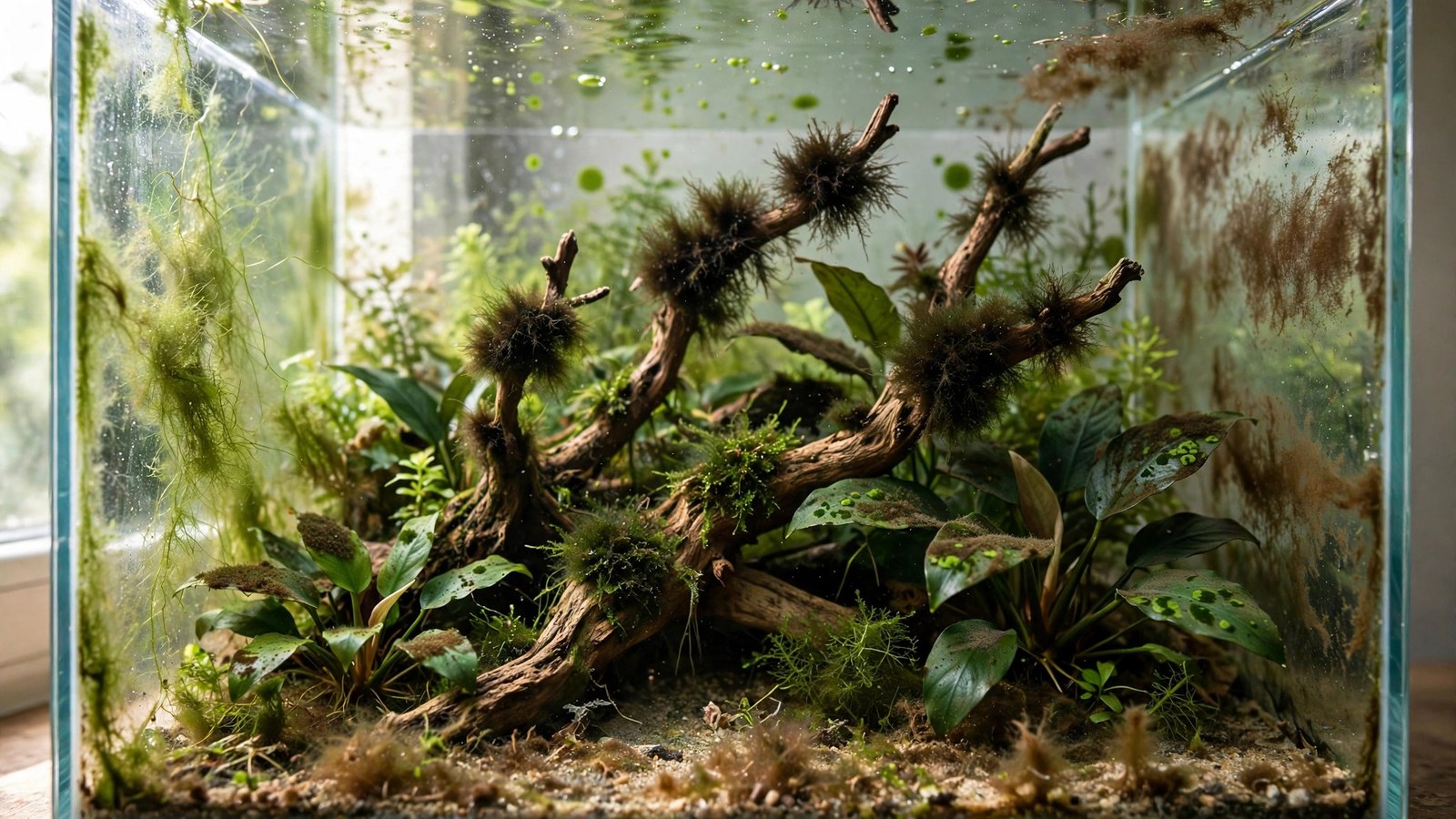
A reader once sent me a photo of his tank with one sentence: "What is this green stuff and why won't it die?" He'd already tried three different fixes for three different algae — a bleach dip, a blackout, and a bottle of algaecide — and his tank was worse than ever. That's the most expensive mistake in algae control: treating the wrong one. There are ten common types of aquarium algae, and each responds to a different first move.
This chart gives you what those three fixes couldn't: a fast, correct ID. Match your invader below by color, texture, location, and a thirty-second touch test, grab the first corrective action, then follow the link to the full treatment guide on this site.
The Master Chart: 10 Types of Aquarium Algae, Side by Side
Find your invader's color, confirm with texture and the touch test, then take the single first corrective action before anything else.
| Algae | Look | Texture | Where it grows | Touch test | First move |
|---|---|---|---|---|---|
| Green spot (GSA) | Flat, hard green dots | Crusty, flat | Glass, anubias & slow leaves | Fingernail fails; razor blade scrapes it | Test & raise phosphate |
| Green dust (GDA) | Uniform dusty film | Powdery | Glass walls | Wipes off in one finger swipe | Don't wipe for 3 weeks — let the cycle finish |
| Hair algae | Bright green strands | Soft, fine hair | Plant tips, hardscape, outlets | Pulls away in weak wisps | Manual removal + rebalance light/nutrients |
| Thread algae | Long tangled threads | Thin, slimy strands | Hardscape, slow growers | Threads snap easily | Spot-treat; check CO₂ reaches every corner |
| Oedogonium | Pale-green star tufts | Fuzzy starbursts | Leaf tips, carpet edges | Brushes off with a toothbrush | Raise CO₂; trim affected tips |
| Fuzz algae | Short pale-green fuzz | Velvet coating | Leaf margins, glass | Rubs off between fingers | Add fast growers or a cleanup crew |
| Cladophora | Dark-green wiry clumps | Tough, branching | Hardscape, substrate | Feels like coarse fishing line | Tweezer out whole — never shred |
| Staghorn | Grey-green antler tufts | Stiff, branching | Leaf edges, equipment, wood | Resists rubbing; turns red when spot-dosed | Spot-dose liquid carbon; trim leaves |
| Black beard (BBA) | Dark bushy tufts | Dense tufts | Leaf edges, wood, filter outflow | Tough; turns red→white after treatment | Spot-dose liquid carbon; stabilize CO₂ |
| Blue-green (cyanobacteria) | Blue-green slimy sheets | Slimy sheet, trapped bubbles | Substrate, glass, still corners | Peels in sheets; strong earthy smell | Siphon out + 3-day blackout |
| Brown diatoms | Golden-brown film | Soft powder | Glass, substrate, leaves in new tanks | Wipes away with zero resistance | Do nothing — otocinclus + patience |
The Thirty-Second Touch Tests
Photos lie. Phone cameras shift greens toward blue, and two algae can look identical in a picture. Run these tests first, identify second.
The finger wipe. Run one finger across the affected surface. If the film smears away like dust on a shelf, you're looking at green dust algae — or diatoms, if the tank is new. If it stays exactly where it was, it's green spot algae, the only common type that refuses a finger and demands a razor blade. That one difference fixes the most common misdiagnosis online.
The smell check. Lift a patch to your nose. A strong earthy, musty smell — like damp soil after rain — means cyanobacteria, even if it looks green rather than blue. True algae barely smell. That earthy note separates blue-green "algae" from everything else on this chart, and it changes the treatment completely: cyano needs flow and nitrate fixes, not algaecides. Full protocol in the cyanobacteria treatment guide.
The pull test. Pinch a strand and pull. Hair and thread algae slide away softly with no resistance. Cladophora fights back — wiry, branching, and every fragment you leave behind becomes a new colony. If it feels like coarse fishing line instead of soft thread, stop pulling and read the cladophora treatment guide before you spread it everywhere. Cladophora is also a notorious hitchhiker arriving as contamination in store-bought moss, so inspect new plants on arrival.
Green Film and Spot Algae: GSA and GDA
These two get confused more than any other pair because both coat glass — but they behave oppositely. Green spot algae (GSA) appears as hard, flat, circular dots that a magnet cleaner barely dents, growing on glass and famously on slow-growing leaves like Anubias in bright light. It's a low-phosphate signal: in a planted tank with strong light and lean dosing, GSA arrives like clockwork. The fix starts with phosphate, not scrubbing — raise phosphate dosing to roughly 1–2 ppm PO₄ weekly, reassess in two weeks, and blade-scrape existing spots meanwhile.
Green dust algae (GDA) looks similar from across the room but wipes off with one finger swipe — and follows one counterintuitive rule: do NOT wipe it for three weeks. Wiping resets its life cycle and it returns indefinitely; left alone, it completes the cycle, dies back, and you clean once. Patience is the entire treatment — the green dust algae guide walks through the timeline so you know exactly when the three weeks are up.
Filamentous Green Algae: Hair, Thread, Oedogonium, Fuzz
Long green strands come in four distinct forms, and texture tells them apart. Hair algae is soft, bright-green, fine filaments on plant tips, hardscape, and filter outlets — the classic "too much light for your nutrient level" signature. Twirl it out with a toothbrush, then rebalance the light-nutrient equation; the hair algae removal guide has the step-by-step.
Thread algae — thin, tangled, slimy strands draped over hardscape and slow growers — is usually rhizoclonium or spirogyra, and both point at CO₂ distribution problems and ammonia spikes. The thread algae treatment guide covers each type in detail.
Oedogonium grows as distinctive pale-green star-shaped tufts on leaf tips — the "fuzzy starburst" look, almost always a CO₂/light imbalance under bright light. It responds fast once CO₂ is raised and affected tips are trimmed.
Fuzz algae is the mildest of the group: a short, pale-green velvet coating on leaf margins and glass, usually transient in cycling or recently rescaped tanks. It often clears once plant mass catches up, and a cleanup crew helps it along.
Cladophora: The Impostor
Cladophora earns its own section because it punishes the standard advice. It looks like dark-green wiry clumps on hardscape and substrate — and it's routinely sold as "moss balls," which is how it enters most tanks. The critical rule: never shred it. Pulling or scrubbing fragments it, and each fragment starts a new colony. Remove whole clumps with tweezers, bleach-dip affected decor, and inspect new moss purchases before they go in.
Red-Group Algae: Staghorn and Black Beard
These two are technically red algae, and both appear as dark tufts that laugh at blackouts and ordinary algaecides. Staghorn algae grows grey-green antler-like tufts on leaf edges, equipment, and driftwood — often where organic waste accumulates or flow is poor. Spot-dose liquid carbon directly onto the tufts (they turn red-pink as they die) and trim the worst leaves to remove the seed stock. The staghorn algae treatment guide details dosing and trimming.
Black beard algae (BBA) is the most feared name on this chart: dense dark tufts on leaf edges, wood, and filter outflows, triggered by unstable CO₂ more than anything else. The response is always two-part — spot-dose liquid carbon to kill what's there (watch it turn red, then white, then fall off) and stabilize CO₂ so it can't return. One without the other fails. And if you want a cleanup crew for the dying tufts, buy the true Siamese algae eater — the flying fox lookalike does not eat BBA. Full protocol: the black beard algae removal guide.
The Non-Algae Lookalikes: Cyanobacteria and Diatoms
Blue-green algae isn't algae at all — it's cyanobacteria, a photosynthetic bacterium. It forms deep blue-green (sometimes nearly black) slimy sheets over substrate and glass, traps tiny gas bubbles, and smells unmistakably earthy when disturbed. It thrives in low-flow, high-organic-waste, low-nitrate corners. First move: siphon it out thoroughly during a water change, then run a three-day total blackout. Algaecides aimed at true algae won't touch it, and antibiotics are a last resort, not a first step.
Brown diatoms are the golden-brown powdery film that coats nearly every new tank in weeks two through six. They feed on silicates (present in new substrate, fresh tap water, and new glass) and — this is the important part — they almost always disappear on their own once silicates deplete and the tank matures. Wiping, blackouts, and chemicals are all overkill. Add a few otocinclus, keep up water changes, and wait. The brown diatom algae in new tanks guide explains the timeline so you can tell diatoms from a real problem.
When the Same Algae Keeps Coming Back
Every algae on this chart is a symptom, not a disease. Persistent green spot means your phosphate dosing is wrong. Recurring BBA means your CO₂ fluctuates. Cyanobacteria means dead spots and organic waste. If the same type returns after a correct treatment, stop treating the algae and start auditing the tank: test nitrate, phosphate, and KH weekly for a month, check that your filter turns the tank over 8–10× per hour, and see whether your light schedule matches your plant mass. If you're not sure which tests to run, prioritize nitrate, phosphate, and KH — those three drive nearly every algae diagnosis.
Tanks styled around heavy hardscape and high light — like many zen-style aquascapes — run algae-prone by design until plant mass catches up, so factor the scape into your expectations. Humidity-driven setups have their own dynamics, with paludarium algae differing from submerged-tank algae.
Two authoritative references we recommend alongside our per-type deep dives: the Tropica algae guide and the 2Hr Aquarist algae control library.
Frequently Asked Questions
How do I identify algae if it doesn't match any photo online?
Ignore the photo and run the touch tests: finger wipe, smell check, and pull test. Phone cameras shift greens toward blue and white balance invents colors, so 90% of IDs are settled by texture and behavior — wipes off versus scrapes off, earthy smell versus none, wiry versus soft — not by matching a picture.
Can one tank have multiple types of algae at once?
Yes, and it's common — hair algae on the tips, green spot on the glass, and BBA on the filter outflow can all coexist because each exploits a different weakness. Identify and treat each separately instead of hunting for one magic fix. Fix the biggest outbreak first, then reassess the survivors after two weeks.
Why does algae keep coming back after I remove it?
Because removal treats the symptom, not the cause. Hair algae returns when light outruns nutrients; BBA returns when CO₂ fluctuates; cyanobacteria returns when flow is poor and organics build up. If the same type returns within two weeks of a correct treatment, audit parameters, flow, and lighting instead of re-treating.
Is a blackout safe for my plants?
A 3-day total blackout is safe for nearly all aquarium plants — they store enough energy to ride it out — but it only works on certain invaders, mainly cyanobacteria and green water. It barely affects black beard algae, staghorn, or green spot, so only blackout after identifying a type that actually responds to it. Wrong-tool blackouts just starve your plants for nothing.
Are algae-eating fish and shrimp a cure?
They're maintenance, not medicine. Otocinclus polish off diatoms, Amano shrimp graze fuzz and hair algae, and true Siamese algae eaters handle young BBA — but none fix the underlying imbalance, and none touch cladophora or adult BBA. Add a cleanup crew after correcting the cause, not instead of correcting it.
Should I use algaecides at all?
As a last resort, not a first step. Spot-dosing liquid carbon on specific tufts (BBA, staghorn, thread algae) is targeted and plant-safe when done correctly, but broadcast algaecides stress plants and filter bacteria while leaving the root cause intact. Identify first, apply the targeted action, and reconsider only if the specific problem persists after two weeks.
Match It, Then Fix It — That's the Whole Game
Bookmark this chart and come back every time something new appears in the tank. The thirty seconds you spend on the touch tests will save you the weeks lost on wrong treatments — and once you've got the ID, the per-type deep dives on this site take you the rest of the way. Algae isn't a curse on your tank; it's a diagnostic readout. Learn to read it, and it tells you exactly what to fix.
More guides in this series:
- Oedogonium Algae in Planted Tanks: Identification and Treatment
- Rhizoclonium Algae: Identification and Treatment Guide
- Spirogyra Algae Aquarium Guide: Identification and Treatment
- How Long Does Brown Algae Last? The Diatom Timeline and When to Act
- Will Hair Algae Go Away on Its Own? (When to Wait, When to Act)
- Staghorn Algae vs Hair Algae: How to Tell Them Apart (and Treat Each One Right)
- Green Spot Algae: Causes, Prevention & Removal (The Complete Guide)
- Green Water: Clearing Algae Blooms in Planted Tanks
- Fuzz Algae on Plant Leaves: Causes & Fixes