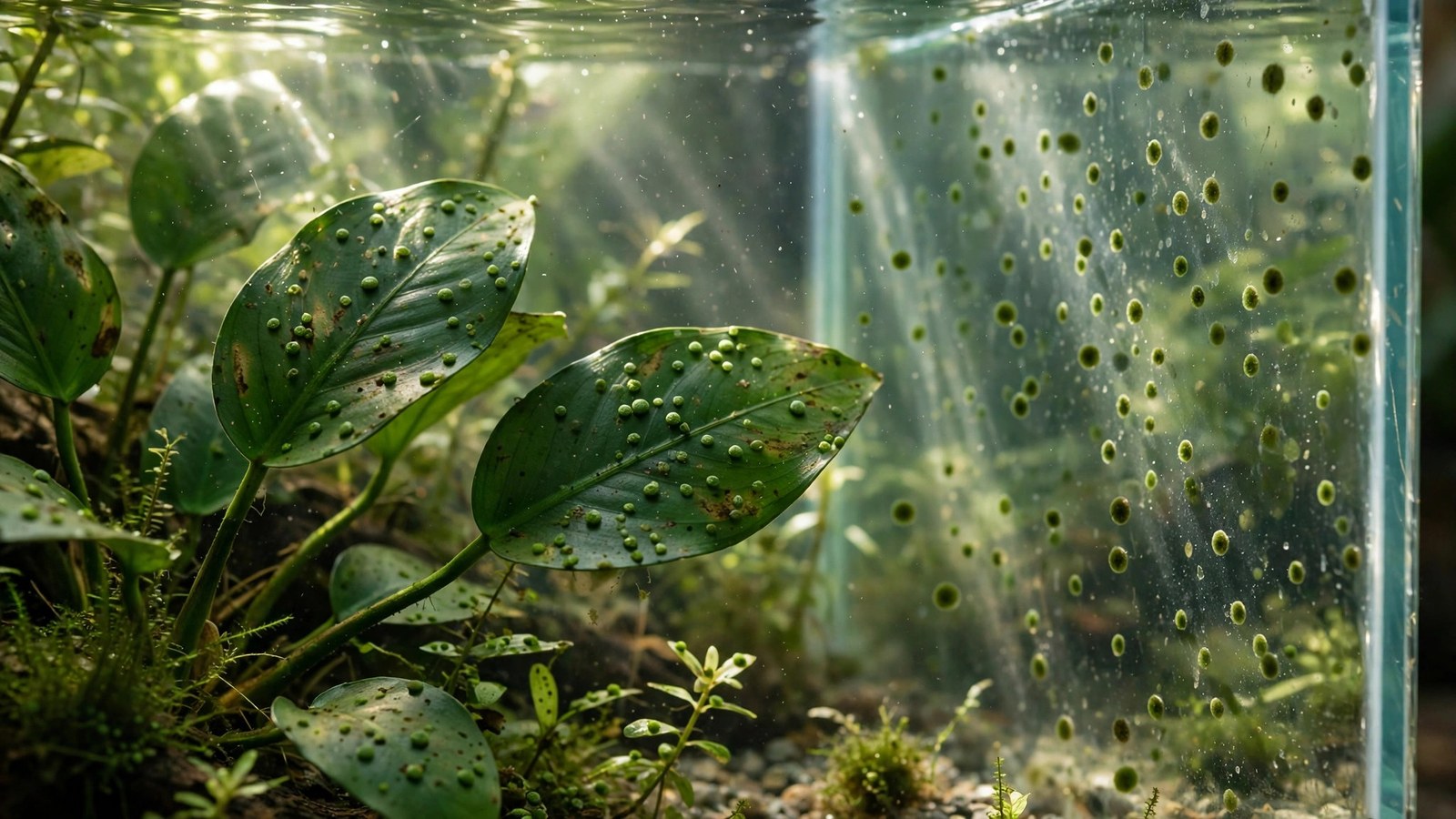
You scrub the glass on Saturday, and by the following weekend the same hard green dots are back, laughing at your algae magnet. Those stubborn little circles are green spot algae (GSA), and the reason most hobbyists lose this fight is simple: they're attacking it with a scraper instead of fixing the water. By the end of this guide, you'll know how to identify GSA in ten seconds, remove it in one session, and — more importantly — rebalance your tank so it never takes hold again.
What Green Spot Algae Looks Like (and What It's Not)
Green spot algae forms small, round, dark-green spots — 1 to 3 mm across — that feel rock-hard when you run a fingernail over them. They start on the glass, usually low on the front panel where the light hits hardest, then colonize slow-growing leaves (Anubias, Java fern, Bucephalandra), driftwood, and filter intakes. New spots appear as faint dots that darken over a week or two; in neglected tanks they merge into a continuous green crust.
The most common misidentification is green dust algae (GDA), which forms a soft, cloudy film you can wipe away with your finger or a sponge. GSA is the one that needs a razor blade. Here's the ten-second touch test:
| Trait | Green spot algae (GSA) | Green dust algae (GDA) |
|---|---|---|
| Shape | Distinct round dots, 1–3 mm | Diffuse cloudy film, no dots |
| Texture | Hard, crusty — resists a fingernail | Soft, smears when touched |
| Removal | Razor scraper or hard blade required | Wipes off with a sponge or magnet |
| Common surfaces | Glass, slow-grower leaves, hardscape | Glass only, rarely on plants |
| Typical cause | Low phosphate + low/inconsistent CO2 + strong light | Often appears in cycling or newly disturbed tanks |
If your spots match the GSA column, you're in the right place. GDA follows a completely different treatment path — if you have GDA, read our green dust algae guide instead.
The Cause Triad: Why GSA Appears in Your Tank
GSA is unusual among algae because its cause is well understood and highly repeatable. Three conditions team up, and the spots arrive like clockwork whenever all three are present.
1. Low phosphate
Phosphate (PO4) is the headliner. Decades of planted-tank experience — and the well-known Estimative Index (EI) dosing experiments — show that tanks running chronically low phosphate, near 0 ppm, develop GSA within a few weeks. Meanwhile, heavily dosed tanks running 2–5 ppm phosphate stay GSA-free, even under intense light. This is the evidence behind the modern counter-intuitive truth: in planted tanks, phosphate starvation causes green spot algae, not phosphate itself. The old myth that "phosphate causes algae" came from marine reef keeping and poorly designed freshwater studies; in planted aquariums it does the opposite for this species.
2. Low or fluctuating CO2
The second leg of the triad is carbon. Plants starved of CO2 slow down and leak ammonia and organics from stressed tissue, while GSA — which fixes carbon far more efficiently than most plants — thrives on the leftovers. The worst pattern is inconsistent CO2: a DIY yeast bottle that fizzles out every few days, or pressurized CO2 that runs out without you noticing, creates exactly the boom-and-bust cycle GSA loves.
3. Strong light with poor flow
GSA is an epiphytic opportunist: it colonizes surfaces that receive plenty of light but weak nutrient exchange. That's why it loves the front glass (maximum light, and your plants aren't competing for nutrients there) and slow-growing leaves that sit in stagnant corners. High light plus dead zones is the perfect storm. If you've ever wondered why hair algae attacks the bright side of fast-growing stems while GSA camps on your Anubias, this is the difference: hair algae is a light/CO2 imbalance on fast growth; GSA is phosphate starvation on surfaces nothing else wants.
How to Remove Green Spot Algae (One Cleaning Session)
Removal and prevention are two separate jobs. Do the removal in one focused session, then implement the prevention checklist below in the same week.
Glass: the razor blade method
Nothing beats a single-edge razor blade scraper on flat glass. Hold the blade at roughly a 30° angle and use long, overlapping strokes — the spots pop off in sheets. Wipe the blade on a paper towel between passes, and do this before your water change so the freed fragments siphon out with the gravel vacuum. Magnetic scrapers and melamine sponges are fine for maintenance, but for an established crust they just smear it around; the razor is 10× faster.
Hardscape: toothbrush and spot treatment
On driftwood and rocks, scrub with a stiff toothbrush during the water change, directing the hose at the piece as you work. For stubborn spots on removable hardscape, you can pull the piece and spray it with 3% hydrogen peroxide (the standard pharmacy concentration), wait 5–10 minutes, then rinse thoroughly before returning it to the tank. Keep peroxide away from mosses and sensitive plants — it will bleach them.
Slow-growing plants: prune, don't scrub
Anubias and Bucephalandra leaves encrusted with GSA rarely recover cleanly — the algae etches into the leaf surface. The practical fix is to prune the worst leaves at the rhizome with sharp scissors. It feels drastic, but slow growers push new foliage in 3–6 weeks under good conditions, and the new leaves arrive spot-free because you're fixing the cause at the same time. If the whole plant is coated, consider our species-specific advice in green spot algae on Anubias before you strip it bare.
Fixing the Root Cause: The Phosphate Protocol
This is the step most guides skip — and the reason GSA keeps coming back. Once the visible spots are gone, rebalance the tank so new ones can't form.
Raise phosphate to 1–2 ppm weekly
If your test showed near-zero phosphate, add a phosphate source. The simplest approach:
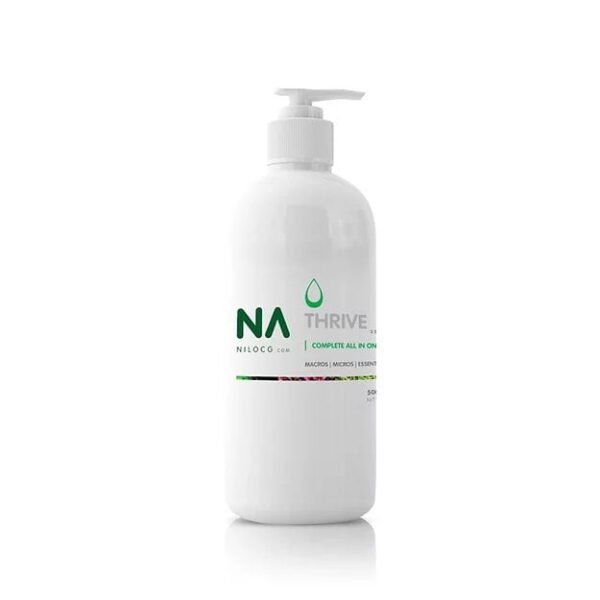
- Check your fertilizer. Many all-in-one liquid fertilizers deliberately contain low phosphate; some "algae-safe" brands contain almost none. Switch to a complete formula with listed PO4 (Tropica Specialised Nutrition, APT Complete, or an EI-based dry dosing routine all include meaningful phosphate).
- Dose to a target. Aim for 1–2 ppm PO4 in the water column after your weekly water change. A standard EI regimen delivers roughly 1.3 ppm per dose — 3 doses per week holds it in range with consumption.
- Test and adjust for two weeks. Measure PO4 before each water change. You're looking for a stable reading above zero, not a specific peak. If it stays pinned at zero, increase dosing; if it climbs past 3–4 ppm with no plant uptake, you may have other limiting factors to address.
 ★4.7
NilocG Thrive All-in-One 500ml
Check Price on Amazon ★4.7Expect existing spots to stop expanding within a week and new glass to stay clean within two to three weeks. You won't see old spots vanish — they're crust, not film — so combine this with the one-time scrape above. For a second, independent walkthrough of the phosphate-first approach, the 2Hr Aquarist's guide to controlling green spot algae reaches the same conclusion: lean nutrients, especially low phosphate, let GSA take hold on older leaves and glass.
Stabilize CO2 at the same time
GSA often persists in tanks where phosphate is fine but CO2 swings daily. If you run pressurized CO2, verify your bubble rate is stable and your drop checker stays lime-green from lights-on to lights-off. If you run DIY CO2, the practical reality is that most yeast bottles crash every 7–10 days — rotate two bottles on alternating schedules, or treat this algae outbreak as the sign to consider pressurized. For tanks without CO2 injection, cutting the light intensity by 20–30% (raising the fixture or shortening the photoperiod to 6–7 hours) reduces the carbon demand your plants can't meet, which removes GSA's advantage.
Fix the flow
Dead zones behind hardscape and in dense plant corners are GSA nurseries. Aim your filter output or a small circulation pump so a gentle current visibly sways plants in the front corners. As a rule of thumb, your filter should turn over the tank volume 5–10 times per hour for planted setups — and that flow has to reach the algae-prone spots, not just swirl the surface.
The Cleanup Crew: What Actually Eats GSA
Let's be honest about livestock. Most "algae eaters" sold for planted tanks ignore green spot algae entirely: Siamese algae eaters (SAE) won't touch it, Amano shrimp can't rasp it off, and otocinclus prefer the soft films.
| Species | Eats GSA? | Notes |
|---|---|---|
| Nerite snails (Neritina spp.) | Yes — the best GSA crew | Rasp hard spots with their radula; 1 per 5–10 gallons |
| Mystery/apple snails | Marginal | Prefer soft algae and detritus; rarely dent GSA |
| Ramshorn snails | Marginal | Help with biofilm, not crusts |
| Otocinclus | No | Excellent for soft diatoms, ignore GSA |
| Siamese algae eaters | No | Brush/thread algae specialists |
| Amano shrimp | No | Too small to rasp hardened spots |
A crew of 3–5 nerite snails in a 20-gallon tank will clear mild GSA from glass within a week or two and — better — keep it from re-establishing while your phosphate protocol takes effect. The catch: nerites lay small white eggs on hardscape that are nearly impossible to remove, so skip them if pristine wood matters more to you than algae control.
Livestock is support, not the solution. Snails buy you time; only phosphate, CO2, and flow remove the cause. The same principle applies across algae types — compare how we handle thread algae and staghorn algae, where the imbalance is different but the pattern is the same: identify the trigger, then fix the chemistry.
GSA Prevention Checklist (Monthly)
Once your tank is clean, run this five-minute check once a month to keep it that way:
- Test phosphate. Keep PO4 detectable (0.5–2 ppm). If your fertilizer routine drifts or you switch brands, re-test.
- Confirm CO2 consistency. Drop checker lime-green by lights-on, stable all day. Check the cylinder level monthly — a tank running empty overnight is the classic GSA trigger.
- Verify flow reaches the front glass. Add or redirect circulation if detritus collects in the same corner.
- Cap the photoperiod. 7–8 hours at moderate intensity for most planted tanks. More light with the same CO2/fert routine is how GSA returns.
- Prune slow growers proactively. Remove aging Anubias leaves before they become algae platforms — old, shaded leaves are always the first colonized.
- Quarantine new hardscape. Rocks and wood from other tanks or the wild can carry established GSA crusts. Scrub and bleach-dip (1:20 bleach, then dechlorinated rinse) before adding.
If you're dealing with multiple algae types at once, that's a signal the whole tank is out of balance rather than a single-parameter problem. Our cyanobacteria treatment guide covers the other end of the spectrum — excess organics and low flow — and seeing both patterns helps you read what your water is telling you.
Frequently Asked Questions
Will green spot algae go away on its own?
No — established GSA doesn't fade without intervention. The spots are a hard mineralized crust, not living film, so they persist even after conditions improve. What does change is that new spots stop forming: once you fix phosphate and CO2, the glass stays clean after your one-time scrape, and that's the real victory.
How long does it take to get rid of green spot algae?
The visible cleanup takes one afternoon with a razor scraper. Stopping new growth takes 2–3 weeks after you raise phosphate to detectable levels and stabilize CO2. Tanks with severe infestations on many slow-grower leaves may need 6–8 weeks as you prune old foliage and new growth arrives spot-free.
Does phosphate really not cause algae?
In planted freshwater tanks, dosing phosphate to 1–3 ppm does not trigger GSA — it prevents it, and this has been demonstrated repeatedly since the early Estimative Index experiments. The "phosphate causes algae" idea comes from reef aquariums and from studies confounded by ammonia. Excess ammonia, unstable CO2, and excessive light drive algae in planted tanks; phosphate is plant food.
Can I just use an algaecide like Excel or hydrogen peroxide?
Spot-treating with liquid carbon (glutaraldehyde products) or peroxide kills GSA on contact, but it's a treadmill: the spots return within weeks because the phosphate/CO2 imbalance remains. Use spot treatment as a rescue for badly coated hardscape, then implement the phosphate protocol so you don't need it again.
Why do only my Anubias and the glass get green spots, not my stem plants?
GSA is an opportunist that colonizes surfaces nothing else wants. Fast-growing stems constantly grow away from it and compete fiercely for nutrients at their growing tips, so they stay clean. The front glass (high light, no plant competition) and slow-growing leaves in stagnant spots are exactly where GSA wins the competition.
Do water changes help with green spot algae?
Indirectly. Water changes remove organics and reset excess nutrients, which keeps the tank stable — but they don't add phosphate or stabilize CO2, so they can't fix GSA alone. The one critical exception: do your big scrape right before the water change so the dislodged fragments get siphoned out instead of resettling on the glass.
The Bottom Line
Green spot algae looks like a scrubbing problem but behaves like a chemistry problem. Scrape it once, raise your phosphate into the detectable range, lock down your CO2 consistency, and fix your flow — and those green dots become something you dealt with once, not a weekly chore. If another algae type shows up after GSA is gone, work through our hair algae removal guide or the rest of the plant-problems section the same way: identify the trigger, fix the water, then clean the tank.
Related: our algae identification chart covers the ten most common types.