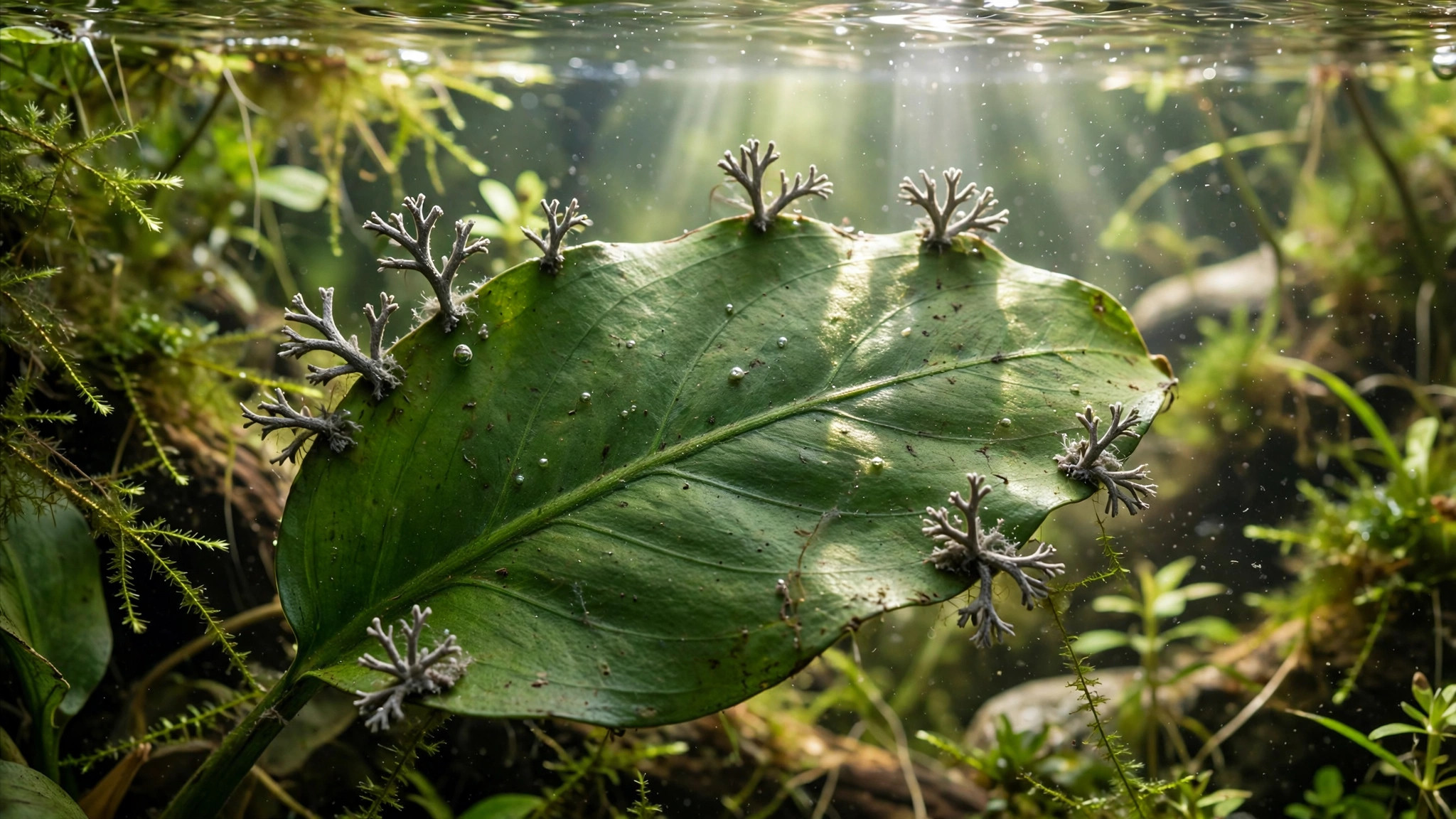
Pinch it. Right now, in your tank, pick up one of the tufts and roll it between your fingers. If it feels like wet cotton candy and collapses into a soft clump, you have hair algae. If it feels like stiff wire that holds its shape and snaps instead of bending, you are looking at staghorn algae — and the fix for each one is completely different. Treat staghorn like hair algae and you will spend weeks on remedies that never touch the real cause.
Most aquarists misidentify these two at least once. From across the room they look almost identical: grey-green fuzz creeping along leaf edges. But they belong to different algae families, they grow in different conditions, and they die by different methods. This guide walks you through the five-minute identification, the causes behind each, and the exact treatment protocol for the one in your tank.
What Staghorn Algae Actually Looks Like
Staghorn is a red-group algae, and its growth habit is its signature. It appears as thick, grey to smoky-green tufts that branch like tiny deer antlers. Outbreaks almost always start on the tips or edges of slow-growing plants — anubias, java fern, bucephalandra — because those leaves are the oldest and the most stressed. From there it colonizes filter outlets, hardscape, and anywhere detritus collects.
The defining trait is rigidity. A staghorn tuft keeps its branching shape even when your filter blasts it with current. Young growth can look grey-green and slightly translucent, but mature tufts turn darker and almost metallic. If you can’t decide between staghorn and black beard algae, remember this: staghorn is branching and grey with a thicker, wirier texture, while black beard algae is finer, darker, and grows in round, fuzzy patches rather than antlers.
What Hair (Thread) Algae Looks Like
Hair algae is a true green algae and behaves like one. It grows as soft, bright-green strands that can be short and velvety or long and stringy, depending on the species and the conditions. Unlike staghorn, it has no stiffness at all — it sways and dances in the current, streaming off leaf tips and hardscape like hair underwater.
It usually starts where light is strongest: the upper leaves, the surface of the substrate under direct light, or the glass facing the window. In weaker light it can look dull olive-green and short, which is when people confuse it with staghorn. The pinch test never lies though — soft and collapsible is always green hair algae, never staghorn.
It also loves newly planted tanks: transplanted plants leak nutrients while they adapt, and hair algae capitalizes on that window before the plant settles in.
Staghorn vs Hair Algae: Side-by-Side Comparison
| Trait | Staghorn Algae | Hair (Thread) Algae |
|---|---|---|
| Color | Grey to grey-green, darkening with age | Bright green to olive-green |
| Shape | Branching, antler-like tufts | Long, straight or tangled strands |
| Texture | Stiff, wiry, snaps instead of bending | Soft, silky, collapses when pinched |
| Behavior in current | Holds its shape; unaffected by flow | Sways and streams with the water |
| Where it starts | Edges and tips of slow-growing plants, filter outlets | Brightest spots: upper leaves, sunlit glass, open substrate |
| Algae family | Red algae group | Green algae group |
| Main cause | Unstable or low CO2, ammonia spikes | Excess light, nutrient imbalance |
| Manual removal | Hard to pull; breaks off in pieces | Easy; twirls around a toothbrush |
The 30-Second Touch Test
If the comparison table left you unsure, do this: turn off your filter so the water goes still, then use clean tweezers or your fingers to lift one tuft and pinch it gently.
- It collapses into a soft, mushy clump → hair algae. Skip to the hair algae treatment below.
- It holds its shape, feels wiry, and snaps into rigid pieces → staghorn. Follow the staghorn protocol below.
- It smears green on your fingers → you actually have green dust or film algae on the leaf, not either of these. Wipe it off and revisit your photoperiod.
While the filter is off, also watch how the tufts move. Hair algae falls limp and hangs down once flow stops; staghorn keeps standing proud like tiny antlers. That visual alone settles most identification debates in seconds.
Why Staghorn Algae Appears
Staghorn is almost always a message about instability, not filth. The classic trigger is fluctuating or insufficient CO2: a pressurized system that runs out mid-week, a DIY yeast setup with inconsistent output, or a high-light tank with no carbon source at all. When CO2 swings, plants stall, stressed plants leak metabolites from their leaf margins, and staghorn attaches exactly there — on the edges of slow growers.
The second most common trigger is an ammonia spike: a disturbed substrate, a new tank that hasn’t cycled properly, overfeeding, or a filter clogged with organic waste. Staghorn is also associated with dead spots — areas of the tank where flow never reaches and detritus settles. Some aquarists also link it to heavy iron dosing, so if you recently started an iron-heavy fertilizer regime, that timing is worth noting.
Here’s the diagnostic question that matters: did this appear on stressed plants? If the affected leaves belong to a plant that was recently moved, recently melted back, or is growing slowly and struggling, staghorn is telling you the plant’s conditions need fixing, not just the algae.
Why Hair Algae Appears
Hair algae is the light-driven algae. The classic recipe is a strong light running long hours over a tank with thin plant mass — all that unused photosynthetic energy has to go somewhere, and green algae are faster to claim it than slow-adjusting plants. A photoperiod past 9–10 hours on a high-output fixture is the single most common cause I see in beginner tanks.
The second ingredient is a nutrient mismatch: excess iron is the most commonly blamed, but any imbalance where plants can’t use what’s available leaves the door open. Newly planted tanks are especially vulnerable because the plants aren’t established enough to outcompete algae yet, and the substrate is still settling. Unlike staghorn, hair algae doesn’t need CO2 problems to thrive — it does perfectly well in low-tech tanks with plenty of light.
Ask yourself: did this start where the light is strongest? If the algae is worst on the top leaves and the shaded growth is clean, you’re looking at a light problem, and shortening the photoperiod will do more than any chemical.
How to Remove Staghorn Algae (The 2-Week Protocol)
Staghorn is stubborn because it’s tough to pull and it comes back if the instability continues. Follow these steps in order — each one matters, and spot-treating without fixing the cause is how people end up fighting it for months.
Step 1: Trim the worst leaves. Staghorn anchors deep on stressed, old growth, and that growth will never fully recover. Cut off heavily affected leaves at the base so the plant can redirect energy to new growth. This single step removes most of the biomass.
Step 2: Fix the instability. Check your CO2: is the bottle empty, the diffuser clogged, or the bubble rate drifting? Clean the filter, improve flow to dead spots, and test for ammonia after any recent substrate disturbance. If you don’t fix the trigger, everything else is cosmetic.
Step 3: Spot-treat what remains. This is where liquid carbon earns its keep. Turn off your filter and wait five minutes for the water to go still, then use a syringe to apply Seachem Flourish Excel ★4.7 directly onto the staghorn tufts. The algae turns pinkish-red within a day or two and then white as it dies, at which point shrimp and snails clean up the remains. Turn the filter back on after 10–15 minutes. Never exceed the product label’s directions, and spot-treat only a portion of the tank at a time.
Step 4 (alternative): hydrogen peroxide. If you don’t keep liquid carbon on hand, 3% hydrogen peroxide works the same way — syringe it directly onto the tufts with the filter off. Food-grade 3% hydrogen peroxide ★4.6 with no toxic stabilizers is the safest choice for a planted tank. Dose conservatively: a few milliliters aimed at the algae, once a day at most, and never near shrimp or fry.
Step 5: Deploy the cleanup crew. Amano shrimp will pick at staghorn once it’s weakened by spot-treatment. A group of 5–10 Amanos in a 20-gallon tank makes a real difference during recovery.
Disclosure: this guide includes affiliate links to Amazon. If you buy through them, AquaVerdia earns a small commission at no extra cost to you — it helps fund more guides like this one. I only recommend products that genuinely fit the treatment described.
How to Remove Hair Algae (The 1-Week Protocol)
Hair algae is mechanically easy and usually the fastest algae problem to solve, because its cause is so direct. Start with removal, then remove the cause.
Step 1: Twirl it out. Push an old toothbrush or a bottle brush into the strands and twist — hair algae winds up like spaghetti. Pull gently so you don’t uproot plants. For short, velvety growth on hardscape, a soft brush and a water change to catch the debris works well. Do this before every water change during the treatment week.
Step 2: Cut the light. Reduce your photoperiod to 6–8 hours with a timer, and if your fixture has dimming, drop intensity by about 20%. This is the move that actually breaks the cycle. Tanks with a siesta schedule (4 hours on, 2 hours off, 4 hours on) do especially well against hair algae.
Step 3: Balance nutrients and bulk up plant mass. Make sure your fertilizing routine is consistent — irregular dosing stresses plants and opens the door. Add fast-growing stems if the tank is sparsely planted; they outcompete hair algae for nutrients and shade the substrate where it starts.
Step 4: Water changes. Do two 40–50% water changes a week apart during treatment. This resets dissolved organics and gives your plants clean water to recover in.
Frequently Asked Questions
Can staghorn algae turn green?
Young staghorn tufts often look grey-green and slightly translucent, which is exactly why people confuse them with hair algae early on. As the tuft matures it turns darker grey and stiffens. If a grey-green tuft is rigid and branching, it’s still staghorn — the pinch test is more reliable than color.
Is staghorn algae harmful to fish?
Staghorn doesn’t poison fish, but a heavy outbreak signals problems that do affect them: unstable CO2 can swing pH, and ammonia spikes — a common trigger — are directly toxic. Dense tufts also smother plant leaves, cutting the plant’s oxygen production at night.
Will Amano shrimp eat staghorn algae?
Amanos will pick at staghorn once it’s weakened or dying, especially after a spot-treatment turns it pink and white. Don’t expect them to clear a healthy, established outbreak on their own — shrimp are the cleanup crew, not the treatment.
Can hair algae disappear on its own?
In a new tank, yes: it often peaks around weeks 3–6 and fades once plants establish. But with too much light or inconsistent dosing it settles in as a permanent resident — shortening the photoperiod speeds up the natural recovery.
Should I do a blackout for staghorn algae?
A blackout rarely fixes staghorn because it doesn’t address CO2 instability or ammonia, the actual triggers. It also stresses your plants, which can invite a worse outbreak when lights return. Save blackouts for green water and cyanobacteria; for staghorn, fix the cause and spot-treat.
How fast does staghorn algae spread?
Faster than you’d expect from something so stiff. A tuft visible on one leaf edge on Monday can seed several plants by the end of the week in an unstable tank. That’s why step one is trimming: every tuft you leave behind is a spore factory while you work on the underlying cause.
Identify It Right, Fix It Once
Algae control is really a matching game: the right ID, the right cause, the right treatment. Staghorn and hair algae look like cousins, but one is a CO2-and-stability problem solved with trimming and spot-dosing, and the other is a light problem solved with a toothbrush and a timer. Run the pinch test, confirm which one you’re actually dealing with, and spend your effort on the cause — that’s how you fix it once instead of fighting it for months. For a wider reference covering every common type, see the 2Hr Aquarist’s staghorn guide and FishLab’s staghorn identification walkthrough.