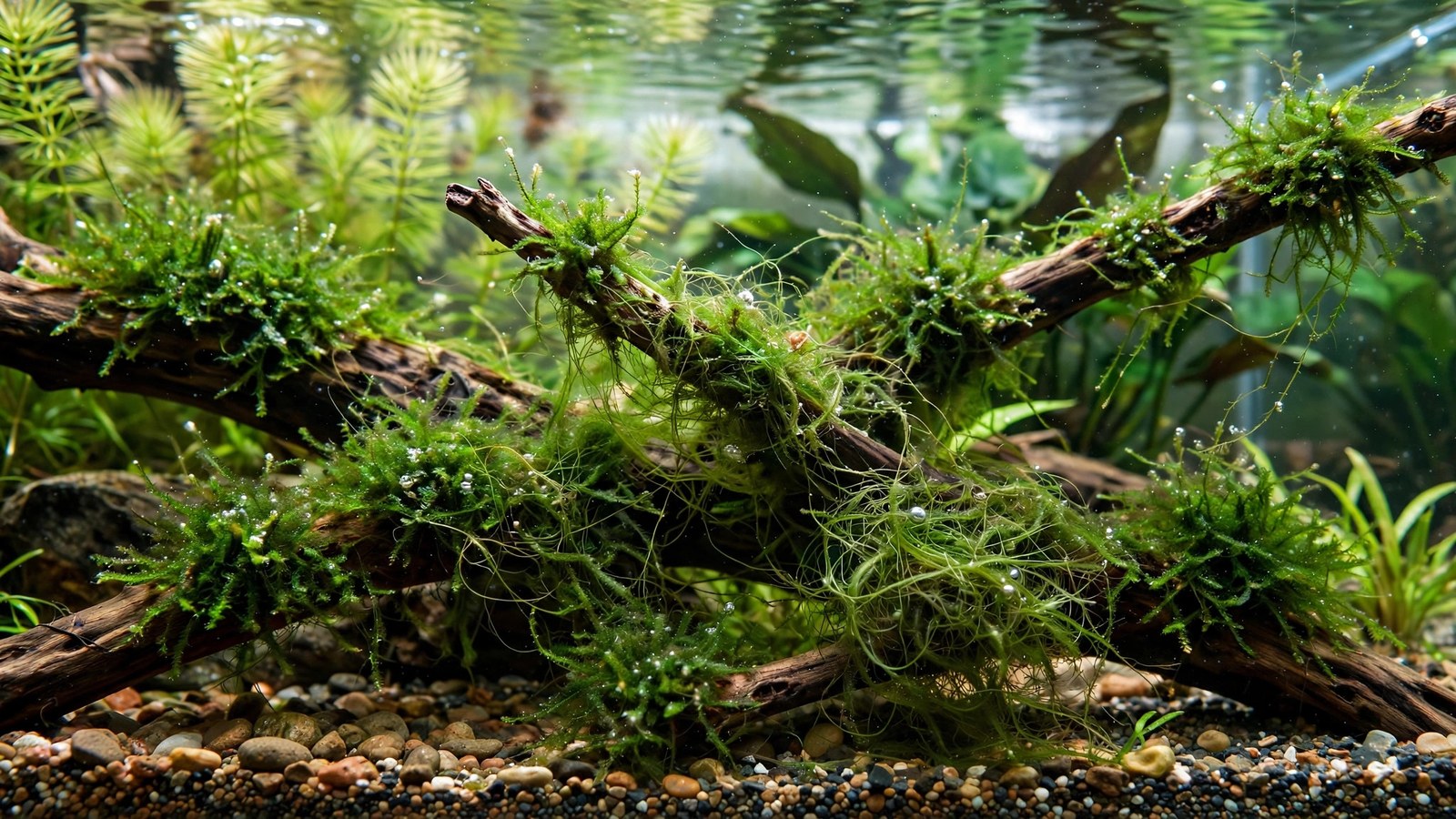
You bought a "moss ball" and it started growing wiry green beards. Or your java moss developed tough, branching tufts that won't pull out cleanly. Meet cladophora — the algae that impersonates moss so convincingly that it's sold in stores as a plant. Unlike the soft filamentous algae that surrender to a toothbrush, cladophora is wiry, stubborn, and genuinely hard to kill. But it can be beaten with identification certainty, relentless manual removal, and fixing the low-flow, high-organic conditions it loves.
What Cladophora Is (and Isn't)
Cladophora is a genus of branching green algae with a distinctive wiry structure. Under magnification it looks like tiny branching trees; to the naked eye it forms:
- Dense, wiry tufts on hardscape, slow-growing plants, and equipment
- Round "moss balls" — the marimo balls sold in the trade are literally a cladophora species (Aegagropila linnaei) rolled into spheres by water motion
- Branching beards growing from moss, where it's hardest to distinguish from the host plant
The touch test (definitive ID)
Cladophora feels coarse, wiry, and springy — like wet wool or horsehair. It resists breaking; pull a strand and it stretches rather than snapping. Compare:
- Hair algae — soft, slimy, breaks apart easily. See our hair algae removal guide.
- Thread algae — soft single strands, easily crushed. Covered in our thread algae treatment guide.
- Java moss — soft, feathery, delicate branching. If it feels soft, it's moss; if it feels like wire, it's cladophora.
This distinction matters because treatments that kill soft algae often fail on cladophora. Hydrogen peroxide spot-dosing that melts hair algae may barely faze it — the same limitation applies to staghorn algae treatments, which target a similarly tough organism. Misidentification is the number-one reason cladophora "treatments" fail. When in doubt between wiry algae types, compare against our green spot algae guide (hard spots, not wiry tufts) and remember that true fuzz algae feels soft, never wiry.
How Cladophora Gets In
- Hitchhiking on plants and moss — the most common vector. A few invisible filaments in a moss portion or on a potted plant establish a colony in weeks.
- Marimo moss balls — sold as ornamentals, they're cladophora colonies. Fragments break off, drift, and anchor elsewhere. Many infestations trace back to a single moss ball.
- Contaminated equipment — nets, tweezers, and filter media moved between tanks carry fragments.
Why It's So Hard to Kill
- Thick cell walls — resist chemical treatments that destroy soft algae.
- Fragmentation reproduction — every broken piece is a new colony. Rough handling spreads it.
- Low requirements — tolerates low light, low nutrients, and neglect. It persists in tanks where other algae starve.
- Anchors deeply — rhizoid-like holdfasts grip textured surfaces, wood grain, and moss matrices tenaciously.
The Eradication Protocol
Step 1: Quarantine the mindset — contain first
Before removing anything, stop moving things between tanks. Sterilize nets and tools (bleach dip, then dechlorinate). Cladophora spreads through fragments, so every careless water change seeds new colonies. Turn off filters during removal sessions so dislodged fragments don't get blasted around the tank.
Step 2: Manual removal (the core of the treatment)
- Tweezers, not toothbrushes — grip tufts at the base and pull slowly with steady pressure. The wiry structure usually comes out in satisfying clumps.
- For moss infestations: remove the entire moss portion. Pick through it in a bucket of tank water under good light, removing every wiry strand. If the moss is more cladophora than moss, discard and replace it — this is the pragmatic call experienced keepers make. Moss is cheap; eradication months aren't.
- For hardscape: remove the rock or wood, scrub with a stiff brush, and pour boiling water over it (for rocks) or soak in a bleach solution (1:20, then dechlorinate thoroughly) for wood.
- Siphon aggressively during and after each session — catch every drifting fragment.
- Repeat twice weekly. You're hunting fragments; consistency is everything.
Step 3: Fix the conditions it loves
- Increase flow — cladophora thrives in still, detritus-collecting corners. Reposition outlets, add circulation, eliminate dead spots.
- Reduce organics — vacuum detritus, remove decaying leaves promptly, don't overfeed. Cladophora loves the dissolved organics that accumulate in neglected tanks.
- Moderate the light — drop to 6–7 hours during eradication. It tolerates low light, but every disadvantage helps.
- Keep plants growing — healthy, fast-growing plants compete for the same nutrients. Don't starve the tank; a hungry tank favors the toughest algae, which is cladophora.
Step 4: Targeted chemical assistance
- Hydrogen peroxide — less effective than on soft algae, but repeated spot-dosing (filter off, syringe onto tufts, 2 ml per 10 gallons, 15 min) weakens it over multiple applications. Expect 3–4 sessions, not one.
- Glutaraldehyde-based liquid carbon — spot-dosed at label strength can damage cladophora, but use cautiously near shrimp and vallisneria.
- Bleach dips for removed hardscape — 1:20 bleach soak for 5 minutes kills it completely; dechlorinate thoroughly before returning.
- Never whole-tank algaecide — ineffective at safe doses against cladophora's thick walls, and harmful to everything else.
Step 5: The nuclear option (for severe cases)
If cladophora has thoroughly infested moss, carpet, and hardscape across the tank:
- Remove and discard all moss — it's the primary reservoir and nearly impossible to fully clean.
- Remove hardscape for bleach treatment.
- Trim carpeting plants hard — they regrow from runners faster than cladophora re-establishes from fragments.
- Consider this a rescape opportunity rather than a defeat. Many keepers report the post-cladophora rescape becomes their best tank.
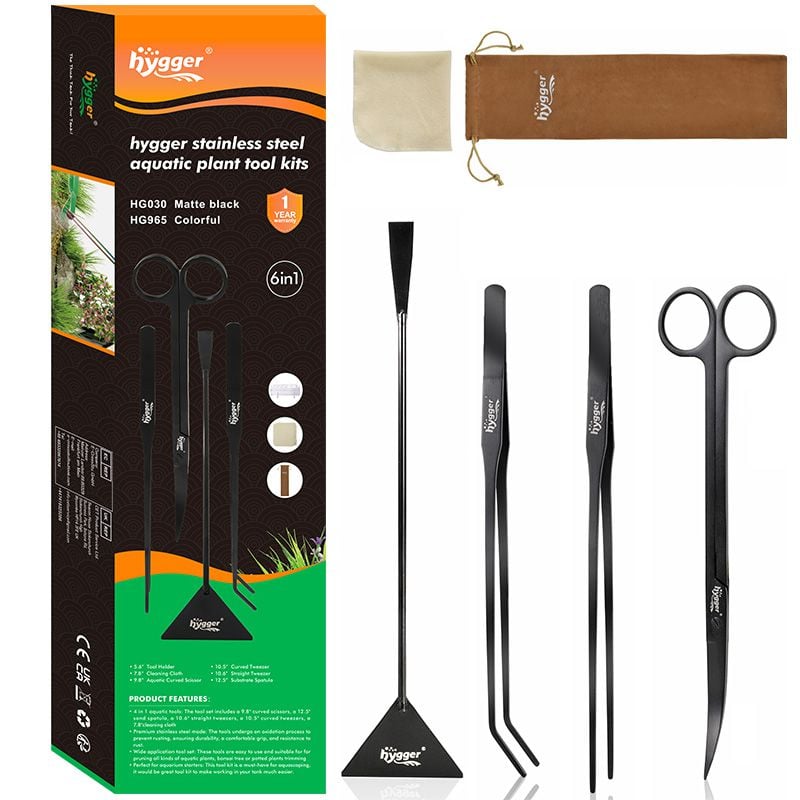
Manual removal with tweezers is the core of the protocol; clado resists chemicals: hygger aquascaping tools.
 ★4.6
hygger 6-in-1 Long Aquarium Aquascaping Tools Kit
Check Price on Amazon ★4.6Spot-treats remaining strands after manual removal: 3% hydrogen peroxide.
Prevention: Never Again
- Quarantine all new plants and moss — inspect moss portions under bright light before adding; pick out anything wiry.
- Think twice about marimo balls — they're attractive, but they're cladophora colonies in your tank. If you keep them, isolate them and never let fragments drift.
- Sterilize tools between tanks — a quick bleach dip prevents cross-contamination.
- Maintain flow and cleanliness — cladophora establishes easiest in neglected, still tanks. Regular maintenance is prevention.
The Marimo Ball Dilemma
Marimo "moss" balls deserve special discussion because they're the only cladophora product sold deliberately — and the most common infestation source. In their native lakes, wave action rolls cladophora into velvet spheres; in your tank, they sit still, slowly shedding fragments that colonize everything downstream.
If you love the look and want to keep them, quarantine them permanently: keep marimo in their own container or a dedicated tank, never in the main display. Roll them in your palms during water changes — this maintains the spherical shape and lets you inspect for loose fragments. Rinse them in old tank water regularly, squeezing gently like a sponge to expel trapped detritus (which otherwise rots inside the ball). And never, ever toss a deteriorating marimo into the main tank "to recover" — a falling-apart ball is a fragment bomb.
Be aware that many mass-market "moss balls" aren't even true marimo — they're java moss wrapped around foam, or worse, cladophora species far more aggressive than Aegagropila linnaei. If a store-bought ball starts growing wiry beards within weeks, treat it as an infestation source: remove it, inspect the tank for fragments, and don't buy replacements from the same supplier.
Frequently Asked Questions
Is cladophora harmful to fish or plants?
Not directly toxic, but it smothers. Dense tufts block light from leaves, trap detritus that rots against plant tissue, and outcompete moss for surface area. Fish and shrimp ignore it — few grazers touch the wiry strands, which is part of why it's so persistent. Amano shrimp may pick at young growth but won't control an established colony.
Can I just leave cladophora if it looks like moss?
Some keepers intentionally cultivate it on hardscape for a "mossy" look, and marimo balls are deliberately kept. The risk is spread: "controlled" cladophora fragments constantly, and today's accent tuft becomes next month's infestation in your moss and carpet. If you keep it deliberately, isolate it and remove fragments religiously. Most keepers who tried the decorative route eventually eradicated it.
Why didn't hydrogen peroxide kill my cladophora?
Because cladophora's thick cell walls resist single chemical hits that melt soft algae. Peroxide weakens it but rarely kills established tufts outright — it takes repeated applications plus manual removal. If you treated once and declared failure, you under-treated. Combine 3–4 spot-dosing sessions with aggressive tweezer removal for real results.
How do I know I've fully eradicated it?
You don't, for about two months. Cladophora regrows from microscopic fragments, so eight clean weeks with no new tufts is the all-clear threshold. Keep inspecting moss and hardscape crevices weekly during this period — catching a regrowing tuft at 5 mm takes seconds; catching it at 5 cm takes a session.
Should I throw away infested moss or try to clean it?
Clean it once, thoroughly, in a bucket. If after that session the moss still shows wiry strands woven through it, discard and replace. Moss is inexpensive and regrows fast; months of fighting cladophora hidden in a moss mat costs more in frustration than a new portion costs in money. This is the voice of collective hobby experience speaking.
Respect the Wire
Cladophora demands more patience than any soft algae — tweezers over toothbrushes, weeks over days, and the humility to throw away a beloved moss mat when it's the reservoir. But it's beatable: fragment by fragment, with clean flow, low organics, and quarantined new arrivals, even bad infestations end. The keepers who win are the ones who identify it correctly on day one and never let a fragment drift.
Related: our algae identification chart covers the ten most common types.