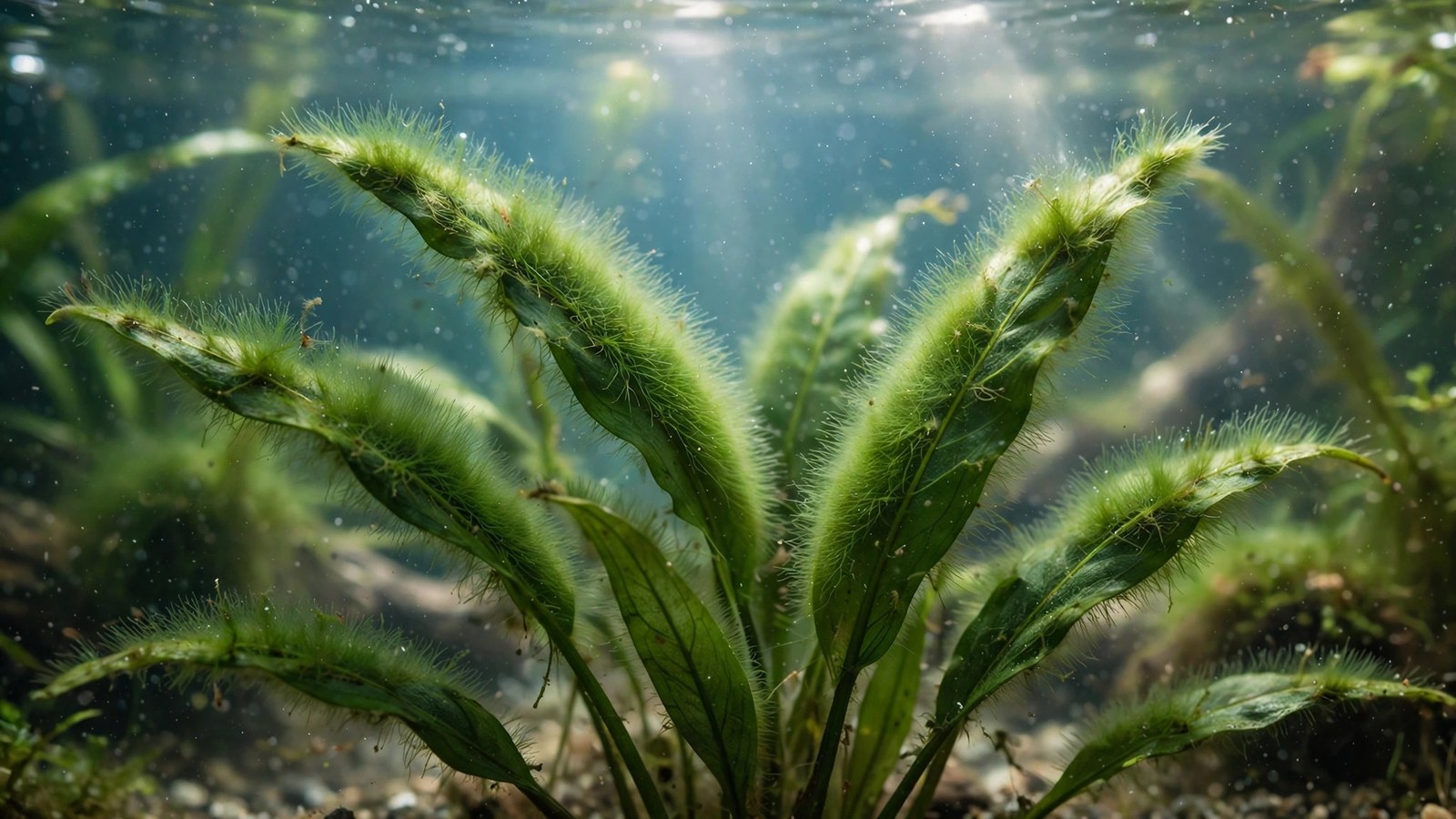
Your anubias leaves wear a soft green fuzz, like peach skin. Your java fern looks dusty. The slow growers in your tank are getting furry while the fast stems stay clean — classic fuzz algae behavior. Fuzz algae is the mildest-mannered of the filamentous crew: short, soft, and usually a symptom of leaves that sit still too long under too much light. It's easy to treat, easier to prevent, and worth understanding because it's often the first warning that your tank's balance is drifting.
What Fuzz Algae Looks Like
- Short, soft filaments — 1–3 mm, like fine velvet or peach fuzz on the leaf surface. Shorter and softer than hair algae.
- Color: light to medium green; sometimes greyish-green in lower light.
- Location: overwhelmingly on slow-growing, broad leaves — anubias, java fern, bucephalandra, older sword leaves. Rarely on fast-growing stems (they shed it with new growth).
- Texture: rubs off easily between fingers, leaving the leaf intact underneath.
Distinguish from: hair algae (longer, denser tufts — our hair algae guide), green dust algae (flat film, no filaments — our GDA guide), and staghorn (stiff, branching, grey-green — our staghorn guide). Fuzz is the shortest and softest of the bunch.
Why Fuzz Targets Slow Growers
Leaves that don't move
Fast-growing stems outrun algae — by the time filaments establish, the leaf is old news and the tip has moved on. Slow growers like anubias hold the same leaf for months, giving algae an undisturbed, long-term substrate. Fuzz isn't choosing anubias because it's weak; it's choosing it because it's stable.
Too much light on still leaves
The core trigger: light intensity that exceeds what slow-growing leaves can use. Anubias and java fern are low-light plants by nature — blasting them with high light doesn't make them grow faster (they can't), it just feeds the fuzz. Every photon the leaf can't use is a photon for algae.
Ammonia and organics
Brief ammonia spikes and accumulated detritus on leaf surfaces seed fuzz outbreaks, same as other filamentous algae. Leaves near the substrate or in low-flow areas collect settling organics and fuzz first.
New tanks
Fuzz frequently appears in the first two months — sparse planting, unsettled balance, slow growers sitting under new-tank lighting. It usually fades as the tank matures and plant mass increases.
Treatment: Gentle and Straightforward
Step 1: Rub it off
During a water change, gently rub affected leaves between thumb and forefinger. Fuzz comes off easily without damaging healthy leaves. For delicate or heavily coated leaves, a soft toothbrush works. Remove the dislodged fuzz with a siphon — don't let it resettle.
Step 2: Reduce light on the slow growers
- Shade them: position anubias and java fern under overhangs, driftwood, or floating plants. In nature they grow in shade — replicate that.
- Drop intensity 20% if dimmable, or shorten the photoperiod to 6–7 hours.
- Floating plants are the elegant fix — frogbit or salvinia diffuses harsh overhead light while consuming excess nutrients. Double benefit.
Step 3: Deploy the cleanup crew
Fuzz is the easiest algae for grazers to control:
- Otocinclus — superb fuzz grazers; a small group keeps anubias leaves polished.
- Nerite snails — relentless on hardscape and broad leaves.
- Amano shrimp — pick fuzz off leaves meticulously.
- Cherry shrimp colonies — constant low-level grazing prevents fuzz from establishing.
Step 4: Keep the system balanced
- Maintain complete fertilization — slow growers still need nutrients; deficiency-weakened leaves fuzz faster. Check our nutrient deficiency guide if leaves look pale as well as fuzzy.
- Stable CO2 if injected — fluctuations stall even slow growers.
- Weekly 30% water changes; don't let organics accumulate on leaf surfaces.
- Improve gentle flow around slow-growing plants — enough to prevent detritus settling, not enough to batter them.
Step 5: Trim the hopeless cases
Leaves that are more fuzz than leaf, yellowing underneath, or clearly dying should be removed at the rhizome. Anubias and java fern constantly produce new leaves from the rhizome — sacrificing ruined old leaves redirects energy to fresh, clean growth. See our rhizome rot rescue guide if the rhizome itself looks unhealthy.
Safe water for the water changes in the gentle treatment: Seachem Prime.
Fuzz Algae as an Early Warning System
Experienced keepers treat fuzz as a dashboard indicator, not just a nuisance:
- Fuzz appearing suddenly → check for a recent ammonia event (dead fish, overfeeding, filter issue).
- Fuzz creeping up over weeks → light has likely crept too high, or plant mass has thinned. Rebalance.
- Fuzz only on oldest leaves → normal. Old leaves are meant to be replaced; trim them.
- Fuzz plus yellowing → possible nutrient deficiency weakening the leaves. Diagnose with our anubias yellowing guide.
Prevention: The Fuzz-Free Slow-Grower Tank
- Plant slow growers in shade from day one — under wood, under floaters, on the dimmer side of the tank.
- Match light to the slowest plant, not the fastest. If anubias shares a tank with high-light stems, shade the anubias rather than blasting everything.
- Stock grazers early — otos and shrimp in a cycled tank prevent fuzz from ever establishing.
- Remove old leaves proactively — don't wait for them to become algae farms. A monthly leaf-inspection trim keeps slow growers clean.
- Keep up water changes — clean water grows clean leaves.
Fuzz Algae on Hardscape and Equipment
Fuzz doesn't only grow on leaves. New driftwood often furs up with a pale green-grey fuzz in the first weeks — this is usually a harmless biofilm/early algae stage that fades as the wood matures and its initial organic leaching subsides. Don't scrub new wood aggressively; the biofilm is feeding your shrimp and otos, and it resolves on its own within a month. Just rinse off the loosest material during water changes.
Filter intakes, heater tubes, and thermometer suction cups also collect fuzz — they're still, textured surfaces in the current's path. Wipe them during monthly maintenance; a quick swipe with an algae pad is enough. Persistent fuzz on equipment near the light (like a heater suction-cupped high on the glass) is a light-placement hint: if equipment fuzzes but plants don't, your light is hitting hardware more than foliage, and repositioning either the equipment or the light spread improves efficiency.
One more spot: the waterline. Fuzz and green film accumulate where glass meets air, especially under bright lights. Wipe the waterline band weekly — it takes ten seconds and prevents the crusty buildup that eventually needs a razor blade. This is basic tank hygiene that pays off across every algae category.
Clears fuzz off hardscape and equipment during cleanup: FL!PPER magnetic cleaner.
Fuzz Algae vs. Biofilm in New Tanks
New tanks grow a translucent-white biofilm on wood and glass in the first weeks — bacterial, not algal, and completely harmless. Beginners often confuse it with fuzz algae and reach for treatments. The differences: biofilm is white/translucent and slimy rather than green and filamentous, it appears in week 1–3 rather than later, and shrimp devour it eagerly. If it's white and your tank is under a month old, it's biofilm — leave it alone and let the shrimp handle it. True green fuzz appearing after the first month is the algae this guide addresses.
Frequently Asked Questions
Is fuzz algae harmful to my plants?
Mild fuzz is harmless — it's a cosmetic film that grazers remove. Heavy, long-standing fuzz blocks light from the leaf surface and traps detritus, slowly weakening the leaf. The plant itself is fine; the affected leaves may decline. Rub it off, shade the plant, add grazers, and new growth comes in clean. It's the least damaging common algae.
Why is only my anubias fuzzy but nothing else?
Because anubias holds its leaves for months under light it can't fully use — the perfect fuzz substrate. Your stems outgrow it and your floaters are too close to the light to care. This is normal fuzz behavior, not a sign your anubias is sick. Shade it, add otos, rub the leaves, and it'll stay clean.
Will reducing light hurt my other plants?
Not if you shade selectively rather than dimming the whole tank. Use floating plants, hardscape positioning, and placement to give slow growers less light while stems keep their bright spots. If you must dim globally, most plants tolerate 6–7 hours fine — it's the intensity mismatch on slow leaves that causes fuzz, so targeted shading beats blanket dimming.
Can I use hydrogen peroxide on fuzz algae?
You can, but it's overkill for most fuzz. Spot-dosing works (filter off, syringe onto leaves, 1 ml per 10 gallons), but manual rubbing plus grazers achieves the same result with zero risk. Save peroxide for stubborn filamentous algae like hair algae. Fuzz surrenders to a thumb.
My java fern has fuzz AND black spots. Related?
Possibly, but they're separate issues. Black spots on java fern are usually normal spore development or minor nutrient responses — see our java fern black spots guide to tell the difference. Fuzz on the same leaves just means they're old, still, and well-lit. Treat the fuzz (rub, shade, grazers) and evaluate the spots independently.
Listen to the Fuzz
Fuzz algae is the hobby's gentlest alarm bell — a soft green whisper that your light is a touch too strong, your grazers a touch too few, or your water a touch too rich. Answer it early with a thumb-rub, some shade, and a few otos, and it never becomes more than a footnote. Ignore it, and it graduates into the hair algae campaign. The fuzz is telling you something; it's worth listening.
Related: our algae identification chart covers the ten most common types.