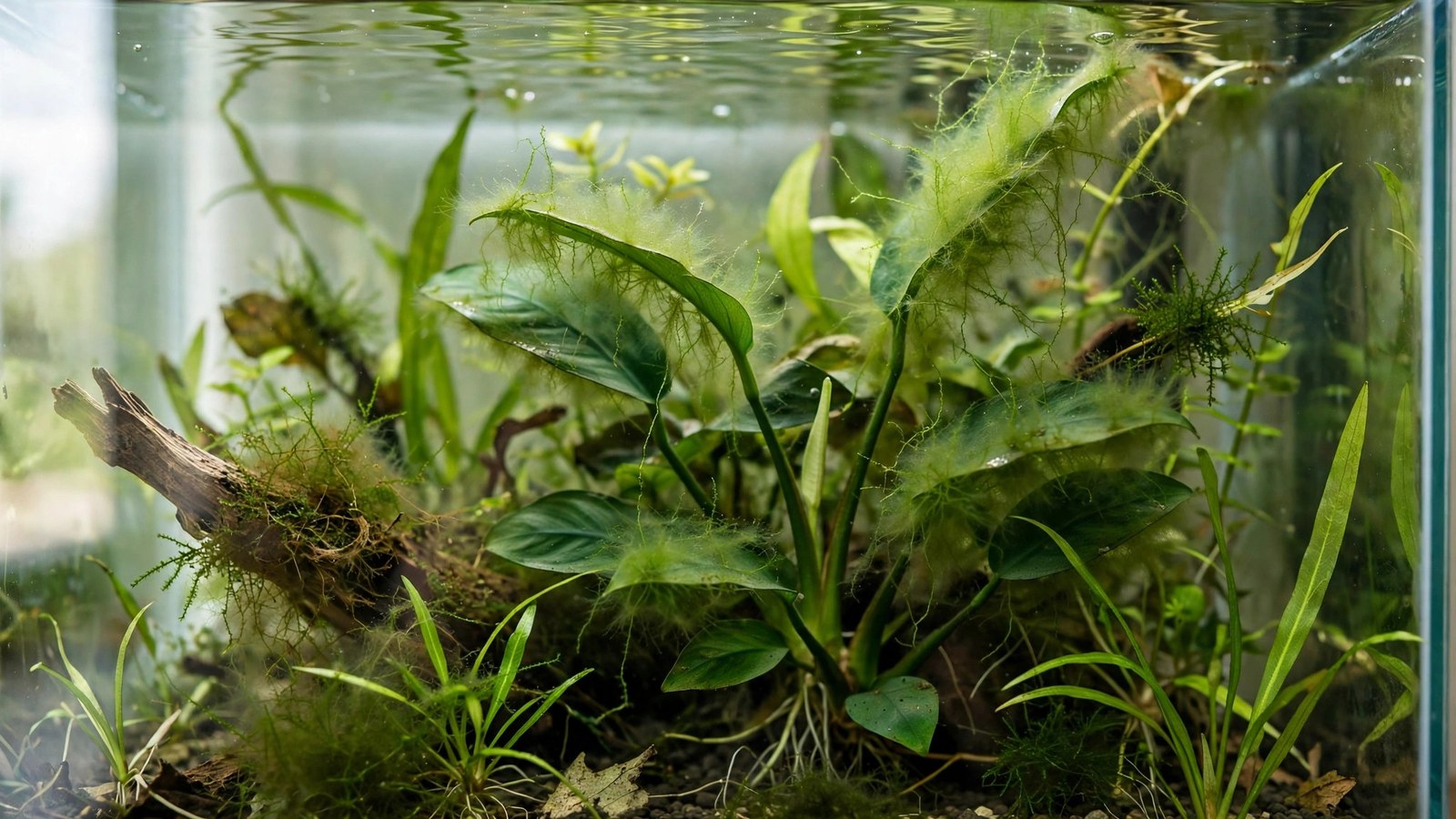
If you're wondering will hair algae go away on its own, you probably just spotted the first wispy green tufts and you're hoping patience will fix it. Here's the honest answer: sometimes yes, sometimes absolutely not — and guessing wrong is how a mild outbreak turns into a tank-eating mess. This article gives you a simple 2–4 week test to tell which situation you're in, so you wait when waiting works and act when it doesn't.
When Waiting Actually Works: New-Tank Succession
Here's the scenario where patience pays off. You set up a planted tank a month ago: the cycle is stabilizing, stem plants are still rooting, and the filter is immature. Around week 3–6, a light haze of hair algae — or its thread-like cousin, thread algae — appears on slow-growing leaves and hardscape.
This is algae succession, documented for decades by planted-tank veterans on the Barr Report forum. A new tank's biology is a frontier town: nutrients spike before the bacteria, plant biomass, and microflora that consume them are in place. Hair algae colonizes the vacuum first. Then the system matures, plant roots pull nitrate and phosphate from the water, the tufts bleach white and detach — and nothing replaces them. Not certain it's hair algae and not a look-alike? Check our aquarium algae identification chart first.
Will Hair Algae Go Away on Its Own in an Established Tank?
No. If your tank is more than three months old and hair algae is spreading, there is no biological process left to "mature into" — the imbalance is the system. Mature tanks with chronic hair algae have a specific, ongoing cause: too much light for the available CO2 and plant mass, a slow nitrate or phosphate creep from overfeeding or skipped water changes, or plant biomass too sparse to outcompete the algae.
It follows a grim loop: algae colonizes the slowest growers first (Anubias, Buce, Java fern), shades their leaves, weakens them, and their decay leaks more nutrients — which grows more algae. If the tank is established and the algae is gaining ground, skip to the action plan: the hair algae removal guide starts with the cause-diagnosis steps that actually break the cycle.
The 2–4 Week Observation Test
When you're unsure which scenario you're in, don't guess — measure. Give the tank two to four weeks and score three signals:
| Signal | Resolving (keep waiting) | Getting worse (act now) |
|---|---|---|
| Algae biomass | Tufts shrink or hold steady; some bleach white and detach | Tufts lengthen past 1–2 cm and spread to new surfaces |
| Location | Stays on glass and hardscape; plant leaves mostly clear | Spreads onto plant leaves, especially slow growers like Anubias |
| Nitrates (test weekly) | Trending down or stable under 20 ppm as plants grow in | Climbing week over week, or stuck over 40 ppm |
Test once a week — nitrate plus phosphate if you have the kit. If all three signals point to "resolving" after two weeks, extend the wait to four. If any single signal says "getting worse," the wait is over.
Red Flags That Override the Waiting Period
Some developments mean waiting is wrong, no matter how young the tank is:
- It reaches plant leaves. Algae on glass is cosmetic; on leaves it's a slow kill. A coated leaf can't photosynthesize, rots, and feeds the next wave.
- It forms thick mats. Thin tufts can fade. Dense mats over 1 cm thick are established colonies with their own nutrient reserves.
- It regrows days after cleaning. Same spots returning after a 30% water change and a glass scrub means an ongoing source, not a passing phase.
- Your plants have stalled. No new leaves, melting starts, pearling stops — the algae is winning the resource war.
- Nutrients keep climbing. Nitrates rising from 10 to 30+ ppm across two weeks means the balance is drifting the wrong way.
What a Real Self-Resolution Looks Like
Know the signature. Dying hair algae loses its bright green first, turning pale or grayish-white, then detaches in small clumps you can siphon out during a water change. Crucially, no new tufts appear elsewhere. Meanwhile your plants visibly accelerate: new leaves, roots anchoring, stem plants needing their first trim. That growth is the engine of recovery — it's what's starving the algae out.
Timeline reality check: in a new tank the whole arc usually runs from week 3–6 (peak) to week 8–12 (gone). If you're at week 10 with no improvement, the succession theory no longer applies — treat it as chronic. And if your outbreak shifts appearance week to week, the green dust algae guide and our piece on staghorn algae on plants cover two common misidentifications.
When You Decide to Act: The Right Sequence
If the test came back "getting worse" — or you hit any red flag — waiting has told you what you needed to know. Act in this order:
- Manual removal first. Twist tufts around an old toothbrush and siphon out debris — this alone removes 60–70% of visible biomass.
- Fix the cause. Shorten the photoperiod to 6–7 hours, check nitrate and phosphate, and confirm your plant mass can outcompete algae — sparse plantings are the number-one cause of persistent hair algae.
- Add grazers as support. Algae eaters like Amano shrimp handle short, soft tufts — but nothing clears a mature outbreak alone. They're the cleanup crew, not the treatment.
- Stay consistent for a month. Keep the corrected routine for at least four weeks after the first improvement. Algae rebounds fastest in week two of complacency.
For the full walkthrough — dosing adjustments, the blackout option, and peroxide spot-treatment — see the hair algae removal guide. The 2hr Aquarist's algae-control guides are excellent further reading on the light–nutrient science behind it.
Frequently Asked Questions
How long does hair algae last in a new tank?
Typically 4–8 weeks from first appearance to gone, peaking around week 4–6 after setup. The arc: tufts appear as the tank cycles, plants establish and consume nutrients aggressively, the algae bleaches white and detaches, and no new growth replaces it. Still thriving at week 12? It's no longer succession — treat it as a chronic imbalance.
Will reducing light kill hair algae?
Reducing light slows hair algae but rarely kills it alone — algae tolerates low light better than your plants do. A measured cut to 6–7 hours works as part of a package with water changes and manual removal, but starving the tank of light weakens plants first and usually makes things worse when normal lighting resumes.
Does hair algae mean my tank is cycled?
Not reliably. Hair algae feeds on ammonia, nitrate, and phosphate — it can appear during cycling from the ammonia spike or long after from overfeeding or excess light. Its presence says "nutrients are available," not "the cycle is complete." Test for zero ammonia and nitrite before declaring the cycle done.
Will shrimp eat all the hair algae?
No — but Amano shrimp genuinely help with short, soft tufts under about 1 cm. Stock roughly 1 shrimp per 2 gallons to graze new growth and suppress regrowth after you've done the heavy lifting manually. They won't touch long, mature strands or dense mats, and they can't fix the imbalance that grew the algae.
When should I manually remove hair algae?
Remove it immediately when it appears on plant leaves, forms mats thicker than 1 cm, or regrows within days of cleaning — those mean waiting is wrong. During genuine new-tank succession you can be hands-off, but a quick toothbrush-twist on the worst spots cuts the nutrient load, so there's rarely a reason not to tidy them.
The Bottom Line
Hair algae sometimes goes away on its own — in a young tank, as plants establish and the biology matures, it's practically expected. Everywhere else, "waiting it out" is procrastination with a nicer name. Run the two- to four-week test, trust your photos and test kit over your hope, and the moment the trend turns, switch from waiting to working.