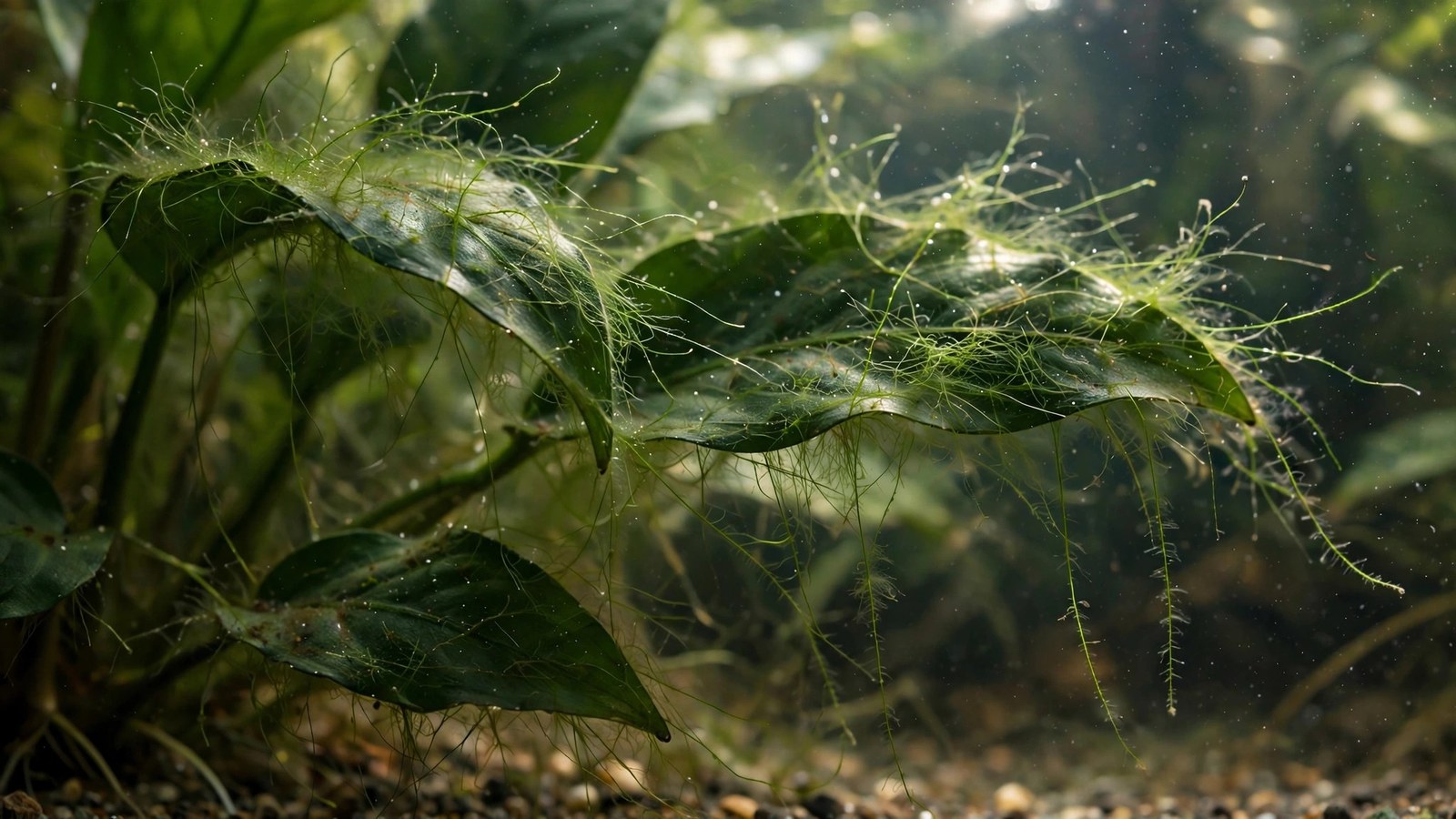
Finding fuzzy bright-green tufts on the edges of your older leaves usually means you need oedogonium algae treatment before the problem spreads. Oedogonium is a filamentous green algae that thrives when light, carbon dioxide, and plant growth fall out of balance, and it happily colonises the leaves your plants have stopped defending. The good news is that it responds well to a steady, methodical fix: remove what you can see, rebalance your light and CO2, help your plants regain dominance, and the tufts disappear within a few weeks. This guide shows you how to identify it with confidence, how it differs from lookalike algae, and how to clear it without harming your plants or livestock.
What Oedogonium Algae Looks Like
Oedogonium forms short, fine, fuzzy filaments that grow in dense, velvety tufts — often described as resembling a light green cottony fuzz or a short "green beard" sprouting from leaf surfaces. The filaments are typically brighter and more vividly green than hair algae, and they feel slightly coarse or wiry when you brush them with a fingertip. Under a microscope the filaments show a distinctive ladder-like segmentation, but you will never need one: the growth pattern alone is diagnostic in a home aquarium.
Unlike algae that coat the whole leaf or trail in long ribbons, oedogonium strongly prefers leaf margins and tips of older leaves. You will see it fringing the edges of Anubias, Bucephalandra, Java fern, and aging stem-plant foliage, though it can also speckle hardscape and substrate edges. When the infestation is heavy, whole plants can look like they are wearing a green fur collar.
Growth speed is moderate: a few tufts today become obvious patches within a week. It rarely appears in the very first days of a new tank. Oedogonium usually shows up after the initial diatom and green-dust phases fade, often in weeks four to eight of a new setup or whenever an established tank's balance slips. If you are watching new growth rather than old leaves, you will notice the freshest leaves stay clean while the older ones carry the fuzz — that selective pattern is one of the clearest identification clues.
Oedogonium vs. Other Filamentous Algae
Several green algae look similar at a glance, and treating the wrong one wastes weeks. Use the table below to pin down which filamentous algae you actually have before you act.
| Feature | Oedogonium | Hair / thread algae | Cladophora |
|---|---|---|---|
| Appearance | Short, fuzzy, bright-green tufts; slightly coarse texture | Long, soft, thin strands up to several inches; limp and wispy | Dark green, wiry, tightly branched; mats feel like steel wool |
| Where it grows | Edges and tips of older leaves; occasionally hardscape | Anywhere — plant surfaces, hardscape, substrate, filter outlets | Usually hardscape, moss, and substrate; often arrives on new plants or moss |
| Colour | Vivid light green | Pale to mid green | Dark, greyish green |
| How it detaches | Rubs off leaves with a fingertip or soft brush, but clings firmly at the base | Pulls off easily in long ribbons; a toothbrush twirls it up neatly | Sticks hard, breaks rather than peels; extremely difficult to remove manually |
| Main driver | CO2/light imbalance plus declining leaf health | Ammonia spikes, high light, unstable CO2 | Spore introduction on plants/moss, low nutrients, poor plant growth |
| Livestock control | Amano shrimp and some snails eat it when young | Amano shrimp, Siamese algae eaters, mollies | Almost nothing eats it reliably |
If your strands are long, soft, and flowing, you are likely dealing with hair algae instead, and a dedicated hair algae removal guide will serve you better. Very fine, pale threads tangling through stem plants usually point to thread algae, and soft green fuzz spread evenly across whole leaves rather than edges leans toward fuzz algae — each has its own dedicated treatment approach.
Why Oedogonium Appears in a Planted Tank
Like almost every algae outbreak, oedogonium is a symptom, not the disease. It blooms when something stops your plants from outcompeting it. Understanding the cause matters because killing the algae without fixing the cause guarantees a repeat performance.
CO2 deficiency or instability
The single most common driver is carbon dioxide falling below what your plants need — either too little injected CO2, an inconsistent CO2 schedule, or a low-tech tank where plant growth demands have crept past available carbon. When plants slow down from carbon limitation, they leak dissolved organics from older leaves, and oedogonium spores read those signals as an invitation. Learning to read CO2 deficiency signs in plants helps you catch this early: stunted new growth, pale young leaves, and algae fringing old foliage together form a classic pattern.
Too much light for the tank's CO2 and nutrient supply
Strong lighting with modest CO2 and fertiliser is an imbalance algae always wins. High PAR levels push plants to grow faster than their carbon and nutrient budget allows, the weakest leaves decline first, and oedogonium colonises them. This often follows an upgrade — a new LED light, a raised intensity setting, or a longer photoperiod — without a matching increase in CO2 or fertilisation.
Loss of plant dominance
A tank full of thriving, fast-growing plants is naturally algae-resistant because healthy leaves physically shade competitors and release compounds that discourage algae attachment. When plant mass thins out — after a heavy trim, a nutrient crash, or neglect — algae gets the light and space. Slow-growing species like Anubias and Bucephalandra are especially vulnerable: their leaves persist for months, giving oedogonium a stable platform it can colonise faster than the plant outgrows it.
Ammonia spikes and poor maintenance
New substrates, disturbed aquasoil, decaying plant matter, or overfeeding release ammonia, which stresses plants and fertilises algae simultaneously. Tanks that go a few weeks without water changes or gravel vacuuming accumulate the dissolved organics that filamentous algae love. Staghorn algae on plants shares several of these triggers, and a tank suffering one imbalance often grows several algae types at once.
Step-by-Step Oedogonium Algae Treatment
Treatment works in phases: remove the existing algae, fix the underlying imbalance, and give your plants the tools to take back control. None of this is complicated, but the order matters — attacking step three while ignoring step one is the most common reason treatments "fail".
Step 1: Remove what you can see
During your next water change, rub affected leaves gently between your fingers or with a soft toothbrush — oedogonium tufts slough off while the leaf usually survives. For heavily coated leaves that are already yellowing or translucent, trim them off entirely; a deteriorating leaf will never heal and simply reattracts algae. Siphon out loose filaments, then complete a 30–50% water change to export spores and organics. Repeat the manual removal at each water change for the first two or three weeks.
Step 2: Fix the CO2 supply
In an injected tank, raise CO2 until your drop checker sits at a stable lime-green during the whole photoperiod, and make sure CO2 starts one to two hours before the lights come on. Chasing a darker green that dips toward yellow is dangerous — the goal is consistency, not the maximum your fish tolerate. In a low-tech tank, reduce growth pressure instead: dim the light or shorten the photoperiod. If you have never verified your CO2 is actually adequate, spend a week watching the drop checker before touching anything else.
Step 3: Balance light and fertilisation
Set the photoperiod to six to eight hours on a timer and leave it fixed — constant tinkering keeps plants in adaptation stress. If you recently raised light intensity, dial it back 20–30% until the algae recedes and plants show healthy new growth. Dose fertilisers consistently rather than in bursts; lean dosing causes the nutrient gaps that weaken older leaves, while erratic heavy dosing can feed algae spikes. Floating plants are a useful temporary ally here: they shade the tank, absorb excess nutrients, and can be thinned out once balance returns.
Step 4: Prune and replant aggressively
Cut out every algae-covered, melting, or transparent leaf — plants replace them faster than you think, and each removed leaf is removed real estate for oedogonium. Replant the healthiest stem cuttings to thicken plant mass quickly. Aim for visibly dense planting within two weeks; a tank with bare substrate and sparse stems invites exactly the imbalance you are fighting. Healthy new leaves are your scoreboard: when fresh growth emerges clean and stays clean for a week or more, the tank is turning the corner.
Step 5: Consider plant-safe algaecides only as a last resort
If manual removal plus rebalancing has not reduced the algae after three to four weeks, a targeted chemical treatment can be a legitimate backup — but approach it conservatively. Use only products labelled safe for planted aquariums and sensitive livestock, start at half the recommended dose, and observe fish and shrimp for at least 24 hours before continuing. Never combine multiple chemical approaches at once, and always follow a treatment with a water change. If your livestock includes sensitive shrimp or expensive fish, lean on steps 1–4 longer before trying chemicals — patience is cheaper than a restocking order.
Spot-dosing liquid carbon weakens the filaments for easy removal: Seachem Flourish Excel.
Algae Eaters That Help Against Oedogonium
A cleanup crew is support, not a solution: no shrimp army fixes a CO2 problem. Still, once you have rebalanced the tank, the right livestock speeds the cleanup considerably.
- Amano shrimp (Caridina multidentata): the single best oedogonium eater. They graze young filaments enthusiastically. A group of five to ten in a mid-size tank makes a visible dent within days.
- Nerite snails: excellent on hardscape and glass, decent on broad leaves. They cannot reach tufts tucked along leaf edges, so pair them with shrimp.
- Otocinclus: good grazers of soft algae films and young filaments on plant leaves; supplement their diet once the algae is gone.
- Siamese algae eaters (Crossocheilus siamensis): effective against many filamentous algae in larger tanks, but verify you have the true species and give them room to grow.
Only add livestock after the tank is cycled and stable — stressed shrimp in an unstable tank will not solve anything. And once the algae disappears, keep the crew fed with sinking pellets or vegetables; hungry algae eaters turn on delicate plants.
Preventing Oedogonium From Coming Back
Prevention is the same recipe as treatment, minus the emergency removal. Keep these habits permanent and oedogonium has very little to work with:
- Run a fixed photoperiod (6–8 hours for most setups) on a timer; never change lighting without rebalancing CO2 and fertiliser together.
- Keep CO2 stable and verified — a drop checker you actually look at beats a precise one you ignore.
- Do weekly 30–50% water changes and siphon detritus from the substrate; decaying organics are algae fuel.
- Maintain dense, fast-growing plant mass and trim before plants crowd themselves into decline; replant the tops.
- Remove dying leaves immediately instead of hoping they recover — they will not, and they seed the next bloom.
- Feed livestock what they eat in two minutes; uneaten food decomposes into the ammonia algae thrives on.
- When adding new plants, inspect them and give them a quick rinse to avoid importing algae spores on the leaves.
Most aquarists who beat oedogonium once find it never returns, because the habits that fix it are exactly the habits that keep a planted tank healthy overall.
Frequently Asked Questions
Is oedogonium algae harmful to fish and shrimp?
No, oedogonium is not toxic to fish, shrimp, or snails. The danger is indirect: a heavy infestation signals a CO2 or light imbalance that can stress livestock on its own, and dead algae decomposing in the tank can foul water quality. Amano shrimp and some snails even graze young oedogonium filaments. Treat the underlying imbalance promptly, and your livestock will be unaffected.
How long does it take to get rid of oedogonium?
With manual removal, stable CO2, and corrected lighting, most tanks show clear improvement within two to three weeks and full clearance within four to six. The existing filaments die back as new, healthy plant growth replaces infested leaves. If nothing changes after four weeks of consistent fixes, recheck your CO2 stability and light levels — something in the balance is still off.
Can I use a blackout to kill oedogonium?
A three-day blackout (total darkness, tank covered) will weaken or kill oedogonium without usually harming established plants, and many hobbyists use it as a reset. However, a blackout treats the symptom, not the cause: if your CO2 and light are still unbalanced when the lights return, the algae returns too. Use blackouts only alongside the rebalancing steps above, and avoid them on newly planted tanks where plants lack energy reserves.
Will trimming infected leaves hurt my plants?
Removing badly infested leaves does not harm healthy plants — in fact it helps them. A leaf that is yellowing, translucent, or thickly coated with algae is already a net drain on the plant's resources and will never recover. Pruning redirects energy into new growth, which is your actual goal. Slow growers like Anubias recover more slowly, so trim selectively rather than stripping them bare.
Why does oedogonium keep coming back on my Anubias?
Slow-growing plants with long-lived leaves are magnets for oedogonium because their leaves sit in the water column for months, accumulating algae while the plant grows too slowly to outpace it. The fix is usually more light shading or slightly higher CO2 relative to the light, plus rubbing leaves clean regularly. Placing Anubias in shaded spots under hardscape or fast growers reduces the light that oedogonium needs.
Is oedogonium the same as hair algae?
No, though they are often confused. Hair algae grows in long, soft, flowing strands that can reach several inches, while oedogonium forms short, fuzzy, wiry tufts concentrated on leaf edges. The distinction matters because hair algae is more often tied to ammonia spikes and nutrient swings, while oedogonium points more specifically at a CO2 and light imbalance with declining leaf health. See the comparison table earlier in this guide to tell them apart.
Steady Plants Beat Oedogonium Every Time
Oedogonium looks alarming but it is one of the more forgiving algae a planted tank can host: it responds to logic, not panic. Identify it correctly, remove the visible growth, stabilise your CO2, bring light and fertiliser back into proportion, and let dense plant growth take over from there. Skip the temptation to nuke the tank with chemicals first — the manual-and-balance route is slower by a week or two and better by every measure that matters. Once your plants are growing cleanly and outpacing the algae, you have not just solved an outbreak; you have built a tank that resists the next one.
Related: our algae identification chart covers the ten most common types.