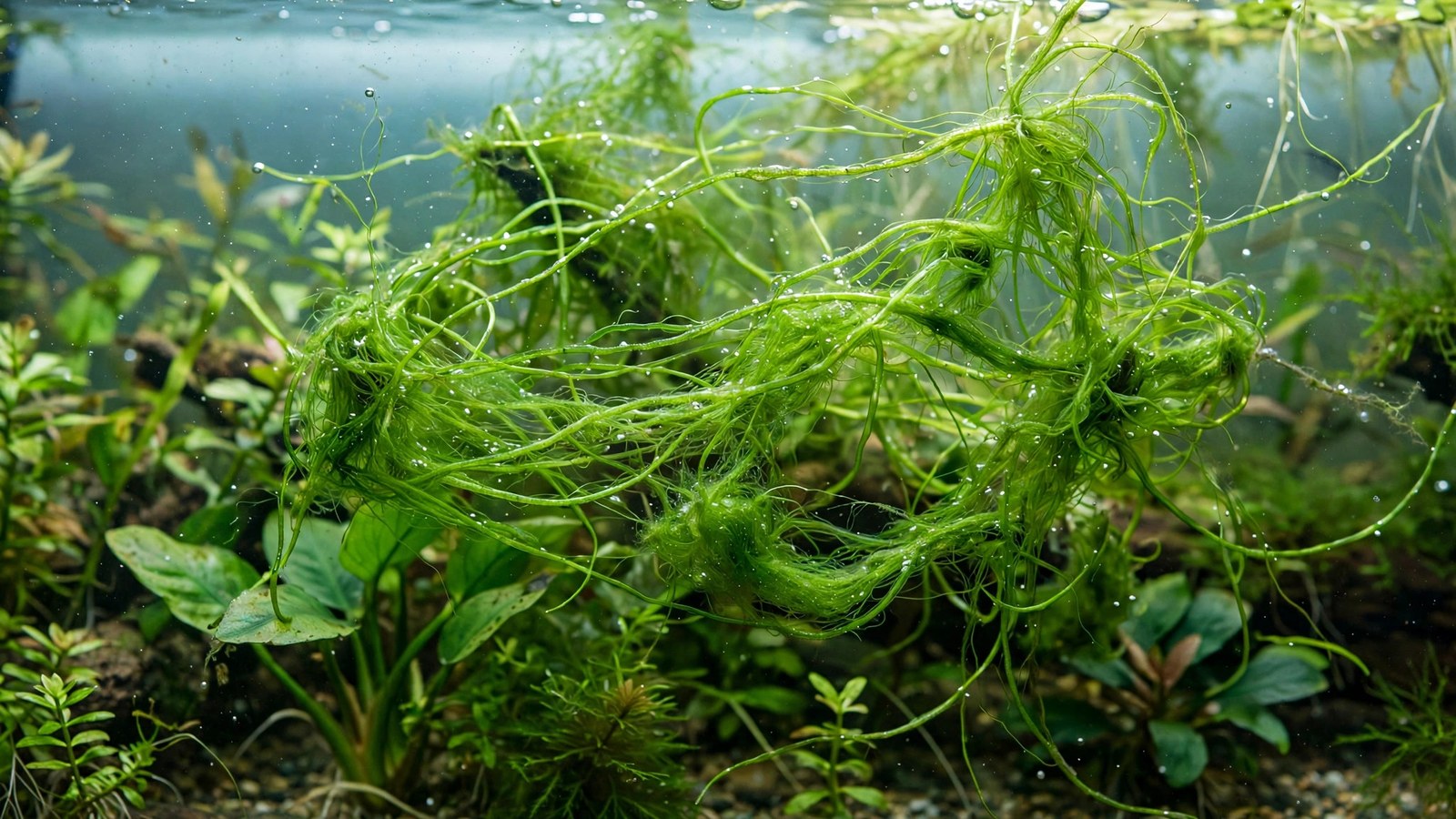
If you have ever reached into your planted tank and felt long, slimy green strands wrap around your fingers like wet hair, you may be dealing with a spirogyra algae aquarium outbreak. Unlike the harmless soft growths that come and go, spirogyra can carpet plants, clog filter intakes, and turn a thriving aquascape into a swamp in a matter of days. The good news is that once you learn to identify it correctly — and understand what triggered it — spirogyra is one of the most beatable algae problems in the planted-tank hobby.
Spirogyra is a genus of filamentous green algae, and it gets its name from the beautiful spiral-shaped chloroplasts inside each cell. Under a microscope it looks like a tiny green spring, but to the naked eye it just looks like long, slimy, bright-green threads. Confusing it with other filamentous algae is the most common mistake aquarists make, and that mistake costs time: each type responds to slightly different treatment. This guide walks you through identification, the causes behind an outbreak, and a proven step-by-step treatment plan.
What Causes a Spirogyra Algae Aquarium Outbreak?
Spirogyra is a free-living green alga made of unbranched filaments of cylindrical cells. In aquariums it typically shows up as soft, silky mats of long green threads that drape over plants, drift in the current, and collect around hardscape. Individual filaments can grow to several centimeters long, and the mats often trap oxygen bubbles, forming floating green rafts that can cover the water surface.
Unlike some algae that are always lurking at low levels, spirogyra tends to arrive suddenly and explode. It is commonly introduced on new plants (it survives as microscopic fragments on leaves), on driftwood, or in tap water in areas with heavy agricultural runoff. Once inside the tank, it waits for the right conditions — and when they arrive, it multiplies with startling speed.
Key characteristics of spirogyra
- Texture: distinctly slimy and slippery to the touch; strands slide between your fingers
- Strength: soft and easy to pull apart — filaments break rather than resist
- Color: bright, vivid green (darker mats can look almost emerald)
- Growth habit: long, draping threads that form clouds and mats; often traps oxygen bubbles
- Microscope signature: spiral chloroplasts inside each cell — the defining feature
Identifying Spirogyra: The Three-Way Comparison
Three filamentous green algae dominate planted-tank problem threads, and spirogyra is one of them. The other two are thread algae (often the Oedogonium type) and Cladophora, sometimes called the "impostor moss." Correct identification matters because Cladophora, for example, is tough and resists the manual-removal methods that work beautifully on spirogyra.
The touch test
The single most reliable field test costs nothing: reach in and grab the strands.
- Spirogyra feels slimy and slippery, like wet hair. It pulls apart easily, with almost no resistance.
- Cladophora feels wiry and coarse, almost like green steel wool. It resists pulling and does not feel slimy at all. Our Cladophora treatment guide covers this stubborn lookalike in detail.
- Thread/hair algae feels fine and delicate — wispy rather than slimy, shorter and softer than spirogyra strands.
Visual and growth comparison
| Feature | Spirogyra | Thread algae (Oedogonium) | Cladophora |
|---|---|---|---|
| Texture | Slimy, slippery | Fine, wispy | Wiry, coarse |
| Strand length | Long (up to several cm) | Short to medium | Medium, tangled |
| Branching | Unbranched | Unbranched | Branched, net-like |
| Bubble trapping | Common — floating mats | Rare | Rare |
| Where it grows | Plants, glass, substrate, hardscape | Mostly leaf edges and tips | Slow growers, moss, hardscape |
When you are still unsure
If the touch test is inconclusive, clip a small strand and place it on a white background in bright light. Spirogyra filaments are translucent enough that you can sometimes see the spiral pattern even without a microscope. Many aquarists also find that photographing the strands with a macro lens helps — see our guide on how to photograph aquarium plants for diagnosis for tips that work equally well for algae identification. For a second opinion on the different filamentous types, Tropica's algae type guide describes how to distinguish them by growth habit.
What Causes a Spirogyra Outbreak?
Spirogyra, like all algae, is opportunistic: it blooms when light and nutrients are available but your plants cannot use them fast enough. The spores or fragments are almost certainly already in the tank — the question is what tipped the balance in their favor.
Too much light
The number-one trigger is excessive light relative to plant uptake. Tanks running long photoperiods (10+ hours), very intense LED fixtures, or receiving direct sunlight through a window are prime spirogyra territory. Algae are far more efficient than higher plants at harvesting light at high intensities, so when you blast light without matching CO2 and nutrients, spirogyra wins the race.
Low or unstable CO2
Plant growth stalls when carbon is the limiting factor, and stalled plants leak organics and stop absorbing nutrients — a double gift to algae. Spirogyra outbreaks frequently follow a CO2 system that ran out, a DIY CO2 setup that went inconsistent, or a schedule change. For the warning signs, see CO2 deficiency: 7 signs your plants want more.
Nutrient imbalances
Excess ammonia or ammonium is a classic trigger — it commonly follows overstocking, overfeeding, disturbed substrate, or the melt of decaying leaves. High iron and phosphate levels relative to nitrate are also frequently implicated. Paradoxically, both nutrient excess and nutrient starvation can fuel spirogyra: starving plants stop growing and become perfect algae hosts. A nutrient deficiency guide will help you read what your plants are telling you.
Poor circulation and new-tank instability
Dead spots where detritus accumulates become local nutrient hotspots. Tanks in their first two to three months — or tanks that just had a major rescape — are especially vulnerable because the biological filtration and plant mass are not yet stable. New-tank algae waves are so common they have their own playbook; brown diatom algae in new tanks is often the first act, and spirogyra sometimes follows.
Spirogyra Algae Treatment: Step-by-Step Plan
Resist the urge to fight spirogyra with a single magic bullet. Algae treatments that work reliably combine immediate removal with correction of the underlying causes. Follow this sequence in order.
Step 1 — Manual removal
Spirogyra's soft, slimy texture is actually its weakness: it winds beautifully onto a toothbrush. During your next water change, twirl an old toothbrush through the strands like spaghetti on a fork. Siphon out as much as you can — every strand you remove is biomass that will not seed the next generation. For strands embedded among delicate plants, tweezers or gentle rolling with the toothbrush work better than yanking, which damages leaves.
Step 2 — Big water change and cleanup
Remove 40–50% of the water, siphon detritus from the substrate, clean pre-filters, and prune any algae-smothered leaves you cannot salvage. Leaves that are more than half covered are unlikely to recover — cutting them removes both algae habitat and the decaying tissue feeding it. This step resets the nutrient slate so your later adjustments start from a clean baseline.
Step 3 — Reduce light intensity and photoperiod
Drop the photoperiod to 6–7 hours and reduce intensity by 30–50% if your light is dimmable. You are not trying to starve the tank of light permanently — you are buying time for your plants to regain the upper hand. Keep this reduced schedule for two to three weeks. Blackout periods (2–4 full days of darkness) are sometimes recommended, but in planted tanks they stress plants too; the moderate light reduction is safer and usually sufficient.
Step 4 — Stabilize CO2 and nutrients
Get CO2 consistent (target 20–30 ppm in injected tanks; ensure drop-checker stays green throughout the photoperiod). Resume a balanced, regular fertilization routine rather than guessing — over-fertilizing symptoms and deficiencies look surprisingly similar. In lean tanks, dosing a complete fertilizer so plants actually grow is often more effective than chasing phosphate levels down.
Step 5 — Consider spot treatments (optional, with caution)
For stubborn patches on hardscape, many aquarists spot-dose with 3% hydrogen peroxide from a syringe directly onto the algae (with filters off for 15–20 minutes, roughly 1–2 ml per gallon). Liquid carbon products (glutaraldehyde-based) dosed directly onto mats also work. Both are harsh on sensitive plants, mosses, and invertebrates — never dose the whole tank, remove shrimp and snails if treating heavily, and always treat these as supplements to the core fixes, never the whole strategy.
Step 6 — Enlist the cleanup crew
Amano shrimp are genuinely effective spirogyra grazers — a crew of one per 2–5 gallons can keep strands mowed once the mat is under control. True Siamese algae eaters and nerite snails help with residual growth. Cleanup crews polish the victory; they cannot win the war alone against a full-blown outbreak.
Step 7 — Hold the course for 3–4 weeks
Spirogyra will not vanish overnight. Expect manual removal sessions twice weekly for the first two weeks, then tapering. The outbreak is beaten when new growth slows, strands stop reappearing between sessions, and your plants resume visible new growth. Only then should you gradually restore the photoperiod — add 30 minutes per week back toward your normal schedule.
Liquid carbon spot treatment is the standard first strike: Seachem Flourish Excel.
Preventing Spirogyra From Coming Back
Treatment without prevention is a treadmill. The long-term fixes are boring but permanent:
- Light discipline: keep the photoperiod at 7–8 hours once plants are growing well; use a timer, never manual switching.
- Stable CO2: CO2 on 1–2 hours before lights, off 1 hour before lights out; refill before the canister runs dry.
- Consistent fertilization: dose a complete fertilizer on a schedule matched to plant mass, and trim regularly so growth never stalls.
- Stocking restraint: overfed, overstocked tanks export ammonia faster than plants and filters can handle.
- Quarantine new plants: rinse new plants and inspect for strands; a brief dip in an alum or potassium permanganate solution removes hitchhikers before they reach your tank.
- Weekly maintenance rhythm: regular water changes, filter cleaning, and detritus siphoning keep nutrient baselines low.
What Spirogyra Does NOT Mean
A few myths worth clearing up. Spirogyra does not mean your tank is "dirty" or that you are a bad aquarist — even meticulous tanks get outbreaks after a CO2 canister dies over a weekend. It is not directly toxic to fish or shrimp; the harm is indirect (smothering plants, depleting nighttime oxygen in extreme mats). And you do not need to tear the tank down and start over — nuking and rebuilding just resets you to the vulnerable new-tank stage where algae thrive most.
Frequently Asked Questions
Is spirogyra algae harmful to fish?
Not directly — spirogyra is not toxic. The real risk is indirect: heavy mats smother plants, block light, and in severe cases consume enough nighttime oxygen to stress livestock. Fish are safe during normal treatment, and most chemical spot treatments are fish-safe at recommended doses. Remove shrimp and sensitive invertebrates before using hydrogen peroxide spot doses, then reintroduce them after a large water change.
How do I tell spirogyra apart from hair algae?
Use the touch test. Spirogyra feels distinctly slimy and slippery, and its strands are long — often several centimeters. Hair/thread algae feels fine and wispy, with shorter, softer strands. Spirogyra mats also trap oxygen bubbles and float, which hair algae rarely does. For a full breakdown of the wispy lookalike, see our hair algae removal guide.
Will Amano shrimp eat spirogyra?
Yes — Amano shrimp are among the most effective biological controls for spirogyra, and they genuinely prefer its soft strands over tougher algae like Cladophora. They work best as maintenance: add a solid crew (one per 2–5 gallons) after you have knocked the outbreak down manually. They will not clear a tank completely choked with mats on their own, so pair them with the full treatment plan above.
How long does it take to get rid of spirogyra?
Expect 3–4 weeks of active treatment: twice-weekly manual removal for the first two weeks, reduced light, stabilized CO2 and nutrients, and a cleanup crew. The strands you pull out will not return if the underlying cause is fixed — but any single step done alone (spot treatments without light reduction, for instance) usually fails, because spirogyra regrows from fragments within days.
Does a blackout kill spirogyra?
A 2–4 day total blackout does weaken spirogyra, but it also stresses your plants and stalls the very growth you need to outcompete the algae. A sustained moderate light reduction (6–7 hour photoperiod, lower intensity) for two to three weeks is usually just as effective and far safer for planted tanks. Reserve blackouts for extreme cases, and never combine them with heavy chemical dosing in the same week.
Can spirogyra come back after treatment?
Yes — fragments and dormant cells persist in the tank, so any return of the trigger conditions can restart an outbreak. The good news is that established, well-planted tanks with stable CO2 and disciplined lighting rarely see a second bloom. Keep your weekly maintenance rhythm, never let CO2 run out unnoticed, and quarantine new plants to cut off the main reintroduction route.
Take Back Your Tank
Spirogyra looks intimidating when it first drapes your prized plants in green silk, but it is a symptom, not a sentence. Identify it with the touch test so you are not fighting the wrong algae, pull it out by hand, turn down the light, stabilize your CO2 and nutrients, and give your plants three weeks to reclaim their tank. Every outbreak also teaches you something about your tank's balance — the aquarists who beat spirogyra once almost never lose to it twice. Your aquascape is still in there, waiting to come back.
Related: our algae identification chart covers the ten most common types.