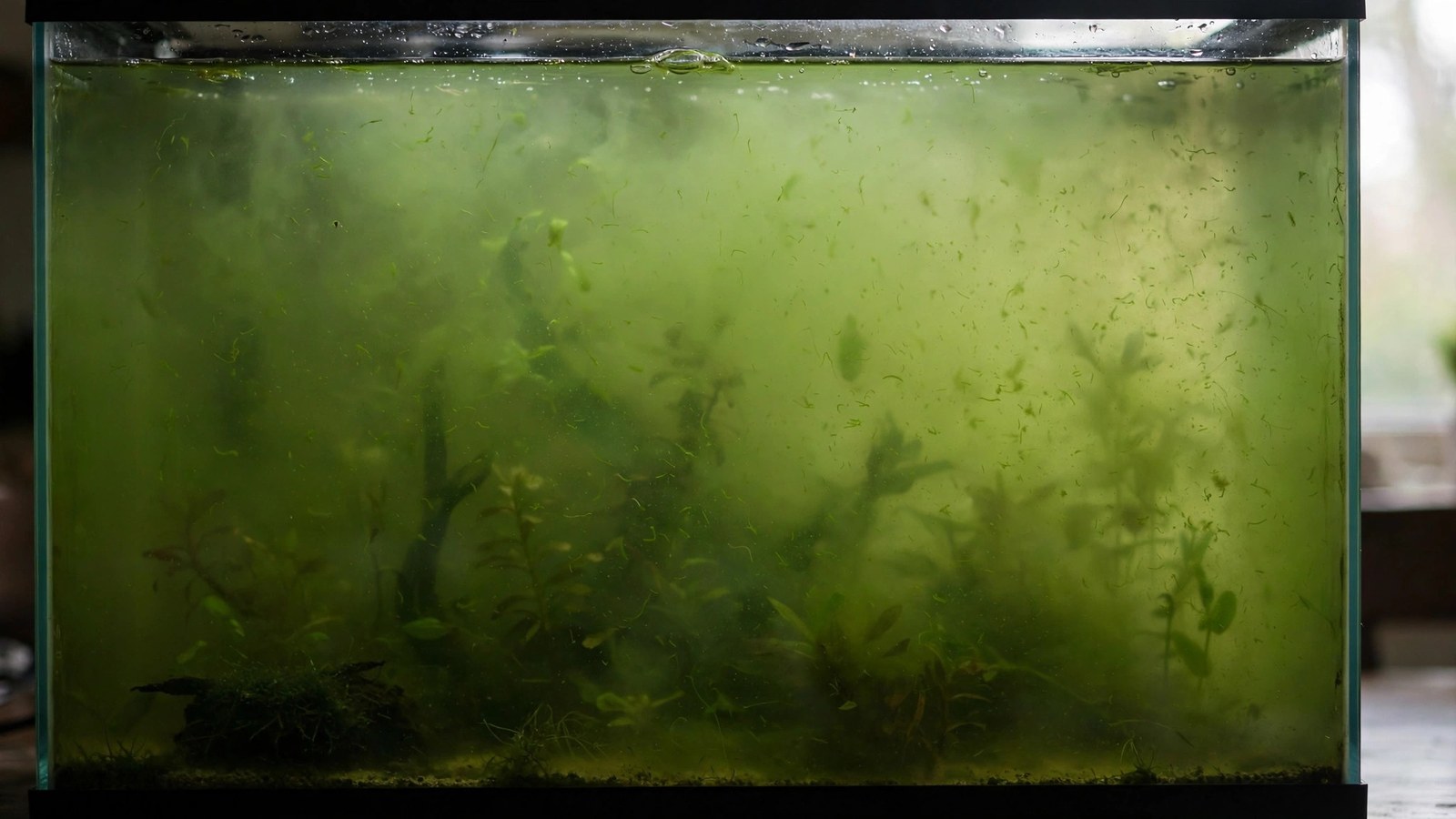
You wake up and your crystal-clear planted tank has turned into pea soup overnight. You can't see the back glass, your fish are shadows, and the plants you carefully arranged are invisible. A green water algae bloom is the most dramatic-looking problem in the hobby — and one of the least dangerous. The water is full of single-celled algae, not poison, and with the right sequence of steps you can go from soup to clear in days without harming a single plant.
What Green Water Actually Is
Green water is a bloom of free-floating single-celled algae (usually Chlorella or related species), suspended in the water column rather than attached to surfaces. Unlike the films and threads that coat glass and leaves, these cells drift — which is why the whole tank turns uniformly green and why scraping the glass does nothing.
The bloom can appear shockingly fast: a tank that's clear at bedtime can be opaque by morning. The algae doubles fast under the right conditions, so the transition from "slightly hazy" to "can't see the fish" often happens in 24–48 hours. The speed is alarming, but it's also diagnostic — nothing else in a freshwater tank greens water that quickly.
Is it dangerous?
Mostly no, with two caveats:
- Oxygen swings — dense blooms photosynthesize hard during the day (raising oxygen) and respire at night (consuming it). In severe blooms, pre-dawn oxygen can dip low enough to stress fish. If fish gasp at the surface in the morning, increase surface agitation immediately.
- Light starvation for plants — a thick bloom blocks light from reaching your plants. A few days is fine; weeks of green water will weaken them. This is why clearing it matters even though the algae itself is harmless.
What Triggers a Green Water Bloom
The usual suspects
- Ammonia spike — the number-one trigger. A dead fish hidden behind hardscape, overfeeding, a filter that stopped overnight, or disturbed substrate releasing trapped waste. Single-celled algae are ammonia opportunists par excellence.
- Sudden light increase — a new, stronger light fixture, a tank moved near a window, or a timer failure leaving lights on 24 hours. Algae responds to light changes far faster than higher plants.
- New tank syndrome — cycling tanks with immature bacterial colonies and fluctuating ammonia are prime bloom territory. Blooms in the first month are common and usually self-resolve as the cycle stabilizes.
- Overfeeding + excess dissolved organics — uneaten food and heavy bioloads feed the dissolved nutrients algae thrives on.
- Disturbed substrate — deep gravel vacuuming or rescaping releases a pulse of nutrients into the water column.
Rule out the trigger first
Before treating, spend five minutes investigating: test ammonia and nitrite, check the filter is running, count your fish, and think about what changed in the last week. Treating the bloom without fixing an ammonia source is mopping while the tap runs — our plants dying after water changes guide covers related water-quality detective work.
The Clearing Protocol (Fastest to Slowest)
Method 1: UV sterilizer (fastest, 2–5 days)
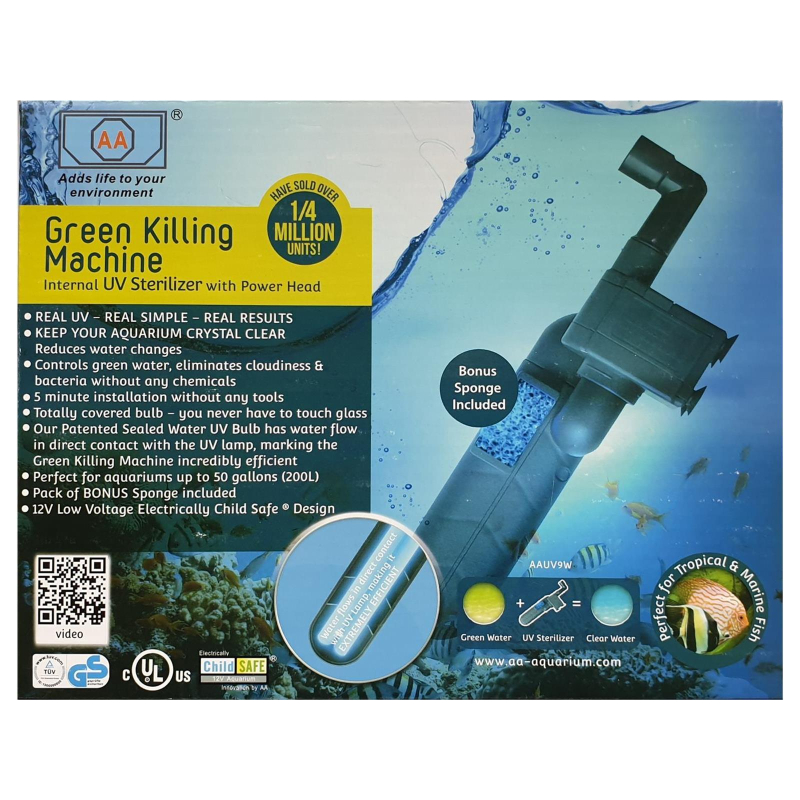
A UV sterilizer is the gold standard for green water. Water passing the UV lamp gets its suspended algae cells destroyed; within 48–120 hours the water goes from soup to gin-clear. Size the unit to your tank volume and run it 24/7 until clear, then keep it running a few extra days to catch stragglers.
- Does not harm plants, fish, shrimp, or beneficial bacteria (those live on surfaces, not in the water column).
- Won't prevent the next bloom if the trigger persists — it's a cure for the symptom.
- Inline or hang-on units both work; even a small submersible UV clarifier clears a nano tank.
Method 2: Fine mechanical filtration + water changes (3–7 days)
No UV unit? Layer fine filter floss or a micron polishing pad in your filter to physically trap the cells, and rinse or replace the floss daily — it clogs fast during a bloom. Pair with 30–40% water changes every other day to dilute the population. This is slower than UV but costs nothing and works reliably.
Method 3: The blackout (3–4 days)
Wrap the tank completely in blankets or black plastic — zero light for 72–96 hours. Without light, the suspended algae starves and dies. Plants tolerate a few days of darkness far better than algae does (they have stored energy reserves; single cells don't).
- Keep the filter and heater running; add an air stone since plants won't be producing oxygen.
- Don't feed fish during the blackout, or feed very lightly.
- After uncovering, do a large water change to remove the dead algae before it rots.
- Blackouts are effective but stressful — use them when UV and filtration aren't options, not as routine maintenance.
Method 4: Daphnia (the living filter)
Adding a starter culture of daphnia (water fleas) can clear mild green water — they filter-feed on the exact cells causing the bloom. It's the most natural method and fun to watch, but unreliable in tanks with fish (the fish eat the daphnia first) and slow. Best for fishless plant-only tanks.
The fastest clearing method in this protocol; 9W unit for tanks up to 50 gallons: AA Green Killing Machine UV sterilizer.
 ★4.4
AA Aquarium Green Killing Machine 9W UV Sterilizer
Check Price on Amazon ★4.4During the Bloom: Protecting Plants and Fish
- Increase surface agitation — point a filter outlet at the surface or add an air stone. This guards against the pre-dawn oxygen dips that are the bloom's only real danger to livestock.
- Don't stop fertilizing entirely — your plants still need nutrients, and starving them weakens their competitive position. Dose at half strength during the bloom; resume full dosing once clear. See our nutrient deficiency guide for why starvation backfires.
- Reduce the photoperiod to 6 hours — less light slows the bloom's reproduction without hurting plants long-term.
- Feed fish lightly — uneaten food feeds the bloom. What they eat in 60 seconds, once a day, until the water clears.
Keeps ammonia and nitrite non-toxic while the bloom crashes and decays: Seachem Prime.
Preventing the Next Bloom
Green water is almost always a symptom of instability, so prevention is about stability:
- Never let ammonia spike — remove dead livestock promptly, don't overfeed, and clean filters in old tank water (never tap water, which kills the bacteria). Our melting diagnosis guide covers how ammonia events also trigger plant melt.
- Change light gradually — when upgrading fixtures, start at reduced intensity or a shorter photoperiod and ramp up over two weeks.
- Keep fast-growing plants in the mix — stem plants and floaters are nutrient sponges that outcompete single-celled algae. A tank of only slow-growing anubias is far more bloom-prone than one with a stem-plant background. If growth has stalled generally, read why aquarium plants stop growing.
- Quarantine new-tank impatience — don't fully stock a cycling tank in week one. Build the bioload gradually so bacteria keep pace.
- Consider a permanent small UV unit — many planted-tank keepers run a small UV sterilizer continuously as bloom insurance. It's cheap peace of mind.
Green Water vs. Other Cloudy Water
Not all cloudy water is green water. Bacterial blooms turn water milky white (common in new tanks, harmless, self-resolving). Suspended substrate dust looks tan or grey and settles within hours. Tannins from driftwood tint water tea-brown. Only a distinctly green tint that doesn't settle is a true algae bloom — and only that responds to UV and blackouts. If your water is white and cloudy in a new tank, leave it alone; the bacteria are doing their job.
Frequently Asked Questions
Will green water kill my aquarium plants?
A short bloom (under a week) won't kill healthy plants — it just pauses their growth by blocking light. Blooms lasting several weeks can weaken plants, especially carpeting species and slow growers that can't reach for light. Clear the bloom within days using UV or filtration, and your plants will resume as if nothing happened. If plants were already struggling, check why plants turn brown for compounding issues.
Can I use algaecide to clear green water?
You can, but it's the riskiest option. Algaecides kill the bloom fast, but the mass die-off releases all the cells' nutrients back at once — often triggering a second bloom days later. They can also harm shrimp, snails, and sensitive plants. UV sterilization or fine filtration achieves the same result with none of the side effects. Save chemicals for problems that have no mechanical solution.
How long does a green water bloom last if I do nothing?
Weeks to months. Blooms sometimes self-resolve when the triggering nutrient pulse is exhausted and competing organisms establish, but "sometimes" isn't a plan — meanwhile your plants are light-starved. Active treatment (UV, polishing filtration, or blackout) clears it in days. Doing nothing is the one approach we don't recommend.
My green water keeps coming back every few weeks. Why?
Recurring blooms mean a recurring trigger — most commonly chronic low-level ammonia from overstocking or overfeeding, or a light schedule that's too aggressive for your plant mass. Test ammonia and nitrite at the same time each week for a month to catch the pattern. Also check for a hidden corpse behind hardscape; one decaying fish can fuel repeated blooms. Persistent instability sometimes shows up as holes in leaves too.
Is green water safe for shrimp?
Yes — shrimp are unaffected by the algae itself and will graze happily through a bloom. The only risk is the same pre-dawn oxygen dip that affects fish, so keep surface agitation up during severe blooms. Don't dose algaecides in shrimp tanks; shrimp are far more sensitive to those chemicals than to the green water.
Soup Today, Crystal Tomorrow
Green water looks like a catastrophe and behaves like a minor inconvenience. Find the trigger, kill the bloom with UV or polishing filtration, protect oxygen overnight, and stabilize the tank so it doesn't return. Most aquarists get one memorable green-water episode early in the hobby — and after clearing it in days, never fear it again.
Related: our algae identification chart covers the ten most common types.