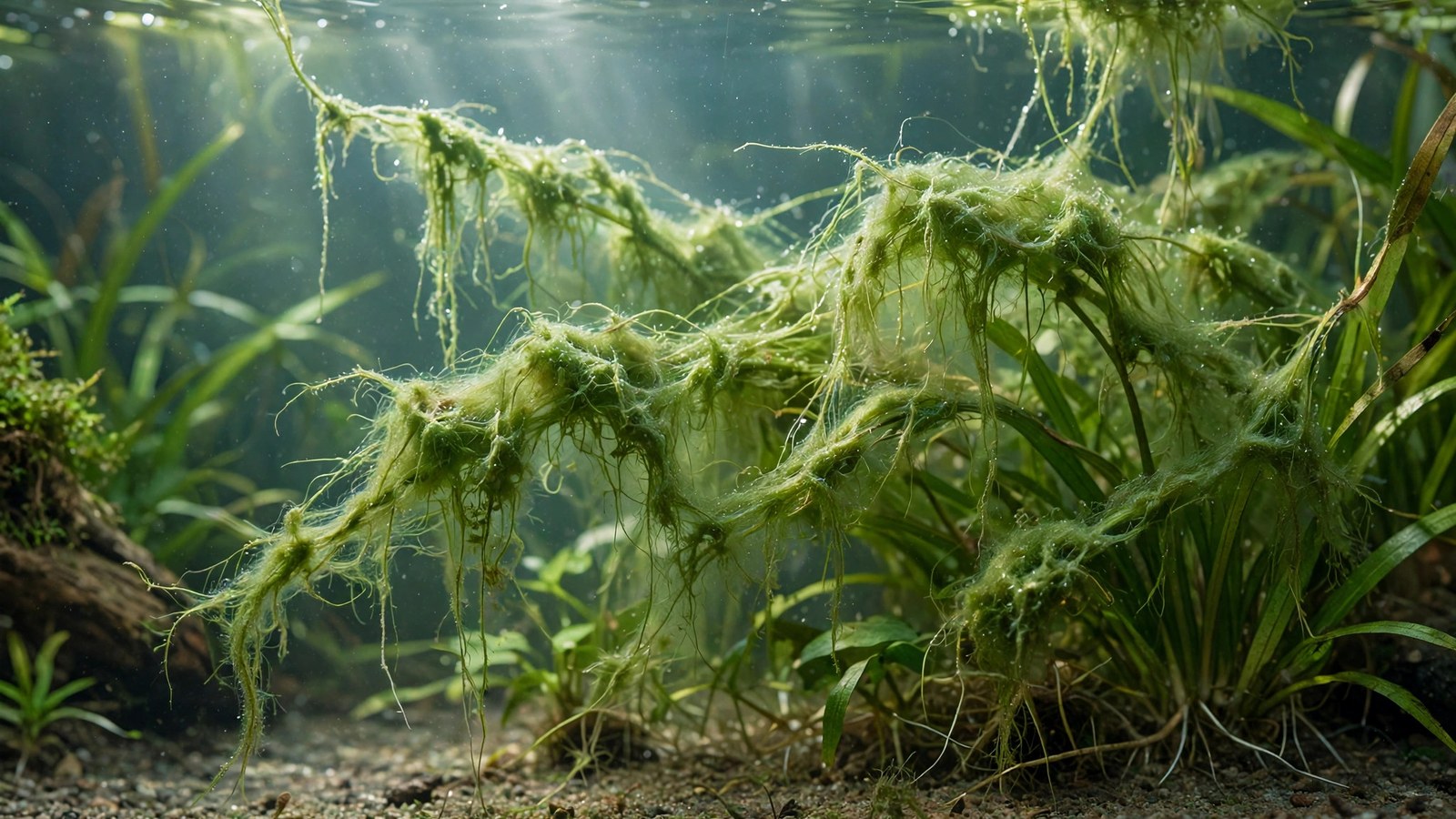
You notice it first on the filter outflow or the tips of your stem plants: wispy green filaments that feel slick and slimy between your fingers, not coarse or springy. That slimy texture is the tell, because rhizoclonium algae is the most misidentified filament algae in the hobby — treated like hair algae or cladophora, it comes back angrier. By the end of this guide you'll be able to identify it with confidence, remove it without shredding your plants, and fix the underlying imbalance so it doesn't return.
How to identify rhizoclonium algae: the texture test
Most identification guides lean on photos, but aquarium algae look alike in pictures. Your fingers are the better instrument — pinch a strand and pull gently:
- Rhizoclonium stretches a little and feels slick, almost mucus-like. The filaments are fine — thinner than thread algae — and branch irregularly, clinging to leaf surfaces, moss, and filter intakes in loose, wispy tufts.
- Thread/hair algae feel dry and hair-like, like pulled cotton, forming longer, straight strands that branch little.
- Cladophora is the tough one: coarse, wiry, almost like steel wool. It holds its shape when lifted and smells distinctly earthy. You cannot twirl it out — it resists.
- Spirogyra is springy and buoyant: lift it and it stretches, then snaps back. It also forms floating clouds in the water column, which rhizoclonium rarely does.
Another field mark: rhizoclonium colonizes slow-growing surfaces first — old anubias leaves, Java fern tips, and the lips of your filter outflow.
File this mental test: slimy + slow growers + dead spots = rhizoclonium.
Rhizoclonium vs. the look-alikes: comparison table
| Trait | Rhizoclonium | Hair / thread algae | Cladophora | Spirogyra |
|---|---|---|---|---|
| Strand thickness | Fine, branching | Fine, mostly unbranched | Coarse, wiry | Medium, elastic |
| Texture in hand | Soft, slippery, slimy | Dry, hair-like | Tough, holds shape | Springy, snaps back |
| Forms floating mats | Rarely | Sometimes | Rarely | Often |
| First colonized | Slow growers, outflows, dead spots | Fast growers, new setups | Hardscape, moss | Anywhere, mid-water |
| Manual removal | Toothbrush twirl works | Toothbrush twirl works | Pull in clumps; twirls poorly | Nets out easily |
| Eaten by Amano shrimp | Young filaments only | Readily | Rarely | Readily |
Print this test mentally: slimy + slow growers + dead spots = rhizoclonium. For the full breakdowns of its two closest look-alikes, compare with our oedogonium identification guide and our spirogyra identification guide.
What causes rhizoclonium outbreaks
Rhizoclonium is an opportunist, not a plague. It appears when plants stop growing fast enough to outcompete it. Four imbalances do most of the damage, and in most tanks two of them are acting together.
1. Low or unstable CO2 relative to light
If you run CO2, check that your drop checker reads lime-green by lights-on (start CO2 60–90 minutes before the photoperiod), and that surface agitation isn't gassing it off before plants use it. Without CO2, keep light moderate: 6–8 hours at medium intensity beats 10 hours of bright light with no carbon.
2. Poor circulation and dead spots
Rhizoclonium's favorite addresses are the tank's still corners. Every planted tank needs visible water movement across all leaf surfaces — every plant should sway slightly. Target 8–10x turnover per hour through the filter, plus a small circulation pump for stagnant corners. After feeding, watch where uneaten food settles: that's where your flow doesn't reach, and that's where this algae starts.
3. Nutrient imbalance, especially lean dosing
Counterintuitively, rhizoclonium thrives more often in under-fertilized tanks than over-fertilized ones. When nitrate bottoms out below 5 ppm or phosphate drops under 0.5 ppm, plants stunt while algae — which need far less — keep growing. Test your water: aim for nitrate 10–20 ppm and phosphate 1–2 ppm in a CO2-injected tank. If you're not dosing at all, start with an all-in-one liquid fertilizer at half the label dose.
4. Too much light for the plant mass
Newly planted tanks with sparse stems under strong lighting are rhizoclonium nurseries — there simply isn't enough plant tissue to absorb the light energy, so algae take the surplus. The fix isn't always dimming the light; sometimes it's planting more densely. Aim for 70–80% substrate coverage in a new setup, and run a 6-hour photoperiod for the first 3–4 weeks, increasing by 30 minutes weekly as growth takes off.
Step-by-step treatment plan
Work through these steps in order — most tanks never need to go past step 3. Each step addresses a deeper layer of the cause, and skipping ahead to chemicals while flow is still poor just resets the countdown to the next outbreak.
Step 1: Manual removal (day 1)
During your weekly water change, twirl a clean toothbrush through the filaments and lift them off. Rhizoclonium comes off easier than cladophora — gentle twirling pulls whole tufts without tearing leaves. For moss and carpet edges, use tweezers and trim the worst-affected portions rather than scraping, which releases spores into the water column. Siphon what you dislodge immediately, and rinse the toothbrush in hot water between patches. Remove 80% of the visible algae in one session — over-scrubbing damages plant tissue the algae will just recolonize.
Step 2: Fix flow and lighting (days 1–3)
Reposition your filter outflow so it sweeps the previously still corners, and remove any hardscape that traps debris. If a corner is unreachable by the outflow, add a small 200–400 L/h circulation pump aimed across it — this single change ends more rhizoclonium outbreaks than any product. Simultaneously, cut your photoperiod to 6–7 hours for two weeks. If you run CO2, raise the bubble rate until the drop checker is lime-green one hour into the photoperiod; watch fish for gasping and dial back 10% if you see any.
Step 3: Add a cleanup crew (days 3–7)
Amano shrimp are your best filament eaters: stock 1 per 5 liters (a 100-liter tank gets ~20). They devour young rhizoclonium enthusiastically but ignore mature, long strands — which is why you remove it manually first and let the shrimp police the regrowth. Nerite snails handle glass and hardscape at 1 per 20 liters. Livestock is reinforcement, not the strategy.
Step 4: Correct the nutrients (weeks 1–2)
Test nitrate and phosphate with a liquid kit. If nitrate is below 5 ppm, dose up gradually to 10–20 ppm; if phosphate reads zero, bring it to 1–2 ppm. Keep iron around 0.1–0.5 ppm but don't dump iron-rich fertilizer to "help the plants" — excess iron with low plant uptake feeds algae more than it feeds plants. Do a 40–50% water change weekly for the first month.
Step 5: Hydrogen peroxide spot treatment (for stubborn patches)
For clumps growing on hardscape or a few resilient plant leaves after two weeks of the above, 3% hydrogen peroxide spot treatment is effective — conservative dosing is the entire point. Turn off the filter and circulation so the water is still. Draw up 3% peroxide in a syringe and apply directly onto the algae at 1 ml per 10 liters of tank water (so 10 ml in a 100-liter tank), never exceeding 2 ml per 10 liters even on large tanks. Wait 15–20 minutes, then restart filtration. The algae will turn white or brownish within 24–48 hours as it dies. Start low, observe your livestock — shrimp and snails are the canaries; if they look stressed, do a 30% water change immediately and don't repeat. Never treat more than once per week, and never treat the whole tank as a bath. Excel-style glutaraldehyde products work similarly but are harsher on sensitive plants like vallisneria and anubias — peroxide is the gentler first choice.
Step 6: Blackout — the last resort
Wrap the tank completely in black trash bags or thick blankets — zero light, not "dim" — for 3 days, keeping CO2 and filtration running. Fish and shrimp can fast safely for 3 days. After uncovering, do a 50% water change, remove the dead algae, and run a 6-hour photoperiod for another week. Blackouts kill the symptom, not the cause: skip steps 2 and 4 and rhizoclonium will be back within a month.
 ★4.4
Mag-Float Large Magnetic Algae Cleaner
Check Price on Amazon ★4.4Recovery timeline: what to expect, day by day
| Timeframe | What you'll see | What you should do |
|---|---|---|
| Days 1–3 | Visible algae reduced after manual removal; a few new wisps appear | Fix flow, shorten photoperiod, start livestock additions |
| Days 4–10 | Regrowth slows; filaments stay short and don't spread to clean leaves | First nutrient test and correction; weekly 40–50% water change |
| Weeks 2–3 | Plants resume active growth; algae limited to old patches that you spot-treat | Apply peroxide only to stubborn clumps if needed |
| Weeks 3–4 | New leaves grow clean; shrimp keep regrowth grazed down | Extend photoperiod by 30 min/week back toward normal |
| Weeks 4–6 | Algae gone or reduced to a few strands on old leaves | Trim old affected leaves; maintain dosing and flow routine |
If nothing changes by week 3, re-diagnose: you may be fighting black beard algae on plants or a cyanobacteria bloom instead. Stubborn rhizoclonium almost always means one of the four causes wasn't actually fixed — most often, the "improved" flow still has a dead corner, or the CO2 drop checker never actually reached lime-green.
Preventing rhizoclonium from coming back
Prevention is just the treatment plan in maintenance mode:
- Keep flow honest. After every rescape or plant trim, check that water still reaches every corner. Filter output drops 10–20% as media clogs, so clean mechanical media monthly.
- Dose consistently. Daily or every-other-day micro-dosing beats one big weekly dump — stable nutrient levels keep plants growing steadily instead of feast-and-famine cycles that favor algae.
- Quarantine new plants. Rhizoclonium hitchhikes on nursery plants. A 2-minute dip in a peroxide bath (20 ml of 3% peroxide per liter of water, plants only, no livestock) before planting kills filaments and most spores.
- Trim aggressively. Remove old, slow leaves before algae colonize them. Leaves already growing green spot algae are photosynthesizing poorly — trim them and let fresh growth take over.
- Feed the tank, not the filter. Overfeeding is the stealth nutrient source in most outbreaks. Feed what fish finish in 90 seconds, once or twice a day, and skip a day weekly.
Frequently Asked Questions
Is rhizoclonium algae harmful to fish or shrimp?
Rhizoclonium isn't toxic to fish, shrimp, or snails — it's an aesthetic and plant-health problem. The real damage is indirect: thick mats block light from leaves, causing plant die-off that feeds more algae. The treatments matter more than the algae: conservative peroxide dosing is safe when you start low, but overdosing can harm invertebrates. Observe livestock for 24 hours after any chemical treatment.
Can I just pull rhizoclonium out and be done with it?
Manual removal alone buys you about a week. Rhizoclonium reproduces from fragments and spores, so any cause you leave in place — low flow, lean nutrients, excess light — restarts the bloom from remnants you can't see. Think of removal as resetting the clock while the treatment plan fixes what set it ticking. Tanks that only get the toothbrush treatment usually see the algae return within 7–10 days.
Why does rhizoclonium keep growing on my anubias but not my stem plants?
Anubias and Java fern grow slowly, so their leaves sit in the water for months — ideal long-term real estate for filament algae. Fast stem plants outgrow colonization by producing fresh, clean tissue every few days. This pattern confirms your diagnosis: rhizoclonium prefers slow growers in still water. Trim the oldest affected leaves, improve flow across your rhizome plants, and move them out of the tank's brightest, stillest zone.
Does a blackout really kill rhizoclonium?
A 72-hour total blackout kills most rhizoclonium — it can't photosynthesize in complete darkness and starves. But blackouts are a reset button, not a fix. Without correcting flow, CO2, or nutrients, spores and fragments survive in the substrate and the outbreak restarts within weeks. Use blackouts only after 3–4 weeks of the root-cause plan, never as the first move.
How is rhizoclonium different from staghorn algae?
Staghorn grows in branching, antler-like clumps that are gray-green and wiry, usually on leaf edges in high-ammonia conditions like a new tank cycle. Rhizoclonium is softer, slimier, brighter green, and spreads in loose tufts across surfaces. They point at different causes: staghorn suggests ammonia spikes and filter immaturity; rhizoclonium suggests flow and CO2 problems in established tanks.
Will reducing light alone get rid of it?
Reducing light slows rhizoclonium but rarely eliminates it — algae need far less light than your plants do. Dimming enough to starve the algae usually starves the plants first, which backfires: stressed plants leak more nutrients and the algae returns. Instead, balance light against carbon and nutrients — raise CO2 and dosing to match your light, or lower light while keeping everything else stable.
You can beat rhizoclonium for good
Rhizoclonium looks intimidating when it coats your slow growers, but it's one of the more honest algae: it tells you exactly what's wrong — flow, CO2, or nutrients — and it responds when you fix it. Do the texture test, twirl it out, fix your circulation, and correct your dosing. For the broader picture of filament algae control, Tropica's algae guide and the 2Hr Aquarist algae-control guide both cover the light-CO2-nutrient balance that prevents outbreaks. Most tanks turn the corner by week three.
Related: our algae identification chart covers the ten most common types.