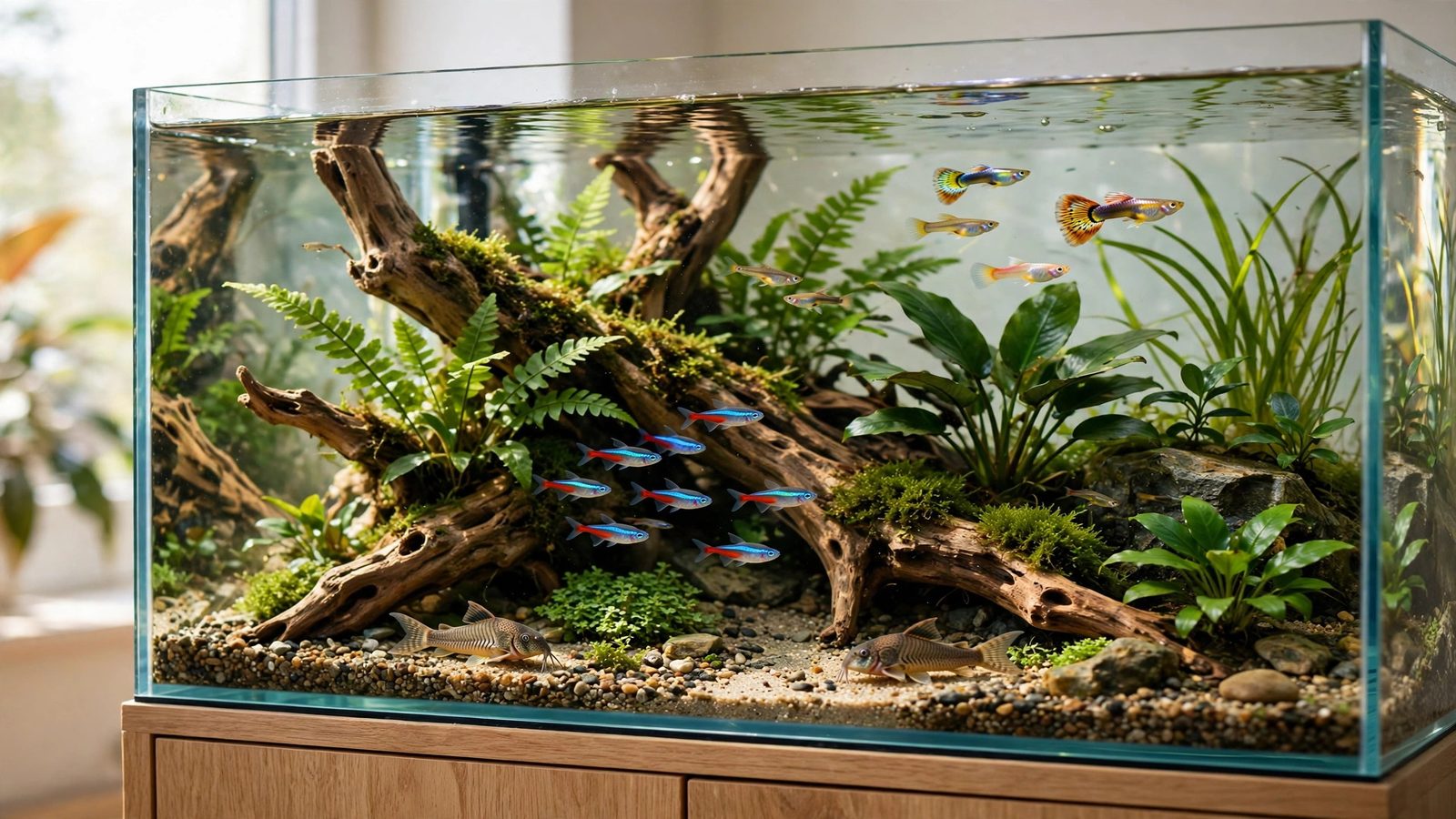
Most beginners kill their first batch of plants within six weeks — and the fish usually get blamed. The truth is simpler: the wrong plant in a beginner's tank never stood a chance. If you have been hunting for the easiest aquarium plants for beginner tanks, these seven species survive tetras, guppies, plain gravel, no CO2 and a cheap LED.
A community tank — peaceful fish like tetras, rasboras and guppies under a stock light — is the most forgiving place a plant can live. For the bigger picture on picking plants around your fish rather than the other way round, start with our fish-first guide to aquarium plants for fish tanks before you buy anything.
The 7 easiest aquarium plants for beginner community tanks
These are the plants experienced keepers recommend for a first tank, because they forgive every beginner mistake: inconsistent light, tap water, plain gravel, the occasional skipped water change. All seven grow slowly enough that you will not fight them weekly, and none needs CO2 or a specialty light.
| Plant | Substrate? | Light | Growth | Best spot |
|---|---|---|---|---|
| Anubias | No — epiphyte | Low | Very slow | Tied to driftwood/rocks |
| Java fern | No — epiphyte | Low–medium | Slow | Tied to hardscape |
| Java moss | No — epiphyte | Low | Slow–medium | Wood, rocks, filter intake |
| Cryptocoryne wendtii | Yes — root feeder | Low–medium | Slow | Foreground/midground |
| Hornwort | No — floater/stem | Low–medium | Very fast | Floating or weighted bunch |
| Water sprite | Optional — floats | Low–medium | Fast | Floating or background |
| Amazon sword | Yes — heavy root feeder | Medium | Medium | Background centerpiece |
1. Anubias
The toughest beginner plant on the market — thick, leathery leaves that shrug off nibbling tetras and algae. The one rule: never bury the rhizome, the thick horizontal stem the leaves grow from. Tie it to driftwood or rock with cotton thread, or dab gel super glue on the roots only. Buried rhizomes rot within days.
2. Java fern
Same playbook as anubias: epiphyte, low light, nearly indestructible. It propagates itself — tiny plantlets sprout on the undersides of old leaves. Once a plantlet has a few leaves and visible roots, pinch it off and attach it to a new spot. It does not care about your substrate at all.
3. Java moss
The community tank's secret weapon: shrimp graze it, fry hide in it, and it carpets anything you smear it onto. Spread a thin layer over driftwood, tie loosely with thread, and ignore it. If it traps debris and browns underneath, rinse it in old tank water and thin it out — it recovers within two weeks.
4. Cryptocoryne wendtii
The best rooted beginner plant because it genuinely likes plain gravel — as long as it gets food from below. Push one root tab (such as Seachem Flourish Tabs) under each plant every 2–3 months. Crypts often "melt" their leaves in the first 1–2 weeks after planting: leave the roots alone and new leaves emerge in 3–4 weeks.
5. Hornwort
The fastest grower here — a beginner's cheat code that drinks nitrates from the water, shades against algae, and gives fry instant cover. Float it, weigh it down as a bunch, or wedge it behind hardscape. Trim the top half every 1–2 weeks; neglected hornwort sheds needles and clogs filters.
6. Water sprite
Float it and it becomes a trailing canopy that fry and labyrinth fish love; plant the stems and it fills the background. Softer and lacier than hornwort, with less shedding. Thin floating mats regularly so light still reaches the plants below.
7. Amazon sword
The classic centerpiece — one big rosette fills a 20-gallon background beautifully. A heavy root feeder: give it 2–3 root tabs under the crown at setup, refreshed every 2–3 months. Snip yellowing outer leaves at the base so the plant keeps pushing new growth from the center.
What makes these beginner-proof
Beginner plants share three traits: they tolerate low light, they grow from tap water without injected CO2, and they survive the fish you already have. Everything else is setup: a stock LED on a timer for 6–8 hours a day (more light mostly grows algae) plus a 30% weekly water change.
The mistake that kills most first attempts is buying for the tank you wish you had. Carpets and red stems need CO2 and strong light; in a beginner tank they melt within two weeks. Buy for the tank you have. Our roundup of the easiest no-CO2 plants expands the shortlist when you want more options.
Planting day: gravel, no substrate, or both
You do not need aquasoil for any plant here. Plain gravel suits every rooted species — these plants grow in plain gravel, and crypts and swords just need their root tabs. Epiphytes skip substrate entirely; see the full list of plants that grow without substrate for bare-bottom or sand tanks.
Plant rooted species with the crown just above the gravel and one root tab per sword or crypt at setup. Tie epiphytes to driftwood and rocks — our guide to epiphyte aquarium plants shows ideal placement for each. On a dim kit LED, stick to the low-light end of the list first — low-light plants for beginners pair perfectly with stock lighting.
Feeding them: the whole routine
Beginner community tanks need almost no fertilizer. Column feeders (anubias, java fern, moss, hornwort, water sprite) live on fish waste plus a weekly half-dose of a gentle liquid fertilizer like Seachem Flourish — a full weekly dose is the classic recipe for an algae farm. Root feeders get food from tabs, refreshed every 2–3 months.
Watch new leaves: pale growth means a touch more liquid; pinholes in old sword leaves means a root tab is overdue. For authoritative species-level parameters, the Tropica plant database is the best free reference online.
Frequently Asked Questions
What is the single easiest aquarium plant of all?
Anubias — specifically Anubias barteri or nana. It tolerates the widest range of light and water, its tough leaves resist nibbling and algae, and it needs neither substrate nor CO2. The only way to kill it is burying the rhizome, which you avoid by tying it to wood or rock.
Do I need special substrate for beginner plants?
No. Every plant here grows in plain gravel or sand. Epiphytes (anubias, java fern, java moss) use no substrate at all, floaters feed from the water column, and rooted species like swords and crypts get nutrients from root tabs pushed into the gravel every 2–3 months.
Will tetras and guppies eat my plants?
Healthy tetras, guppies, rasboras and platies do not eat living plant tissue — they peck algae and biofilm off leaves, which is harmless. Fish only chew plants when starving or when leaves are already dying, so feed properly and trim melting leaves promptly.
Can I keep these plants without CO2?
Yes — all seven are chosen because they thrive without injected CO2. They use dissolved CO2 from surface exchange and fish respiration, which suffices at low-to-medium light. CO2 only becomes necessary for high-light stems, carpets, or red plants, which none of these are.
How many plants should I start with?
For a 20-gallon community tank, start with 5–8 plants or portions: one sword centerpiece, two or three crypts, one anubias, one java fern, and a floating portion of hornwort or water sprite. That gives a planted look from day one and enough fast growers to stabilize water parameters.
Start with those seven, keep the light modest, and let the tank teach you before you level up. In three months — crypts filled in, hornwort due for its trim — you will have a stable, algae-quiet community tank.