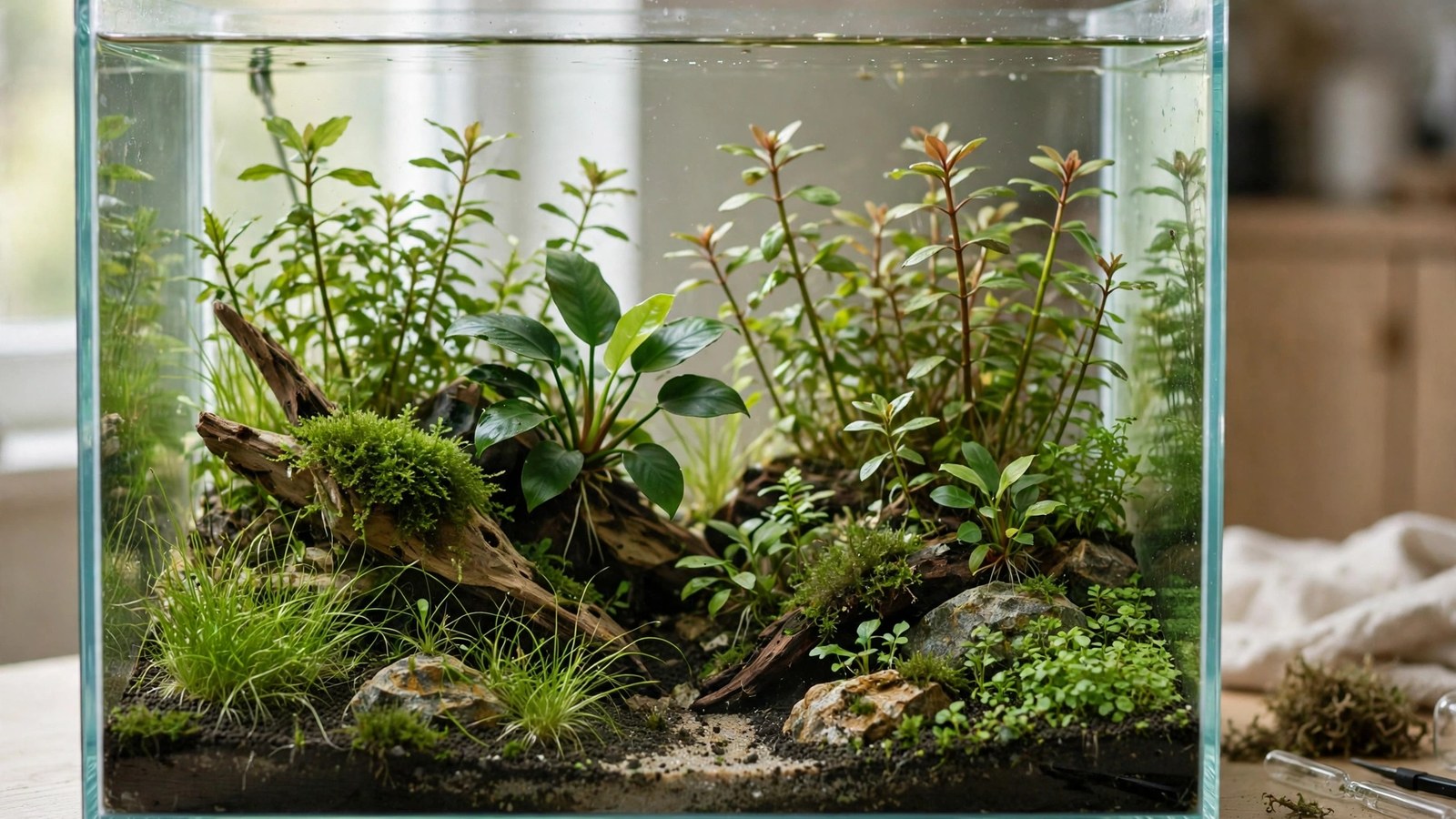
The first month decides whether your new planted tank becomes a thriving little ecosystem or a swampy science experiment. Get the opening four weeks right and everything afterward — algae control, plant growth, healthy fish — gets dramatically easier. Get them wrong and you'll spend the next three months firefighting problems that were entirely preventable. This week-by-week guide for the new planted tank first month tells you exactly what to do, what to expect, and what to leave alone during each of the 30 days that matter most.
Day 0: Planting Day Done Right
Everything in month one traces back to how the tank goes together on day one, so treat planting day as the most important day of your hobby year. Fill the tank only partway — a few inches of water over the substrate — before you plant. Stems and carpets are far easier to position when you can see them, and you'll disturb the soil less. Fill the rest slowly, trickling water over a saucer or plastic bag laid on the substrate so the flow doesn't carve craters into your aquasoil.
Before anything hits the water, read through a first planted tank shopping list and confirm you actually have water conditioner, a test kit that measures ammonia, nitrite, and nitrate, and a timer for your light. Then plan your planting density: new tanks should start at roughly 70–80% planted, not sparse. A densely planted tank outcompetes algae from day one; a sparse one invites it. Tissue-culture cups and potted plants should be split, rinsed, and planted in small clumps rather than dropped in as one big wad.
Weeks 1–2: The Melt Phase
Your crypts are melting. Your stem tops look limp. The rotala you paid good money for is shedding leaves like it's autumn. Congratulations — your tank is behaving normally. Almost all nursery-grown aquarium plants were raised emersed (out of water), and the old leaves were never built for a submerged life. The plant abandons them and grows new, submersed-adapted foliage. This is the melt phase, and it hits hardest in weeks 1–2.
What matters is what's happening at the base. If the crown or stem base is still firm and green, or you can see tiny new submerged leaves emerging, the plant is transitioning, not dying. Trim mushy, translucent leaves with scissors — never yank, or you'll pull up roots that were just establishing — and remove the worst decay from the tank daily if you can. Rotting leaves leach organics that feed the algae you're about to meet.
Lighting during the melt
This is not the moment for maximum light. Start your photoperiod at 6 hours per day at roughly 50–60% of your light's maximum intensity. Use the timer — consistency beats intensity, and an erratic schedule is an algae invitation. If your fixture has no dimmer, you can hang it higher or float a layer of frogbit or water lettuce to shade things while plants adapt. This restrained start is one of the biggest differences between beginners and people who read a beginner planted tank mistakes guide first.
Weeks 2–3: Diatoms, Cycling, and Water Changes
Somewhere around week two, a dusty brown film will spread across your glass, substrate, and slow-growing leaves. Don't panic and don't nuke it: these are diatoms, silicon-eating organisms that colonize virtually every new tank and burn themselves out once the available silicates are consumed, usually by week four. Wipe them off glass with an algae pad during water changes, but don't gravel-vacuum obsessively or dose algaecides — they leave on their own.
Cycling with plants in the tank
A planted tank cycles just like any other aquarium: ammonia from soil and decay → nitrite → nitrate. Plants help by consuming some ammonia and nitrate directly, and a silent-cycle approach lets the plants themselves carry much of the biofilter load. Still, you must verify. Test ammonia and nitrite every 2–3 days through weeks 2–3. Active aquasoil releases a significant ammonia pulse early on — this is normal and feeds your developing bacteria, but it's also why fish can't go in yet. If ammonia climbs above 2 ppm, do a water change that day; high ammonia burns plants and stalls the cycle. A full cycling guide for planted tanks will walk you through the bacterial timeline if you want the deeper science.
The first-month water-change rhythm
Forget "a little water change every couple of weeks." New tanks need aggressive dilution. Follow this schedule:
| Setup type | Weeks 1–2 | Weeks 3–4 |
|---|---|---|
| Active aquasoil | 50% three times per week | 50% twice per week |
| Inert substrate + root tabs | 30% twice per week | 30% once or twice per week |
| Dirted / Walstad-style | 50% twice per week | 40% once per week |
Big early water changes are the single highest-leverage anti-algae action in month one. They export the ammonia and dissolved organics that fuel every early bloom, and they cost nothing but time. Keep this up through the first month and you'll sail through the phase where most tanks turn green.
Week 3: The Lighting Ramp-Up and First Fertilizer
By week three you should see genuine new submerged growth — crypts pushing fresh leaves, stem plants rooting and reaching. That's your signal to start feeding the tank more light. Increase the photoperiod by 30 minutes each week, from 6 hours toward a final target of 7–8 hours by week four or five. If you're injecting CO2, this is also the week to verify your drop checker hits a solid green one hour before lights-on and stays there until lights-off; 1–2 bubbles per second in a 20-gallon tank is a typical starting point.
When to start fertilizing
Beginner intuition says "fertilize from day one," and it's wrong for most setups. Active aquasoil releases a flood of nutrients in the first weeks — adding a full EI-style fertilizer dose on top is asking for green water. The right schedule:
- Weeks 1–2: No liquid fertilizer with active soil. With inert substrate, add potassium and a micro mix at quarter dose twice a week.
- Week 3: Start lean: dose 1/3 of the recommended amount after each water change.
- Week 4: Move to 1/2 dose if new growth looks pale or pinholes appear; ramp to full dose in month two only if plants show hunger.
Potassium is usually the first thing plants need, and a slight deficiency shows as pinholes in older leaves. For dosing math, the Rotala Butterfly nutrient calculator turns any fertilizer bottle into an exact ppm recipe so you're never guessing at milliliters.
Week 4: First Trims and Adding Livestock
If your stem plants are 4–6 inches tall and sending out side shoots, they're ready for their first trim. Topping stem plants forces bushier growth — cut just above a node, remove the leggier bottom portion, and replant the healthy top in the bare spot. Do one section of the tank at a time rather than hacking everything at once; plants trimmed all at once can't absorb the nutrients that are still flowing, and algae notices the surplus. Uprooting and replanting crypts or sword plants is a different matter — leave their roots undisturbed for at least 8 weeks, or you'll trigger a fresh mini-melt.
Stocking order: cleanup crew first, fish last
Fish go in only when ammonia and nitrite have read zero for a solid week — typically week four at the earliest, and often week five or six. The impatient get algae and dead fish; the patient get a stable tank. The safe month-one stocking sequence:
- Week 3–4: Snails (nerites, ramshorns) and a small shrimp colony — 10–20 neocaridina per 20 gallons. They graze diatoms and biofilm relentlessly.
- Week 4–5: Algae-eating fish or otocinclus, once biofilm is visibly established on hardscape.
- Week 5+: Your main fish, added in small groups of 4–6 with a week between groups.
A well-chosen cleanup crew for your planted tank — amano shrimp, nerites, otos — does more anti-algae work in month one than any product. For species specifics, pick algae eaters matched to your tank size, not to your ambitions.
 ★4.6
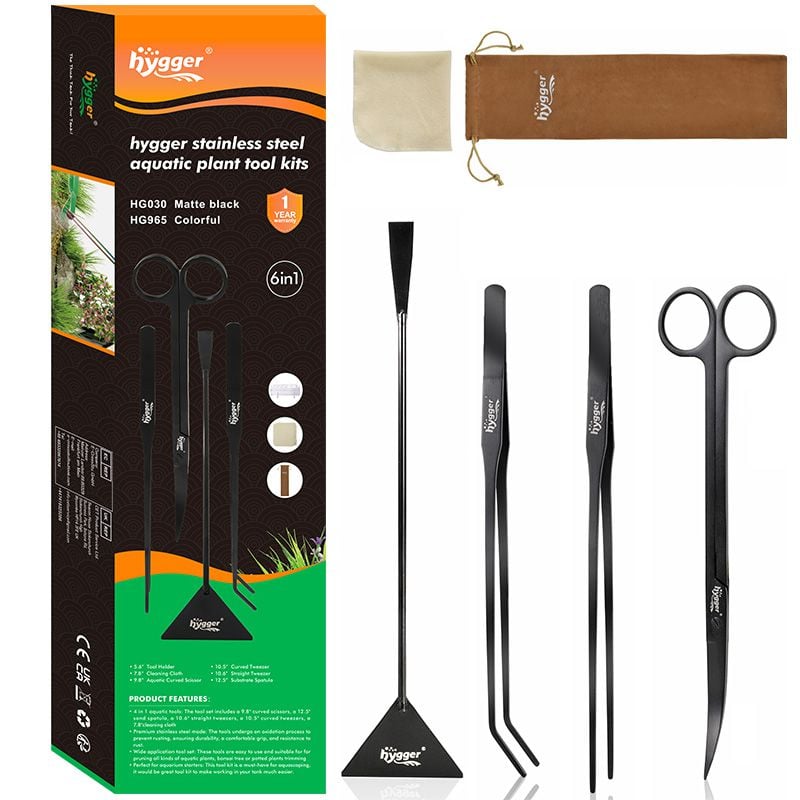
hygger 6-in-1 Long Aquarium Aquascaping Tools Kit
Check Price on Amazon ★4.6Watch Your Water Parameters
One weekly habit saves more tanks than any gadget: test your water. Through month one, keep a log of pH, ammonia, nitrite, nitrate, and KH. Target ranges for most planted tanks: pH 6.4–7.4 (CO2-injected tanks swing daily; that's fine), ammonia and nitrite at 0, nitrate 5–20 ppm, KH 3–6 dKH, GH 4–8 dGH. A full breakdown of planted tank water parameters explains what each number means and how to nudge it. Note that active aquasoil buffers pH down to ~6.0–6.5 for the first months — don't fight it with baking soda or you'll exhaust the soil's buffering capacity for nothing.
Troubleshooting Your New Planted Tank's First Month
Even well-run tanks hit a snag. Diagnose, don't panic:
| Symptom | Likely cause | Fix |
|---|---|---|
| Brown dust coating everything | Diatoms, weeks 2–4 | Wipe glass; nerite snails; leave the substrate alone — it fades by week 4 |
| Thread/hair algae on plants | Too much light, too little plant mass or CO2 | Drop photoperiod back to 6h, add more fast growers, increase surface agitation |
| Green water (pea soup) | Ammonia + excess light | 3-day blackout + 50% water changes; check conditioner dosing |
| Plants melting completely, bases mushy | True plant death, often at the crown | Remove, replace; don't replant the same spot for a week |
| Ammonia stuck above 2 ppm | Soil overload + weak bacteria | Daily 50% changes until under 1 ppm; reduce light to 5h temporarily |
Frequently Asked Questions
How long before a new planted tank is fully established?
The nitrogen cycle completes in 4–6 weeks, but a planted tank isn't truly mature until around month 3, when biofilm is established, algae pressure drops off naturally, and plants have deep root systems. Month one is survival; months two and three are when the tank finds its balance. For ways to move things along safely, see how to cycle a planted tank faster.
Should I run the light 24/7 to help plants grow faster?
Absolutely not. Plants need a dark period — photosynthesis saturates, and respiration plus algae dominate after about 8 hours. Run 6 hours in weeks 1–2, ramping to 7–8 by month two, on a timer you never skip. More light than the plants can use is the most common beginner cause of month-one algae.
Can I add fish during the first week if the water tests fine?
Test strips can read zero ammonia on day three and still leave you with a dead tank. The bacterial colony needs 4–6 weeks to establish, and active soil keeps releasing ammonia for weeks. Add a cleanup crew in week 3–4 and fish only after ammonia and nitrite hold at zero for a full week.
Why are my plants melting even though I bought healthy ones?
Nursery plants are grown emersed, and their air-grown leaves can't function underwater. The plant sheds them and grows submerged leaves — this melt is normal adaptation, not a failure. Trim rot, keep parameters stable, and judge success by new growth at the base, not by how the old leaves look.
When should I do my first water change?
On day 3 or 4, then follow the twice-to-three-times-weekly rhythm for the whole first month. Early water changes export soil ammonia and dissolved organics before algae can use them. This is the highest-impact habit in the entire guide — never skip a scheduled change in month one.
Do I need CO2 for a successful first month?
No — most low-tech setups thrive without it, and it adds variables a beginner doesn't need. CO2 becomes worthwhile when you want carpeting plants or fast growth, but a low-tech tank with good soil, moderate light, and diligent water changes will cruise through month one on atmospheric CO2 alone.
The Month-One Checklist
You've made it through the hardest stretch. Keep the timer consistent, water changes aggressive, and stocking patient, and month two is where the payoff begins: plants carpeting, water crystal clear, diatoms a memory. Set a recurring test day, log your parameters weekly, and resist the urge to rescape — stability is the fertilizer that money can't buy. For what comes next, fold these habits into a steady planted tank maintenance schedule and you'll spend your time enjoying the tank instead of fixing it. If you want to read the deeper science behind any of this, Tropica's guide to starting a planted aquarium is the best free reference in the hobby.