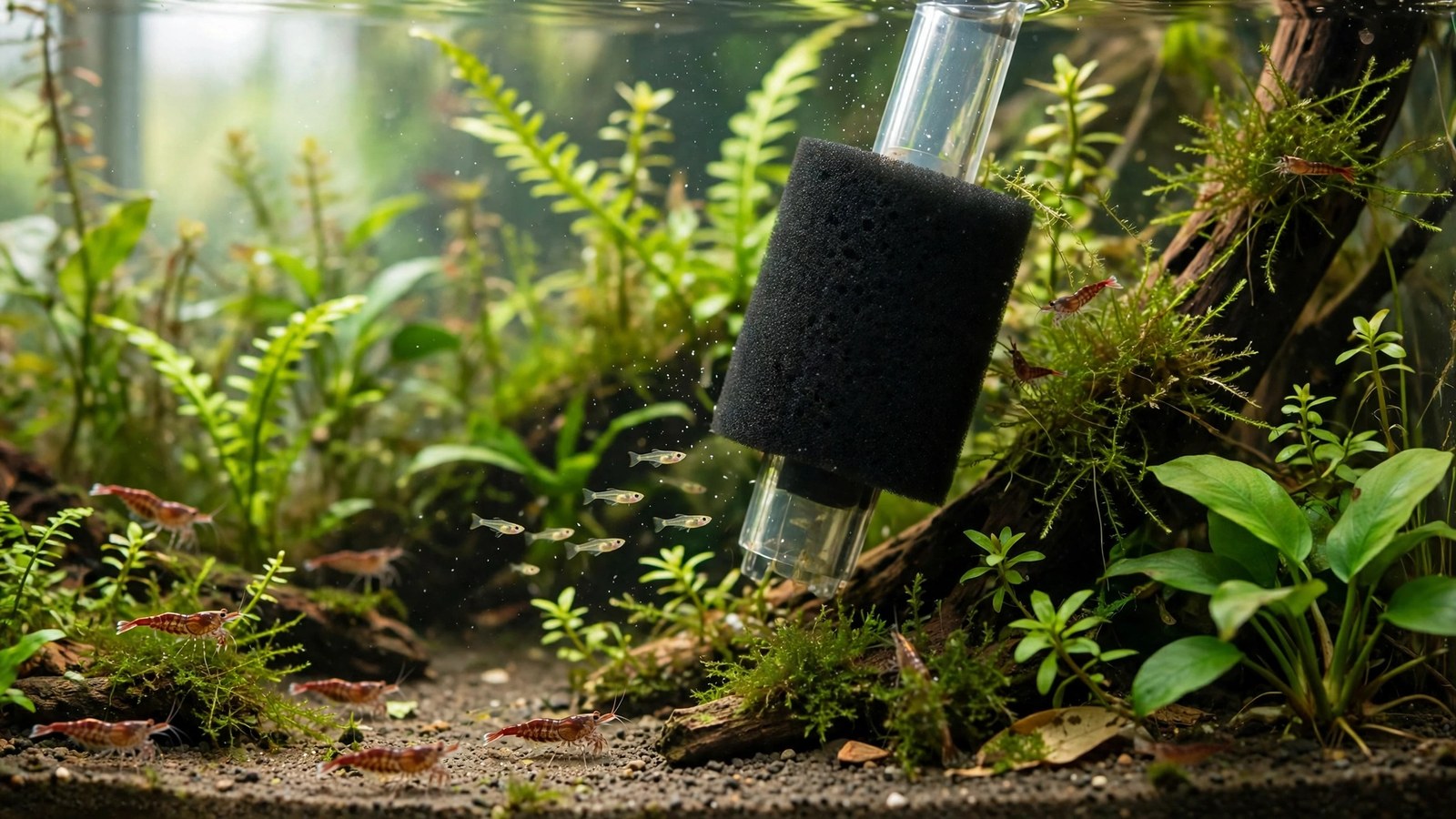
You started with ten cherry shrimp; two weeks later there are six, and your hang-on-back filter is humming louder than usual. The missing shrimp aren't hiding behind the driftwood — they're stuck inside the intake tube. A prefilter sponge, a foam sleeve over your filter intake, stops that from happening again while doing your filter's dirtiest work.
What this foam sleeve actually does
It becomes the first stage of filtration: water passes through the foam before reaching the filter body, so debris gets trapped on the sponge instead of packing into your filter's media — and it sits inside the tank, so you clean it without opening the filter.
It works three ways: a livestock guard (pores too small for shrimplets, fry, or snails), mechanical filtration that catches coarse debris, and biological filtration — constant flow colonizes it with beneficial bacteria, the same principle behind sponge filters in a planted tank, wrapped around an intake you already own.
Bonus: the sponge grows biofilm that shrimp actively graze — in a shrimp-heavy tank it becomes one of the most visited feeding spots.
Do you need one on your filter intake?
- Shrimp keepers — newborn shrimplets fit through standard intake slots, so on a shrimp tank setup it's close to mandatory.
- Breeders — weak-swimming fry get pinned against bare intakes by suction.
- Clog-prone filters — the sleeve intercepts debris first and stretches service intervals.
- Heavy trimmers — floating leaf bits head straight for the intake; the sponge keeps them out of the impeller, where they cause rattling and wear.
Skip it only in a bare high-flow tank with no small livestock. For cherry shrimp and other small residents on the cleanup crew, it's one of the cheapest upgrades in the hobby.
Will it reduce your filter's flow?
A clean one barely does; a clogged one absolutely does. A correctly sized sponge costs only a few percent of flow — far less than debris packed into your filter's media.
Coarse foam (10–15 ppi) barely restricts flow but passes fine particles; fine foam (30+ ppi) polishes water but clogs faster. For most planted tanks, 20–30 ppi is the sweet spot:
| Pore density | Flow impact (clean) | Debris caught | Clogs after |
|---|---|---|---|
| 10–15 ppi (coarse) | Negligible | Large debris, leaves | 4–6 weeks |
| 20–25 ppi (medium) | Minimal (~3–5%) | Most food and waste | 2–3 weeks |
| 30+ ppi (fine) | Noticeable | Very fine particles | 1–2 weeks |
Watch for the warning sign: a hang-on-back unit gets louder, or a canister's output stream weakens. That's the impeller fighting a restricted intake, which shortens the filter's life. Squeeze the sponge in old tank water and flow snaps back in ninety seconds. An automatic top-off system also helps, keeping evaporation from exposing the intake.
How to choose the right prefilter sponge
Measure your intake tube's outer diameter — the only number that matters. The sponge's inner hole should match it or sit a touch smaller so the foam grips snugly; too loose and it slides off:
| Tube outer diameter | Sponge inner hole | Sponge body | Best for |
|---|---|---|---|
| 9–14 mm | ~10 mm (0.4″) | ~36 mm dia × 60 mm tall | Nano HOBs, small internal filters |
| 14–18 mm | ~15 mm (0.6″) | ~40 mm dia × 70 mm tall | Standard hang-on-back filters |
| 18–22 mm | ~20 mm (0.8″) | ~46 mm dia × 80 mm tall | Large HOBs, small canisters |
| 22–32 mm | ~32 mm (1.25″) | ~90 mm dia × 140 mm tall | Canister intakes |
Aquarium Co-Op's pre-filter sponge comes in Mini, Medium, and Large with published dimensions — the Large (1.25″ hole, ~20–25 ppi foam) is the go-to for canister intakes. AQUANEAT multi-packs are the budget generic route: vacuum-packed cylinders in 0.4″–1″ hole sizes, handy for multiple tanks. Fluval's Edge pre-filter sponge (A1387) is model-specific — Fluval's official product page confirms it doubles as fry protection. DIY works too: cut a foam block, hollow a channel, and zip-tie it on.
On color: black foam hides against dark backgrounds; pale foam shows debris sooner — a built-in cleaning reminder.
Sizing guide names intake-hole diameter as the key fit criterion; the AQUANEAT 6-pack covers the common 0.6" intakes: a multi-pack of prefilter sponges like AQUANEAT's 6-pack.
How to install and clean it
Installation takes a minute: rinse it in dechlorinated water, slide it firmly over the tube, restart the filter, and check it sits straight.
Cleaning is where technique matters:
- Slip a large fish bag or pitcher around the sponge while it's still underwater.
- Lift sponge and bag out together — the bag catches debris that shakes loose.
- Squeeze it in the bag's tank water, discard, and repeat until it runs mostly clear.
- Slide it back on; the brief cloudiness settles within an hour or two.
Clean every 1–2 weeks in a stocked tank, every 3–4 in a lightly stocked one. Heavily fed breeding tanks foul sponges fastest — if flow drops early, trust the sponge over the schedule.
Between cleanings it's a grazing station: its biofilm feeds shrimplets continuously — our biofilm guide for shrimp tanks explains why this matters for newborns.
Sleeve or sponge filter: what's the difference?
Same word, different tool: a prefilter sponge is an accessory on an existing filter's intake; a sponge filter is a standalone filter driven by an air pump:
| Prefilter sponge (sleeve) | Sponge filter (standalone) | |
|---|---|---|
| Needs | A filter you already own | An air pump + airline |
| Filtration | Adds mechanical + bio to existing filter | Full mechanical + biological |
| Livestock protection | Excellent — guards the intake | Excellent — no intake at all |
| Flow control | Follows your filter's output | Adjustable via air valve |
| Best use case | Upgrading a HOB/canister on a shrimp tank | Breeding racks, quarantine, low-flow tanks |
They're not mutually exclusive — breeders often run both. Our guides on hang-on-back filters and canister filters cover which base filter fits a planted tank best.
Frequently Asked Questions
What is a prefilter sponge?
A foam cylinder that slides over a filter's intake tube. It traps debris before water enters the filter, keeps shrimp, fry, and snails from being sucked in, and hosts beneficial bacteria for biological filtration. It cleans in minutes without opening the filter.
Do I need one on my filter intake?
If you keep shrimp, fry, or small snails — standard intake slots pull in shrimplets and weak swimmers. It's also worthwhile if your filter's media clogs quickly, since the sponge intercepts debris first. Skip it only in bare high-flow tanks with no small livestock.
Will a prefilter sponge reduce my filter flow?
A clean, correctly sized sponge costs only a few percent of flow. A clogged sponge is what chokes flow, so maintenance is the real variable. Rinse it in old tank water every 1–2 weeks; if the filter gets louder or the output weakens, clean it immediately.
How often should I clean it?
Every 1–2 weeks in a stocked tank, every 3–4 in a lightly stocked one; heavily fed breeding tanks foul fastest. Squeeze it in old tank water — never soap or hot tap water — and slip a bag around it before removal so debris doesn't dump back into the tank.
Prefilter sponge vs sponge filter — what's the difference?
A prefilter sponge is a sleeve over an existing intake; a sponge filter is a standalone filter run by an air pump. The sleeve upgrades a filter you own; the sponge filter is a full filter for breeding racks, quarantine, and low-flow tanks.
Small foam, big difference
Few upgrades cost this little and prevent this much heartache. It stops the silent livestock losses that confuse new shrimp keepers, stretches your filter's service intervals, and feeds shrimplets between meals. Measure your tube, match the hole size — you're ninety seconds from a safer tank.