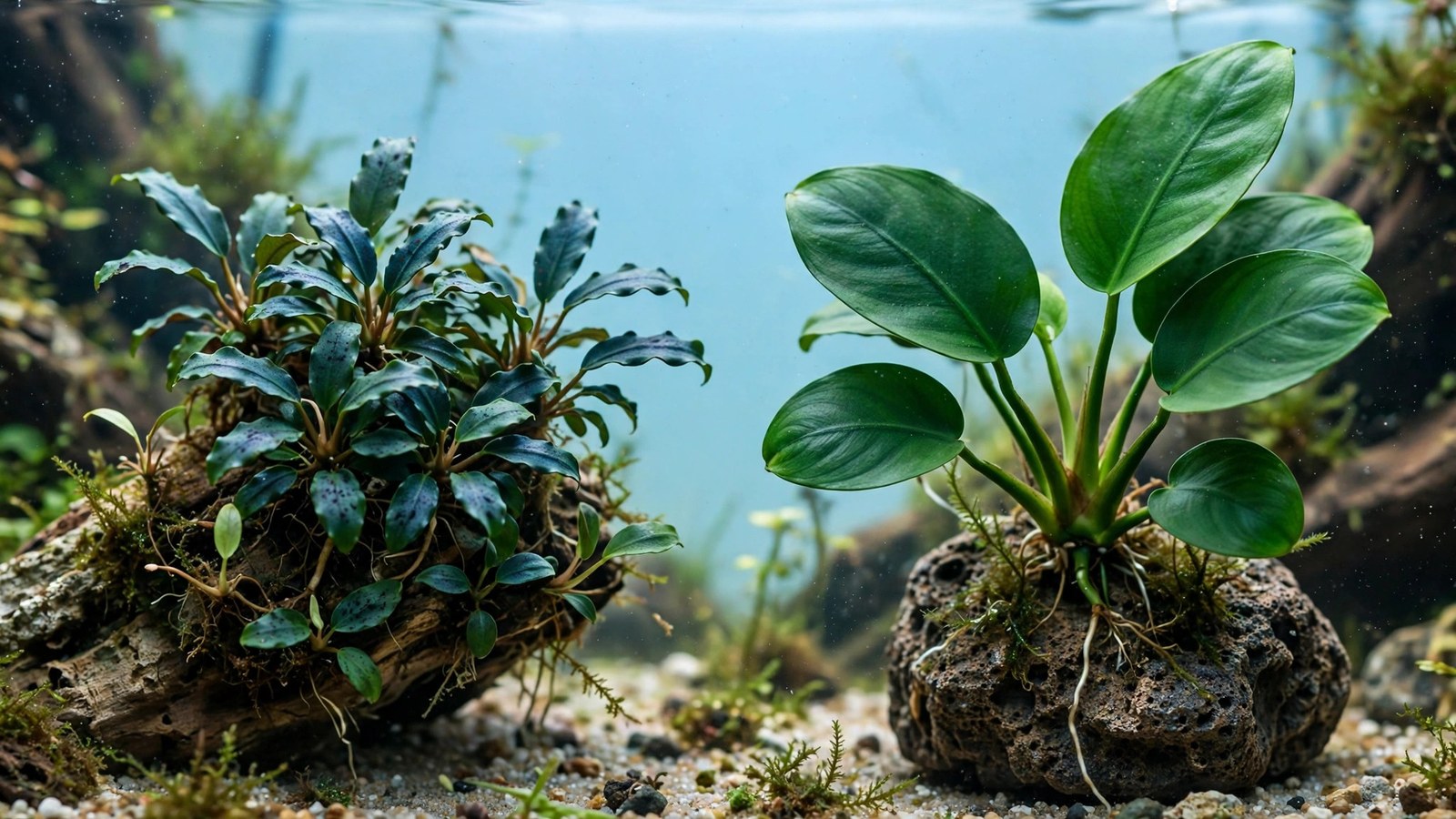
A beginner walks into a fish shop with twenty dollars and walks out with one small pot of Bucephalandra instead of five lush Anubias — and that is where the bucephalandra vs anubias debate costs real money. Both are rhizome epiphytes that die if buried, yet one costs up to ten times more per leaf and grows half as fast. Here is which one deserves your money.
Bucephalandra vs Anubias: The Honest Breakdown
Strip away the marketing and these two genera are closer than their price tags suggest. Anubias comes from shaded West African streams; Bucephalandra grows along Bornean riverbanks. Yet both evolved the same strategy: grip rock or driftwood with a thick horizontal rhizome, feed from the water column, and grow slowly enough that low light is plenty. As our complete Anubias care guide and our Bucephalandra care guide show, the parameters overlap almost completely — with the real differences coming down to speed, price, and variety:
| Trait | Anubias | Bucephalandra |
|---|---|---|
| Price per portion | $6–15 | $15–40+ for a small clump |
| Growth rate | Slow: 1–2 leaves per month | Very slow: under 1 leaf per month |
| Difficulty | Nearly indestructible | Easy once established; melts after disturbance |
| Light | Low–medium (15–35 PAR) | Low–medium (20–40 PAR); colors deepen in stronger light |
| CO2 | Optional | Optional, but improves color |
| Leaf size | 1–6 inches by variety | 0.5–4 inches; many stay tiny |
| Colors | Mostly green, some variegated | Blue, purple, red, metallic |
| Best buyer | Beginners, low-tech tanks | Established tanks, collectors, nano scapes |
What They Actually Share
For both, the rhizome is the whole story: a thick horizontal stem creeping along rock and wood, sending leaves up and roots down. The single deadliest mistake for either is burying it in substrate, where it rots within weeks — glue it, tie it, or wedge it into a crevice, keeping it exposed to the water column. Both feed from the water itself, so liquid fertilizer and a stocked tank matter more than rich substrate. And because both grow so slowly, their leaves sit in the light for months — exactly why green spot algae loves them. Keep light moderate and they hold their shape for months on a weekly water change alone. Healthy plants of both genera can even flower underwater — see how Anubias flowers underwater.
Price: Where the Real Gap Lives
A standard potted Anubias barteri or nana costs $6–10, and one pot usually splits into two or three plantings (see the Anubias nana petite care guide). Collector varieties like Anubias Pinto and Anubias Pangolino run $20–40.
Buce pricing is a different universe. A named variety like Bucephalandra 'Kedagang' sells for $15–30 as a clump of five to eight leaves, and rare imports reach $50 for a coin-sized fragment. Why? Buce grows far slower so farms cannot bulk it up, most varieties came from limited Bornean collection, and a collector market prices named varieties like rare coins. Budget honestly: $30 of Anubias fills a 20-gallon hardscape; $30 of Buce accents one piece of driftwood. Never release aquarium plants into local waterways.
Growth Rate and Tank-Filling Math
A healthy Anubias nana produces roughly one new leaf every two to four weeks under low light without CO2, and a rhizome chunk doubles in six to twelve months. Five $8 pots ($40) give you a respectable 20-gallon hardscape by month six — and splitting rhizomes is free multiplication (see our Anubias propagation guide).
Bucephalandra math is harsher: one new leaf every three to six weeks per growth point, with some varieties pausing a full month after any disturbance. A $20 clump of six leaves might reach ten by month four — it will not fill anything. Treat Buce as jewelry, not landscaping: it accents a branch or rock seam while faster plants do the filling. For a lush tank within three months, put every dollar in Anubias and finish the scape with other easy beginner plants.
Attaching Them to Wood and Rock
Attachment works identically for both. Cyanoacrylate super glue gel — the plain gel sold for aquarium use — is fastest: dab a pea-sized dot on wood or rock and press the rhizome (never the roots) onto it for ten seconds. Cotton thread or fishing line also works and can be removed once roots grip, usually within four to six weeks. Wedging rhizomes into crevices costs nothing and looks most natural.
Two rules apply equally. Keep the rhizome above the substrate line — even a thin layer of sand invites rot, and rot spreads along it like a fuse. And position both where fast-growing stems will not smother them in shade; a shaded rhizome stops growing and invites algae.
Which One Should You Actually Buy?
Buy Anubias if this is your first or second planted tank, your lighting is basic, you run no CO2, or anything in the tank destroys delicate plants; Anubias leaves are thick enough to survive fish that shred everything else. Start with barteri or nana; split one pot into three plantings for under $30.
Buy Bucephalandra when your tank is at least two months old and stable, when you already keep healthy Anubias and want the next step, or when you are scaping a nano tank where tiny, colorful leaves matter more than coverage — see our deep-water Bucephalandra care guide before paying collector prices. It rewards CO2 and good light with blue and purple tones no Anubias can match, but those fade to green under basic conditions.
The middle path most keepers take: fill the tank with Anubias, then add one or two Bucephalandra accent pieces — the bulletproof backbone plus the collector jewelry.
Frequently Asked Questions
Can you plant Bucephalandra and Anubias in substrate?
No — a buried rhizome rots within weeks. Both are epiphytes that must be glued, tied, or wedged onto wood and rock with the rhizome exposed to the water column. Fine roots may touch substrate, but the thick rhizome itself must stay uncovered.
Which grows faster, Bucephalandra or Anubias?
Anubias: one to two new leaves per month per rhizome under low light, and it splits easily for free multiplication. Bucephalandra typically manages one leaf every three to six weeks per growth point and often stalls a month after any disturbance.
Why is Bucephalandra so expensive?
It grows far slower so farms cannot bulk it up, most varieties came from limited Bornean collection, and a collector market prices rare varieties like rare coins. You are paying for scarcity and striking color, not hardiness — a $10 Anubias is the tougher plant in most tanks.
Can I keep Bucephalandra and Anubias in the same tank?
Yes — their needs overlap almost completely: low to medium light, 72–82°F, no CO2 required, attachment to hardscape. Many aquascapers use Anubias as the structural backbone and Bucephalandra as colorful accents on the same driftwood, kept clear of shading stems.
Do Bucephalandra or Anubias need CO2 or special fertilizer?
Neither requires CO2 — both thrive in low-tech tanks on fish waste and a basic liquid fertilizer dosed weekly. CO2 mainly improves Bucephalandra's color intensity and density. Avoid heavy fertilization; excess nutrients feed algae on their long-lived leaves instead of speeding growth.
Which is better for a betta or low-tech beginner tank?
Anubias, without question. It is cheaper, grows faster, tolerates dim lighting and irregular maintenance, and its broad leaves give bettas resting spots near the surface. Save Bucephalandra for your second tank, once your parameters are stable and your maintenance routine is solid.
The Bottom Line
There is no universal winner — only the right plant for your tank today. Anubias is the workhorse: cheap, nearly unkillable, fast enough to fill a scape. Bucephalandra is the collector's reward: stunning colors at a premium, best in a mature tank. Start with Anubias, then treat yourself to the Buce — and browse Tropica's plant database before buying named varieties.