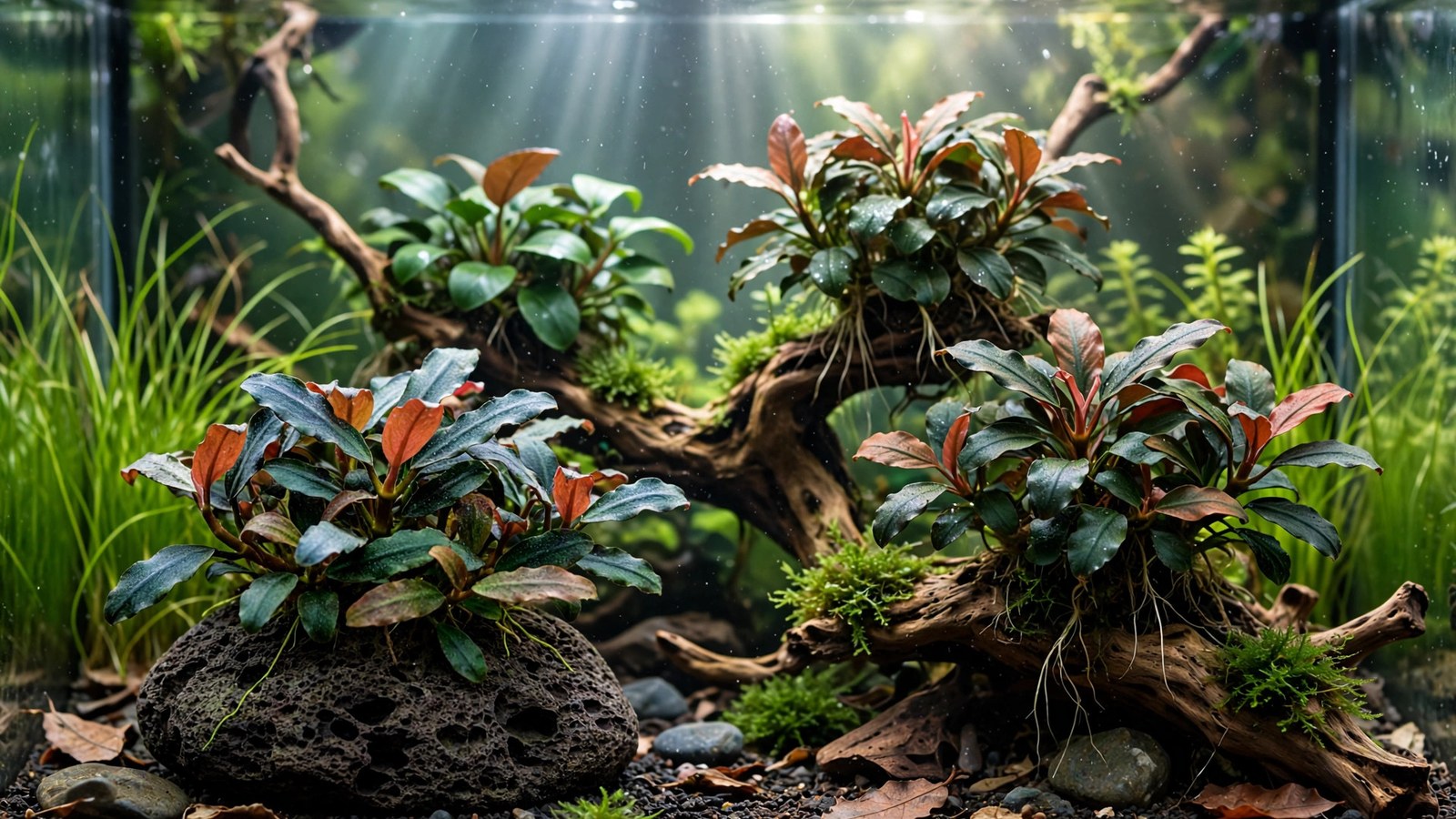
Your Bucephalandra looked flawless in the store cup, then you wedged it into a crevice 65 cm below the waterline of your tall show tank — and watched it stall, shrink, and slowly vanish under a film of green dust. Here is the hard truth: bucephalandra deep water is a different game from the shallow-carpet Buce advice you will find everywhere else. In tanks 60 cm and deeper, light can drop below the plant's compensation point while CO2, flow, and algae dynamics all shift against slow-growing epiphytes. By the end of this guide you will know exactly how much light your Buce receives at depth, how to transition emersed-grown cups without a melt massacre, and which varieties forgive you when you get it wrong.
Why Deep Water Punishes Bucephalandra
Bucephalandra is an obligate rheophyte — it clings to rocks in the splash zones of Bornean streams. That heritage makes it astonishingly adaptable, but also a slow grower: a new leaf every 7–14 days is normal. In a deep tank, that slowness becomes a liability.
Light falls off with depth roughly following an inverse-square relationship, modified by water clarity, glass, and tannins — see this UKAPS discussion of water depth and light penetration. In a typical 60–70 cm tank with a single quality LED bar, the substrate can receive as little as 25–35 µmol of PAR while the surface bakes at 150+. Most general guides — including our Bucephalandra care guide — assume a standard 30–45 cm tank, where 40–60 µmol at the substrate is easy. Double the depth and you halve the margin of error twice over.
Below the light compensation point (roughly 15–20 µmol for most Bucephalandra), the plant burns more energy respiring than it harvests. It does not die dramatically — it just stops. Leaves shrink, new growth stalls, and after 8–12 weeks you lift the plant and find half of it missing. That slow fade is the deep-tank failure pattern, and it is almost always a light problem wearing a different costume. Weaker CO2 and flow at depth, plus detritus settling where flow dies, compound the problem for a plant that cannot outgrow it.
Bucephalandra Deep Water Light: PAR Targets at 60cm and Below
You cannot eyeball this. The difference between thriving and stalling at depth is 20–30 µmol of PAR — invisible to the human eye underwater. Borrow or buy a PAR meter and measure at the exact spots where you intend to plant. For context on why substrate PAR is the only meaningful intensity number, read the 2Hr Aquarist's guide to choosing aquarium light for planted tanks.
| Depth below surface | Typical PAR (single LED bar) | Verdict for Buce | Adjustment |
|---|---|---|---|
| 20–30 cm | 120–180 µmol | Excellent | Shade delicate types |
| 40 cm | 60–100 µmol | Good | Standard placement works |
| 50 cm | 40–70 µmol | Marginal | Elevate on hardscape, add flow |
| 60 cm | 25–45 µmol | Risk zone | Elevate 10–15 cm, run CO2 steadily at a conservative level |
| 70 cm+ | 15–30 µmol | Below compensation | Move up, add light, or skip Buce |
These numbers assume clear water and a mid-tier LED. Tannins, surface film, and floating plants each shave another 10–20% off — a thick mat of floaters over a 65 cm tank can drag substrate PAR below 15 µmol, dark territory where even Anubias sulks.
How to buy back light without a second fixture
Raising the planting position 10 cm toward the light typically gains 8–15 µmol — often the difference between stalling and growing. Build stone pillars or choose a tall driftwood branch as your Buce host; a rhizome at 45 cm in a 65 cm tank transforms the light math versus the substrate. Pale sand bounces 5–10% of PAR back upward (dark aquasoil absorbs it), a monthly glass-lid wipe recovers roughly 8%, and an 8–10 hour photoperiod raises the daily light integral enough to matter.
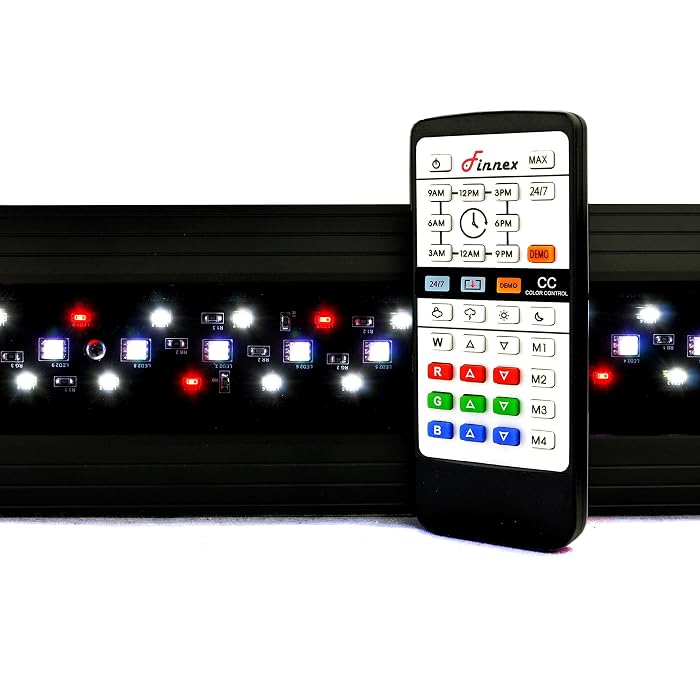
PAR at depth is the section's central number; a high-output full-spectrum light is the fix it recommends: a high-output light like the Finnex Planted+ 24/7 HLC.
 ★4.5
Finnex Planted+ 24/7 HLC LED Light
Check Price on Amazon ★4.5Emersed-Grown Buce: Surviving the Descent
Most Bucephalandra arrives emersed-grown — potted or as a tissue-culture cup — with thick, waxy leaves tuned to air. Plunge them straight to 60 cm and two shocks hit at once: the submersed transition (old leaves melt as water-adapted foliage forms) and the depth shock (new growth must form under a fraction of the light).
Do the transition shallow first. Plant new Buce at 20–35 cm depth for 4–6 weeks. In that window, 30–50% of the emersed leaves will yellow and melt — this is normal, not failure. New submersed leaves emerge smaller, thinner, and often more colorful. Only after you see 3–4 new submersed leaves per rhizome section should you move the plant to its final deep position.
Tissue-culture cups arrive 100% sterile — algae magnets from day one. Rinse the gel thoroughly, split the clump into 3–4 portions, and give TC Buce a 2-week shallow head start before deep placement. Learn the melt-versus-rot distinction: translucent, papery leaves on a firm green rhizome is melt — leave it alone. A soft, mushy, brown-black rhizome is rot: cut 5 mm back into firm tissue, dip the wound in 1:20 hydrogen peroxide for 10 seconds, and reattach. Rot never reverses.
Placement and Attachment at 60cm+
At depth, placement is strategy, not decoration. The rhizome must sit on hardscape — never in substrate, where buried rhizomes rot unnoticed — in the upper two-thirds of the tank, on the sides of wood towers or the faces of rock stacks where flow washes over the leaves.
| Method | Hold time | Deep-tank caveat |
|---|---|---|
| Cotton thread | 6–8 weeks, then dissolves | Can loosen in flow; re-check at week 4 |
| Cyanoacrylate gel | Permanent | Skins over in seconds — work fast |
| Wedge into crevices | Indefinite | Deep crevices trap detritus; brush weekly |
| Stainless pins | Permanent | Remove once rooted to avoid staining |
Rhizome detachment is the deep-tank plague. You inspect less often at depth, and a loosened plant drifts into a shadowed corner where it starves silently. Tug-test at week 2 and week 6 — roots take 6–10 weeks to grip at low light, roughly twice as long as in a bright shallow tank. Design your hardscape so you can reach the attachment points with long tools; deep tanks punish layouts you cannot maintain.
Flow and CO2 at depth
At 60 cm your filter's flow has dissipated, and stagnant boundary layers around each leaf starve the plant of CO2 and nutrients even when the water column tests fine. You want gentle flow visibly rippling every Buce leaf — a circulation pump or angled lily pipe pushing a slow gyre along the deep hardscape. Leaves that flutter lightly are right; leaves pinned flat are too much, since Buce roots hold weakly and strong flow rips new attachments free.
CO2 mist is most effective when it washes directly over deep epiphytes — position your diffuser or reactor outflow so the enriched current sweeps across the Buce zone. Drop checker readings at the surface lie about conditions 60 cm down, so hang a second drop checker at plant level and tune until both read green. As with any CO2 change, start low and observe your livestock: begin around 1 bubble per second, confirm with the deep-placed drop checker, and increase only after a full week of watching for stress. Deep tanks give you less margin for error, so patience here is the safety net. Planting tall background species too? Our giant Vallisneria guide covers a deep-tank strategy that pairs well with Buce on hardscape.
Buce is an epiphyte: it gets attached to wood/rock, never buried — glue is the how-to this section teaches: aquarium-safe glue like Seachem Flourish Glue.
Beating Algae in Low-Light Depths
Slow growers in dim water are algae's favorite real estate. At deep-tank light levels, Buce grows just fast enough to stay alive and far too slowly to shed algae by outgrowing it. Three offenders dominate:
- Green dust algae (GDA) — a green haze on leaves. Wipe gently with a soft toothbrush during water changes; raise water changes to 40% weekly for a month to reset.
- Black beard algae (BBA) — tufts on leaf edges and rhizomes, almost always a CO2/flow problem at depth. Spot-dose liquid carbon directly on tufts with a syringe (lights off, filters paused 10 minutes), then fix the flow so it does not return.
- Green spot algae (GSA) — hard dots on older leaves. Raise phosphate to 1–2 ppm and prune the oldest foliage periodically; Buce keeps leaves for 6–12 months, so shedding the oldest is normal maintenance.
Your best biological defense is a crew that works the deep zone: shrimp keep slow epiphyte leaves spotless — Anubias nana petite growers have relied on this for years — and nerite snails handle GSA. Avoid large nibblers that will rasp the rhizome.
Which Bucephalandra Varieties Tolerate Depth Best
Varieties differ enormously in leaf thickness, growth rate, and light compensation point. A clear hierarchy has emerged for deep tanks:
| Variety | Deep-tank rating | Notes |
|---|---|---|
| Kedagang (red/green) | ★★★★★ | The deep-tank champion; keeps color down to ~35 µmol |
| Brownie Phantom | ★★★★★ | Fast for Buce; recovers from melt aggressively |
| Wavy Green | ★★★★☆ | Forgiving and cheap; ideal first deep Buce |
| Theia (green/red) | ★★★★☆ | Big leaves catch more light; needs secure attachment |
| Catherine | ★★★☆☆ | Good color but slower; needs the full 50+ µmol |
| Mini Coin / small-leaf types | ★★☆☆☆ | Starve below ~45 µmol; save for shallow tanks |
| Ghost / white-variegated | ★☆☆☆☆ | Low chlorophyll — wrong plant for depth |
The pattern is simple: thicker, larger, darker leaves tolerate depth; small-leaf and variegated types do not. Keep delicate varieties in the top 40 cm and fill the deep zone with Kedagang or Brownie Phantom. Bolbitis heudelotii and Christmas moss make excellent deep-zone companions with matching low-light tolerance. Color is your depth gauge: Buce keeping its blue-purple iridescence is lit enough; uniformly dark green, leggy growth wants more light; faded translucent new leaves mean intensity overshot without enough CO2.
Deep-Tank Buce Maintenance Routine
Once a week, brush leaves with a soft toothbrush and siphon detritus from around the rhizomes. Once a month, check every attachment point and prune the 2–3 oldest leaves per plant. Every 8–12 weeks, reassess: is new growth the same size as the last batch, or shrinking? Shrinking new leaves are your earliest warning that light or CO2 has slipped.
Dose a full-spectrum liquid fertilizer at standard strength weekly — lean dosing starves slow growers first at depth. If you keep heavy root feeders like Alternanthera reineckii in the same tank, keep root tabs away from Buce rhizomes; tabs buried near epiphytes fuel algae on the rhizome, not growth. Run 30–40% weekly water changes: deep zones accumulate dissolved organics that no surface skimmer fully clears.
Frequently Asked Questions
Can Bucephalandra survive at the bottom of a 70 cm tank?
Only with help. Substrate-level PAR in a 70 cm tank typically falls to 15–30 µmol, below the compensation point for most varieties. Elevate the plant on hardscape to 50 cm or less, run CO2 with a drop checker at plant level, and choose a tolerant variety like Kedagang. Without those measures, the rhizome will slowly recede over 2–3 months.
How long does it take emersed Buce to adapt to deep water?
Plan on 8–12 weeks total: 4–6 weeks of shallow transition where emersed leaves melt and submersed growth appears, then 3–4 weeks of adjustment after moving to the final deep position. Do not judge success before week 10 — Buce that looks stalled at week 5 is often just finishing leaf replacement. Consistent CO2 and stable parameters shorten the timeline by roughly a third.
Why is my deep-tank Buce melting even though parameters test fine?
Melt with good parameters is almost always emersed-to-submersed transition, not a deficiency — the plant is discarding air-grown leaves. True deficiency melt usually shows as pinholes (potassium) or pale new growth (iron/CO2). If the rhizome is firm and green while leaves go translucent, leave it alone; submersed leaves typically appear within 2–3 weeks of transition starting.
Should I run CO2 for Bucephalandra in a deep tank?
Yes — at depth, CO2 matters more than in shallow tanks. Dissolved CO2 is leaner near the substrate, and Buce's slow growth means it cannot store much of a surplus. A steady level around 25–30 ppm at plant level (verified with a deep-placed drop checker) roughly doubles effective growth versus non-CO2 deep tanks — but work up to it gradually: start around 1 bubble per second, observe your livestock for a week, and only then nudge upward if plants show deficiency and livestock show zero stress.
What is the minimum light for Bucephalandra at 60 cm?
Aim for 50–80 µmol of PAR measured at the rhizome. Most varieties stall below ~35 µmol and stop entirely near 15–20 µmol (the compensation point). Tolerant varieties like Brownie Phantom can hold at 35–40 µmol, but treat that as a survival floor, not a target. Measure with a PAR meter rather than guessing from the fixture's wattage rating.
Your Deep-Tank Buce Can Thrive — If You Respect the Math
Growing Bucephalandra in deep water is not harder than growing it shallow — it is just less forgiving of guesswork. Measure your PAR, transition emersed plants in the top half of the tank, anchor the rhizome on hardscape where light and flow reach it, and pick varieties suited to the deep zone. Do those four things and a 65 cm tank becomes a Buce showcase: iridescent leaves catching downwelling light exactly the way this plant evolved to do in Bornean streams. The depth is not the enemy. Unmeasured depth is.