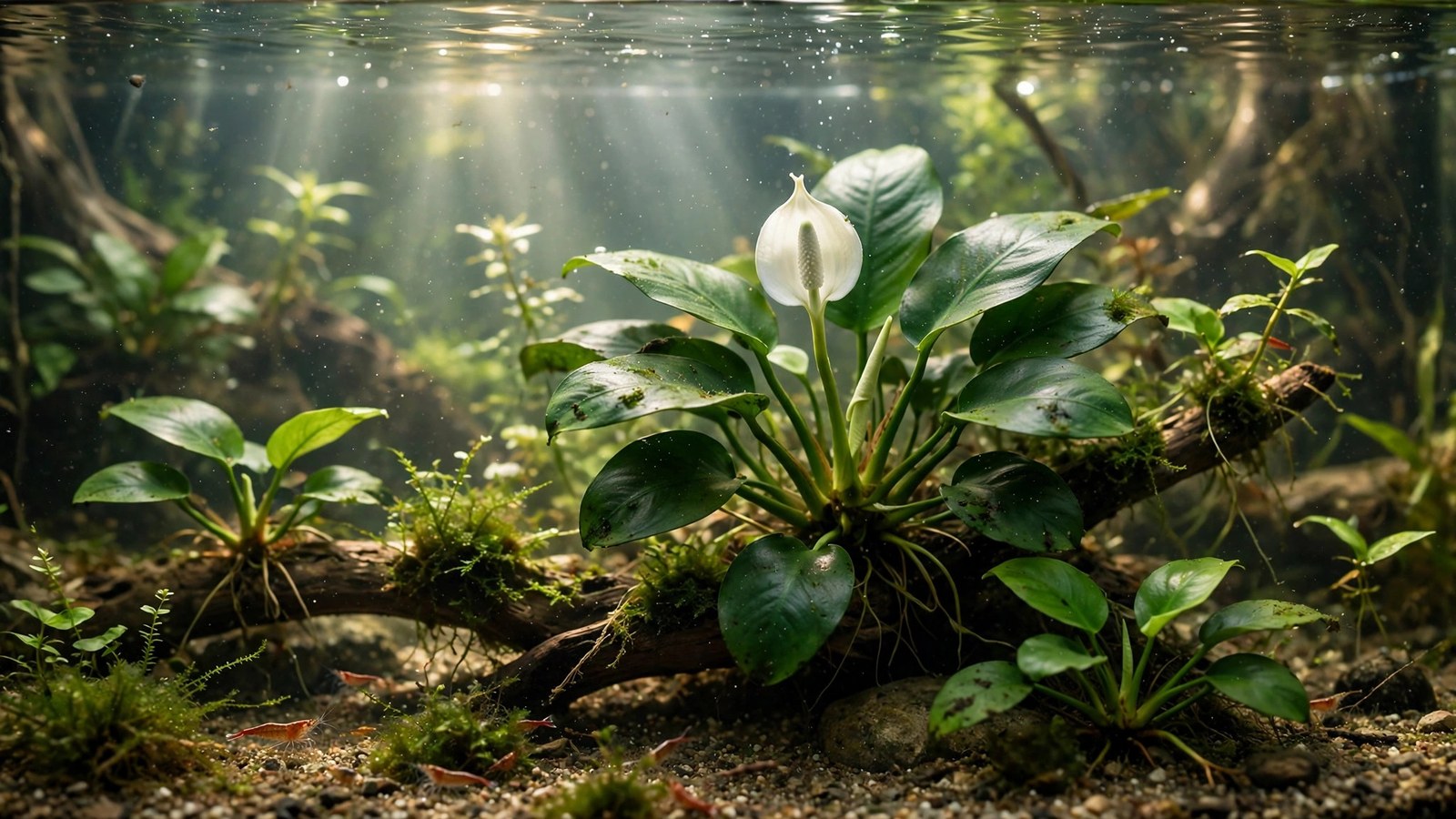
You glance at your tank and freeze: a pale, waxy spike is pushing up from the center of your anubias, ending in a little white curl. It looks like nothing else in the tank — and nothing like a leaf. Here's the good news: anubias flowering underwater is one of the best compliments your aquarium can pay you. That flower means your plant is mature, settled, and thriving enough to spend energy on reproduction.
Most beginners panic at first sight, so let's clear this up fast: the flower is harmless, it won't kill your plant, and you don't have to "fix" anything. This guide covers why it happens, what the flower does over its ~1–2 week underwater life, and the exact method if you decide to remove it. For the full rundown on rhizome placement, light, and water parameters, see our anubias care guide.
Why your anubias is blooming underwater
Anubias is an aroid — in the same family as peace lilies and pothos — and like its relatives it reproduces through a flower made of a central spike (the spadix) wrapped in a modified leaf (the spathe). See the Anubias genus overview on Wikipedia for the botany. Underwater, the spathe usually stays pale green or creamy white, opening slowly over days at the end of a stiff stalk rising from the rhizome.
Two things typically trigger it. First, maturity: once the rhizome is established and the plant has grown undisturbed for months, it has energy to spare. Second, stability: consistent parameters, moderate light, and a plant left alone. Often there's a third factor — the bud formed while the plant was grown emersed at the nursery, and your tank is simply where it finishes opening.
Anubias flowering underwater: what the bloom actually does
Expect the flower to develop over several days: the stalk lengthens, the spathe loosens and unfurls, and the spadix inside becomes visible. Underwater pollination is rare to nonexistent, so the flower won't set seed in a typical aquarium. After roughly 1–2 weeks, the spathe starts to soften and brown from the tip down — that's the flower's natural end, not disease.
While it's open, nothing bad happens. It doesn't leach toxins, spike ammonia, or drain the plant the way some aquarists fear. The leaves keep photosynthesizing on their normal schedule — the flower is a side project, not a swan song. Tropica, the Danish aquatic-plant nursery, notes that anubias thrives even in low light and poor conditions; their plant database is a solid reference for how undemanding this genus is.
The underwater flower timeline: day by day
Knowing what to expect makes the whole event stress-free. Here's the typical arc:
| Stage | Timing | What you'll see |
|---|---|---|
| Stalk emergence | Day 1–3 | A firm green spike pushes up from the rhizome, often 1–3 inches tall. |
| Spathe unfurls | Day 3–6 | The pale spathe loosens and curls open, revealing the spadix inside. |
| Full bloom | Day 6–10 | Flower fully open; stays firm and creamy-white for several days. |
| Fading | Day 10–14 | Spathe softens and browns from the tip; stalk may slump. |
| Decay or removal | Day 14+ | Tissue breaks down — grazed by shrimp/snails, or removed by you. |
Should you leave it or snip it?
Your call entirely. Leaving the bloom is the easy default — it's a rare sight in a freshwater tank, and the cleanup crew handles the end. Snip it if the browning spathe offends your eye, or if it's wedged against the glass where shrimp can't reach it.
If you snip, time it right. Wait until the spathe has clearly faded — cutting a fresh flower just wastes the show. Use sharp, clean scissors (rinsed first, no soap residue) and cut the stalk as close to the rhizome as possible without nicking it. Never yank or twist: the stalk is fibrous, and tearing it can open the rhizome to rot. Snip underwater, lift the piece out, and you're done — no treatment needed.
One thing worth knowing: removing the flower won't trigger more blooms, and leaving it won't exhaust the plant. The decision is purely aesthetic. Flowering can repeat every few months on a healthy plant, so treat a blooming anubias as a fixture, not a fluke. For more on dividing mature rhizomes, see our anubias propagation guide.
What an underwater flower is NOT telling you
Because the event is rare, myths attach to it. A flower does not mean your anubias is about to die, and it doesn't mean your water is wrong — anubias blooms in plain dechlorinated water with no CO2 just as happily as in high-tech tanks. It isn't a nutrient-deficiency signal either.
The one caveat: if the "flower" you're seeing is mushy, brown from the start, and the surrounding leaves are melting, you're looking at anubias rhizome rot, not a bloom. A true flower is firm, rises on a distinct stalk, and unfurls a recognizable spathe. Plants that arrived recently from the nursery sometimes flower from emersed-grown nursery stock, so a bloom on a new plant is normal too, not a stress signal.
How to encourage more blooms
You can't force an anubias to flower, but you can set the stage. Keep the rhizome exposed — never buried, since a smothered rhizome rots (see the attachment methods in our anubias care guide). Give low-to-moderate light, and above all leave the plant alone: stable placement and months of undisturbed growth are what coax out flowers. Dwarf varieties like anubias nana petite and anubias pangolino bloom the same way, just on a smaller scale.
For a broader look at how anubias fits into a community tank, including tankmates that won't harass a blooming plant, see anubias safe for betta fish.
Frequently Asked Questions
Will my anubias die after it flowers?
No. Flowering is a sign of a mature, healthy plant with energy to spare — the opposite of dying. The plant keeps growing leaves on its normal schedule while the bloom runs its course, and flowering can repeat every few months. A flower is never a death signal in anubias.
How long does an anubias flower last underwater?
About 1–2 weeks from the spathe unfurling to noticeable browning. The stalk emerges over a few days, the flower stays open and firm for roughly a week, then softens from the tip down. Shrimp and snails will graze the decaying tissue, which speeds up the cleanup naturally.
Should I cut the flower off my anubias?
Only if you want to — it's purely cosmetic. Snip the stalk as close to the rhizome as possible with clean, sharp scissors once the spathe has faded, and never yank it by hand. The plant is unaffected either way, and leaving the bloom harms nothing.
Why is my anubias flowering right after I bought it?
The bud likely formed while the plant was grown emersed at the nursery and is simply finishing its opening in your tank. This is completely normal and not a stress response. Enjoy it — then give the plant months of stable, undisturbed growth, and it may bloom again.
Can anubias flowers pollinate and make seeds underwater?
Practically never in a home aquarium. Submerged pollination requires specific conditions anubias doesn't get in a tank, so the flower runs its course and decays without setting seed. Anubias propagation is done by rhizome division, not from flowers.
Is the flower toxic to fish or shrimp?
No. The spathe and spadix release nothing harmful into the water, and shrimp and snails actively graze the fading tissue with no ill effects. There's no need to remove a bloom for the sake of tank inhabitants.
So the next time a waxy little flower rises from your anubias, take it as a win: your plant has been sitting pretty, growing slow and steady, and decided the tank was good enough to celebrate. Watch it, photograph it, let the shrimp have their turn — then get back to the quiet business of leaving your anubias alone.