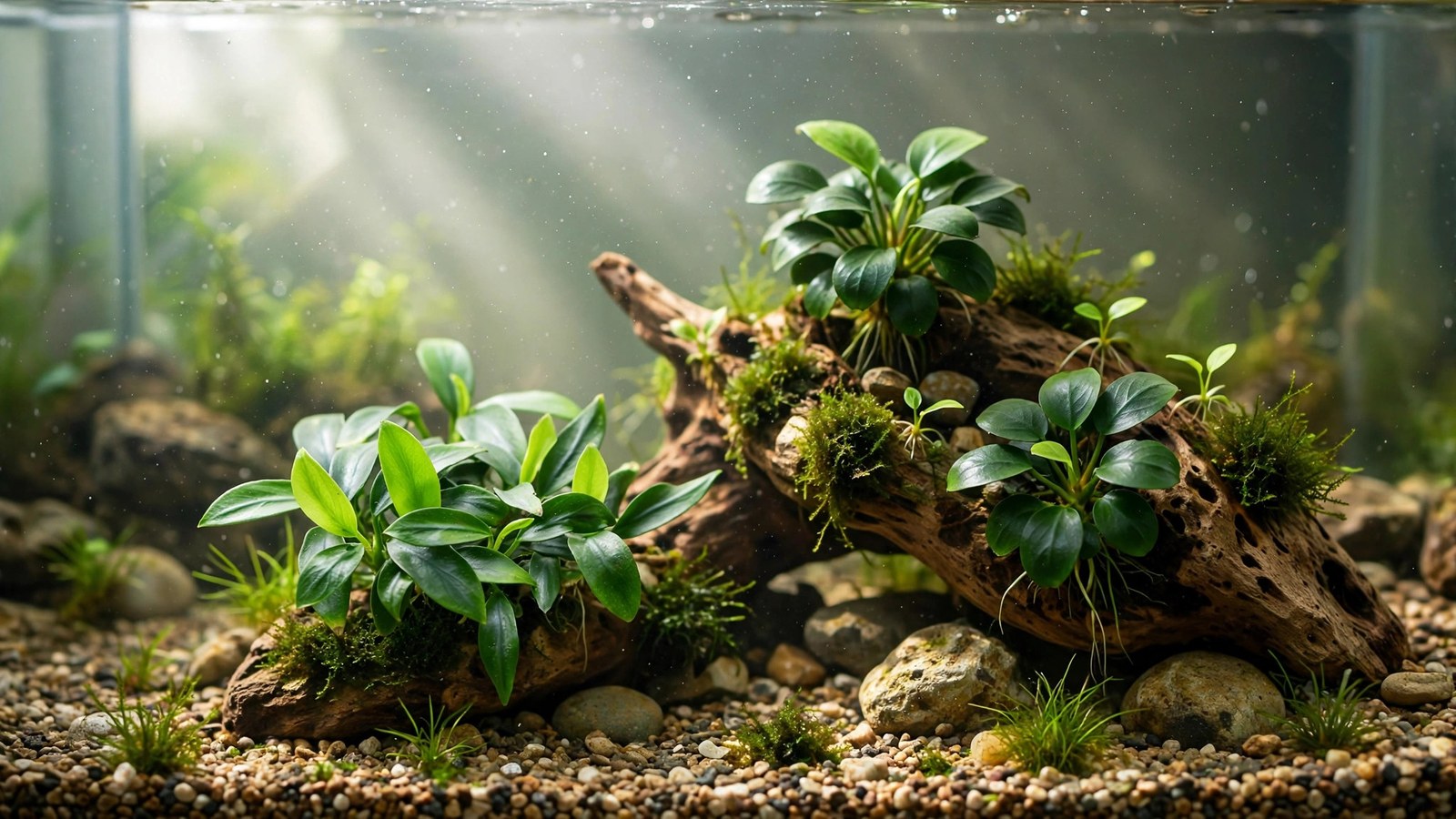
Most "nano" Anubias still push 5–8 cm tall. Anubias pangolino care starts from a different premise: this is a plant whose leaves max out at 2 cm and whose full-grown height is barely 3 cm — a true miniature that keeps its scale even in a 20-litre desktop tank. The catch is its pace: Dennerle rates it "extremely slow," and a single rhizome can take a year to look like the label photo. This guide covers exactly how to plant it, what numbers to target, and how to keep those tiny leaves algae-free.
What Makes Pangolino Different From Other Anubias
Anubias pangolino is Anubias barteri var. nana 'Pangolino', a cultivated variety Dennerle discovered as an accidental mutation inside its stocks of Anubias nana 'Bonsai' and stabilized through tissue-culture selection. An Italian hobbyist named it after the pangolin — the scaly anteater — because the compact, overlapping leaflets look like tiny scales.
Its claim to fame is simple: it's the smallest Anubias in the world. The narrow spear-shaped leaflets max out at about 2 cm, sit on stems shorter than 1 cm, and the whole plant tops out at 2–3 cm tall — genuinely smaller than Anubias nana 'Petite' (sometimes sold as 'Bonsai'), which reaches 4–8 cm. Shops mix the two labels, so check our Anubias Nana Petite care profile before you buy.
| Variety | Max leaf length | Max height | Growth rate |
|---|---|---|---|
| 'Pangolino' | ~2 cm | 2–3 cm | Extremely slow |
| 'Petite' / 'Bonsai' | 1.5–2 cm | 4–8 cm | Very slow |
| var. nana (standard) | 5–8 cm | 8–12 cm | Slow |
| var. barteri (tall) | 15–20 cm | 25–40 cm | Slow |
Because it stays this small, Pangolino fills a niche no other Anubias can: a true foreground epiphyte that can live its entire life in a lava-rock crevice and still be 3 cm tall in five years. The trade-off is patience — a 5-leaf starter portion takes 12–18 months to double, which is why established specimens command collector prices.
Anubias Pangolino Care: Tank Parameters That Matter
Treat Pangolino like any other Anubias for water chemistry — it's remarkably forgiving. It survives 10–30 °C but grows best at 22–28 °C, handles pH 5.0–9.0, and tolerates anything from very soft to very hard water. Where you need to be deliberate is light: this plant was selected for shade.
| Parameter | Target range | Notes |
|---|---|---|
| Temperature | 22–28 °C (72–82 °F) | Survives 10–30 °C; below 20 °C growth nearly stops |
| pH | 6.0–7.5 ideal | Tolerates 5.0–9.0 |
| Hardness (GH) | 3–12 dGH | Also survives harder water |
| Light (PAR at leaves) | 20–40 µmol/m²/s | Low–medium; avoid direct high-power LED blast |
| Photoperiod | 6–8 hours | Shorter is better in new setups |
| CO2 | 0–20 mg/L | Optional; no benefit above ~20 mg/L |
Light is where most Pangolino failures happen. Leaves that persist for months are a sitting target for algae, and 80+ PAR coats them in green spot algae within weeks. Aim for 20–40 PAR — roughly a dimmable LED at 40–60% in a 30-cm-deep tank — and shade it under floating plants if your fixture is stronger. For more on low-tech Anubias care, see our beginner Anubias care guide.
How to Plant It: The Rhizome Rule
Pangolino is an epiphyte, not a substrate plant. All its leaves and roots grow from a thick horizontal rhizome, and burying that rhizome is the single most common way people kill it — a buried rhizome rots and takes the whole plant down in 2–4 weeks. Three reliable ways to attach it:
- Tie it with cotton thread or fishing line. Wrap the rhizome snugly against driftwood or lava rock. Cotton thread rots away in 4–8 weeks, by which point the roots have gripped.
- Superglue gel (cyanoacrylate). A pea-sized blob on the dry rhizome or rock, press for 20 seconds. Fish-safe once cured, and ideal for awkward crevices.
- Wedge it into a crevice. Press the rhizome into a natural rock crack and let the roots anchor it over 3–4 weeks. Don't force it — if it flexes hard, use glue.
The roots can touch the substrate or float free; only the rhizome must stay exposed to the water column. After a month, look for new white root tips reaching toward the hardscape. Mushy, brown-black rhizome means rot (covered below). The technique matches moss attachment — our Phoenix moss care guide walks through the same methods.
Growth Rate: Set Your Expectations Honestly
Pangolino is one of the slowest-growing aquarium plants you can buy. Realistic numbers: 1–3 new leaves per month, with the rhizome extending roughly 1 cm every 2–3 months. A 5-leaf starter portion takes 12–18 months to double — even in optimized nursery conditions, Dennerle says "several months for multiple new leaves to form."
This slowness is a feature: a plant that barely grows never needs trimming, never shades its neighbors, and holds a nano scape's proportions for years. But problems also take forever to reveal themselves, so buy the largest portion you can afford — the gap between a 5-leaf and a 10-leaf plant (typically $15–30 per portion in 2026) buys you a year of waiting.
CO2 and Fertilizer: Less Is More
Pangolino needs very little. Its roots pull nutrients straight from the water column, so root tabs are pointless. Dose an all-in-one fertilizer at quarter to half strength once a week (roughly 1–2 ml per 20 litres); in a low-tech tank with a moderate fish load, fish waste alone often covers it.
CO2 follows the same logic. Pangolino grows fine without it, and adding it only moves the needle from painfully slow to merely slow. If you run a high-tech tank, keep CO2 at 10–20 mg/L (lime-green drop checker) — higher levels won't speed Pangolino up, they just raise livestock risk. The one case where CO2 genuinely helps: tissue-culture plants transitioning to submerged growth, where extra carbon shortens the 3–6 week adjustment melt.
Watch leaves for deficiency signals instead of dosing on autopilot. Pale new leaves mean iron or nitrogen shortage — bump dosing by half for two weeks. Brown pin-holes in older leaves point to potassium. Each leaf lasts months, so give any change 3–4 weeks before judging it. Our Java fern care guide explains water-column feeding and lean dosing in more depth.
Propagation: Dividing the Rhizome
Propagation is straightforward but slow, and it always starts with a sharp, sterile blade. Wait until the rhizome is at least 5–6 cm long with 8+ healthy leaves, then cut between leaf nodes so each section keeps 3–5 leaves and a few roots. Sections with fewer than 3 leaves often stall and rot instead of growing.
- Remove the plant, rinse it, and sterilize a razor blade with rubbing alcohol.
- Cut the rhizome cleanly between leaf clusters — one confident cut, no sawing.
- Attach each section to its own piece of hardscape.
- Expect 4–8 weeks of near-inactivity before new leaf buds appear at the cut ends.
Don't propagate more often than once every 6–12 months — each division costs stored energy the plant rebuilds slowly. Rhizome division works the same for other rhizome plants; our African water fern (Bolbitis) care guide covers the identical method.
Common Problems and How to Fix Them
Pangolino rarely dies from water chemistry. Nearly every failure traces back to one of four causes:
Rhizome rot. The rhizome turns brown-black and mushy; leaves detach with a tug. Cause: buried, wedged too tightly, or damaged. Fix: cut away all soft tissue with a sterile blade until you reach firm, green rhizome, then reattach. A 2-cm firm fragment with 2 leaves can still recover in 2–3 months.
Algae on the leaves. Green spot algae dots or brown diatom film. Cause: too much light or too long a photoperiod. Fix: cut intensity 20–30% or trim the photoperiod to 6 hours, add 5–10 Amano shrimp or 2–3 nerite snails per 40 litres, and rub leaves gently during water changes. Skip bleach dips — the slow regrowth isn't worth it.
Transition melt. Tissue-culture or emersed-grown plants shed 30–70% of leaves in the first 3–6 weeks as air-grown leaves are replaced by submerged ones. Don't panic and don't move it — disturbing the rhizome restarts the clock. If the rhizome stays firm and green, new leaves emerge within 6–8 weeks.
Anubias disease (fast rhizome melt). A spreading rot that liquefies the rhizome in days and can jump between Anubias plants — distinct from slow localized rot because of its speed. Quarantine new Anubias for 2 weeks; if a plant collapses suddenly, remove it immediately and disinfect tools. Lab-grown tissue culture is disease-free, one more reason to buy it.
Aquascaping With Pangolino
Pangolino's miniature scale opens placement options no other Anubias allows. In nano tanks (20–60 litres), it works as a true foreground plant on the substrate-side of a rock — something no Anubias could do before. Glue 3–5 small portions into the cracks of a lava-stone layout and they read as living detail from two metres away.
The classic collector trick is the bonsai-tree effect: attach Pangolino to the fine twig ends of spider wood so the tiny leaves read as a miniature canopy. Because the plant adds only a few leaves a year, the tree keeps its proportions without the constant trimming moss versions demand.
In larger tanks, use it as a detail accent — a pea-sized clump on a stone's edge draws the eye because everything around it is bigger. It pairs beautifully with darker, broader-leaved collector epiphytes (see the contrast ideas in our Bucephalandra care guide), and Hygrophila pinnatifida fills midground space Pangolino never will.
If you're adding Pangolino to a community tank, zone it so faster plants don't shade it out — our planted community tank setup guide covers how to place slow and fast growers together.
Buying Pangolino: Tissue Culture vs Potted
You have two buying options, and for Pangolino the choice matters more than usual:
| Format | Typical price (2026) | Pros | Cons |
|---|---|---|---|
| Tissue culture cup | $18–30 | Pest-, algae- and disease-free; 5–10 plantlets | 3–6 week transition melt |
| Potted / on hardscape | $15–25 | Already submerged-adapted; visible size | Possible snails, algae, or rhizome disease |
Buy tissue culture if you can find it. Pangolino's slow growth means an imported pest or algae problem haunts you for months, and lab stock's disease-free guarantee is worth the premium. Dennerle's official Pangolino plant profile (22–28 °C, pH 5–9, up to 3 cm) is a useful cross-check against any seller's claims.
Regardless of format, quarantine every new plant for 2 weeks and inspect the rhizome: firm and pale green is healthy, brown or mushy is not. Dip potted plants before quarantine — 90 seconds in potassium permanganate (deep pink, ~10 mg/L) or 5 minutes in alum water (1 tablespoon per gallon) kills snails and most algae. Rinse thoroughly afterward; skip the dip only for sterile tissue-culture cups. Garnelio's Anubias species guide documents the pangolin-scale leaf overlap that gave the variety its name.
When shopping, compare leaf size carefully — sellers mix Pangolino and 'Petite' labels, and true Pangolino leaflets stay under 2 cm. A look at a Nana Petite specimen trains your eye before you spend collector money. For a faster foreground while Pangolino establishes, Cryptocoryne parva carpets slowly but visibly, and Pogostemon helferi gives you texture in weeks rather than months.
Frequently Asked Questions
Is Anubias pangolino the same as Anubias nana 'Petite'?
No. They're distinct cultivars of Anubias barteri var. nana. Pangolino's leaflets max out at about 2 cm and the plant stays 2–3 cm tall, while 'Petite' grows 4–8 cm tall overall — roughly twice Pangolino's size. 'Petite' is also sometimes sold as 'Bonsai', which adds to the confusion. True Pangolino stays miniature even in rich, high-tech conditions where 'Petite' would size up.
Does Anubias pangolino need CO2?
No — CO2 injection is not required. Pangolino grows fine in low-tech tanks, and Dennerle's official profile lists its CO2 demand as 0–10 mg/L. Injecting 10–20 mg/L gives a modest boost and helps tissue-culture plants transition faster, but higher levels add nothing for a plant this slow. Start without CO2 and add it only if the rest of your scape demands it.
Why are my Pangolino leaves turning yellow?
Yellow new leaves usually signal a nutrient shortage — most often iron or nitrogen — especially in tanks with few fish and lean dosing. Raise your all-in-one fertilizer to half strength for 2–3 weeks and watch the next leaves. Older leaves yellowing while new ones stay green is normal aging. But yellow leaves plus a mushy rhizome means rot — cut back to firm tissue immediately.
How fast does Anubias pangolino grow?
Extremely slowly: 1–3 new leaves per month and about 1 cm of rhizome extension every 2–3 months. A 5-leaf starter portion takes roughly 12–18 months to double. This is normal, not poor care — Dennerle notes its nursery stock takes several months to produce multiple new leaves. Buy a larger portion than you think you need if you want a display-worthy clump within the first year.
Can I plant Anubias pangolino in substrate?
You can let its roots touch the substrate, but never bury the rhizome. The thick horizontal stem the leaves grow from must stay fully exposed to the water column — buried rhizomes rot within 2–4 weeks and the rot spreads through the whole plant. Tie or glue the rhizome to rock or driftwood instead, or wedge it into a rock crevice sitting on the substrate line.
Bringing It Home
Anubias pangolino rewards the aquarist who thinks in years, not weeks. Give it shade, keep the rhizome exposed, dose lightly, and accept that its calendar runs slower than yours — in exchange you get a plant that holds its miniature scale forever and asks for almost nothing. Buy tissue culture, quarantine it, tuck it into a rock crevice, and leave it alone. A year from now, when that 5-leaf portion has doubled with every leaf spotless, you'll understand the collector premium on the world's smallest Anubias.