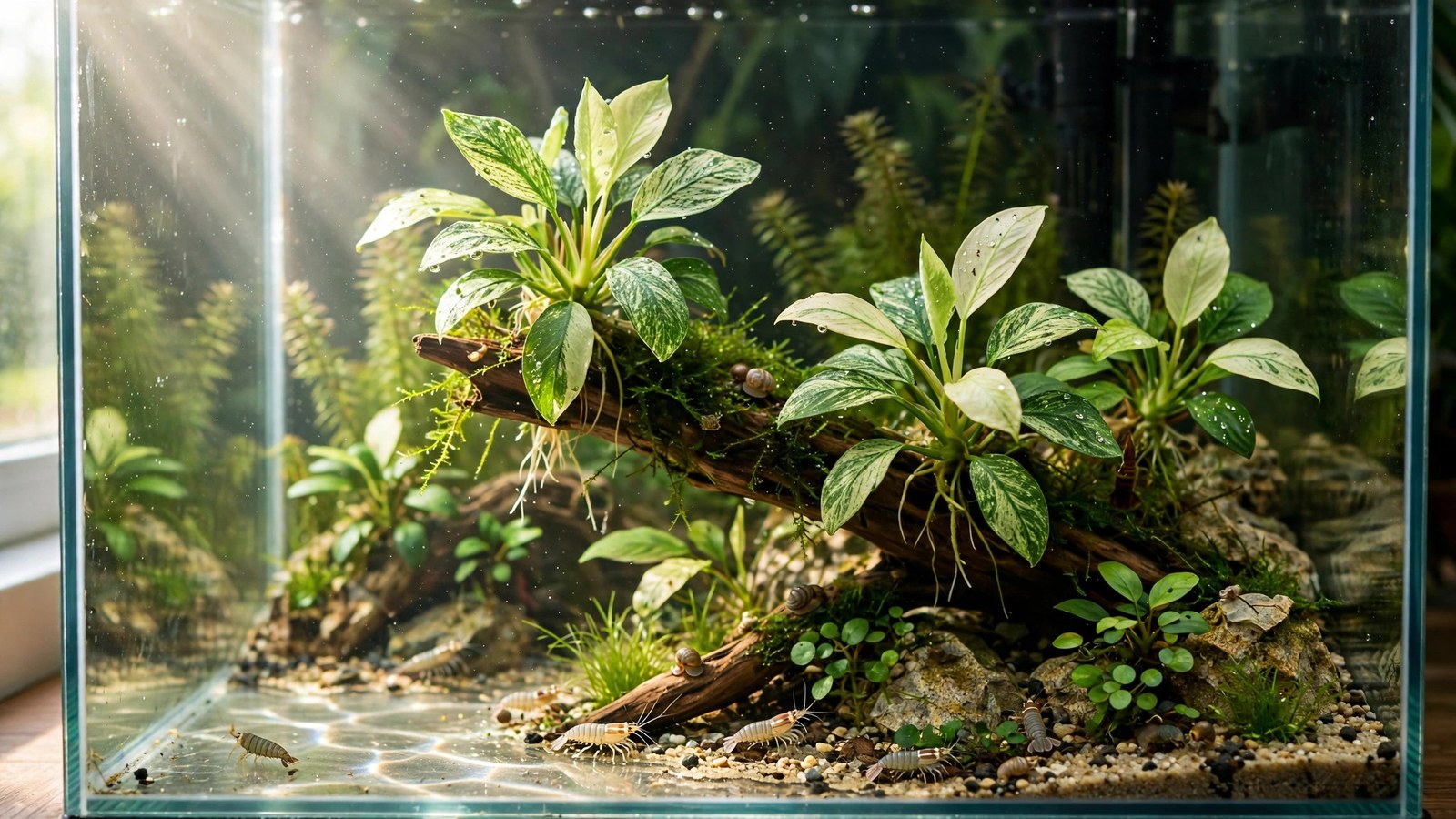
You can kill this plant with kindness before it ever grows a single new leaf. That is the trap of anubias pinto, the white-marbled collector's cultivar of Anubias barteri var. nana: give it the dim, low-light treatment that suits regular Anubias, and its prized white variegation fades back to plain green. Blast it with high light to force the pattern, and algae colonizes every pale leaf within weeks.
This anubias pinto care guide covers the middle path — the medium-light sweet spot that keeps the marbling crisp, the planting method that keeps the rhizome alive, and honest expectations for this slow, rewarding plant.
Anubias Pinto: What Makes This Cultivar Different
Anubias 'Pinto' is a selected cultivar of Anubias barteri var. nana, bred for white-marbled leaves — no two alike, which is why collectors pay a premium. New to the genus? Start with our full Anubias care guide first.
The variegation is chimeric, meaning unstable. White patches hold little chlorophyll, so the plant photosynthesizes weakly and needs more light than plain green Anubias. In dim tanks it protects itself by growing solid-green leaves, and within two to three months your expensive Pinto is ordinary nana. Reverted leaves never re-marble — only new growth under the right light shows the pattern. See how it stacks up when you compare Anubias varieties, and check Tropica's official Anubias 'Pinto' plant profile for the breeder's parameters.
| Trait | Anubias 'Pinto' | Standard A. barteri var. nana |
|---|---|---|
| Leaf color | Marbled white, light and dark green | Solid dark green |
| Light need | Medium, ~30–50 PAR | Low, ~15–30 PAR |
| Growth speed | Very slow (1 leaf per 2–4 weeks) | Slow (1 leaf per 1–2 weeks) |
| Typical price | $12–25 per portion | $5–10 per portion |
| Reversion risk | Yes, in low light | None |
Light Is the Lever That Controls Variegation
Too little light and it reverts to green to survive; too much and the slow-growing white tissue becomes a billboard for algae — far more visible on pale leaves.
Aim for 30–50 PAR at the leaves on a stable 6–8 hour photoperiod. Consistency beats perfection: steady 35 PAR daily outperforms a week of 60 followed by 20. Dim the light, raise the fixture, or tuck the plant under driftwood. Fellow epiphytes like Bucephalandra want the same.
| Light level | Variegation outcome |
|---|---|
| Low (under ~25 PAR) | New leaves emerge solid green; marbling lost in 2–3 months |
| Medium (~30–50 PAR) | Marbling holds on new growth; best pattern-to-algae balance |
| High (over ~60 PAR) | Algae colonizes pale leaves; edges may bleach or brown |
Planting It Right: Rhizome Above Everything
Pinto is an epiphyte: in nature it grips rocks and submerged wood, and its thick horizontal rhizome must never be buried. Push it into the substrate and it softens, turns to mush, and rots within days to weeks — the most common way beginners lose it. Roots are different: let them dangle into the substrate or wedge into crevices.
Attach the rhizome to driftwood or stone with cotton thread, fishing line, or cyanoacrylate super glue gel — aquarium-safe once cured. See how to attach Anubias to driftwood and rock for the technique. Tough, bitter leaves also suit nibbly tank mates — see Anubias and betta fish for betta setups.
Water, Feeding, and Honest Growth Expectations
On chemistry, Pinto is as forgiving as the genus: 22–28 °C, pH 6.0–7.8, soft to moderately hard water, no CO2 needed. A lean weekly dose of all-in-one liquid fertilizer suffices; heavy dosing mostly feeds algae, and white leaves betray imbalance early as browning edges.
Expect one new leaf every two to four weeks, and six to twelve months before a tissue-culture cup looks like a clump. Buy it as a living sculpture, not fast filler. Anubias nana 'Petite' and Anubias 'Pangolino' run on the same timescale, if you want company.
Buying Guide: Tissue-Culture Cups vs Rhizome Portions
Tissue-culture (TC) cups hold five to fifteen tiny sterile plantlets for $10–18 — pest-, snail-, and algae-free. The catch: they are emersed-grown and fragile, so leave them undisturbed for the first two to three weeks while they transition.
Rhizome portions cost $15–25 for instant presence: a firm 5–8 cm rhizome with four to eight leaves. Inspect like a collector — firm white-green rhizome, never mushy or black-spotted, and the newest tip leaves showing the marbling you are paying for. Dip-quarantine any potted plant first.
Keep rhizome-safe super glue gel and cotton thread ready to mount your plant on arrival day. Once the rhizome reaches 8–10 cm, propagate Anubias by rhizome division — sections with at least three leaves each.
Anubias Pinto Care: Keeping White Leaves Algae-Free
White tissue is an algae magnet: it photosynthesizes weakly and shows every spot in high contrast. Hold medium light steady at six to eight hours daily — never "blast it for a week" to force whiter leaves; that ends in an algae farm.
At each water change, wipe leaves gently with fingertips or a soft toothbrush. Two to three otocinclus per 40 liters graze soft algae without damage, and a moss carpet at the base hides the attachment point — see the best aquarium mosses to pair with epiphytes.
Frequently Asked Questions
Why is my Anubias Pinto turning green?
Low light is the usual cause. In dim conditions the plant grows solid-green leaves to survive, and marbling fades over two to three months. Raise light to ~30–50 PAR on a steady 6–8 hour photoperiod. Only new leaves regain the pattern — green leaves never re-marble.
Does Anubias Pinto need CO2?
No. Pinto has low CO2 demand and grows well without injection. Added CO2 may speed growth slightly, but on a plant this slow the difference is marginal. Keep it in a simple low-tech setup and spend the CO2 budget on faster stem plants.
How fast does Anubias Pinto grow?
Very slowly — about one new leaf every two to four weeks. A tissue-culture cup needs six to twelve months to fill into an attractive clump. Pair it with faster plants for coverage and let the Pinto be the slow centerpiece.
Can I plant Anubias Pinto in the substrate?
Roots only — never the rhizome. The thick horizontal rhizome must stay exposed to the water column or it rots within days to weeks. Tie or glue the plant to driftwood or rock, and let the roots find the substrate themselves.
Why are the white leaves getting algae or brown spots?
Pale tissue is vulnerable: excess light fuels algae, and white areas show every speck. Return to ~30–50 PAR with a 6–8 hour photoperiod and wipe leaves gently at water changes. Two to three otocinclus per 40 liters help graze soft algae.
Is Anubias Pinto good for beginners?
Easy to keep alive, moderately hard to keep beautiful — a second purchase, not a first. For fast, forgiving greenery start with standard Anubias nana. If you can wait months for each marbled leaf, Pinto is a wonderful collector's plant.
The Slow-Reward Verdict
Anubias Pinto is not a plant you buy for next month's aquascape photo — it is a plant you buy for next year's. Give it medium, steady light, keep the rhizome in open water, and accept the two-to-four-week rhythm of new leaves. In return you get living marble, grown one leaf at a time — few plants reward patience this visibly.