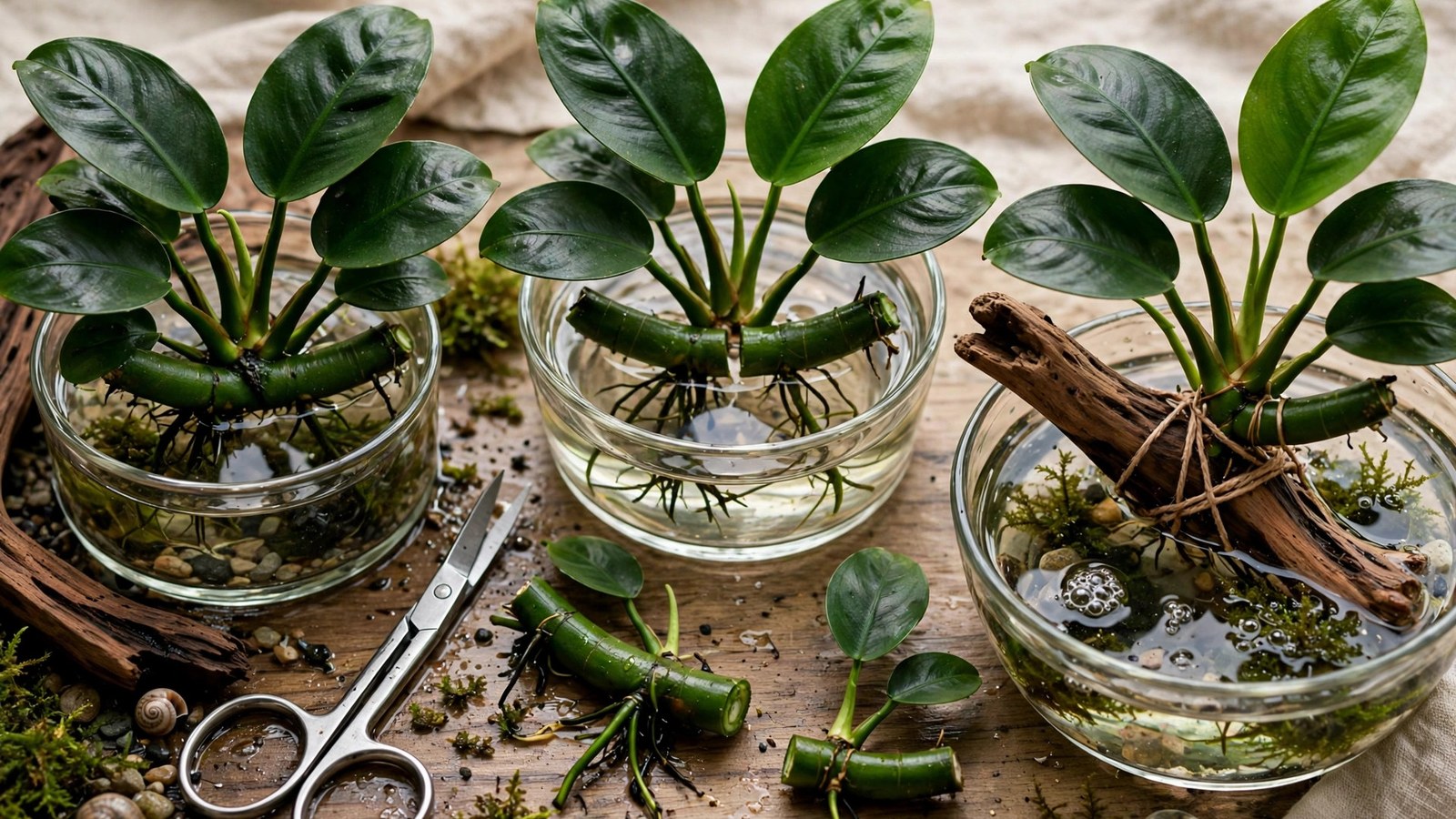
If your Anubias has grown into a mat of rhizome creeping off its rock, you've got a plant worth multiplying. Learning to propagate Anubias by rhizome division is one of the highest-value skills in the hobby: one healthy plant becomes four or more, each genetically identical to the parent. New to the genus? Skim our Anubias care guide for beginners first — then come back with scissors in hand.
Why Anubias Divides So Easily
Anubias grows from a thick horizontal stem — the rhizome — that creeps along surfaces, sending leaves up and roots down. Every inch is a clone-in-waiting, already carrying the leaf nodes and root buds to survive alone. Left alone for 12–18 months, a plant typically develops 8–12 inches of rhizome — enough for several divisions, which is why Anubias is a staple of small aquascapes featuring Anubias nana petite.
When Your Plant Is Ready to Divide
Don't rush it — dividing a small or stressed plant stalls both halves. Wait for these signals:
- The rhizome is 6+ inches long — room for divisions of 3–5 leaves each.
- It's actively growing — new leaves every few weeks means it has energy to heal.
- It's outgrowing its spot. Rhizome creeping off its rock is your cue.
- It's healthy. Firm green rhizome, dark-green leaves, no widespread yellowing or algae.
If the plant shows melt, soft brown spots on the rhizome, or months of no growth, fix the underlying problem before cutting.
Tools You'll Need
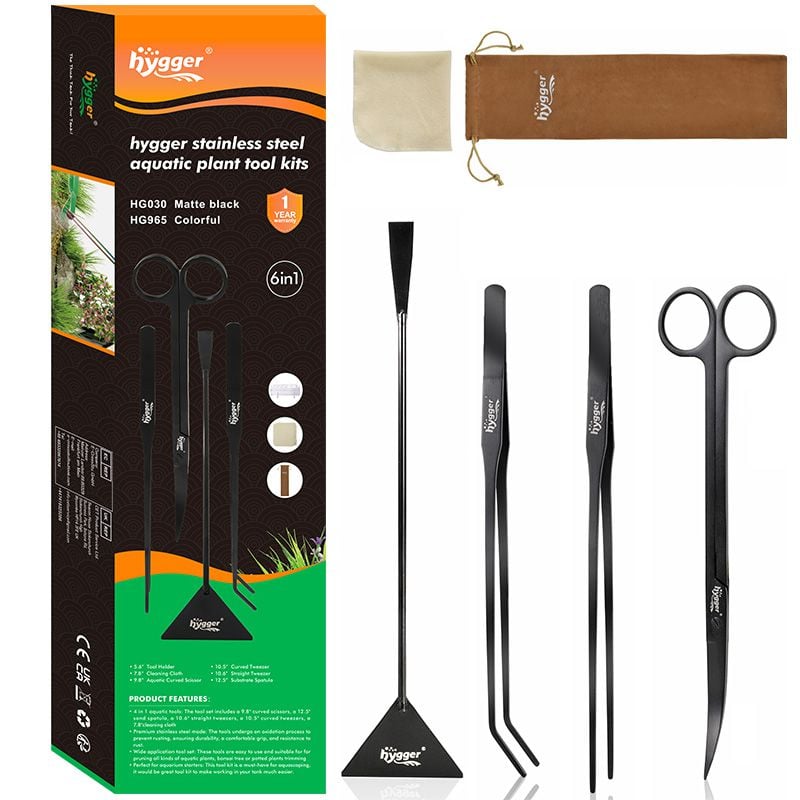
You need less than you'd think: sharp aquascaping scissors are what most hobbyists reach for — one clean snip protects the rhizome. For thick, woody rhizomes on old specimens, a single-edge razor blade is better. No rooting hormone, no special substrate. Keep a bowl of tank water nearby for rinsing, and have your mounting supplies (thread, super glue gel, or small rocks) ready before you cut.
 ★4.6
hygger 6-in-1 Long Aquarium Aquascaping Tools Kit
Check Price on Amazon ★4.6How to Propagate Anubias: The Cut Procedure
- Remove the plant. Gently pry roots off the rock or wood. If superglued, slide a razor blade under the glue rather than tearing the rhizome.
- Rinse. Swirl the plant in a bowl of tank water to reveal the leaf nodes and healthy tissue.
- Plan your cuts. Count off sections of 3–5 leaves, each with a few healthy roots. Cut between leaf nodes, in the bare stretches — never through a leaf cluster.
- Cut once per section. Snip straight through in a single motion — the 45° angle some guides recommend gives no advantage on tissue this thick. The critical rule: never saw, squeeze, or crush. A crushed rhizome is an open wound that invites rot; a clean slice seals in days.
- Trim the roots. Snip long, stringy roots back to 1–2 inches to reduce rot risk and encourage fresh growth.
- Inspect each division. It needs 3–5 firm green leaves, at least 2 inches of firm (not mushy) rhizome, and healthy roots. Discard anything mostly mush — one rotten division can foul a small tank.
Planting the Divisions
The rule that matters most: never bury the rhizome. Anubias is an epiphyte — in nature it clings to rocks and wood in flowing streams. A buried rhizome suffocates, softens, and rots within weeks. This is the number-one reason divisions fail, and it's entirely avoidable.
Press each division against driftwood or rock and secure it with dark cotton thread, a dab of cyanoacrylate super glue gel (aquarium-safe once cured), or wedge it into a crevice. Roots can touch or thread into the substrate, but the rhizome must sit above the surface, exposed to water flow. Place divisions in the same light the parent thrived in — low to medium — and within 3–6 weeks the roots grip on their own.
What About Seeds?
Mature Anubias occasionally flowers and rarely sets seed pods. Ignore this: seeds take 6–12 months to reach seedling size, need emersed conditions most tanks can't provide, and produce variable offspring rather than clones. Division gives you a full clone in weeks.
Aftercare: What to Expect
In weeks 1–2, cut ends may look pale or translucent as callus tissue forms — normal, as long as the flesh stays firm. Some divisions drop one older leaf while reallocating energy — also normal.
By weeks 3–6, fresh white root tips should grip the surface, and new leaves typically unfurl by weeks 4–8. Keep conditions stable: no big parameter swings, no sudden lighting changes, and don't move the division "just to check" — every move resets the attachment clock.
Troubleshooting
| Symptom | Likely cause | Fix |
|---|---|---|
| Division melts within days | Crushed rhizome from a dull blade, or a division too small (under 3 leaves) | Remove the rotten piece; next time use a fresh blade and cut divisions with at least 3 leaves |
| No new growth after 8+ weeks | Too little light, cold water, or a buried rhizome | Expose the rhizome to water flow, confirm low-to-medium light and 72–82°F, then wait — healthy divisions rarely stay dormant past 12 weeks |
| Rhizome rot — brown, soft patches | Buried rhizome or chronic damage | Cut away ALL soft tissue to firm green-white flesh; dry the wound 30 minutes, then remount exposed |
| Roots won't grip | Constant repositioning | Stop moving it for 4 weeks; press roots firmly against the surface and re-secure |
Putting It Into Practice
Once you've divided one Anubias, the technique scales to the whole genus — the Anubias pangolino care guide covers a species whose tiny rhizomes divide identically. For even faster epiphyte propagation, see our Christmas moss care guide: that plant multiplies by simple fragmentation.
Frequently Asked Questions
Can I propagate Anubias from a single leaf?
No. Leaves can't sprout a new plant — they lack the meristem tissue needed to grow a rhizome. Every division must include a section of rhizome with at least 3–5 attached leaves and roots. If the rhizome is too short, just grow the plant out until it reaches 6+ inches, then split it.
How long until a division grows a new leaf?
Most hobbyists see the first new leaf unfurl 4–8 weeks after division, with stable low-to-medium light and 72–82°F water. Roots attach first, usually within 3–6 weeks. If nothing appears by week 12 but the rhizome is still firm and green, don't give up — some divisions simply rest longer in cooler or dimmer tanks.
Do I need rooting hormone or fertilizer?
No. Divisions carry enough stored energy in their rhizomes to re-establish without supplements — a clean cut and correct mounting determine success. Water-column fertilizer helps long-term growth but isn't required for the division itself. Skip hormone dips: they're made for terrestrial plants and offer no benefit underwater.
Can I divide Anubias while it stays in the tank?
Possible, but not recommended. In-tank cuts are awkward, debris fouls the water, and you can't see the rhizome well enough to plan clean cuts between leaf nodes. Removing the plant takes two minutes and keeps your tank clean — it won't be harmed by 10–15 minutes out of water.
Why did my division's rhizome turn brown and mushy?
Nine times out of ten, the rhizome was buried in substrate, which suffocates the tissue. The other common cause is a crushed cut from a dull blade. Trim away all soft tissue until only firm green-white flesh remains, let the wound dry briefly, and remount with the rhizome fully exposed to water flow.
How many divisions can I get from one plant?
Divide the rhizome length by roughly 2–3 inches per division, each with 3–5 leaves. A mature 10-inch rhizome typically yields 3–4 viable divisions. Resist cutting smaller: pieces under 2 inches or with fewer than 3 leaves have much higher melt rates and take months longer to recover.
That's the whole process: wait for a healthy, overgrown plant, make one clean cut per division, and mount with the rhizome exposed. Your single Anubias becomes a colony — free plants, forever.