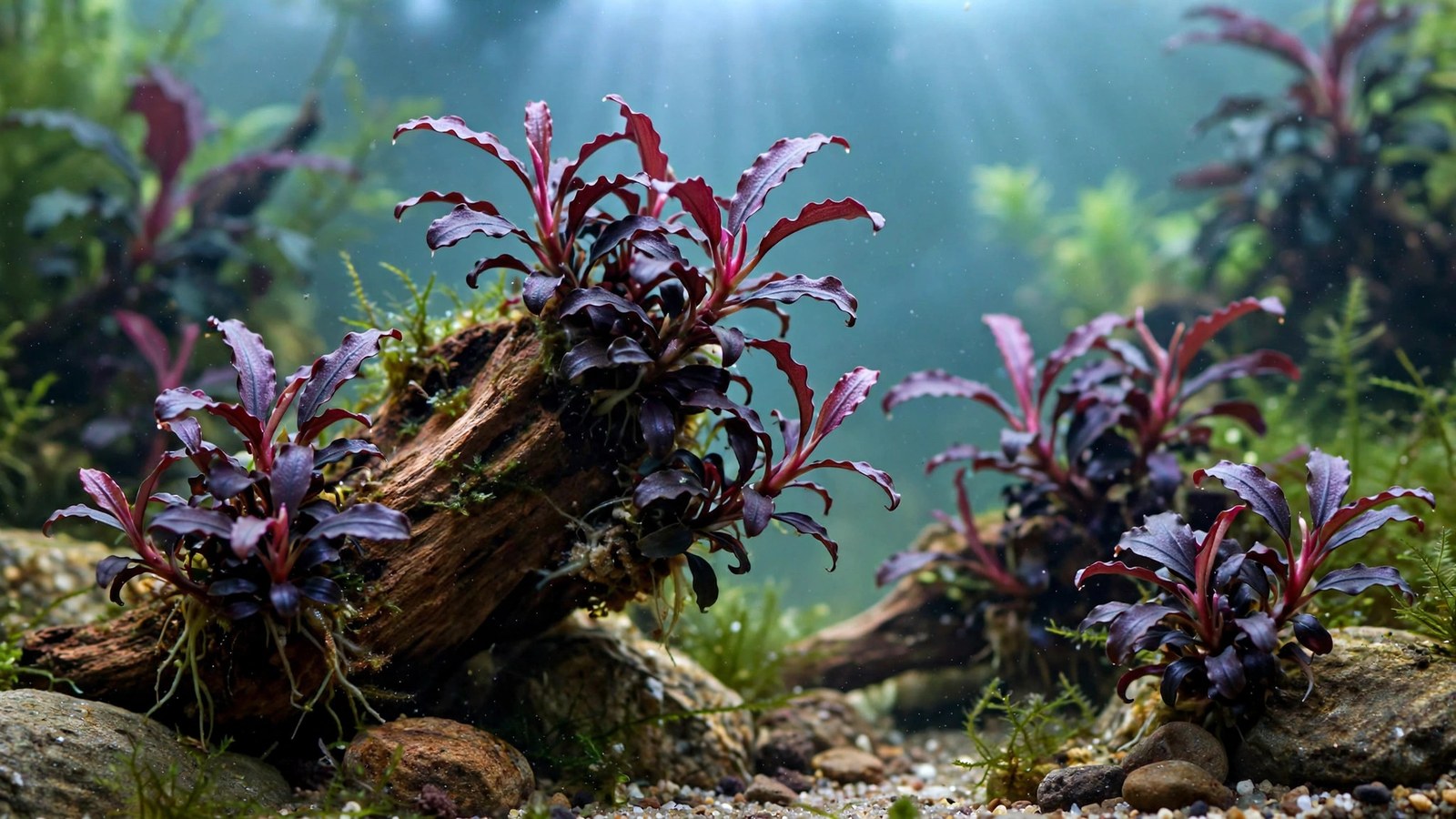
Bucephalandra "Kedagang" is a collector's variety whose leaves glow red-purple under strong light and balanced nutrition — or fade to plain green under weak care. This bucephalandra kedagang care guide covers what makes it distinct, how to hold its color, and how to attach it.
What Bucephalandra Kedagang Actually Is
Bucephalandra is a genus of rheophyte epiphytes from Borneo that grip rocks in fast-flowing streams, and "Kedagang" is a trade name for one collected variety — not a separate species. Its leaves emerge olive-green and deepen toward red, bronze, or purple under the right conditions, sometimes with an iridescent sheen. For the genus foundation, read our Bucephalandra Care: Slow-Growing Epiphyte Guide first. The freshwater aquarium plants guide puts epiphytes in context with the rest of the planted palette.
With buce, the variety name is the product: Kedagang runs warmer than green "Wavy Green" types, but genetics only create the potential for red. Two buyers of the same portion can end up with different plants a month later — the next section covers the levers that move the color.
bucephalandra kedagang care: Holding the Red-Purple Color
Red and purple coloration is mostly anthocyanin pigment produced in response to strong light. Three levers matter — light, iron, nitrate — and chasing just one is the commonest reason collectors end up disappointed.
Light first. Kedagang stays green-brown under ~30 PAR and warms up at 40–70 PAR — medium-high by epiphyte standards. Put it on midground rock in direct light, not a shaded crevice, and raise intensity over two weeks rather than blasting a fresh portion, which invites algae before it adjusts. The anubias care guide covers the same shade trade-offs for its closest epiphyte relative.
Iron and nitrate balance second. Nitrate limitation triggers red pigment, but keep it sane: 5–15 ppm rather than 20+ ppm from heavy feeding, with iron from a complete micro fertilizer. Aim for lean but complete — pale, stunted new growth means deficiency, not color. CO2 is optional; ~30 ppm deepens color slightly.
| Parameter | Survival range | Best-color range |
|---|---|---|
| Light | 20–40 PAR | 40–70 PAR |
| Nitrate | 5–40 ppm | 5–15 ppm |
| Iron (via micros) | Occasional dosing | Consistent per-label dosing |
| CO2 | Not required | ~30 ppm helps color |
| Temperature | 68–82 °F (20–28 °C) | 72–78 °F (22–26 °C) |
| pH / hardness | 6.0–7.5, soft–medium | 6.2–7.0, soft–medium |
Attaching Kedagang to Hardscape
Like all Bucephalandra, Kedagang is an epiphyte, and the single most important rule is to never bury the rhizome in substrate. A buried rhizome stays oxygen-starved and rots — and with a grower this slow, you may not notice until the whole portion has melted. Keep the thick rhizome fully exposed.
Attachment is simple and permanent once roots grip (4–8 weeks). Dot cyanoacrylate gel on dry rock or wood, press the rhizome in for 30 seconds, then place the hardscape in the tank — the glue cures underwater and is inert once set. Or tie with dark cotton thread and let it dissolve after roots take hold.
| Method | Speed | Best for |
|---|---|---|
| Cyanoacrylate gel | Seconds | Precise placement; survives water flow |
| Cotton thread | Minutes | Large rhizomes; dissolves on its own |
| Fishing line | Minutes | Reusable, but must be cut away later |
| Wedge in crevice | Instant | Temporary spots; risky in high flow |
At 4–8 cm tall, Kedagang suits foreground-to-midground rockwork, stone seams, and driftwood bases. In tanks over 45 cm tall, see Bucephalandra Deep Water Care: Thriving in 60cm+ Aquariums — Kedagang on the bottom of a deep tank may never get enough PAR to color up.
Slow Growth, Melt, and the Algae Problem
Expect about one new leaf every one to three weeks, and a full year for a rhizome portion to double in width. That is normal, not a deficiency — so prevention beats treatment.
Melt on arrival is common, not fatal. Shipped or tissue-culture Kedagang often sheds leaves in the first 2–4 weeks while switching to submerged conditions. Don't move it or "help" it. A firm, green rhizome pushes new leaves from its nodes; trim any mushy or brown-black section back to firm tissue at once. The variegated Anubias Pinto follows the same slow-adjustment pattern, so its acclimation notes are worth reading if you keep both.
Algae is the real enemy. Slow leaves are perfect algae real estate, and strong light without balanced nutrients grows algae faster than leaves. The fix is environmental: stable CO2 if you inject, consistent fertilization, a 6–8 hour photoperiod to start, and Amano shrimp or otocinclus grazing the leaves. Spot-treat established algae with hydrogen peroxide (1–2 ml per 10 gallons, filters off 15 minutes) only as a last resort — then fix the imbalance behind it.
Propagating Kedagang by Rhizome Division
Division is simple and the only practical way to multiply a collector's portion. Wait for 8–10 healthy leaves, then:
- Lift the hardscape or detach the plant; work in a tray of tank water so the rhizome never dries.
- Find a natural joint or thin section of rhizome between leaf clusters.
- Cut with a sharp, clean razor — never tear — leaving 4–5 leaves and a few roots on each portion. Smaller divisions survive but stall for months.
- Reattach each portion to rock or wood, rhizome exposed.
- Expect a 2–4 week pause while divisions re-anchor; new leaves confirm success.
Each division is a clone, so propagated Kedagang keeps the parent's color potential — exactly why named varieties hold their value. The technique mirrors anubias division, so How to Propagate Anubias: Rhizome Division Step by Step works as a companion. For compact tankmates on the same rockwork, try Anubias Nana Petite and Anubias Pangolino — both stay small enough to share the foreground without crowding it.
Frequently Asked Questions
Why is my Bucephalandra Kedagang turning green instead of red?
Usually light is too weak (under ~30 PAR) or nitrate is high (20+ ppm) — both suppress red pigments. Move it brighter, hold nitrate at 5–15 ppm, and supply iron via a complete micro fertilizer. Old leaves rarely recolor, so judge by the newest growth.
Does Bucephalandra Kedagang need CO2 injection?
No — Kedagang grows and holds reasonable color in low-tech tanks with moderate light and steady fertilization, just more slowly. CO2 around 30 ppm speeds leaves and deepens red tones slightly. For a showpiece specimen it is worth adding, but stable low-tech always beats unstable injected conditions.
How fast does Bucephalandra Kedagang grow?
Very slowly: about one new leaf every one to three weeks, and a full year for a rhizome portion to roughly double. Maximum height is 4–8 cm. This pace is normal, not a deficiency — resist "fixing" it with extra fertilizer or light, which just feeds algae.
Why is my Kedagang melting after I got it?
Post-purchase melt is normal acclimation as the plant switches from farm or emersed conditions to your submerged tank, usually lasting two to four weeks. Leave the rhizome attached and exposed — don't move or bury it. A firm, green rhizome pushes new leaves; trim soft or brown-black sections to stop rot.
Can I plant Bucephalandra Kedagang in substrate?
No — the rhizome must stay above the substrate. Burying it traps moisture and causes rot, fatal for a plant this slow-growing. Glue or tie Kedagang to rock or driftwood and let its roots grip naturally. Roots wandering into the substrate are fine; the thick rhizome must remain exposed.
Is Kedagang Worth a Spot in Your Tank?
Kedagang earns its collector price only with honest medium-high light, lean-but-complete nutrition, an exposed rhizome on good hardscape, and patience through slow growth and initial melt. In return you get one of the hobby's most striking red-purple epiphytes. The Java Fern care guide covers the other classic slow epiphyte, and the foundational Bucephalandra Care guide is the place to start before any collector variety. For authoritative background, Tropica's plant database documents Bucephalandra's rheophyte origins.