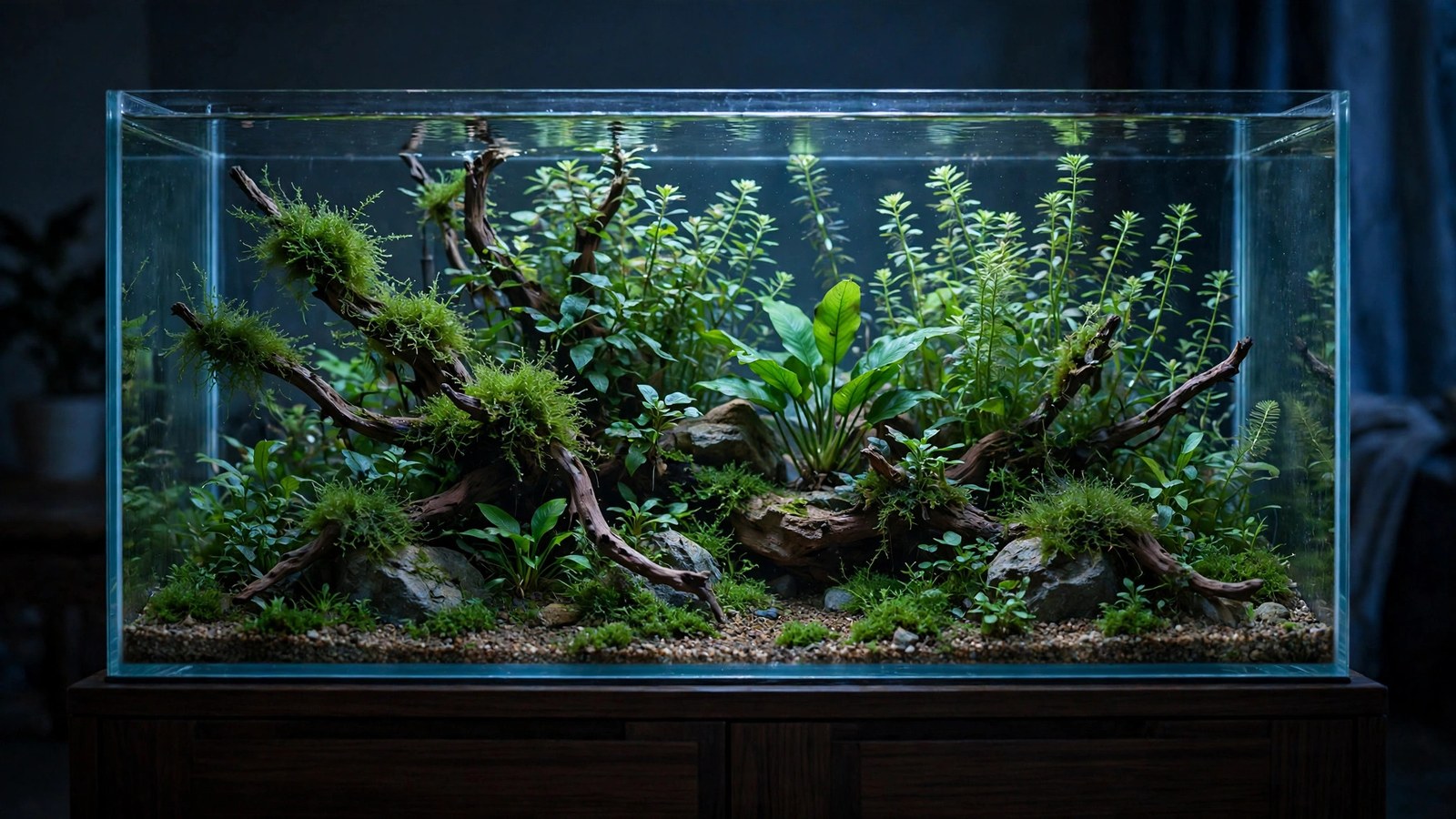
Blue light looks like pure plant fuel — and that assumption quietly wrecks a lot of tanks. Most beginners crank the blue channel to 100% expecting explosive growth, then wonder why their plants stall while a green haze of algae takes over everything. Asking "is blue light good for aquarium plants" is exactly the right question — because the answer is yes, but only in the right dose, for the right reasons, and almost never on its own.
So, Is Blue Light Good for Aquarium Plants?
Yes — blue light is genuinely useful for aquarium plants, just wildly misunderstood. Chlorophyll a and b both absorb strongly around 450 nm, which makes blue one of the two most photosynthetically active wavelengths (the other is red, around 660 nm). Blue also triggers phototropism and keeps stem plants growing compact instead of leggy. But here's the catch: a spectrum that is only blue, or overwhelmingly blue, grows algae far better than it grows plants. The winning setup in 2026 is a balanced white light with a controlled blue component — which is exactly what our RGB aquarium lighting guide shows you how to build channel by channel.
Make it this rule: blue belongs in the mix, never as the mix.
How Plants Actually Use Blue Light
Under water, the physics favor blue. Red wavelengths get absorbed by water within centimeters, while blue penetrates deeper — one reason foreground carpets and low aquascapes respond well to a decent blue component. Plants detect blue through photoreceptors called cryptochromes. In practical terms, a healthy blue dose produces stockier stems, tighter internodes, and stronger red coloration in species like Ludwigia and Rotala.
What blue does not do is replace the rest of the spectrum. Our guide to how aquarium plants use the light spectrum breaks down the full picture, but the short version is in this table:
| Spectrum | What it does for plants | Downside in excess |
|---|---|---|
| Blue (~450 nm) | Strong photosynthesis, compact growth, red pigments | Algae explosion, washed-out fish color |
| Red (~660 nm) | Strong photosynthesis, stem elongation, flowering signals | Leggy, stretched growth |
| Green (~550 nm) | Weak direct use, but penetrates deep into dense leaves | None — mostly about how your tank looks to you |
| Full-spectrum white | Complete, balanced growth at every level of the tank | None, provided intensity and photoperiod are right |
The Mistake That Turns Blue Light Into Algae Fuel
The classic failure mode goes like this: someone reads that "plants love blue," sets their RGB fixture to all-blue, and leaves it running 10 hours a day. Within two weeks the glass is green, cyanobacteria coats the substrate, and the plants look exactly as stunted as before. Blue photons drive photosynthesis in algae just as efficiently as in higher plants — and algae, with their tiny biomass and fast turnover, win every sprint. If your algae appeared right after a spectrum change, the spectrum–algae connection explains the mechanism in detail.
The second half of the mistake is duration. Blue light is often marketed as "moonlight," so people assume it is harmless and leave it on all night. Plants and fish both need genuine darkness — continuous low-level light stresses fish and denies plants their rest phase, which our guide on whether aquarium plants need darkness covers thoroughly.
Dialing In the Right Amount of Blue
For most planted tanks, the sweet spot is simple: set your fixture to its neutral-white preset, then check that blue contributes about one-fifth to one-third of the total. High-tech tanks with CO2 can push toward 30%; low-tech tanks should stay near 20%, because every extra photon in a low-CO2 tank is an algae subsidy.
| Tank type | Blue share | Photoperiod | Moonlight |
|---|---|---|---|
| Low-tech, no CO2 | ~20% | 7–8 hours | Dim blue, 1–2 hours |
| Medium-tech | ~25% | 8 hours | Dim blue, 2 hours |
| High-tech + CO2 | ~30% | 8–9 hours | Dim blue, 2–3 hours |
Make changes gradually — a sudden spectrum shift shocks plants the same way a sudden intensity spike does. For sunrise and sunset ramping, a gentle blue ramp at both ends looks stunning and is biologically gentle, since dawn and dusk in nature are blue-dominant anyway. And if your light is simply too bright overall, dim it first before touching the spectrum — intensity, not color, is the bigger lever.
Blue Light and Smart LEDs: What to Look For in 2026
The real 2026 upgrade isn't more watts — it's scheduling. App-controlled fixtures from Fluval, Chihiros, and Twinstar let you program the blue channel on its own timeline: full contribution during the day, a soft ramp at dusk, a dim moonlight window, then off. Before buying, check three things: (1) each RGB channel can be scheduled independently, (2) the app supports a true dim-blue moonlight mode, and (3) it has sunrise/sunset ramping so nothing snaps on at full blast.
For specific model comparisons, our roundup of the best aquarium lights for planted tanks covers fixtures by budget and tank size, while the Fluval Plant 3 vs 4 comparison and the Twinstar vs Chihiros shootout show how each brand handles channel control. Skip fixtures that only offer a single fixed "blue mode" button — you want a schedule, not a preset. For brand-level specs on spectrum claims, Tropica's plant care database remains the most trustworthy free reference for what light each species actually needs.
Frequently Asked Questions
Can I grow aquarium plants with only blue light?
Technically yes for a while, practically no. Blue-only light drives photosynthesis, but plants grown without red and other wavelengths develop weak, distorted growth and your tank will be overrun by algae long before the plants thrive. Always use blue as part of a full-spectrum setup.
Does blue light cause algae in planted tanks?
Blue light itself doesn't "cause" algae — imbalance does. Blue-heavy settings above roughly 30% of output, or blue left on all night, give algae a competitive advantage. Keep blue at 20–30% of a balanced spectrum with a proper photoperiod and darkness, and algae risk is no higher than with neutral white.
Is a blue moonlight safe to leave on all night?
No — a true all-night blue light stresses fish and robs plants of their dark rest phase. Run a dim blue moonlight for 1–3 hours after the main lights go out, then switch to complete darkness. Your livestock's behavior and your plants' growth will both improve.
Why do my red plants look better under more blue?
Blue light stimulates anthocyanin production — the red pigments in plants like Ludwigia and Rotala. A healthy blue component (25–30%) intensifies reds noticeably. Just don't chase the color by maxing out blue; the reds will deepen while algae takes over the rest of the tank.
Should I use the "blue mode" preset on my LED?
Only as a short viewing mode, not as a growing spectrum. Preset blue modes are designed to look dramatic, not to grow plants — they skew far beyond the 30% blue ceiling. Build your own schedule with a balanced white base and a controlled blue channel instead.
The Bottom Line on Blue Light
Blue light is good for aquarium plants the way seasoning is good for food: it makes everything better in the right proportion and ruins the dish on its own. Aim for a balanced white spectrum with blue at 20–30%, give your tank real darkness at night, and let a smart LED handle the scheduling. Do that, and blue becomes what it should be — the secret behind compact growth, glowing reds, and a tank that looks alive after dark.