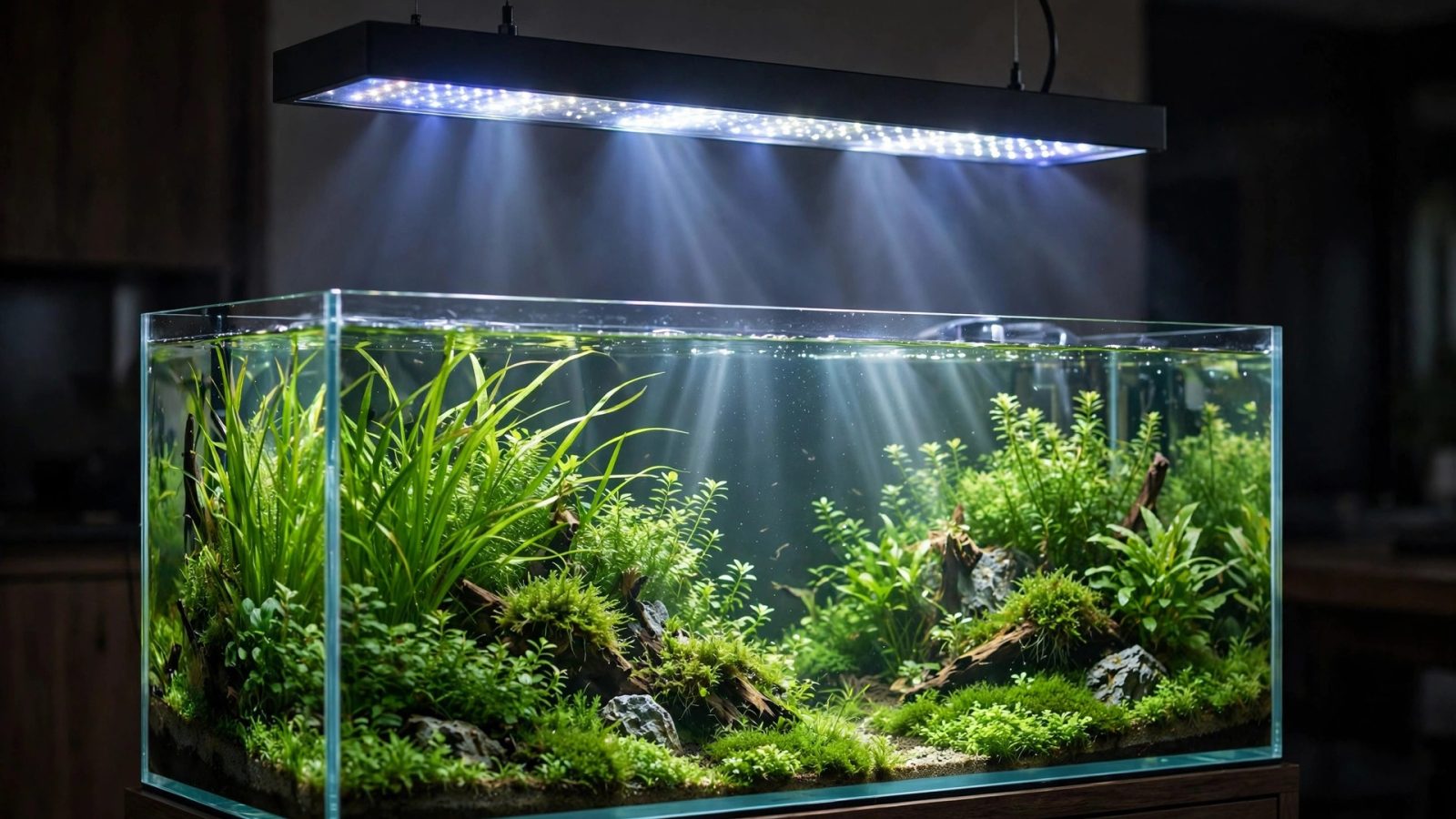
Lighting is the engine of your planted tank — it sets the maximum speed everything else can run at. Too little and plants starve; too much and you’re farming algae. With dozens of LED fixtures at every price point, choosing the right one means matching intensity to your plants, your tank size, and whether you run CO2. This guide compares the 8 best aquarium lights for planted tanks across budget, mid-range, and premium tiers, explains what specs actually matter, and shows you how to size a light to your setup.
If you’re still learning the fundamentals — PAR, photoperiod, and how much light different plants need — read our how much light do aquarium plants need guide first, then come back to pick the fixture.
What Actually Matters in a Planted Tank Light
Marketing sheets throw around lumens, Kelvin, and wattage. Here’s what to actually evaluate:
- PAR at substrate: Photosynthetically Active Radiation is the only intensity metric that matters for plants. Good manufacturers publish PAR charts by depth; fixtures that hide PAR numbers are telling you something. Target roughly 15–30 PAR (low light), 30–60 (medium), or 60+ (high) at the substrate.
- Spectrum: Plants use red and blue most efficiently, but full-spectrum white (6500K-ish daylight) grows plants excellently and looks natural. RGB fixtures add color pop. Avoid old “actinic blue” reef lights — they’re tuned for corals, not plants. Our light spectrum explainer goes deeper.
- Spread and coverage: A light that blasts the center and leaves corners dim grows algae in the middle and starves the edges. Wider fixtures or dual light bars beat a single narrow strip on tanks over 18 inches front-to-back.
- Dimming and programmability: The ability to dim is the single most useful feature — it lets you tune intensity to your CO2 and fertilizer levels instead of being stuck with one output. Sunrise/sunset ramping is a nice bonus for fish stress.
- Build quality and waterproofing: It’s inches above water. Look for splash guards, sealed LEDs, and aluminum heat sinks — heat kills LEDs over time.
The 8 Best Aquarium Lights for Planted Tanks
1. Best Overall: Twinstar S Series
Twinstar’s S line is the planted-tank community’s benchmark for a reason: excellent full-spectrum output with strong reds, clean slim aluminum bodies, and PAR that honestly reaches high-light levels on standard tank depths. The 600S covers 60 cm tanks beautifully. Downsides: premium pricing and the need for a separate dimmer/controller for full programmability. Best for aquascapers who want gallery-grade color rendition.
2. Best Value Full-Spectrum: NICREW ClassicLED Plus / SkyLED Plus
NICREW dominates the budget tier by delivering genuine plant-growing light at a fraction of premium prices. The Plus models add meaningful red and blue diodes over the basic white versions, pushing them into solid medium-light territory on tanks up to 18 inches deep. Extendable brackets fit odd tank sizes. The tradeoff: basic on/off operation (add an inexpensive inline dimmer) and less refined color tuning than premium fixtures. The default recommendation for beginners on a budget.
3. Best for High-Tech Tanks: Chihiros WRGB II / Vivid Series
Chihiros built its reputation on app-controlled RGB fixtures with serious PAR output. The WRGB II series offers per-channel color control via Bluetooth, sunrise/sunset programming, and intensity that handles demanding carpets and red plants in deep tanks. The Vivid line steps up further for large or deep aquascapes. Pricing sits mid-premium. Best for CO2-injected tanks where you want both power and precise control.
4. Best US Mainstream Pick: Fluval Plant 3.0
Fluval’s Plant 3.0 is the easiest premium light to buy in North America — stocked everywhere, backed by a real warranty, and controlled by a genuinely good app with 24-hour programming, custom spectrums, and gradual ramping. PAR is honest medium-to-high depending on model and depth. You pay for the brand and distribution, but the ownership experience (support, availability, resale) is excellent. Ideal if you want set-and-forget programmability without importing.
5. Best Budget Dimming: Hygger Full Spectrum LED
Hygger’s full-spectrum fixtures punch above their price with built-in timers, multiple brightness levels, and color modes — features usually reserved for lights twice the price. PAR is modest (low to medium), making them a natural fit for low-tech setups. Build quality is decent rather than exceptional. The go-to when you want timer + dimming on a tight budget; pair with our low-tech LED roundup for more options in this class.
6. Best for Nano Tanks: ONF Flat Nano / Chihiros C Series
Nano tanks need focused, controllable light — a big fixture blasts a 5-gallon into algae soup. The ONF Flat Nano is the design icon: beautiful form factor, excellent color, and a dimmer-friendly output sized for small tanks. Chihiros’ C series offers similar app control at lower cost. Whatever you choose for nano, dimming is mandatory — small water volumes forgive nothing.
7. Best Proven Workhorse: Finnex Planted+ 24/7 Series
Finnex has been growing plants under its 24/7 fixtures for a decade, and the formula still works: strong 7000K + red LED mix, the signature 24/7 automated day-cycle mode, and tank-busting PAR that reaches high light on standard depths. Newer models (HLC, ALC) refine color control. They’re less sleek than current app-controlled rivals, but the plant-growing track record is unmatched at the price.
8. Best Premium Statement: ADA Solar RGB / ONF Flat One+
At the top end, ADA’s Solar RGB remains the aspirational fixture — engineered specifically for the color rendition Amano’s aquascapes are famous for, with a price to match. ONF’s Flat One+ offers comparable design prestige with modern app control. These are for dedicated aquascapers where the light is part of the furniture. Performance is superb, but the premium over a Chihiros or Twinstar buys aesthetics and brand more than additional plant growth.
Comparison Table
- Twinstar S — Premium · High PAR · External dimmer needed · Best color rendition
- NICREW Plus — Budget · Medium PAR · Manual dimmer add-on · Best value
- Chihiros WRGB II — Mid-premium · High PAR · App control · Best for high-tech
- Fluval Plant 3.0 — Premium · Medium-high PAR · Excellent app · Easiest to buy (US)
- Hygger Full Spectrum — Budget · Low-medium PAR · Built-in timer · Best budget features
- ONF Flat Nano / Chihiros C — Mid-range · Nano-sized · Dimming essential · Best for small tanks
- Finnex Planted+ 24/7 — Mid-range · High PAR · 24/7 auto mode · Proven workhorse
- ADA Solar RGB — Ultra-premium · High PAR · Design statement · Aspirational pick
How to Size a Light to Your Tank
Match length to tank
Choose a fixture rated for your tank’s length — light falls off sharply beyond the fixture’s ends. For tanks 48 inches and up, two shorter fixtures beat one long one for even coverage.
Account for depth
PAR drops with the square of distance. A light that’s “high light” on a 12-inch-deep tank may be medium on a 24-inch-deep one. Check manufacturer PAR charts at your actual substrate depth, not the headline number measured at 12 inches.
Factor in CO2
High light without CO2 injection is the fastest route to an algae farm. If you’re not injecting CO2, cap yourself at low-to-medium PAR fixtures and dim from there. Our too-much-light guide shows what happens when this rule is ignored.
LED vs T5 vs Everything Else in 2026
LEDs have won. T5HO fluorescents still grow plants beautifully, but bulb replacement costs, heat, and energy use make them obsolete for new purchases — buy LED unless you’re inheriting a fixture. Avoid generic “full spectrum” Amazon panels with no PAR data, no brand, and no warranty; the savings evaporate when diodes shift color or die within a year. And skip reef lights (heavy blue/actinic) — wrong spectrum for freshwater plants regardless of intensity.
Setting Up Your New Light
- Start dim. Begin at 50–60% intensity for the first 2–3 weeks, then raise gradually. New tanks with immature biology can’t handle full blast.
- Set the photoperiod first: 6–8 hours daily on a timer. See our light schedule guide for timing strategy.
- Raise, don’t just dim, if needed: hanging kits or risers increase the light-to-substrate distance, softening intensity while improving spread.
- Clean the lens monthly: mineral deposits and dust on the splash guard can cut PAR significantly.
- Give it 3 weeks before judging: plants need time to adapt to new light; early melting of old leaves is normal.
When to Upgrade Your Light
Upgrade when your plants tell you to: leggy stems reaching for the surface, carpets that won’t spread horizontally, or red plants staying green despite good CO2 and ferts all point at insufficient light. Don’t upgrade just for features — a basic dimmable fixture at the right PAR beats a flagship running at 40% because your tank can’t use the rest. Match the tool to the tank, and spend the difference on plants.
Best Light by Tank Size
5–10 gallon nano
Small tanks punish excess light severely — algae appears in days, not weeks. Pick a nano-specific fixture (ONF Flat Nano, Chihiros C II, or a small Hygger) and plan to run it dimmed to 40–60%. Clip-on lights work but create a spotlight effect; a small bar spanning the tank gives evener coverage. Budget: $30–$90.
20-gallon long / 29-gallon
The most common planted tank sizes, and the best-served by the market. A 24–30 inch NICREW Plus or Finnex Planted+ delivers medium-high PAR at substrate for $60–$120. This is the sweet spot where budget fixtures genuinely suffice — save premium money for CO2 or aquasoil instead.
40–55 gallon
At 36–48 inches long and 18–21 inches deep, you need real output. One 36-inch Twinstar 600S or Chihiros WRGB II 60, or two 24-inch mid-range bars for the most even coverage. Expect $120–$280. Depth matters here — verify PAR at 18+ inches before buying.
75+ gallon
Large tanks usually need two fixtures or one premium long unit (Chihiros Vivid, Twinstar 1200S). Budget $250–$500 for lighting alone. Consider the total system cost honestly at this size — lighting, CO2, and fertilizer for a 75-gallon high-tech setup is a real investment, and underspeccing any one leg wastes the other two.
Mounting Options: Legs, Hanging, and Arms
- Tank legs/brackets: included with most fixtures; sit the light 2–4 inches above the rim. Simple, but fixed height means dimming is your only intensity control.
- Hanging kits: suspend the light 8–12 inches above the tank. Raising the fixture softens intensity while dramatically improving spread — the best way to tame a too-powerful light. Also keeps the fixture away from splashes and makes tank maintenance easier.
- Gooseneck/clip arms: common on nano lights; flexible positioning but a single point source creates uneven PAR. Fine for small tanks, poor for wide ones.
New vs Used Lights
Premium fixtures (ADA, ONF, Twinstar) hold value well, and buying used can save 30–40%. LEDs don’t “wear out” like fluorescent tubes, but diode output does degrade slowly over 3–5 years of heavy use, and older app-controlled models may lose software support. If buying used: ask for the purchase date, test every LED channel, verify the app still connects, and factor in a new power supply ($15–$25) as cheap insurance. For budget fixtures under $80, buy new — the savings aren’t worth the risk.
Lighting FAQs
How long do LED aquarium lights last?
Quality LED fixtures run 30,000–50,000 hours — at 8 hours daily, that’s 10+ years before significant output decline. Cheap fixtures often fail earlier through power supply or moisture issues rather than diode death. Keep the splash guard clean and ensure ventilation around the heat sink.
Can I use a regular desk lamp or shop light for plants?
For undemanding plants in a pinch, a 6500K daylight LED bulb in a desk lamp grows anubias and java fern acceptably. It’s a stopgap, not a solution — poor spread, no waterproofing, and ugly. Fine for a quarantine tank; not for a display aquascape.
Do I need a separate light for red plants?
No — you need intensity and CO2 more than a special fixture. Red pigmentation (anthocyanin) develops under strong light; most “planted tank” full-spectrum LEDs already include enhanced red diodes. A dim white light won’t redden plants no matter its color temperature.
One expensive light or two cheap ones?
Two cheap dimmable fixtures usually beat one expensive fixture for coverage on tanks 36 inches and up. Even PAR across the substrate matters more than peak PAR in the center. The exception: deep tanks where cheap fixtures can’t deliver enough punch at depth.
Should the light cover the full tank length?
Ideally yes, or within a few inches. Significant overhang gaps create dim zones where plants etiolate and algae takes hold on hardscape. Extendable brackets help budget fixtures fit odd sizes.
Final Buying Advice
Buy for the tank you have, not the aquascape you fantasize about. A dimmable medium-light fixture matched to your actual plants and CO2 setup will outperform a flagship running throttled — and leave budget for the CO2 system, aquasoil, and plants that actually determine how your tank looks. Light is the engine, but it’s only one part of the car: pair your choice with appropriate CO2 and a sensible photoperiod, and even a mid-range fixture grows a stunning tank.
How to Read a PAR Chart (and Spot Dishonest Ones)
Reputable manufacturers publish PAR measurements at multiple depths — typically 12″, 18″, and 24″ below the light. Here’s how to interpret them:
- Check the measurement depth. A “120 PAR” headline measured at 6 inches might be 35 PAR at your 18-inch substrate. Always find the number closest to your actual light-to-substrate distance.
- Look for center vs edge readings. Honest charts show PAR at center and at the tank’s edges. A fixture with 90 PAR center and 25 PAR at the edges will grow a great centerpiece and struggling corners.
- Distrust lumens-only specs. Lumens measure brightness to human eyes, which are most sensitive to green — the color plants use least. A 2000-lumen light can grow plants worse than a 1200-lumen one with better spectrum.
- Wattage is not intensity. LED efficiency varies enormously; a 30W premium fixture can out-PAR a 60W cheap one. Compare PAR, not watts.
- No PAR data at all is a red flag. If a “planted tank light” won’t publish PAR, assume it’s low. Serious plant lights are proud of their numbers.
Scenario Guides: What We’d Buy
The $100 low-tech 20-gallon
NICREW ClassicLED Plus 24″ ($55) + inexpensive inline dimmer ($12) + outlet timer ($10). Run at 70% for 7 hours. Total: under $80. Grows every low-light beginner plant beautifully. Spend the savings on aquasoil.
The CO2-injected 40-gallon aquascape
Chihiros WRGB II 60 ($220) hung 10 inches above the rim via hanging kit ($25). App-programmed sunrise/sunset, 8-hour photoperiod at 80%. Paired with pressurized CO2, this grows carpets and red stems reliably. Total lighting: ~$245.
The 5-gallon betta planted tank
Small Hygger or Chihiros C II ($35–$60), dimmed to 50%, 6-hour photoperiod. Floating plants (see our betta tank floaters guide) provide natural shade. Total: under $60. Resist the urge to over-light — bettas prefer dimmer tanks anyway.
The deep 75-gallon show tank
Twin 36″ fixtures (Finnex Planted+ HLC or Chihiros WRGB II 90, ~$400 for two) or a single premium long unit. Verify 50+ PAR at 20-inch substrate depth. This is the one scenario where premium fixtures earn their price — cheap lights physically cannot punch deep enough.
Warranty and Support: The Hidden Value
A light fixture hangs over water for years — warranty matters more here than for most aquarium gear:
- Fluval, ONF: strong international warranties (2–3 years) with real support channels. If it dies in month 14, you get a replacement.
- Chihiros, Twinstar: good warranties but support runs through distributors — keep your receipt and know your seller.
- NICREW, Hygger, Finnex: 1-year warranties, responsive enough via Amazon channels. At these prices, replacement often beats repair.
- BeamsWork, no-name Amazon: effectively no warranty. Price accordingly — it’s disposable gear.
Keep the box for premium fixtures. Warranty claims without original packaging get complicated, and resale value is significantly higher with it.
Pre-Purchase Checklist
Before clicking buy, confirm:
- Fixture length matches (or nearly matches) your tank length
- PAR at your substrate depth meets your plants’ needs (see light requirements)
- Dimming available (built-in or add-on) — non-dimmable high-PAR fixtures are a commitment
- Mounting works with your setup (rimless vs braced, lid vs open top)
- Timer compatibility confirmed (or built-in programming)
- Total cost including dimmer/timer/hanging kit fits budget
- CO2 and fertilizer plan matches the light level you’re buying
That last point is the one that saves tanks. A light is never a standalone purchase — it’s one third of the light–CO2–fertilizer triangle. Buy the system, not the fixture.
Light Maintenance: Keeping Output High
LED fixtures need minimal but real maintenance:
- Monthly lens cleaning: mineral deposits from evaporation and dust cut PAR measurably. Wipe the splash guard with a damp cloth — never abrasives.
- Check ventilation: ensure the heat sink has airflow. Enclosed canopies trap heat and shorten LED life; add a small fan if the fixture runs hot to the touch.
- Inspect the power supply yearly: swelling, discoloration, or intermittent flickering means replace it ($15–25) before it fails entirely.
- Update fixture firmware/apps: app-controlled lights occasionally gain features or fix bugs. Check yearly.
- Track your settings: photograph your dimmer position and app settings. After power outages or app resets, you’ll restore the exact setup in seconds instead of re-tuning blindly.
A maintained mid-range fixture outperforms a neglected premium one. Ten minutes monthly protects a $200 investment — the best ROI in the hobby.
Reader Questions Answered
Can I mix brands (e.g., Twinstar + NICREW) on one tank? Yes — PAR is PAR regardless of brand. Mixed fixtures are common on long tanks. Match color temperatures roughly so the tank doesn’t show a visible seam.
Do I need the manufacturer’s controller/app? For basic growing, no — a $10 timer works. The app buys convenience (phone scheduling, ramping, color tuning), not plant growth. Skip it on a tight budget; add it later if you want the features.
How do I know if my current light is “enough”? Grow a fast stem plant for a month. Compact, colorful new growth = enough. Leggy stretching = not enough. The plant is the meter — see our light requirements guide for the full diagnostic.