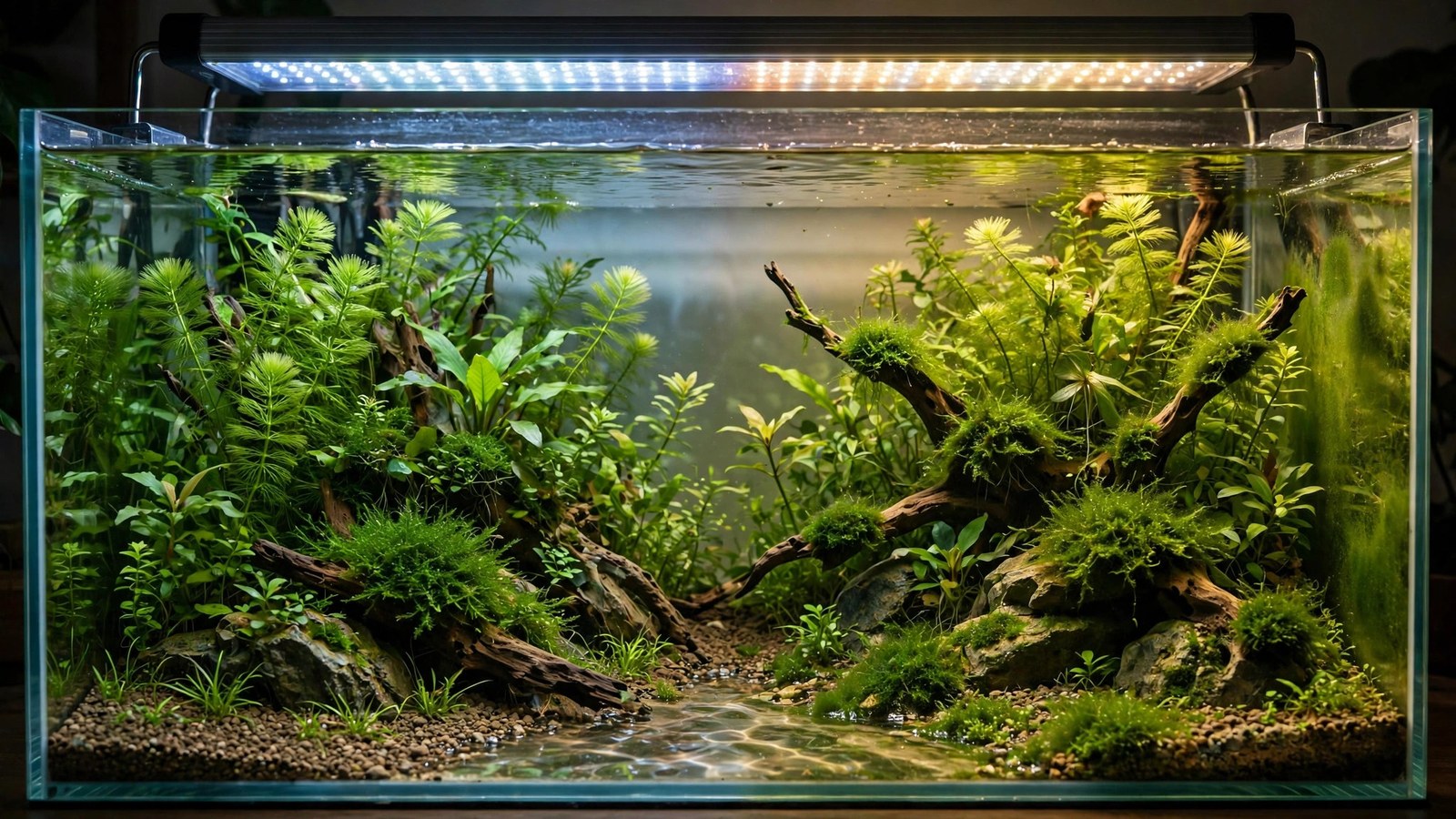
"Blue light causes algae." "Red light causes algae." "You need 6500K or you'll get algae." The hobby is full of confident claims linking light spectrum to algae — most of them wrong, or right for the wrong reasons. The real relationship between spectrum and algae is subtler and more useful than the myths. Here's what actually triggers blooms and what spectrum really does.
The Core Truth: Algae Eats Light, Not Colors
Algae are photosynthetic organisms, and like plants, they use the full PAR band (400–700 nm). No visible color of light grows algae while another doesn't — green algae, the most common aquarium pest, photosynthesizes happily under blue, red, or white light. The idea that you can pick a spectrum that feeds plants but starves algae is biologically incoherent: plants and algae want the same photons.
What actually drives algae is total light energy (intensity × duration) relative to the system's ability to use it. When photon supply exceeds what plants (plus their CO2 and nutrient supply) can consume, the surplus grows algae — regardless of whether those photons are blue, red, or white. Spectrum is a distant secondary factor; dose is the primary one. This is why too much light and overlong photoperiods cause algae under every spectrum ever sold.
Where Spectrum Myths Come From
"Blue light causes algae"
The grain of truth: blue light penetrates water best and is highly photosynthetically efficient — so intense blue-heavy light grows everything fast, including algae. But that's an intensity effect wearing a spectrum costume. A dim blue light grows nothing; a bright white light grows algae just fine. Blaming blue is like blaming the color of a car for speeding.
"Red light causes algae"
Red photons are photosynthetically efficient too (plants use red very well — it's why grow lights are purple). Heavy-red "planted tank" spectrums grow plants vigorously, and in an unbalanced tank (excess light, insufficient CO2), that vigor includes algae. Again: dose and balance, not color.
"6500K prevents algae"
6500K (daylight white) is recommended because it's pleasant to view and grows plants well — not because it has anti-algae properties. Tanks at 6500K get algae whenever they're over-lit, under-maintained, or CO2-limited, exactly like every other color temperature. The Kelvin rating of your light has essentially zero predictive power for algae.
"Green light is safe because algae can't use it"
Plants reflect green (that's why they're green) but still absorb a meaningful fraction — and many algae are less picky than the myth suggests. More importantly, a tank lit only in green looks like a swamp and grows plants poorly. Nobody should optimize for this.
What Spectrum Genuinely Affects
Spectrum isn't irrelevant — it just matters for different things than algae:
- Plant coloration: red plants color up best with strong red/blue components and high intensity; the spectrum influences anthocyanin production. This is aesthetic, not anti-algae.
- Plant morphology: blue-heavy light tends toward compact growth; red-heavy toward elongation. Useful for shaping growth habits.
- Viewing aesthetics: the spectrum you choose determines whether your tank looks crisp, warm, or washed out — pick what pleases your eye.
- Photosynthetic efficiency: red and blue photons drive photosynthesis slightly more efficiently per photon than green — but modern white LEDs already include plenty of both, so this rarely limits real tanks.
For the full picture, see light spectrum for aquarium plants.
The Real Algae Triggers (Ranked)
If spectrum isn't the culprit, what is? In rough order of importance:
- Excess total light dose — too intense, too long, or both, relative to plant mass and CO2/nutrient supply. The #1 trigger, by far.
- CO2 limitation or instability — in injected tanks, fluctuating or inadequate CO2 under strong light is the classic staghorn/BBA trigger. Stable CO2 timing matters more than any spectrum tweak; Tropica's fertiliser and CO2 guide explains the pH/KH/CO2 relationship you can use to verify your injection is actually stable.
- New-tank instability — fresh setups with immature biofilms and unsettled plants are algae-prone under any light. Start dim and ramp up.
- Excess organics — overfeeding, decaying plant matter, dirty filters. Algae feeds on the ammonia and organics; light just provides the energy.
- Photoperiod creep — the "it's only on for..." schedule that's actually 12 hours including long bright ramps. Audit with a timer.
- Spectrum — a distant sixth, and only via intensity-distribution quirks (e.g., a fixture whose "blue channel" is far stronger than its white, effectively raising intensity when you crank it).
RGB and Adjustable-Spectrum Fixtures: Practical Advice
Many modern fixtures let you tune red/green/blue channels independently. How to use this without falling for spectrum myths:
- Tune for looks first. Set the spectrum that makes your tank beautiful to your eye — that's its primary purpose.
- Watch total intensity when adjusting channels. Cranking the blue channel to 100% while white sits at 50% may significantly raise total PAR — the resulting algae is an intensity effect. If you change spectrum, re-verify intensity (ideally with a PAR meter, or by watching the tank for two weeks).
- Don't chase "anti-algae spectrums." There is no channel combination that grows plants but not algae. Anyone selling that idea is selling something.
- Red-boost for red plants is real — increasing red does improve red coloration in many species. Just do it as part of a balanced total intensity, not as an add-on blast.
- Moonlight/blue night modes: dim blue night lighting is for viewing, not growing — keep it truly dim (see moonlights and plants).
UV Light: The Actual Spectrum Exception
One wavelength band genuinely kills algae: ultraviolet (UV-C) — which is why UV sterilizers clear green water. But that's sterilization (DNA damage), not photosynthesis, and it requires a dedicated UV unit with proper dwell time — your light fixture's spectrum has nothing to do with it. Don't confuse "UV sterilizer kills algae" with "light spectrum prevents algae." Entirely different mechanisms.
Diagnosing "Spectrum-Caused" Algae Correctly
"I changed my light's spectrum and got algae" — what usually happened:
- You changed intensity too. New spectrum preset, different channel levels → different total PAR. The algae responded to the dose change.
- You changed photoperiod. New light, new schedule, longer day — classic.
- Coincidence with another change. New lights often arrive with rescapes, new plants, or CO2 adjustments — any of which can trigger algae independently.
- The old light was dying. Replacing an aged, dimmed fixture with a fresh one at "the same setting" is actually a large intensity increase. See raising intensity safely.
Before blaming spectrum, audit in order: photoperiod length, intensity change, CO2 stability, maintenance consistency. The culprit is in that list ~99% of the time.
Frequently Asked Questions
Does blue light cause more algae than white light?
At equal PAR (equal photosynthetic intensity), no — algae grows equivalently. Blue light appears guiltier because blue-heavy fixtures are often run at high intensity (for the "pop" look) and blue penetrates to the substrate efficiently. Match the intensity and the difference vanishes. It's dose, not color.
What color temperature is best to avoid algae?
None — color temperature doesn't prevent algae. Choose 5000–7000K for pleasant viewing and good plant growth, then control algae through intensity, photoperiod, CO2 stability, and maintenance. Anyone promising an algae-proof Kelvin rating is mistaken or marketing.
Will turning down the red channel reduce my BBA?
No. Black beard algae responds to CO2 stability and organic load, not red photons. Dimming red just dims your tank (and washes out red plants). Fix BBA by stabilizing CO2, improving maintenance, and spot-treating with liquid carbon — not by fiddling with channels.
Do algae need different light than plants?
Fundamentally no — both photosynthesize across the PAR band. Some algae types have accessory pigments that use certain wavelengths slightly better, but the differences are far too small to exploit with fixture settings. You cannot starve algae of light while feeding plants; they're at the same table.
My LFS said my "planted tank" red-heavy light would prevent algae. True?
No — and this is a common sales pitch. Red-heavy spectrums grow plants vigorously, which in a balanced tank outcompetes algae — that's the kernel of truth. But the spectrum itself has no anti-algae property; an unbalanced red-heavy tank grows algae vigorously too. Balance prevents algae, not wavelengths.
Does a UV sterilizer count as spectrum control for algae?
It's light-based algae control, but via sterilization (UV-C damaging organisms passing through the unit), not via the tank's illumination spectrum. A UV sterilizer clears green water and reduces free-floating algae spores regardless of your light fixture's spectrum. It's a tool, not a spectrum strategy.
Stop Blaming the Rainbow
The spectrum-algae myths persist because they're comforting — they promise a settings tweak instead of the real work. But algae doesn't care about your color temperature; it cares about photon dose, CO2 stability, and maintenance. Set your spectrum for beauty, set your intensity and photoperiod for balance, keep the CO2 steady — and let the rainbow be pretty instead of guilty.
Tissue-culture plants are the exception — they’re grown in sterile gel and adapt with minimal melting, which is part of what you’re paying for. Plants bought submersed from another hobbyist’s tank also transition with little melt, since they’re already in the right form.
Which Plants Melt Most (and Least)
Heavy melters (expect significant leaf loss)
- Cryptocorynes — infamous for “crypt melt,” sometimes dropping every leaf after any disturbance. They almost always recover from the roots within weeks.
- Stem plants grown emersed — rotala, ludwigia, and hygrophila often shed lower emersed leaves while the growing tips transition.
- Amazon swords — emersed-grown swords typically lose their broad oval aerial leaves and replace them with longer submersed ribbon leaves.
Light melters
- Anubias, java fern, bucephalandra — slow-growing rhizome plants transition gradually; occasional old-leaf melt but rarely dramatic.
- Vallisneria — usually transitions well, though it dislikes the move itself and may sulk for a week.
- Floating plants — minimal melt since their leaves were already at the air-water interface.
The Acclimation Protocol
Step 1: Quarantine or dip first
Before acclimating to your tank’s conditions, make sure you’re not acclimating pests along with the plant. Run new arrivals through our quarantine and dip protocol — it adds days upfront but prevents months of regret.
Step 2: Float to temperature-match (30 minutes)
Float the bag or container in your tank for 20–30 minutes to equalize temperature. Plants are less temperature-sensitive than fish, but a 10°F shock on top of transplant stress is an avoidable insult.
Step 3: Trim before planting
Remove any leaves that are already damaged, yellowing, or heavily algae-covered — they won’t recover and they’ll rot in your tank, feeding algae. For stem plants, trim off the bottom inch and any emersed leaves that look unlikely to adapt; the plant wastes energy maintaining leaves it’s going to shed anyway. Keep the healthy growing tips — that’s where recovery starts.
Step 4: Plant correctly the first time
Follow our planting guide — right depth, crown exposed on rosettes, rhizomes unburied on epiphytes. Every uprooting and replanting restarts the acclimation clock, so get placement right on the first attempt. Decide where each plant goes before it goes in the water.
Step 5: Run a gentle first week
For the first 7 days after planting:
- Moderate light — run your normal photoperiod but consider dropping intensity 20–30% if your light is dimmable. Blast-level light on a melting plant grows algae on the dying leaves, not recovery.
- Stable CO2 — if you inject CO2, keep it consistent. Fluctuating CO2 during acclimation is a melt accelerator. If you’re low-tech, this doesn’t apply — see growing without CO2.
- Half-strength fertilizer — new plants with damaged leaves can’t use full dosing, and the excess feeds algae. Ramp to full strength over 2–3 weeks per our fertilizer schedule.
- No disturbance — don’t move, trim, or “check on” new plants for at least two weeks. Every touch resets root establishment. This is especially critical for crypts.
Step 6: Remove melt, keep the base
As emersed leaves melt, remove the mushy material promptly — decaying leaves release ammonia and grow fungus that can spread to healthy tissue. But never discard the plant while the crown, rhizome, or roots are firm and alive. A crypt that’s lost every leaf but has firm roots is a plant that’s about to recover, not a dead plant. Give it 3–4 weeks before judging.
Telling Normal Melt From Real Problems
Normal transition melt:
- Affects oldest/emersed leaves first, newest growth last
- New submersed leaves emerge even as old ones dissolve
- Roots and crown stay firm and white/green
- Timeline: 1–4 weeks, then obvious new growth
Concerning melt (see our full melting diagnosis guide):
- New growth also melts or emerges deformed
- Rhizome or crown turns mushy and brown — this is rot, not transition
- Entire plant dissolves within days with no new growth after 4+ weeks
- Melting spreads to established plants that weren’t recently moved
Buying Tips to Minimize Melt
- Buy submersed-grown when available — hobbyist-grown cuttings transition with almost no melt.
- Choose tissue culture for sensitive species — crypts and delicate stems establish far more reliably from sterile cups.
- Avoid plants already melting in the store tank — some melt is normal, but a plant that’s mostly mush at purchase has less energy for recovery.
- Transport carefully — keep plants damp and out of direct sun/heat. A plant that dries out or cooks in a hot car melts far worse than one transported properly.
The First-Month Timeline: What to Expect Week by Week
Knowing what’s normal when removes most acclimation anxiety. Here’s the typical timeline for a healthy plant adapting to a new tank:
Week 1: The quiet week
Almost nothing visible happens. The plant is growing roots you can’t see and assessing its new environment. Some species (vallisneria, stem plants) may start shedding their lowest leaves. This is normal. Resist the urge to “help” — no moving, no extra fertilizer, no light changes. The most common beginner mistake is intervening during a week when the correct action is nothing.
Week 2: Melt peaks
This is when emersed leaves give up in earnest. Crypts may drop everything; swords shed their broad aerial leaves; stem plants lose lower foliage. It looks catastrophic and it’s usually fine. Keep removing mushy material, keep conditions stable, and watch the crown and growing tips — if those are firm and green, recovery is already underway.
Week 3: The turn
New submersed-adapted leaves emerge — smaller, thinner, often a slightly different shade of green than the emersed foliage. Stem plant tips start growing visibly; crypts push tiny curled leaves from the crown; swords unfurl narrow ribbon leaves. This is the moment most beginners exhale for the first time.
Week 4+: Established
New growth outpaces melt, and the plant is functionally yours. You can resume full-strength fertilizer, normal trimming, and stop treating it as fragile. Some slow growers (anubias, bucephalandra) take 6–8 weeks to show obvious progress — that’s their normal speed, not a problem.
Acclimating Different Plant Formats
Tissue-culture cups
Sterile, pest-free, and already adapted to high-humidity (not emersed) growth — tissue cultures melt the least of any format. Rinse the agar gel off gently (leftover gel rots and feeds fungus), split the portion into small plantlets, and plant per our planting guide. They establish slowly for the first two weeks, then accelerate. No dip needed, minimal acclimation stress — this is the premium experience you’re paying for.
Potted plants
Remove the pot and strip away the rockwool completely — leftover rockwool traps debris and rots. Tease the root mass apart gently; if it’s a dense mat, splitting it into 2–3 smaller portions actually establishes faster than planting one big clump (more growing points, better water flow around roots). Potted plants are usually emersed-grown, so expect the standard 2–4 week melt cycle.
Bare-root / bunched stems
Typically sold as weighted bunches. Remove any bands, foam, or weights, strip the lower leaves, and plant stems individually or in small groups. Bunched stems from the store are often already transitioning — check for new submersed growth at the tips, which tells you the plant is mid-adaptation and will settle quickly.
Hobbyist cuttings
Already submersed-grown and the fastest to establish — often showing new growth within days. The main acclimation factor is water-parameter difference between the two tanks. Float to temperature-match, plant promptly, and they’ll usually take off with minimal melt. This is why experienced hobbyists prefer trading cuttings over buying potted plants.
Frequently Asked Questions
Should I use a “plant starter” or transplant fertilizer?
Products marketed for transplant shock are mostly B-vitamins and mild hormones. They don’t hurt, but there’s no strong evidence they help aquarium plants specifically. Stable conditions and patience outperform any bottle. Save the money for more plants.
My new plant melted completely — bare crown, no leaves. Is it dead?
Probably not, if the crown or rhizome is firm. Crypts and swords routinely lose 100% of their leaves and regrow from the base within a month. The test is firmness: firm and pale/green means alive; mushy and brown/black means rot. Give firm-but-leafless plants a full 4 weeks before declaring them dead.
Can I speed up acclimation with extra light or CO2?
No — and trying usually backfires. A melting plant can’t use extra light; the excess just grows algae on its dying leaves. Keep light moderate and CO2 stable (not boosted) during acclimation. Growth speed comes from the plant’s own adaptation timeline, which you can’t rush, only avoid delaying.
Should new plants go straight into my main display tank?
After quarantine/dipping, yes — there’s no benefit to a separate “growing-in” tank for most plants. They acclimate to your water fastest in the tank they’ll live in. The exception is very delicate species going into a tank with boisterous fish; give those a few weeks in a calm corner or breeder box first.
The Patience Rule
The single most important acclimation skill is restraint: plant it right, set gentle conditions, remove decay, and then leave it alone for a month. The hobbyists with the best plant growth aren’t doing something clever in week one — they’re simply not interfering in weeks two through four while the plants do what they’ve evolved to do. Melt looks like failure and feels like failure, but in most cases it’s the visible part of a plant successfully becoming yours.