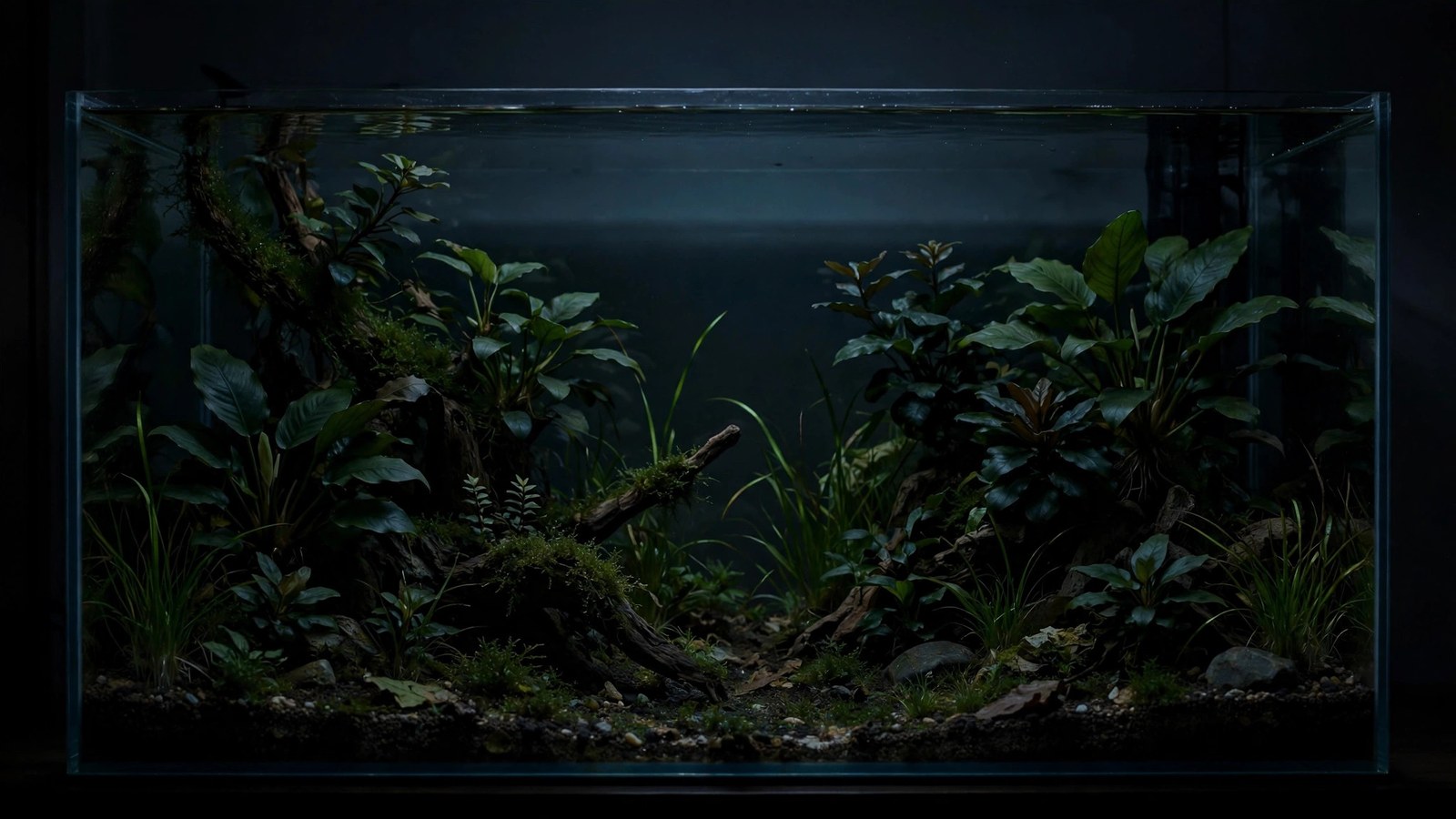
Do aquarium plants need darkness? Yes — a daily dark period is just as important as the light itself. Aquatic plants evolved under a rhythm of day and night, and many of their essential processes, from respiration to nutrient transport to hormone signaling, run on that cycle. Without darkness, plants grow stressed, algae seize the advantage, and your fish never truly rest. Here is what the science actually says about why the dark period matters and how to set it up right.
Do Aquarium Plants Need Darkness? The Short Answer: Yes
It is tempting to think of light as the only thing that matters for aquarium plants — after all, light drives photosynthesis, and photosynthesis drives growth. But plants do not photosynthesize around the clock, and more light hours are not always better. A consistent dark period of roughly 10 to 18 hours per day (meaning 6 to 14 hours of light) is the norm in healthy planted tanks, and dropping below that rest period invites a cascade of problems.
During the day, plants fix carbon dioxide into sugars. During the night, they switch to respiration — burning some of those sugars to fuel cell repair, root growth, nutrient uptake, and the synthesis of new tissue. Growth you see today was powered by energy stored yesterday and metabolized overnight. Deny a plant its night, and you are effectively denying it the time to convert food into actual growth.
There is also a signaling layer. Plants track day and night through photoreceptor proteins (phytochromes and cryptochromes) that regulate growth hormones, leaf movement, and stomatal behavior. A stable light-dark cycle keeps these rhythms synchronized; an erratic or endless light schedule scrambles them. As Colorado State University Extension puts it in their guide to plant growth factors and light, plants are "generally intolerant of continuous light for twenty-four hours" because many important physiological processes — including repair of the photosynthetic machinery — occur at night. The result of perpetual light is not "extra growth" — it is confused, inefficient, stressed plants.
What Plants Actually Do in the Dark
Respiration and growth
Respiration happens all the time, even in daylight — but at night it becomes the dominant metabolic activity. This is when plants translocate sugars from leaves to roots and rhizomes, build cell walls, extend root hairs, and take up nutrients like nitrogen, phosphorus, and potassium through their roots. Much of a stem plant's overnight "housekeeping" happens in the dark, which is why a tank with a stable photoperiod often shows a burst of new growth in the first hours after lights-on.
CAM and the carbon story
Some aquatic plants, including certain Cryptocoryne and Vallisneria species, can switch toward CAM (Crassulacean Acid Metabolism) or CAM-like behavior under stress — fixing CO2 at night when dissolved carbon is harder to compete for, then photosynthesizing with stored carbon by day. This is an adaptation to environments where daytime CO2 is scarce. Whether or not your particular species use CAM heavily, the mechanism exists because the day-night cycle is fundamental to how aquatic plants manage carbon. (A good primer on these photosynthetic pathways is the University of Nebraska–Lincoln Extension publication EC1268 "Plant Growth Processes: Transpiration, Photosynthesis, and Respiration".)
Hormonal reset
Auxins and other growth hormones accumulate and redistribute on a circadian schedule. Consistent darkness keeps the plant's internal clock — its circadian rhythm — entrained to your light schedule, so processes like leaf expansion, nutrient allocation, and gas exchange peak when they should. Random or perpetual light flattens these rhythms and the plant spends energy out of sync, like a person with permanent jet lag.
Why 24/7 Lighting Hurts More Than It Helps
The most common myth in the planted-tank hobby is that leaving the lights on longer equals more growth. In practice, the opposite happens once you pass the plant's saturation point — and the biggest winner of endless light is never your plants.
The algae advantage
Algae are opportunists. Given continuous light, filamentous and green-water algae can keep photosynthesizing through the hours when your plants have already saturated their daily carbon budget and stopped growing efficiently. Plants hit a point of diminishing returns each day; algae mostly do not. This is why tanks run on excessive photoperiods (14+ hours, or lights never off) almost always develop algae problems long before the plants show any "extra" growth. For more on the underlying mechanism, see our breakdown of the connection between light spectrum and algae blooms.
Photoinhibition and bleaching
Beyond a certain daily light dose, plants suffer photoinhibition: the photosynthetic machinery gets damaged faster than it can repair itself. Symptoms look like nutrient deficiencies — pale or bleached new leaves, stalled tips, transparent patches — which is why hobbyists often chase fertilizer fixes for what is actually a light problem. If your plants look washed out despite good ferts and CO2, check whether you are simply running the lights too long before changing anything else. Our guide to signs of too much light covers the full symptom list.
Fish, shrimp, and invertebrates never rest
The dark period is not just for plants. Fish and shrimp need darkness to rest, regulate stress hormones, and behave normally. Chronic light exposure stresses fish — suppressed immunity, faded coloration, skittish behavior — and interferes with the nocturnal routines of many shrimp and catfish species, which feed and molt under cover of darkness. Even a low ambient glow all night can disrupt them.
Oxygen crashes before dawn
Here is the hidden chemistry: plants photosynthesize oxygen only in light, but everyone in the tank — plants, fish, bacteria — respires and consumes oxygen all night. The lowest dissolved-oxygen point of the 24-hour cycle is always just before lights-on. In a heavily stocked or CO2-injected tank, an overlong photoperiod followed by a long dark stretch with heavy livestock respiration can push oxygen uncomfortably low, and you may see fish gasping at the surface before dawn. A balanced photoperiod keeps this cycle within safe bounds.
How Long Should the Photoperiod Be?
The sweet spot for most planted tanks is 6 to 10 hours of light per day, with the exact number depending on your setup's light intensity, CO2 level, and plant selection. Start at 8 hours, observe for two to three weeks, and adjust.
| Tank type | Recommended photoperiod | Notes |
|---|---|---|
| Low-tech, no CO2, easy plants (Anubias, Java fern, mosses) | 6–8 hours | Start low; slow growers need less total light energy |
| Medium light, liquid carbon or light CO2 | 8 hours | The classic all-rounder starting point |
| High light + pressurized CO2, carpeting plants | 8–10 hours | Higher intensity needs more discipline about duration, not less |
| Newly planted / cycling tank | 5–6 hours, ramp up | Start short and increase gradually as plants establish and acclimate |
| Algae outbreak recovery | 6 hours or a blackout period | Reduce the photoperiod before reducing anything else |
One counterintuitive rule: higher light intensity usually pairs with a shorter photoperiod, not a longer one. What matters is the total daily light dose (intensity × duration). Blasting a tank for 12 hours at high PAR is how you grow a magnificent crop of hair algae. For the deeper math on matching hours to your setup, read our photoperiod duration guide comparing 6 vs 8 vs 10 hours, matched to how much light aquarium plants actually need.
What About "Siesta" Periods?
The siesta regimen — splitting the photoperiod into two blocks with a dark rest in the middle, e.g. 4 hours on, 4 off, 4 on — has a devoted following. The theory is that the midday break lets CO2 rebuild in the water (from respiration and decomposition), so plants get a "fresh" carbon supply for the second session, and that algae dislike the interrupted cycle more than plants do.
The honest assessment: siestas can help in low-tech tanks without injected CO2, where carbon genuinely depletes by midday. But they are not magic, and they are not necessary. A single stable 8-hour block works perfectly well for most tanks. If you want to try it, make the dark gap at least 3–4 hours to count as a real break. We evaluate the evidence in detail in our siesta lighting guide.
Moonlights and Blue "Night" Lights: Do They Count as Darkness?
Those faint blue moonlight settings on modern LEDs are one of the hobby's biggest misconceptions. To your eyes, they look like darkness. To plants and fish, they are still light — just dim.
True moonlight in nature is extremely dim (fractions of a lux) and rich in blue wavelengths, and there is debate about how much it affects aquatic life. But a typical LED "moonlight" mode is far brighter than actual moonlight — bright enough to be seen clearly across a room — and it runs for hours. Plant photoreceptors are sensitive to blue light, so a blue nightlight running all night can partially suppress the dark-period processes described above and keep algae ticking over. Our deep dive on whether moonlights affect aquarium plants covers the research.
The practical rule: if your moonlight mode lets you clearly see plants and fish, treat it as light, not darkness, and count it toward your photoperiod. If you love the moonlit look, run it for 30–60 minutes as a dusk wind-down — ideally with a sunrise/sunset ramping schedule — and then let the tank go truly dark.
A reliable pick here is hygger Auto On Off LED with moonlight mode.
Setting Up a Proper Light/Dark Cycle
Use a timer — always
A plug-in timer that turns lights on and off at the same time every day is one of the hobby's highest-value upgrades. Pick hours that suit your viewing — say 14:00 to 22:00 — so the tank is lit when you are home to enjoy it.
Block ambient room light
A dark period only works if it is actually dark. A tank in a bright living room with the TV blazing until 2 a.m. is not getting a real night. Ambient room light feeds algae even when your main fixture is off, and it leaks into the plants' dark period. Position the tank away from windows, dim nearby lamps, or use a tank background and lid to cut stray light. Blackout curtains are the nuclear option; usually just turning off the nearest lamp is enough.
Start conservative and adjust
- New tank or new plants: start at 6 hours.
- Observe 2–3 weeks: new leaves, pearling, no algae surge.
- If plants stall and water is clean: add 30–60 minutes.
- If algae appears: cut 1 hour before touching fertilizers or CO2.
- Never change more than one variable at a time.
The last rule is the whole secret: photoperiod is the easiest variable to change — and the first one to suspect.
A reliable pick here is BN-LINK 7-day digital timer.
Light Stress vs. Dark Deprivation: How to Tell the Difference
Both problems stem from the light schedule, but they look different — and the fixes are opposite, so diagnosis matters.
| Symptom | More likely: too much light | More likely: too little darkness |
|---|---|---|
| Algae on leaves and glass | Yes — classic sign | Possible if total light hours are excessive |
| Bleached or transparent new leaves | Yes — photoinhibition | Less typical |
| Leggy, stretched stems reaching upward | No — this is a low light sign | No — same, insufficient light |
| Plants look fine but algae keeps winning | Yes — plants saturated, algae not | Yes — effectively the same cause |
| Fish pale, hiding, skittish at "night" | — | Yes — no real dark period |
| Fish gasping at dawn | — | Yes — heavy livestock respiration overnight; check oxygen |
When in doubt, shorten the photoperiod first. It is the cheapest, safest, fastest intervention in the planted tank — and it works more often than any fertilizer change.
Frequently Asked Questions
Can I leave my aquarium light on 24/7?
No — continuous lighting is one of the fastest ways to wreck a planted tank. Once plants saturate their daily carbon and nutrient budget, extra hours buy zero additional growth while algae keep photosynthesizing happily. You will get algae blooms, stressed plants with bleached new growth, exhausted fish that never rest, and wasted electricity. No serious aquascaper runs 24/7 lighting; the universal standard is 6–10 hours on a timer.
How many hours of darkness do aquarium plants need?
Aim for at least 10–12 hours of darkness per day, which pairs with 8–10 hours of light on the short end of rest. Low-light tanks running a 6-hour photoperiod get 18 hours of darkness and thrive perfectly well — plants are not "missing" anything during the night; they are respiring, growing roots, and preparing for the next light cycle. Consistency of the schedule matters more than hitting an exact number.
Do aquarium plants grow at night?
Yes, actively. Photosynthesis stops in the dark, but respiration takes over and much of the plant's construction work — cell division, root extension, transporting sugars from leaves to growing tips — happens overnight. This is why well-rested tanks often show visible new growth each morning. A plant without darkness is like a construction site that never gets its delivery trucks: raw materials pile up, but nothing gets built.
Is a blue moonlight the same as darkness for plants?
No. Aquarium moonlight modes are dramatically brighter than real moonlight and rich in blue wavelengths that plant photoreceptors detect. Running one all night can partially suppress dark-period processes and sustain algae. Treat any nightlight bright enough to clearly see the tank as light, not darkness — keep it to a short dusk wind-down of 30–60 minutes, then go fully dark.
Will a split "siesta" photoperiod help my plants?
It can help low-tech tanks without injected CO2, where a midday dark break lets dissolved carbon rebuild for a second growth session, and some hobbyists report less algae with a split schedule. But it is optional, not essential — a single stable 6–10 hour block grows plants just as well in most setups. If you try a siesta, make the dark gap 3–4 hours minimum; shorter interruptions have no real effect.
Should I turn off CO2 at night along with the lights?
Yes, in almost every case. Plants do not consume CO2 in the dark, so injected gas simply accumulates, dropping pH and risking fish. Run CO2 only during the photoperiod — typically starting 1–2 hours before lights-on and shutting off about an hour before lights-off. A solenoid on the same timer as your lights makes this automatic.
The Bottom Line
Darkness is not the absence of care — it is half of the care. Give your tank 6 to 10 hours of good light on a timer, then let it go genuinely dark: no moonlight glow, no TV bleed, no "just leaving it on tonight." Your plants will use the night to turn today's sunlight into tomorrow's growth, your algae will lose their unfair advantage, and your fish will finally get some sleep. Set the timer, trust the dark, and watch the tank thrive.