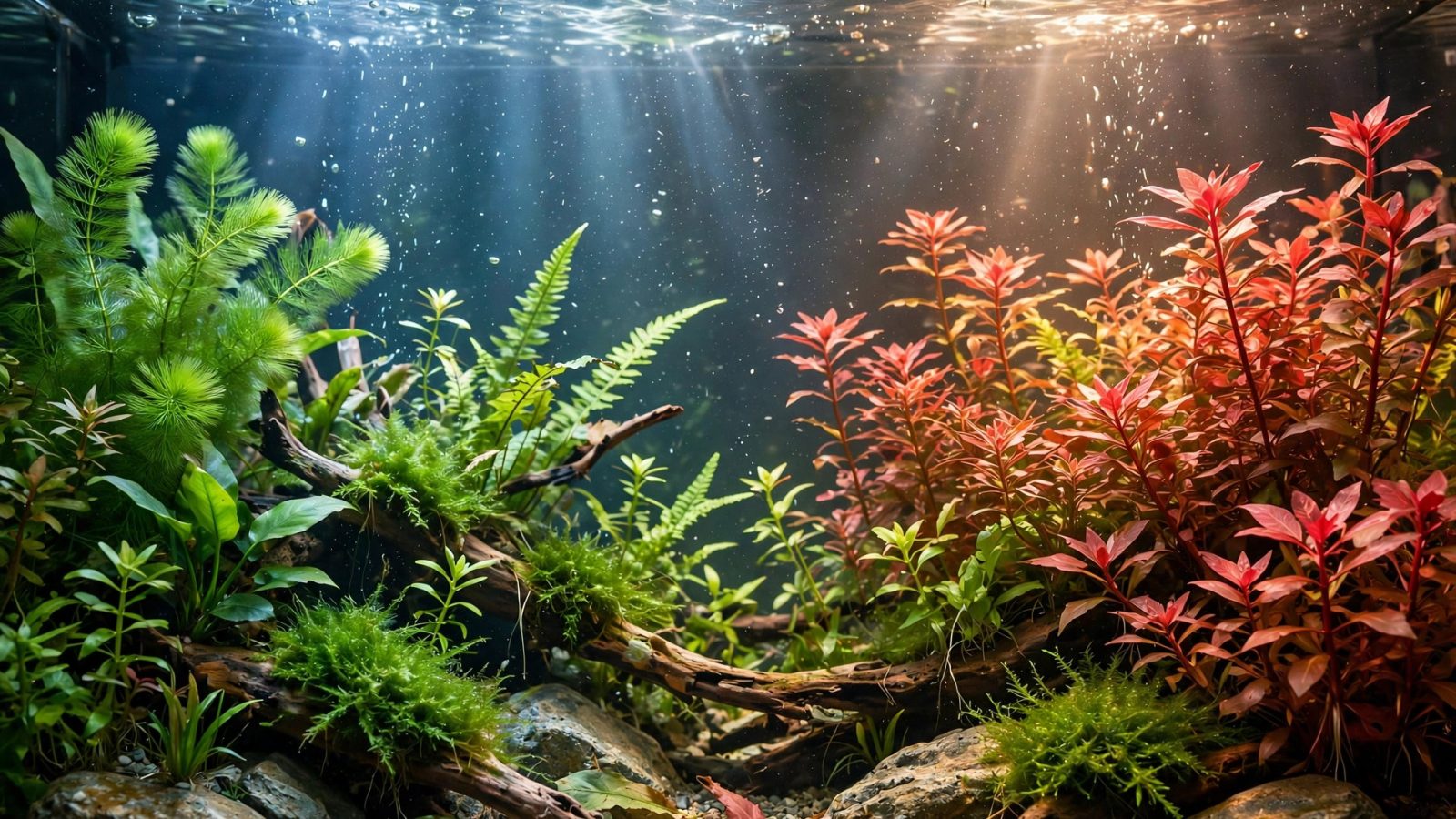
Kelvin, RGB, full-spectrum, 6500K, pink “plant lights” — aquarium lighting marketing is a fog of spectrum claims, most of them designed to sell fixtures rather than grow plants. This guide cuts through it: what light spectrum actually means for photosynthesis, which specs matter, and what’s pure marketing.
Spectrum Basics: What Plants Use
Plants photosynthesize using PAR (400–700 nm) — the visible light band. Within it, chlorophyll absorbs most strongly in blue (~450 nm) and red (~660 nm), and least in green (~550 nm, which is why plants look green — they reflect it).
The crucial nuance: plants use the entire PAR range, just with varying efficiency. Green light penetrates deeper into leaf tissue and into the lower canopy, contributing meaningfully to photosynthesis despite lower chlorophyll absorption. White light containing all wavelengths grows plants excellently — which is why plain daylight-spectrum LEDs work so well.
Kelvin: Color Temperature Explained
Kelvin (K) describes the color appearance of white light, not its plant-growing power:
- 2700–3000K: warm yellowish (incandescent-like). Grows plants fine but looks dingy over an aquarium.
- 5000–6500K: neutral daylight. The standard for planted tanks — natural color rendition, excellent growth.
- 7000–10000K: cool bluish-white. Popular in the hobby (many “planted” LEDs are 7000K+); looks crisp, grows plants well.
- 15000K+: very blue. Reef territory — wrong aesthetic and suboptimal spectrum for freshwater plants.
Kelvin tells you how the light looks, not how well it grows plants. A 6500K and a 7500K fixture with equal PAR grow plants near-identically; pick based on which appearance you prefer. Anyone claiming a magic Kelvin number for plant growth is selling something.
RGB vs Full-Spectrum White
Two design philosophies dominate planted-tank LEDs:
Full-spectrum white (phosphor-converted LEDs)
Blue LED chips coated with phosphor that re-emits across the spectrum — the same tech as household bulbs. Produces smooth, continuous spectrum heavy in blue-green with a red phosphor bump. Advantages: natural color rendition, simple, efficient, cheap. The budget low-tech fixtures use these, and they grow plants superbly.
RGB (discrete red, green, blue diodes)
Separate colored LEDs mixed to make white. Advantages: tunable color (dial in the exact look you want via app), often stronger red peaks for enhanced red-plant coloration, and striking visual pop. Disadvantages: cost, complexity, and potential color-fringing (rainbow edges on shadows) in cheaper implementations. Premium fixtures (Chihiros WRGB, Twinstar S) execute this well.
For plant growth, both work. RGB’s advantage is aesthetic control and red rendition; white’s advantage is simplicity and value. Don’t pay double for RGB expecting double the growth — you’re buying the look.
The Red Light Question
Red diodes deserve special attention because they’re the most oversold spectrum feature:
- What red does: drives photosynthesis efficiently (chlorophyll’s peak absorption) and stimulates anthocyanin (red pigment) production. Red-heavy spectrum genuinely enhances red plant coloration.
- What red doesn’t do: magically grow plants better than equivalent PAR of white light. A watt of red and a watt of white at equal PAR grow plants equivalently — the plant cares about photons, not marketing.
- The pink-light trap: old “plant grow lights” (heavy red + blue, little green) look magenta and make your tank ugly. They were designed for terrestrial grow-ops, not display aquariums. Modern planted-tank lights include red within a balanced white — that’s the right approach.
What About UV and Far-Red?
Some premium fixtures now include UV-A or far-red (730 nm) diodes. The evidence for aquarium benefit is thin: far-red can trigger shade-avoidance responses (stretching — the opposite of what aquascapers want), and UV’s purported color benefits are unproven in aquatic plants. These are differentiators looking for a justification. Don’t pay extra for them; don’t avoid a fixture that has them. They’re essentially irrelevant.
Spectrum Marketing Claims, Debunked
- “Optimized plant spectrum”: meaningless without PAR data. Every manufacturer claims this.
- “Mimics the Amazon sun”: evocative, unverifiable, irrelevant. Your tank isn’t the Amazon.
- “X% more PAR than competitors”: sometimes true, usually measured under favorable conditions. Check independent hobbyist measurements.
- “Full spectrum” as a premium feature: all white LEDs are full-spectrum by definition. It’s like advertising “wet water.”
- Color temperature as a growth spec: Kelvin describes appearance. PAR describes growth. Conflating them is the most common spectrum deception.
What Actually Matters (Ranked)
- PAR at your substrate depth — the only intensity metric that counts. See how much light plants need.
- Even coverage — no dead corners, no blazing hotspot.
- Dimming capability — lets you tune intensity to your CO2 and ferts.
- Color appearance you enjoy looking at — 6500K-ish daylight for natural, RGB-tunable for dramatic. Your preference, honestly.
- Red content — a modest tiebreaker if you grow red plants; irrelevant otherwise.
Everything else is noise. Buy PAR and coverage; choose color by eye; ignore the rest of the spec sheet.
The Bottom Line
Plants are not picky about spectrum — they’re picky about intensity. Any modern daylight-spectrum LED with adequate PAR grows plants well; RGB adds aesthetic control, not growing power. When evaluating fixtures, read the PAR chart first and the marketing copy never. Our lighting roundup compares real fixtures on the metrics that matter.
Wavelength Deep Dive: What Each Color Does
- Violet/blue (400–500 nm): strongly absorbed by chlorophyll; drives compact, bushy growth. Blue-heavy light keeps internodes short — desirable for aquascaping. Excess blue without red can make growth stunted rather than compact.
- Green/yellow (500–600 nm): weakly absorbed by surface chlorophyll but penetrates deep into leaf tissue and down through the plant canopy to lower leaves. More useful than the old textbooks suggested — don’t fear green.
- Red (600–700 nm): chlorophyll’s other absorption peak; highly efficient for photosynthesis. Drives stem elongation (the opposite of blue) and anthocyanin production. Red-heavy light grows plants fast but leggy without balancing blue.
- Far-red (700–750 nm): triggers shade-avoidance (stretching). In nature, far-red enrichment signals “competitors overhead.” In aquariums, it’s mostly a side effect of warm-white phosphors — harmless at typical levels, but another reason not to chase exotic spectra.
The takeaway: balanced white light already contains all of these in sensible proportions. The hobby’s best fixtures succeed through intensity and coverage, not secret spectral recipes.
CRI: The Forgotten Spec
CRI (Color Rendering Index) measures how accurately a light renders colors versus natural daylight (100 = perfect). It matters enormously for your enjoyment and not at all for plants:
- CRI 80+: decent. Most budget LEDs. Fish look fine, greens look green.
- CRI 90+: excellent. Reds pop, fish colors glow, the tank looks vivid. Premium fixtures (Twinstar, ONF, ADA) prioritize this.
- CRI under 80: washed out. Cheap white LEDs can make a beautiful aquascape look flat.
Two fixtures with identical PAR can make the same tank look dramatically different. If you care about aesthetics — and aquascaping is aesthetics — CRI deserves weight in your decision alongside PAR. Our lighting roundup notes color rendition for each pick.
Do Plants Care About “Natural” Light Cycles?
Beyond the basic photoperiod, some hobbyists simulate seasons, cloud cover, or lunar cycles with programmable fixtures. The honest assessment: plants respond to consistent photoperiods; there’s no evidence aquarium plants benefit from simulated weather. Fish may find gradual seasonal shifts mildly enriching, but it’s aquarist enjoyment, not biology. Program a stable 7–8 hour day with gentle ramps and spend the automation budget on a reliable timer setup instead.
Spectrum and Algae: Is There a Connection?
A persistent myth claims certain spectra (often blue-heavy) “cause” algae. The reality: algae photosynthesizes across the same PAR range as plants. Excess energy grows algae regardless of color — a dim blue light grows less algae than a bright red one. Spectrum tweaks don’t fix algae; intensity and duration adjustments do. If someone sells you a spectrum solution to an algae problem, they’re selling you a feeling, not physics. Address it with the too-much-light protocol instead.
Reading a Fixture’s Spectrum Graph
Premium manufacturers publish spectral power distribution graphs. How to read them:
- X-axis is wavelength (400–700 nm); Y-axis is relative intensity.
- Look for continuous coverage across the range — smooth curves (phosphor white) or well-blended peaks (good RGB). Sharp isolated spikes with deep valleys mean missing wavelengths.
- A blue peak ~450 nm and red shoulder ~630–660 nm with solid middle = the classic planted-tank profile.
- Graphs are relative, not absolute — a tall red peak doesn’t mean high PAR, just high red proportion. Always pair with PAR data.
- No published graph + no PAR data = buy something else.
Spectrum and Fish Coloration
An underappreciated spectrum effect: light color dramatically changes how fish look. Red-heavy spectra make cardinals and cherry barbs glow; blue-heavy light washes out warm colors but makes neon tetras’ stripes electric. This is purely aesthetic — fish don’t care — but since you’re buying a display light, factor it in:
- Warm/red-leaning light: flatters red, orange, and yellow fish; greens look rich. Can make the water look slightly amber.
- Neutral 6500K: honest rendition of everything. The safe default.
- Cool/blue-leaning light: crisp, modern look; blues and silvers pop, reds mute. Can make green plants look slightly teal.
RGB fixtures let you tune this per your livestock — one of their genuine advantages beyond plant growth. A tank of cardinal tetras under warm-tuned RGB looks fundamentally better than under cool white, with identical PAR.
The Future: What’s Actually Coming in Aquarium Lighting
Honest assessment of trends:
- Better apps and integration: real progress. Unified control of light, CO2 solenoid, and dosers from one app is genuinely useful.
- Higher efficiency diodes: incremental — 5–10% more PAR per watt every few years. Nice, not revolutionary.
- “AI-optimized spectra”: marketing. There’s no secret wavelength combination waiting to be discovered; plant photobiology is well understood.
- Cheaper precision: the real trend — last decade’s $400 performance at $150. This democratization matters more than any spectral innovation.
Buy for today’s proven metrics (PAR, coverage, dimming, CRI), not tomorrow’s promised breakthroughs.
Spectrum Cheat Sheet
- Plants use all visible wavelengths; intensity matters more than color recipe.
- 6500K-ish white is the proven default — everything else is preference.
- RGB buys aesthetic control and red rendition, not extra growth.
- Kelvin describes appearance; PAR describes growing power. Never confuse them.
- Red diodes help red plants color up; they don’t replace intensity or CO2.
- UV/far-red extras are irrelevant to your buying decision.
- CRI 90+ makes the same tank look significantly better to human eyes.
- No PAR data + no spectrum graph = no purchase.
Spectrum and Plant Form: The Photomorphology Bonus
Beyond photosynthesis, light color shapes how plants grow — photomorphogenesis:
- Blue-rich light: compact growth, short internodes, thicker leaves. The aquascaper’s friend — this is why “planted” fixtures skew slightly cool.
- Red-rich light: elongated stems, larger thinner leaves, stronger red pigmentation. Fast growth, leggier form.
- Balanced white: natural form — what the plant would do outdoors. The baseline everything else deviates from.
Advanced aquascapers exploit this: bluer light during the grow-in phase for compact carpets, then a redder tune for the photography phase to pop colors. It’s subtle — a 10–15% effect, not a transformation — but it’s real, and it’s the legitimate version of “spectrum matters.”
Key Takeaways
- Spectrum fine-tunes; intensity transforms. Get PAR right first.
- Any daylight white (5000–7500K) with adequate PAR grows plants well.
- RGB’s value is control and aesthetics, not magic growth.
- Photomorphology (blue = compact, red = leggy + colorful) is spectrum’s real secondary effect.
- Marketing beyond PAR + CRI + coverage is noise. Buy the numbers, not the story.