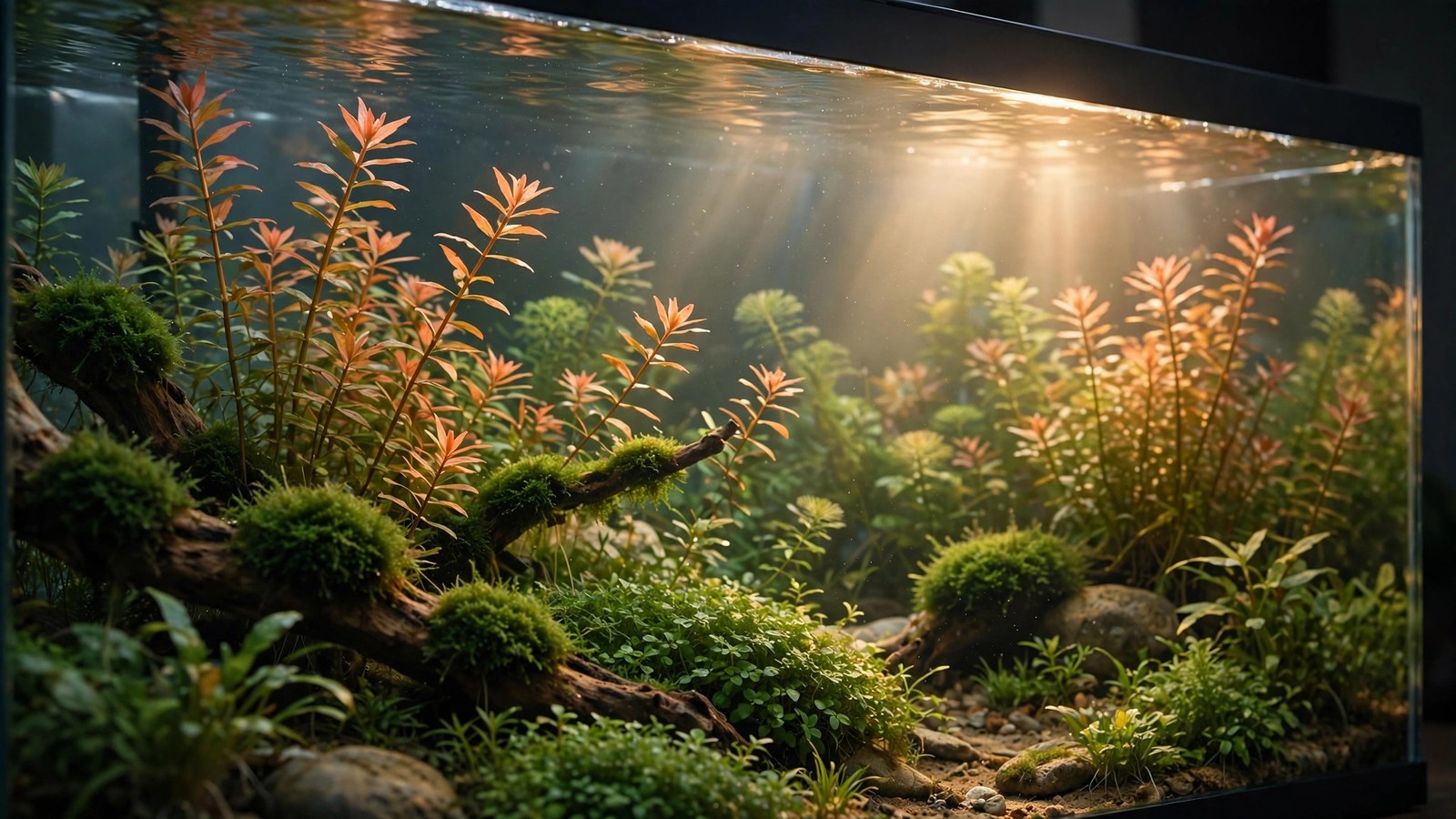
Modern LED fixtures love to advertise "natural sunrise/sunset simulation" — lights that ramp gently up in the morning and fade to dusk in the evening instead of snapping on and off. It looks gorgeous, and fish clearly appreciate the gentle transition. But aquarists keep asking the plant question: do aquarium plants care about sunrise/sunset ramping? The honest answer is nuanced — and it changes how you should program your light.
What Ramping Actually Does
A ramping schedule replaces the binary on/off with a gradual curve: 0% → 30-minute ramp → full intensity → hold → 30-minute fade → 0%. Some fixtures offer fancier curves (siesta dips, midday peaks, color-temperature shifts through the day). The light looks natural. The question is whether the biology notices.
What Plants Actually Perceive
Plants count photons, not aesthetics
Photosynthesis responds to total photon dose (intensity × time) far more than to how gracefully the light arrived. A plant receiving 8 hours at full intensity grows essentially the same whether the light snapped on or ramped over 30 minutes — the ramp periods contribute a small fraction of the day's total photons. From the plant's perspective, a 30-minute sunrise at low intensity is roughly equivalent to a few extra minutes of full light.
The photoperiod question: does ramping "count"?
This is where ramping genuinely matters for plants. Algae and plants both respond to the effective photoperiod — the hours of biologically meaningful light. Dim ramp light (under ~10–15% intensity) is below the compensation point for most plants and algae: it doesn't drive meaningful photosynthesis. So a schedule of "30-min ramp + 8 hours full + 30-min fade" is effectively an 8-hour photoperiod, not 9.
The practical rule: count only near-full-intensity hours toward your photoperiod. If you run long, bright ramps (some fixtures ramp over 1–2 hours at significant intensity), those hours do count — and a "10-hour day" that's really 8 full + 2 bright-ramp can push you into too-much-light territory. See photoperiod duration for targets.
Circadian rhythms: real but forgiving
Plants do have circadian clocks — they anticipate dawn, open stomata, and schedule metabolic processes on ~24-hour cycles. Research shows abrupt light transitions are mildly stressful compared to gradual ones, but aquarium plants are extraordinarily adaptable: millions of tanks run binary on/off timers with thriving plants. For a deeper dive into how intensity, spectrum, and duration interact for plant growth, the 2Hr Aquarist planted-tank lighting guide walks through PAR targets and photoperiod logic with worked examples for low-tech and high-tech setups alike. The takeaway for ramping purposes stays simple: once total dose and timing are right, the shape of the on/off transition is a distant third in importance — genuinely nice for livestock, essentially negligible for growth.
Who Ramping Really Benefits
Fish and shrimp: the clear winners
This is ramping's strongest case, and it's about livestock, not plants. Lights snapping on at full intensity startle fish — darting, flashing, and stress responses are common, especially in shy species. A 15–30 minute dawn ramp lets fish wake gradually, find cover or schooling positions, and start the day calm. Evening fade-outs similarly avoid the "lights out, everyone panics" scramble. If you keep skittish species (wild-caught tetras, dwarf cichlids), ramping is genuinely worthwhile welfare.
The aquarist: viewing pleasure
Let's be honest — a big part of ramping's appeal is that it looks fantastic. A tank that glows to life at dawn and settles into dusk is simply more enjoyable to live with. That's a legitimate reason to use it. This hobby is supposed to be beautiful.
Plants: marginal, mostly indirect
Direct plant benefits of ramping are small: slightly less transition stress, and the low-intensity periods are effectively "free" viewing time that doesn't extend the productive photoperiod. There's one indirect benefit worth noting — ramping makes intensity mistakes gentler. A too-strong light that ramps up gives you a visual warning (and gives plants a gentler onset) compared to a binary blast, though it doesn't fix the underlying over-intensity.
How to Program Ramping Correctly
- Keep ramps short-ish: 15–30 minutes each way is the sweet spot — enough for fish comfort and aesthetics, short enough not to meaningfully extend the photoperiod.
- Don't count dim ramp time as photoperiod. Your 8-hour target means 8 hours at (near) full intensity, plus ramps on either side. Program: ramp-up → 8h full → ramp-down.
- Watch total bright-ramp time. If your fixture's "sunrise" runs 2 hours at 40%+ intensity, that's real photosynthetic light — shorten it or reduce your full-intensity hours to compensate.
- Coordinate with CO2. Pre-inject CO2 so the tank is at target when the ramp finishes and full intensity begins — not when the first dim glow appears. Time the solenoid to the end of the sunrise ramp.
- Skip the midday "siesta" dips unless you're deliberately running a split photoperiod — random intensity dips just complicate CO2 stability for no plant benefit.
Ramping and Algae: The Real Concern
The main ramping risk isn't to plants — it's accidentally extending the effective photoperiod. Algae responds to the same photon dose logic as plants: long bright ramps add productive light hours, and if your "8-hour day" is secretly 10 hours of meaningful light, algae is the first to tell you. Symptoms of ramp-creep: algae increasing after you "only" added a pretty sunrise, with no other changes.
The fix is accounting, not abandonment: measure your schedule in full-intensity-equivalent hours. A 30-min ramp averaging 30% intensity ≈ 9 extra minutes of full light — negligible. A 90-min ramp averaging 60% ≈ 54 extra minutes — significant. Keep the bright portion of ramps short and the total honest.
What About Color-Temperature Shifting ("Natural Daylight Cycle")?
Some fixtures shift spectrum through the day — warm dawn, neutral noon, warm dusk, mimicking the sun. For plants, this is almost entirely cosmetic. Plants use the full PAR band regardless of color temperature; a warm-white dawn grows plants the same as a cool-white dawn at equal PAR. (Spectrum nuances exist — see light spectrum — but dawn/dusk color shifts are too brief and dim to matter biologically.) Enjoy the pretty sunrises; don't expect growth effects.
Frequently Asked Questions
Do plants grow better with sunrise/sunset ramping?
Not meaningfully. Plants respond to total daily photon dose, and ramp periods contribute little to it. Growth differences between ramped and binary schedules are negligible in practice. Ramping's real benefits are fish welfare (no startling) and aesthetics — both legitimate reasons, just not plant-growth reasons.
Should ramp time count toward my photoperiod?
Only the bright parts. Dim ramp light below ~15% intensity doesn't drive meaningful photosynthesis, so a 30-minute gentle ramp barely counts. But long, bright ramps (an hour+ at 40%+) contribute real photon dose — count those proportionally. When in doubt, keep ramps to 15–30 minutes and count only full-intensity hours.
Will ramping reduce algae?
Not by itself — algae responds to total light dose just like plants do. Ramping neither helps nor hurts algae if total photoperiod stays honest. But ramping that secretly extends bright-light hours will grow algae, which is why the accounting matters. Ramping is neutral; sloppy scheduling is not.
My light doesn't support ramping — am I harming my plants?
No. Binary on/off timers have grown world-class planted tanks for decades. Your plants don't need ramping; your fish would prefer it but survive fine without it (most adapt to the snap-on within days). If you want the benefit cheaply, a two-stage approach works: a dim room lamp or small secondary light on an earlier timer as a "pre-dawn," then the main light.
How long should sunrise/sunset ramps be?
15–30 minutes each way. Shorter than 15 minutes barely registers as a transition for fish; longer than 30–45 minutes starts contributing meaningful light to the photoperiod (depending on ramp brightness). Thirty minutes is the widely used sweet spot — gentle for livestock, negligible for the light budget.
Should CO2 start at the beginning or end of the sunrise ramp?
Time pre-injection to finish at the end of the ramp — the tank should hit target CO2 as full intensity begins. Starting gas 60–90 minutes before full intensity (which includes the ramp period) works: e.g., 30-min ramp ending at 12:00 with full light 12:00–20:00 → CO2 on around 10:30–11:00. Details in our CO2 timing guide.
Pretty, Fish-Friendly, and Plant-Neutral
Sunrise/sunset ramping is one of those features that's genuinely nice without being biologically important for plants: your fish wake up calmly, your living room gets a beautiful dawn effect, and your plants carry on counting photons exactly as before. Use it for the livestock and the aesthetics, program it honestly (ramps don't extend the photoperiod for free), and coordinate your CO2 with the end of the sunrise. One final tip: save two ramp profiles in your controller or app — a weekday schedule and a weekend schedule shifted a bit later — so the dawn effect matches when you're actually awake to enjoy it. Everyone — fish, plants, and you — gets what they need.
Tissue-culture plants are the exception — they’re grown in sterile gel and adapt with minimal melting, which is part of what you’re paying for. Plants bought submersed from another hobbyist’s tank also transition with little melt, since they’re already in the right form.
Which Plants Melt Most (and Least)
Heavy melters (expect significant leaf loss)
- Cryptocorynes — infamous for “crypt melt,” sometimes dropping every leaf after any disturbance. They almost always recover from the roots within weeks.
- Stem plants grown emersed — rotala, ludwigia, and hygrophila often shed lower emersed leaves while the growing tips transition.
- Amazon swords — emersed-grown swords typically lose their broad oval aerial leaves and replace them with longer submersed ribbon leaves.
Light melters
- Anubias, java fern, bucephalandra — slow-growing rhizome plants transition gradually; occasional old-leaf melt but rarely dramatic.
- Vallisneria — usually transitions well, though it dislikes the move itself and may sulk for a week.
- Floating plants — minimal melt since their leaves were already at the air-water interface.
The Acclimation Protocol
Step 1: Quarantine or dip first
Before acclimating to your tank’s conditions, make sure you’re not acclimating pests along with the plant. Run new arrivals through our quarantine and dip protocol — it adds days upfront but prevents months of regret.
Step 2: Float to temperature-match (30 minutes)
Float the bag or container in your tank for 20–30 minutes to equalize temperature. Plants are less temperature-sensitive than fish, but a 10°F shock on top of transplant stress is an avoidable insult.
Step 3: Trim before planting
Remove any leaves that are already damaged, yellowing, or heavily algae-covered — they won’t recover and they’ll rot in your tank, feeding algae. For stem plants, trim off the bottom inch and any emersed leaves that look unlikely to adapt; the plant wastes energy maintaining leaves it’s going to shed anyway. Keep the healthy growing tips — that’s where recovery starts.
Step 4: Plant correctly the first time
Follow our planting guide — right depth, crown exposed on rosettes, rhizomes unburied on epiphytes. Every uprooting and replanting restarts the acclimation clock, so get placement right on the first attempt. Decide where each plant goes before it goes in the water.
Step 5: Run a gentle first week
For the first 7 days after planting:
- Moderate light — run your normal photoperiod but consider dropping intensity 20–30% if your light is dimmable. Blast-level light on a melting plant grows algae on the dying leaves, not recovery.
- Stable CO2 — if you inject CO2, keep it consistent. Fluctuating CO2 during acclimation is a melt accelerator. If you’re low-tech, this doesn’t apply — see growing without CO2.
- Half-strength fertilizer — new plants with damaged leaves can’t use full dosing, and the excess feeds algae. Ramp to full strength over 2–3 weeks per our fertilizer schedule.
- No disturbance — don’t move, trim, or “check on” new plants for at least two weeks. Every touch resets root establishment. This is especially critical for crypts.
Step 6: Remove melt, keep the base
As emersed leaves melt, remove the mushy material promptly — decaying leaves release ammonia and grow fungus that can spread to healthy tissue. But never discard the plant while the crown, rhizome, or roots are firm and alive. A crypt that’s lost every leaf but has firm roots is a plant that’s about to recover, not a dead plant. Give it 3–4 weeks before judging.
Telling Normal Melt From Real Problems
Normal transition melt:
- Affects oldest/emersed leaves first, newest growth last
- New submersed leaves emerge even as old ones dissolve
- Roots and crown stay firm and white/green
- Timeline: 1–4 weeks, then obvious new growth
Concerning melt (see our full melting diagnosis guide):
- New growth also melts or emerges deformed
- Rhizome or crown turns mushy and brown — this is rot, not transition
- Entire plant dissolves within days with no new growth after 4+ weeks
- Melting spreads to established plants that weren’t recently moved
Buying Tips to Minimize Melt
- Buy submersed-grown when available — hobbyist-grown cuttings transition with almost no melt.
- Choose tissue culture for sensitive species — crypts and delicate stems establish far more reliably from sterile cups.
- Avoid plants already melting in the store tank — some melt is normal, but a plant that’s mostly mush at purchase has less energy for recovery.
- Transport carefully — keep plants damp and out of direct sun/heat. A plant that dries out or cooks in a hot car melts far worse than one transported properly.
The First-Month Timeline: What to Expect Week by Week
Knowing what’s normal when removes most acclimation anxiety. Here’s the typical timeline for a healthy plant adapting to a new tank:
Week 1: The quiet week
Almost nothing visible happens. The plant is growing roots you can’t see and assessing its new environment. Some species (vallisneria, stem plants) may start shedding their lowest leaves. This is normal. Resist the urge to “help” — no moving, no extra fertilizer, no light changes. The most common beginner mistake is intervening during a week when the correct action is nothing.
Week 2: Melt peaks
This is when emersed leaves give up in earnest. Crypts may drop everything; swords shed their broad aerial leaves; stem plants lose lower foliage. It looks catastrophic and it’s usually fine. Keep removing mushy material, keep conditions stable, and watch the crown and growing tips — if those are firm and green, recovery is already underway.
Week 3: The turn
New submersed-adapted leaves emerge — smaller, thinner, often a slightly different shade of green than the emersed foliage. Stem plant tips start growing visibly; crypts push tiny curled leaves from the crown; swords unfurl narrow ribbon leaves. This is the moment most beginners exhale for the first time.
Week 4+: Established
New growth outpaces melt, and the plant is functionally yours. You can resume full-strength fertilizer, normal trimming, and stop treating it as fragile. Some slow growers (anubias, bucephalandra) take 6–8 weeks to show obvious progress — that’s their normal speed, not a problem.
Acclimating Different Plant Formats
Tissue-culture cups
Sterile, pest-free, and already adapted to high-humidity (not emersed) growth — tissue cultures melt the least of any format. Rinse the agar gel off gently (leftover gel rots and feeds fungus), split the portion into small plantlets, and plant per our planting guide. They establish slowly for the first two weeks, then accelerate. No dip needed, minimal acclimation stress — this is the premium experience you’re paying for.
Potted plants
Remove the pot and strip away the rockwool completely — leftover rockwool traps debris and rots. Tease the root mass apart gently; if it’s a dense mat, splitting it into 2–3 smaller portions actually establishes faster than planting one big clump (more growing points, better water flow around roots). Potted plants are usually emersed-grown, so expect the standard 2–4 week melt cycle.
Bare-root / bunched stems
Typically sold as weighted bunches. Remove any bands, foam, or weights, strip the lower leaves, and plant stems individually or in small groups. Bunched stems from the store are often already transitioning — check for new submersed growth at the tips, which tells you the plant is mid-adaptation and will settle quickly.
Hobbyist cuttings
Already submersed-grown and the fastest to establish — often showing new growth within days. The main acclimation factor is water-parameter difference between the two tanks. Float to temperature-match, plant promptly, and they’ll usually take off with minimal melt. This is why experienced hobbyists prefer trading cuttings over buying potted plants.
Frequently Asked Questions
Should I use a “plant starter” or transplant fertilizer?
Products marketed for transplant shock are mostly B-vitamins and mild hormones. They don’t hurt, but there’s no strong evidence they help aquarium plants specifically. Stable conditions and patience outperform any bottle. Save the money for more plants.
My new plant melted completely — bare crown, no leaves. Is it dead?
Probably not, if the crown or rhizome is firm. Crypts and swords routinely lose 100% of their leaves and regrow from the base within a month. The test is firmness: firm and pale/green means alive; mushy and brown/black means rot. Give firm-but-leafless plants a full 4 weeks before declaring them dead.
Can I speed up acclimation with extra light or CO2?
No — and trying usually backfires. A melting plant can’t use extra light; the excess just grows algae on its dying leaves. Keep light moderate and CO2 stable (not boosted) during acclimation. Growth speed comes from the plant’s own adaptation timeline, which you can’t rush, only avoid delaying.
Should new plants go straight into my main display tank?
After quarantine/dipping, yes — there’s no benefit to a separate “growing-in” tank for most plants. They acclimate to your water fastest in the tank they’ll live in. The exception is very delicate species going into a tank with boisterous fish; give those a few weeks in a calm corner or breeder box first.
The Patience Rule
The single most important acclimation skill is restraint: plant it right, set gentle conditions, remove decay, and then leave it alone for a month. The hobbyists with the best plant growth aren’t doing something clever in week one — they’re simply not interfering in weeks two through four while the plants do what they’ve evolved to do. Melt looks like failure and feels like failure, but in most cases it’s the visible part of a plant successfully becoming yours.