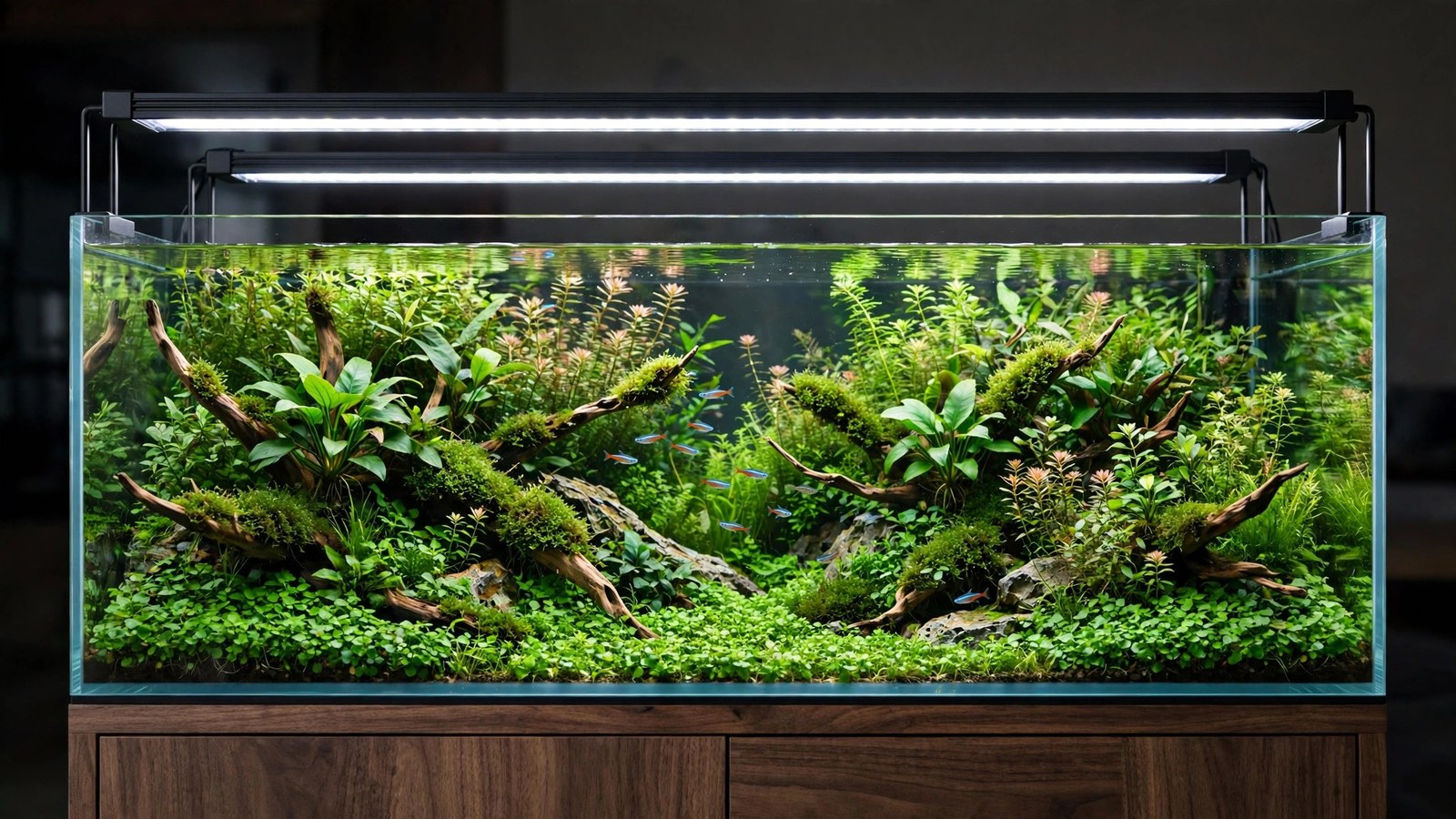
You have already made the big decision: a premium RGB fixture, not a bargain white panel. That puts two names on your shortlist — twinstar vs chihiros is the head-to-head every serious planted-tank hobbyist argues about, and both brands genuinely deserve to be there. But they win for different reasons, and buying the wrong one means paying for app features you never wanted or staring at a fixed look you cannot tune. This guide settles the argument properly: spectrum science, real wattage and lumen figures, app control, model-tier decoding, and a decisive verdict for every tank size.
The two brands in one sentence each
Chihiros is the feature-density champion: app control built into nearly every fixture, individual red/green/blue channel sliders, and programmable sunrise-to-sunset schedules with no external timer. Twinstar is the purist's choice: a deliberately curated spectrum, jewel-like fixtures, and a reputation built on competition-grade aquascapes where coloration was the deciding factor.
That philosophical split is visible in how each company sells you brightness. Twinstar's current S-series (Ver. 5.0) uses a 6-color LED array plus dedicated plant-growth diodes across a 400–780 nm range — that is, deeper into the red spectrum than the usual 400–700 nm aquarium range, with strengthened ~450 nm blue and ~660 nm red peaks. Chihiros takes the opposite route with the WRGB II: 3-in-1 RGB chips you can tune channel by channel, trusting you to dial in the color balance yourself. Neither approach is objectively "more advanced"; they are two answers to the same question of how RGB aquarium lighting really works.
Spectrum and red-plant coloration: the RGB battleground
This is where most buyers actually feel the difference, so let us be specific. Twinstar's spectrum is engineered so red plants look electric — the brand's Ver. 5.0 marketing leans hard on "deep red (700–780 nm) enhances root growth," and the color mix was developed with professional aquascapers for what they call "true" color rendition. In practice, Twinstar fixtures make Rotala and Ludwigia reds glow with a stained-glass quality that is hard to match at default settings.
Chihiros gives you the same glow if you are willing to tune it. The WRGB II 60's 4,500 lumens at 67W come from RGB-dominant chips, and because the app exposes each channel independently, you can push red intensity far beyond what a fixed fixture allows. Out of the box the presets look a little cooler; after ten minutes of slider work, most owners say it catches up completely. For the science behind why ratios matter, see our breakdown of WRGB vs white LED aquarium lights.
One honest caveat for both: red coloration is mostly about CO2, nitrate limitation, and iron — light spectrum is the garnish, not the meal. Neither fixture will paint a red plant crimson if the rest of your dosing is wrong. What a premium RGB fixture does is reveal the colors your husbandry already earned.
App control: built-in Bluetooth vs optional controllers
Here is the clearest, least debatable divide between the brands, and for many buyers it decides everything. Every current Chihiros WRGB II fixture ships with a built-in Bluetooth controller. You download the free My Chihiros app, pair once, and you get: independent R/G/B channel sliders, individually programmable daily phases (dawn, midday, dusk, moonlight), a built-in timer so you need no external one, and firmware-style lighting presets. Wi-Fi control exists via an optional hub, but Bluetooth covers the daily-driver features.
Twinstar's approach is a la carte. The S-series fixtures (Ver. 5.0) support Bluetooth, but the controller — LightControl Pro or Standard — is a separate purchase you add on. Without it, you adjust brightness the old-fashioned way, with the manual dimmer or an inline dimmer on older versions. That is a real cost gap: factor roughly $40–$60 extra into any Twinstar quote if you want app features to compare with Chihiros.
The practical upshot: if you love schedules and tinkering from the sofa, Chihiros is the obvious pick. If you set one pleasing look and leave it alone for a year, Twinstar's lack of bundled app control costs you nothing in practice.
Head-to-head: the 60cm flagships, by the numbers
Both brands sell fixtures from 30cm nano sizes to 120cm+ monsters, but the 60cm model is where most head-to-head buyers land. Here is how the current flagships stack up, using each manufacturer's published specifications:
| Spec (60cm model) | Twinstar 600S (Ver. 5.0) | Chihiros WRGB II 60 | Chihiros WRGB II Pro 60 |
|---|---|---|---|
| Power consumption | 67W | 67W | 74W |
| Luminous flux | 4,100 lm | 4,500 lm | 6,630 lm |
| Lumens per watt | ~61 | ~67 | ~90 |
| LED configuration | 6-color + plant-growth diodes | 3-in-1 RGB chips | 4-in-1 WRGB chips |
| Spectrum range | 400–780 nm (extended deep red) | Full RGB, channel-tunable | Full WRGB, channel-tunable |
| Control out of the box | Manual dimming; Bluetooth controller sold separately | Built-in Bluetooth + My Chihiros app, per-channel sliders | Built-in Bluetooth + app; optional Wi-Fi hub |
| Legs / mounting | Adjustable metal legs; wire-kit pendant option on S IV variants | Variable stainless-steel brackets, up to 10mm glass | Stainless brackets; cable suspension kit compatible |
| Splash protection | Heat-sink body design | IP43 (open-tank use only) | IP43 (open-tank use only) |
| Typical price range | $200–$250 (plus ~$40–$60 for controller) | $150–$220 | $250–$350 |
Read that table the way an engineer would: the Chihiros WRGB II Pro 60 is brutally efficient — ~90 lumens per watt is nearly 50% more output per watt than either flagship. The standard WRGB II 60 beats the Twinstar 600S on both lumens and efficiency at a lower price. Where Twinstar earns its premium is nowhere on this table: the curated spectrum, the fixture aesthetics, and the competition pedigree. Whether that is worth the gap is a personal call, which is exactly what our single-brand Twinstar LED review explores in more depth.
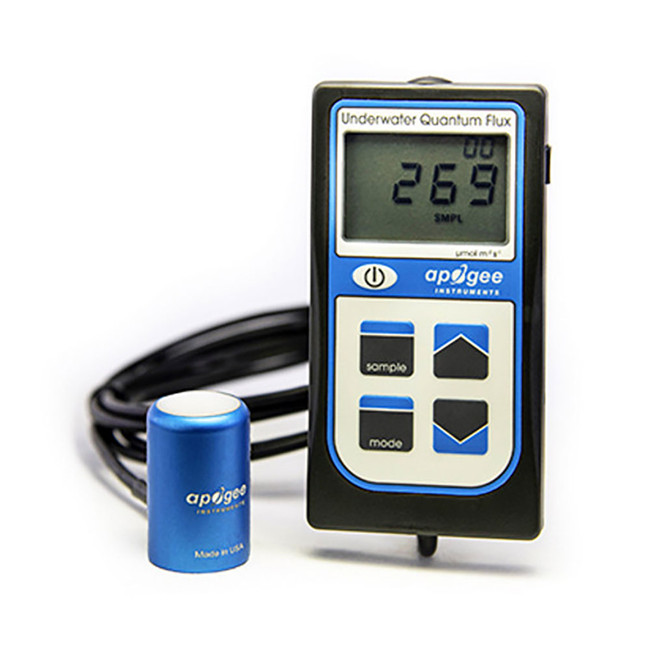 ★4.4
Apogee MQ-510 Underwater PAR Meter
Check Price on Amazon ★4.4Model-tier guidance: decoding the lines so you buy the right one
Both brands' lineups are alphabet soup, so decode them before you shop:
Twinstar S series is the flagship for high-tech tanks — highest output, titanium finish, the full 400–780 nm spectrum. One tier down, the E series uses the same spectrum with roughly 20% lower output at a friendlier price, the smart pick for medium-tech 45–60cm tanks. Older S III fixtures (e.g., the 600S at 52W / 3,250 lm) remain excellent if found discounted. The SP pendant line is discontinued — buy it only if you specifically want hanging and confirm warranty support.
Chihiros WRGB II is the standard flagship — the one 90% of buyers should compare. The WRGB II Pro is the overkill tier: up to 130W on the 120cm model, for very deep or demanding tanks. The WRGB II Slim keeps full app control in a thinner body for medium-tech setups. For nano tanks under 45cm, the Chihiros C II RGB is the purpose-built pick — a 360° swivel head with app control. Low-tech owners should look at the budget A-series instead.
If you are shopping the full premium field, do not stop at two brands: Week Aqua's LED lineup is the dark-horse third contender, and our roundup of the best LED lights for high-tech planted tanks compares them all side by side.
Twinstar vs Chihiros: which brand gives you more growing power per dollar?
Neither manufacturer publishes PAR numbers — lumens and watts are all they give you — so honest PAR comparisons come from hobbyists with meters. The pattern from independent measurements is consistent: the Chihiros WRGB II 60 delivers more usable light per dollar than the Twinstar 600S at center-tank PAR, mostly because 4,500 lumens at $150–$220 is simply a strong value. The WRGB II Pro 60 widens that gap further. Twinstar owners report very respectable PAR too — the 600S's 67W all go into growing light, not Wi-Fi chips and screens — but you are paying for spectrum refinement, not brute photons.
The important nuance: PAR-per-dollar only matters when you are PAR-limited. On a standard 60cm tank, both fixtures produce more light than most plant lists need — you will be dimming either one for anything short of a deep-tank carpet. Before letting a number decide, read how PAR ratings actually work and consider borrowing a PAR meter instead of guessing.
Who should NOT buy either light
Premium RGB fixtures are superb at their job, and their job is narrower than the marketing suggests. Skip both brands if any of these describe you:
You run a low-tech tank without CO2. A 67W RGB fixture over a tank with no CO2 injection is an algae subscription. You will either run it dimmed forever (at which point a budget fixture does the same job for a third of the price) or you will be scraping glass weekly. This is the single most common expensive mistake in the hobby.
You want set-and-forget for a shallow desktop tank. A 30–45cm tank with easy plants does not need 4,500 lumens. A clip-on or a basic LED panel gives you the same viewing pleasure, and the money you save buys a year of fertilizer.
You need a fixture under a closed hood. The Chihiros WRGB II is IP43 splash-proof and explicitly not designed for closed tops — trapped heat shortens LED life, and Twinstar's heat-sink bodies need airflow too. If your tank has a lid, shop for lights rated for enclosed use instead.
If the "too much light" scenario sounds familiar, our guide to the signs of too much light in a planted tank shows you exactly what over-illumination looks like — memorize it before you spend premium money.
Frequently Asked Questions
Is Twinstar really better than Chihiros for red plants?
At default settings, yes — Twinstar's curated 6-color spectrum is tuned to make reds glow with no fiddling. But once you tune Chihiros' individual R/G/B channels, the gap mostly closes. Redness comes primarily from CO2, nutrient strategy, and intensity rather than brand. Buy Twinstar for the out-of-box look, Chihiros if you enjoy dialing in your own.
Does the Chihiros WRGB II need a separate controller?
No. Every current WRGB II fixture has a built-in Bluetooth controller — you install the free My Chihiros app and get per-channel sliders, daily phase scheduling, and a timer with no extra hardware. Only Wi-Fi control (beyond Bluetooth) requires an optional hub. This is the biggest practical difference from Twinstar, whose Bluetooth controllers are sold separately.
Can I use the Twinstar 600S or Chihiros WRGB II 60 on a low-tech tank?
You can, but you probably should not. Both are ~67W high-intensity fixtures designed for CO2-injected, fertilized aquascapes. On a low-tech tank you will run either one dimmed or on a short photoperiod, which wastes most of what you paid for — and full power without CO2 almost guarantees an algae outbreak. A budget LED is the better purchase until you go high-tech.
Which brand is better for a nano tank under 45cm?
Chihiros, by design. Its C II RGB is purpose-built for 20–45cm tanks with a 360° swivel head and full app control at a nano-friendly price. Twinstar covers small tanks with compact S-series sizes, but they cost more per liter and you still face the optional-controller question. For a 30cm cube, the Chihiros option is simply the better-engineered choice.
Are these lights worth it over a $50 budget LED?
Only if you will use what you are paying for: the RGB coloration, the app-driven schedules, and the headroom for demanding plants. A $50 panel grows green plants perfectly well — it just looks flatter and offers crude control. If your tank is a simple low-tech setup, bank the $150+ difference; if you are building a CO2-driven aquascape, the premium fixtures pay for themselves in color and control.
The verdict: Chihiros for control and value, Twinstar for spectrum and soul
After laying every spec on the table, the decision is cleaner than the forum wars suggest. Buy the Chihiros WRGB II if you want the most complete premium experience per dollar: built-in app control, per-channel RGB tuning, sunrise-to-sunset automation, and the strongest lumens-per-watt of the two standard flagships — all for typically $150–$220 at 60cm. It is the rational choice, and rationality is not an insult in this hobby. Compare the current models on Chihiros' official WRGB lineup before you buy, since they iterate generations quietly.
Buy the Twinstar S series if the out-of-box look matters most — the spectrum pedigree shows, the fixtures are beautiful objects, and the reds need zero tuning. Just price in the controller from day one: check the specs on Twinstar's official 600S S-series page and add roughly $40–$60 for the LightControl module. The best premium light is the one matched to your tank, not the most expensive one you can afford.