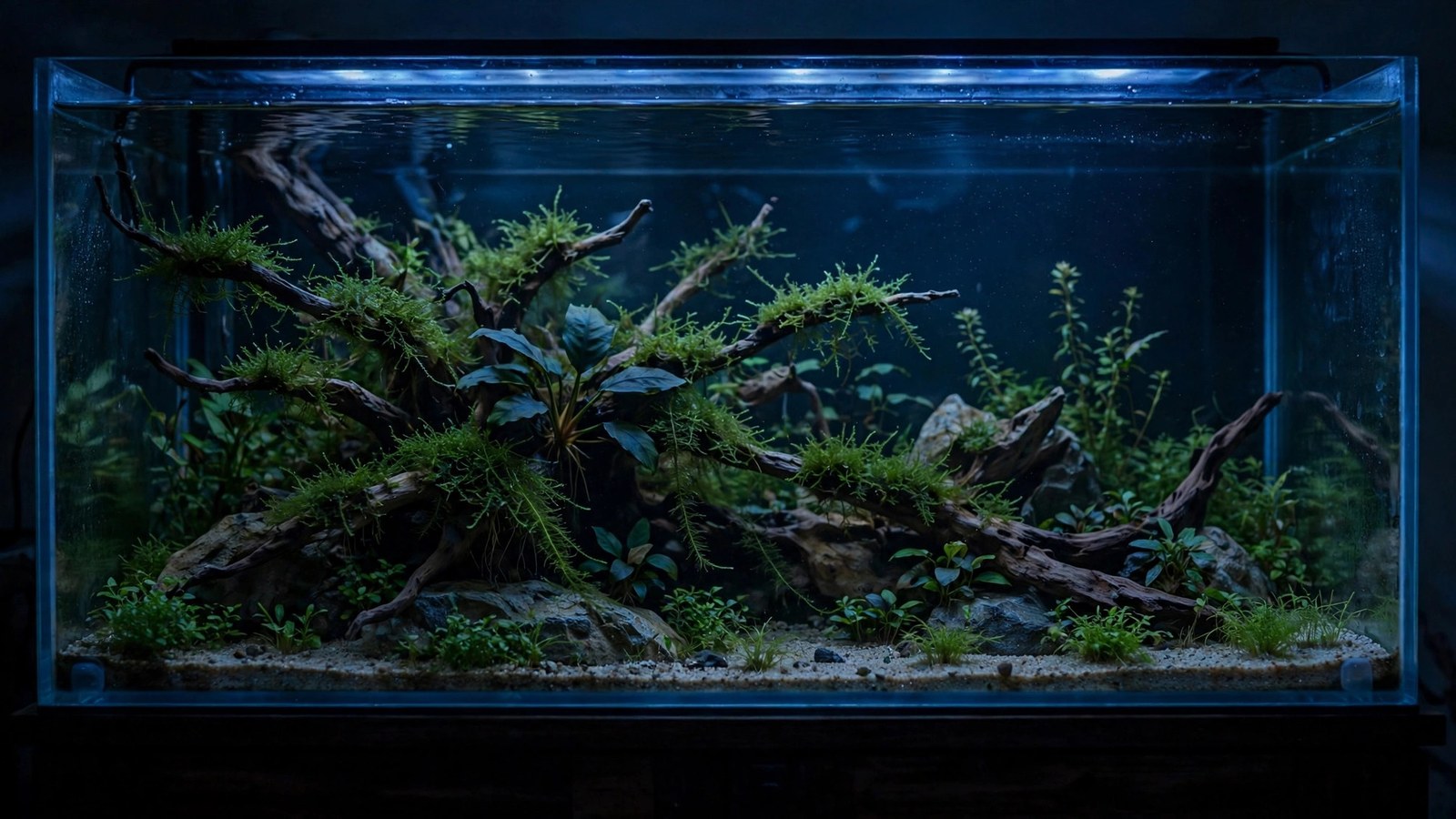
That soft blue glow after lights-out looks magical — moonlight modes are among the most-used features on modern LED fixtures. But aquarists worry: do moonlights affect plants? Could that gentle blue shimmer be extending the photoperiod, feeding algae, or disrupting the tank's night cycle? The answer is reassuring, with a few caveats worth knowing.
What Moonlights Are
Moonlights (or "night modes") are low-intensity, usually blue-spectrum LEDs run after the main photoperiod — for evening viewing, aesthetics, and observing nocturnal livestock behavior. Typical implementations: a dedicated blue channel at 1–10% intensity, or a separate string of small blue LEDs. They're meant to evoke moonlight, not to grow anything.
The Short Answer: True Moonlights Don't Affect Plants
Photosynthesis has a compensation point — a minimum light intensity below which a plant's respiration exceeds its photosynthesis, meaning no net growth occurs. Real moonlight is far below this point (a full moon delivers roughly 0.05–0.1 lux — essentially darkness to a plant). Properly dim aquarium moonlights (a faint blue glow where you can barely see the fish) are similarly below the compensation point for plants and for algae.
In other words: a genuinely dim moonlight is biologically night. Plants continue respiration, maintain their circadian dark period, and gain nothing — but also lose nothing. The dark period's functions (respiration, metabolic housekeeping, the overnight CO2 reset) proceed normally.
The Caveat: "Moonlight" That's Actually Just Dim Light
Here's where problems creep in. Many fixtures' night modes are far brighter than moonlight — a clearly visible blue wash at 10–20% of a powerful fixture can deliver meaningful PAR, especially in shallow tanks. At that point it's not moonlight; it's a dim photoperiod extension, and it counts:
- It extends the effective day. An 8-hour main photoperiod plus 4 hours of "moonlight" at real intensity is a 12-hour day in disguise — with the algae risk to match. See photoperiod duration.
- It can disrupt circadian rhythms. Plants (and fish) need a true dark period. Chronic low-level light at night has been shown to disturb circadian regulation in various organisms — the research in aquariums specifically is thin, but the precautionary principle says: night should be dark.
- It feeds algae preferentially. Here's the subtle one: at very low light levels, some algae (especially green dust and film algae) can eke out net growth where higher plants can't — their compensation points are lower. A too-bright "moonlight" can grow a persistent film of algae while doing nothing for plants.
The brightness test
Hold your hand 6 inches above the substrate under moonlight-only. If you can clearly see detail and color, it's probably too bright to be biologically neutral. True moonlight mode should be barely enough to make out fish shapes — atmospheric, not illuminating. When in doubt, dimmer is safer.
Moonlights and Fish: The Stronger Consideration
Honestly, fish care about night lighting more than plants do:
- Most fish need true darkness for proper rest — they're diurnal animals with circadian rhythms as real as ours. Chronic night light is a low-grade stressor.
- Nocturnal species are the exception — some catfish, loaches, and shrimp are more active and viewable under dim blue light, which is the legitimate use case for moonlights: observing night behavior, not lighting the tank.
- Breeding in some species is triggered or suppressed by photoperiod cues; a too-bright night mode can interfere with seasonal breeders.
Practical compromise: run moonlights for 1–3 hours of evening viewing, then full darkness until morning — not all night. You get the aesthetic and the nocturnal show; the tank gets its real night. If you want background reading on how light duration and intensity shape planted-tank health, the 2Hr Aquarist lighting guide covers PAR targets and photoperiod design in detail — useful context for deciding how much of the 24-hour cycle should be true darkness. As a rule of thumb, aim for at least 8–10 hours of genuine dark: that gives fish a real rest period and lets the tank's nighttime respiration and nutrient-processing rhythms run undisturbed.
Blue Spectrum: Any Special Concern?
Moonlights are usually blue because moonlight looks blue-white to us and blue LEDs are efficient. Biologically, blue light is highly photosynthetically active — plants use blue photons very efficiently — which is exactly why a too-bright blue night mode is worse than a too-bright warm-white one at equal dimness. But again, at true-moonlight intensities, this is academic: below the compensation point, spectrum doesn't matter because nothing is photosynthesizing net-positive anyway.
One real blue-specific note: blue light penetrates water best and scatters most visibly, so blue moonlights look brighter than their PAR suggests — which tempts people to run them dimmer than needed for effect. Trust the dimness; the blue carries the aesthetic at very low power.
Setting Up Moonlights Right
- Set intensity to the minimum visible — start at the lowest setting and increase only until you can faintly see the tank. Resist the urge to make it "pretty bright."
- Time-limit it: 1–3 hours after main lights-out, then off. All-night moonlight is for the aquarist's benefit, not the tank's — and the tank pays in disrupted rhythm.
- Don't count it as photoperiod — but do count it if it's bright enough to read by. Be honest with yourself about which it is.
- Coordinate with CO2: moonlight hours are night hours — the solenoid stays off regardless. Moonlights don't change gas scheduling.
- Watch for film algae in the first weeks — a faint green film appearing specifically during the moonlight era is the signal to dim further or shorten the duration.
A reliable pick here is hygger Auto On Off LED with moonlight mode.
Moonlights vs Ambient Room Light
Worth comparing: the dim blue moonlight you program deliberately vs the ambient room light leaking into the tank all evening. A living-room lamp left on until midnight can deliver more stray light to the tank than a proper moonlight mode — and it's usually warmer, broader-spectrum light that registers more biologically. If you're meticulous about a 2-hour dim moonlight but the tank sits six feet from a bright floor lamp until 1 AM, the lamp is the bigger circadian disruptor. For tanks in lived-in rooms, the practical priority order is: (1) keep the main photoperiod consistent, (2) minimize bright ambient light late at night (a simple background or room dimming helps), (3) then worry about moonlight mode settings. Don't optimize the 2% while ignoring the 20%.
Frequently Asked Questions
Will moonlights cause algae?
Truly dim moonlights (below plants' compensation point) won't grow meaningful algae. But "moonlight" modes bright enough to clearly illuminate the tank absolutely can — especially film and dust algae, which tolerate lower light than plants. If algae increases after adding a night mode, dim it to barely-visible or cut its hours; that's your diagnosis and fix in one.
How many hours of moonlight is safe?
1–3 hours of genuinely dim blue for evening viewing is safe and standard. All-night operation isn't ideal — fish and plants both benefit from true darkness, and the longer the exposure, the more any excess brightness matters. Think of moonlights as a viewing session, not a night-long installation.
Do I need moonlights at all?
No — they're purely optional. Tanks thrived for decades with binary on/off lighting and full darkness at night. Moonlights are an aesthetic and observational luxury: lovely to have, completely unnecessary. If your fixture lacks them, a tiny separate blue LED on a timer gives the same effect for a few dollars.
Can moonlights help nocturnal fish feel secure?
Somewhat — very dim blue lets nocturnal species (many loaches, catfish, shrimp) be active while still feeling "night" to them, and lets you watch. But complete darkness is also fine for them; they've evolved for it. The benefit is mostly yours (viewing), which is legitimate — just keep it dim and time-limited.
My fixture's moonlight is surprisingly bright — what should I do?
Check if intensity is adjustable (many are, buried in the app or manual). If not, shorten the duration to an hour or less, or diffuse it — some aquarists put a strip of window tint or dimming film over the moonlight LEDs. As a last resort, skip the built-in mode and use a separate dim blue light you can control properly.
Do moonlights affect the CO2/pH cycle at night?
At true-moonlight intensity, no — there's no meaningful photosynthesis, so the nighttime respiration/degassing cycle proceeds as if dark. Only if the "moonlight" is bright enough to drive net photosynthesis would it perturb the cycle, and at that point you have a photoperiod problem, not a moonlight question.
Dim, Brief, and Then Dark
Moonlights are one of the hobby's harmless pleasures — provided "moonlight" means what it says. Keep them genuinely dim, limit them to a few evening hours, and give the tank true darkness overnight. Your plants won't notice them (which is exactly the goal), your nocturnal livestock get their cameo, and you get that magical blue glow without paying for it in algae or stressed fish. Set it once on a timer, then forget it — the best moonlight is the one you never have to think about.