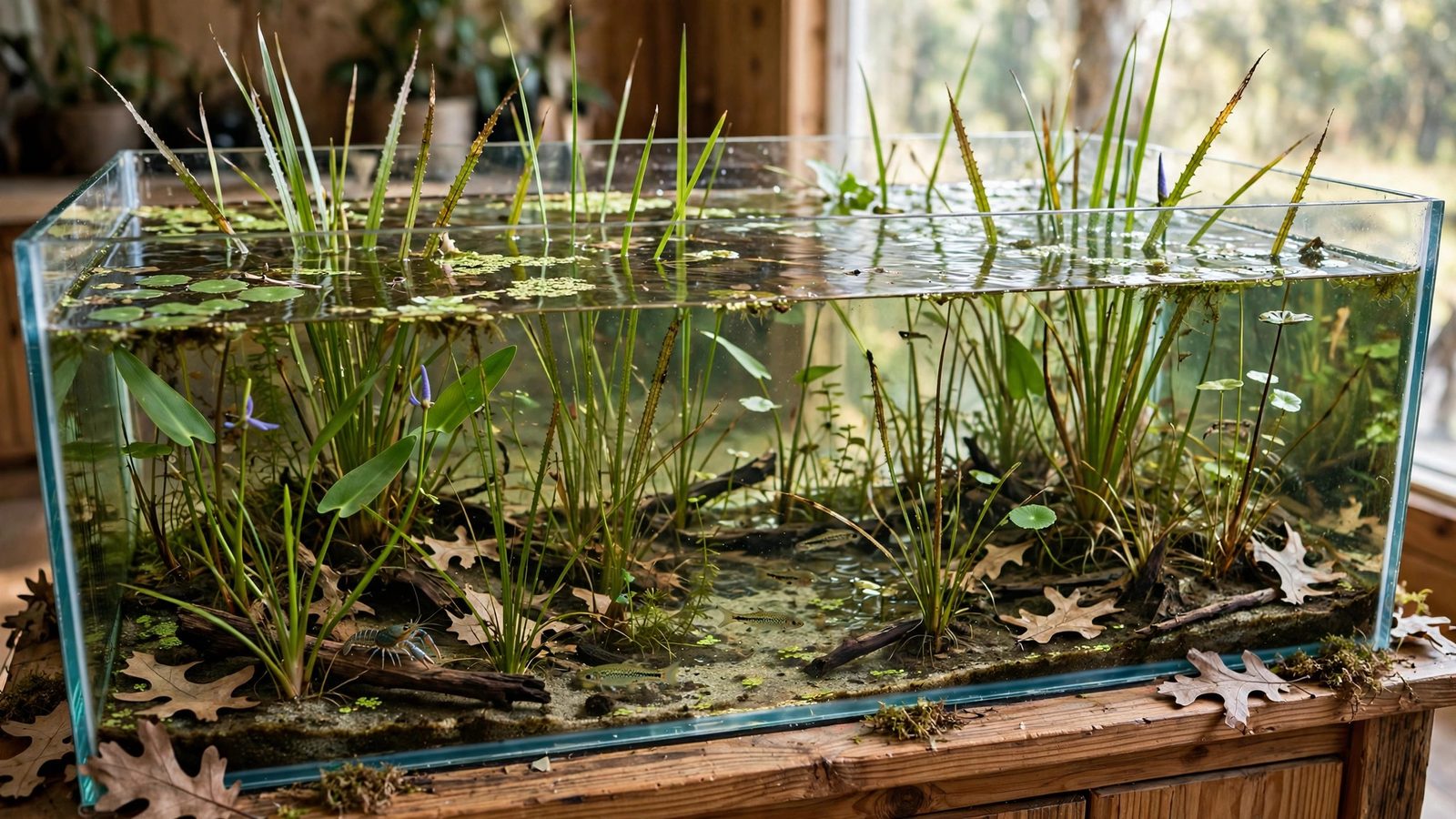
Most biotope builds chase the Amazon's blackwater or Africa's rift lakes, while South Florida's flooded marsh sits almost untouched — Practical Fishkeeping even flagged the Everglades as one of the biotopes that aren't being done enough. A Florida Everglades biotope aquarium is a shallow, sunlit slice of that subtropical marsh: a sandy bed, native Vallisneria and Sagittaria, and a killifish-led native assemblage. If you know biotope aquascaping basics, this is the field application.
Short answer: A Florida Everglades biotope aquarium recreates a shallow South Florida marsh: fine sandy substrate, well-soaked fallen branches, blazing light with floating-plant cover, and a native assemblage led by the Florida flagfish (Jordanella floridae — 6 cm, pH 6.0–8.0, 19–24°C) with eastern mosquitofish, golden topminnow, and Everglades pygmy sunfish. Plant Vallisneria, Sagittaria, Cabomba, Bacopa, Najas flexilis, and Myriophyllum. Never collect without checking Florida FWC rules — buy captive-bred.
What a Florida Everglades biotope aquarium really is
A biotope is a habitat portrait, and the Everglades portrait is a subtropical marsh: vast shallow water over sand and limestone, grasses giving way to submerged meadows, and a fish community of small, hardy natives. Field research describes mosquitofish as ubiquitous, with sailfin mollies and bluefin killifish mixed in, all riding a seasonal wet/dry hydrology. Your tank captures one moment of that cycle: a sunlit, plant-dense shallow.
Do not confuse it with the other famous seasonal wetland in this site's biotope series. The Pantanal floodplain biotope is a South American floodplain stocked with Hyphessobrycon eques and Apistogramma borellii; the Everglades is a North American marsh built around killifish and pygmy sunfish. Different continent, different fauna, different build.
Substrate and hardscape: sand first, almost nothing else
The Everglades recipe is blunt: sandy substrate is the key, hardscape is minimal — a few well-soaked fallen branches, nothing more. The Everglades pygmy sunfish specifically needs soft substrate and slow flow to behave naturally; piling in dragon stone builds a river, not a marsh.
Lay 5–7 cm of fine sand, sloping from back to front. Soak branches until they sink, and keep open sand lanes between plant groups — the flagfish graze these lanes.
Planting the marsh
Native plants carry the biotope's credibility, and the Everglades nursery list is generous: Vallisneria, Sagittaria, Cabomba, Bacopa, Najas flexilis, and Myriophyllum. Match species to your light and water with the native plant list, then plant in drifts, not specimens:
- Vallisneria along the back glass — tall ribbons swaying in the flow.
- Sagittaria as the foreground meadow — low, grassy, honest marsh floor.
- Cabomba and Bacopa in midground clumps — fine texture against broad vallisneria leaves.
- Najas flexilis and Myriophyllum as filler — feathery cover for pygmy sunfish fry.
Then add the recipe's insisted layer: floating-plant cover. Frogbit or water lettuce dapples the blazing light and gives the surface trio shaded hunting lanes. Thin floaters weekly to a third of the surface.
Water, light, and the seasonal rhythm
Run the tank cool and bright. The flagfish's comfort zone is 19–24°C (66–75°F) at pH 6.0–8.0, and the pygmy sunfish tolerates 10–30°C — so a room-temperature tank in most homes needs no heater, only a thermometer and a plan for summer heat. Keep the waterline a few centimeters below the rim; the marsh is shallow, and a lower waterline sells the wetland better than any backdrop.
Honor the wet/dry hydrology gently: shallow water, gentle filtration, and a long, bright light cycle like a Florida summer day. Sponge filters suit the build — soft flow, no fry lost.
Stocking the native marsh
The recipe centers on a trio of surface insect-feeders — Florida flagfish, eastern mosquitofish, and golden topminnow — with field surveys adding the supporting cast. Six species, all documented in the marsh:
| Species | Adult size | Role in the marsh | Notes |
|---|---|---|---|
| Florida flagfish (Jordanella floridae) | 6 cm | Algae-eater, surface insect-feeder | Algae-eating rivals the Siamese algae eater; peaceful cool-water killifish |
| Eastern mosquitofish (Gambusia holbrooki) | — | Surface insect-feeder | Ubiquitous in marsh surveys |
| Golden topminnow (Fundulus chrysotus) | — | Surface insect-feeder | Mid-to-surface dweller |
| Everglades pygmy sunfish (Elassoma evergladei) | 3–4 cm | Micro-predator | Strictly carnivorous — live foods only, rarely takes dry food |
| Sailfin molly (Poecilia latipinna) | — | Grazer | Recorded in marsh field research |
| Bluefin killifish (Lucania goodei) | — | Midwater forager | Recorded in marsh field research |
This is a biotope build — a slice of Everglades marsh with a full native assemblage. For the single-species Florida flagfish setup, see the Florida flagfish planted tank guide. The stocking the wetland walkthrough helps you scale the headcount without overloading the marsh.
Feeding: the top of the water column does the work
The trio are surface insect-feeders, so feed like the marsh does: small floating foods, freeze-dried daphnia, and live fruit flies or pinhead crickets tapped onto the surface. Watching flagfish rise to a fruit fly is the single best argument for this biotope. The flagfish also grazes algae constantly — its algae-eating rivals the Siamese algae eater — making it the recipe's cleanup crew.
The pygmy sunfish is the exception: strictly carnivorous, live foods only, rarely takes dry food. Baby brine shrimp, microworms, and grindal worms are the staples, and given heavy cover it breeds constantly.
The legality honesty check
Florida collecting is regulated. Check the Florida Fish and Wildlife Conservation Commission (FWC) rules before you even think about a dip net — and for most builders the honest answer is captive-bred stock. The North American Native Fishes Association and its member code of ethics wrote the responsible-collecting playbook; read it first.
And the rule with no exceptions: never release aquarium organisms. The Everglades is already fighting some of the worst invasive-species damage on the planet; your tank must never add to it.
Frequently Asked Questions
Can I collect fish and plants from the Everglades myself?
Florida collecting is regulated, so check current FWC rules first — permits, bag limits, and protected-area restrictions all apply. For most builders, captive-bred stock from native-fish breeders is the simpler route. And never release aquarium organisms: the Everglades already battles severe invasive-species pressure, and releases are how new invasions start.
How is this different from the Pantanal biotope?
Both are seasonal wetlands, and that is nearly all they share. The Pantanal is a South American floodplain built around Hyphessobrycon eques and Apistogramma borellii. The Everglades is a North American subtropical marsh built around killifish, mosquitofish, and pygmy sunfish. Different continent, different fauna, different build.
Do I need a heater for an Everglades biotope?
Usually not. The Florida flagfish thrives at 19–24°C and the Everglades pygmy sunfish tolerates 10–30°C, so a room-temperature tank in most homes sits inside their range. Skip the heater, keep a thermometer, and plan for summer heat instead — cool, stable water with gentle flow is the marsh condition these fish evolved for.
Will Florida flagfish really eat algae?
Yes — the Florida flagfish is a genuine algae-eater whose grazing rivals the Siamese algae eater, and it is a peaceful cool-water killifish at 6 cm. It still needs a varied diet of small foods alongside its grazing, so treat it as a working member of the assemblage, not a magic cleanup solution.
What do Everglades pygmy sunfish eat?
They are strictly carnivorous and need live foods — baby brine shrimp, microworms, and grindal worms are the reliable staples — and they rarely accept dry food. Feed small amounts twice daily in the plant thickets where they hunt. Given heavy cover and steady live food, they breed constantly.
A marsh you can sit in front of
A Florida Everglades biotope aquarium is not a doorway showpiece; it rewards sitting close — flagfish rising to fruit flies, pygmy sunfish flashing in the Najas, floaters drifting over sand. Build it honestly — sand, natives, legal stock, no exotics — and you get a biotope almost nobody else is doing. For another continent, the New Guinea rainbowfish stream biotope takes the same discipline to rainforest streams.