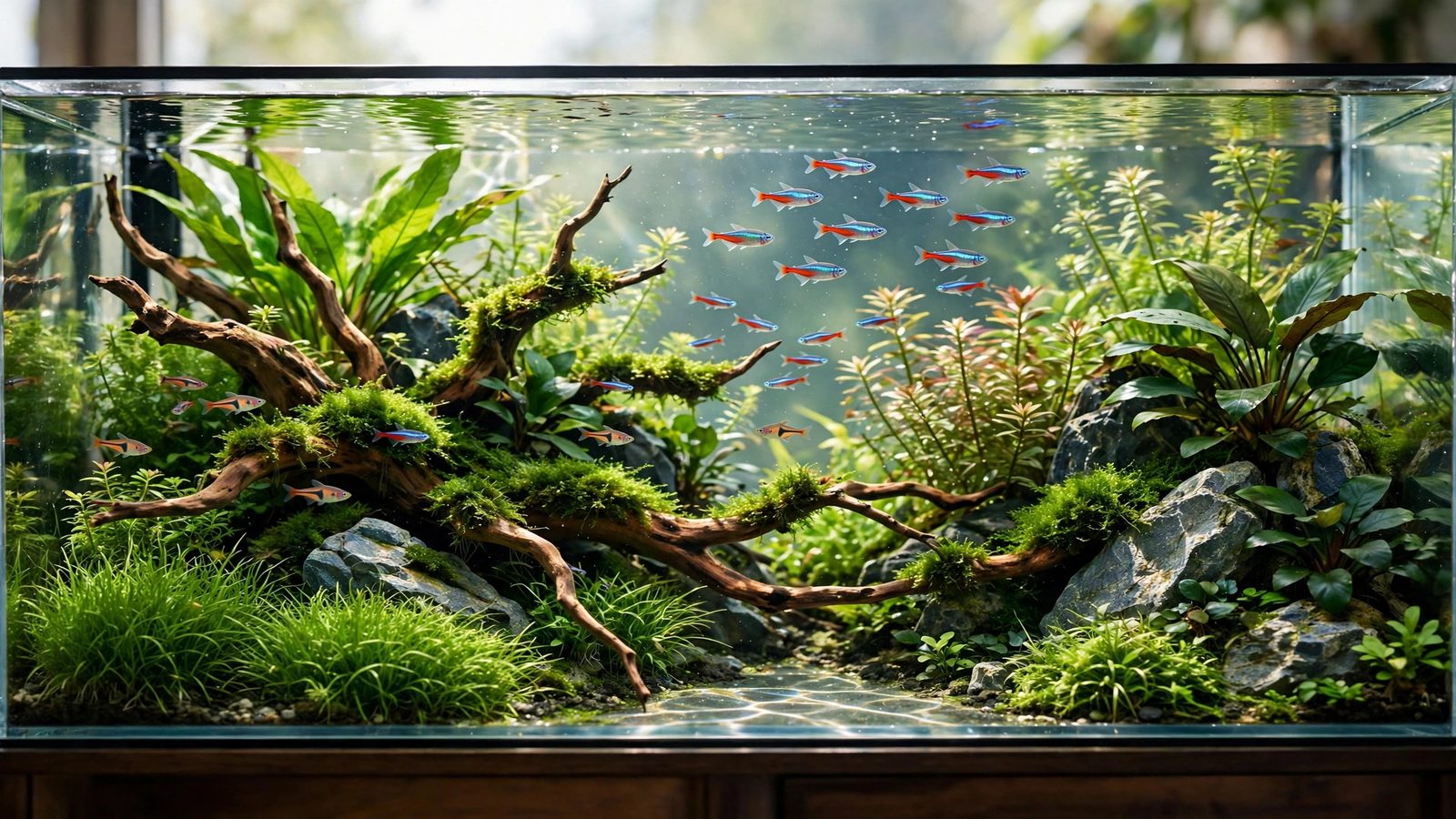
Most beginners buy a betta, a castle ornament, and one sad plastic plant — then wonder why the water never clears. Here's what changes everything: a living forest of freshwater aquarium plants can shoulder a large share of your biological filtration load, while turning a glass box into something alive. By the end you'll know which freshwater aquarium plants to buy first, where to place them, how to feed them, and how to dodge the mistakes that kill half of all beginner planted tanks.
What Freshwater Aquarium Plants Actually Are
A freshwater aquarium plant is any plant that can grow fully submerged in low-salinity water. Some, like Vallisneria and Hornwort, are true aquatics that live their whole lives underwater. Others, like Anubias, Cryptocoryne, and most carpeting species, are marsh plants in the wild: in the dry season they live in air with wet feet, and when the rains flood them they grow new, thinner submerged leaves. That's why a new Cryptocoryne often looks completely different a month after planting.
Saltwater planted tanks are nearly a different hobby: the ocean has very few true plants, mostly seagrasses demanding intense light and deep sand beds. Freshwater offers hundreds of aquarium-suitable species, from coin-sized rosettes to six-foot background giants. If you want a planted tank, freshwater is where the action is.
Why Live Plants Change Everything in a Tank
It's easy to treat plants as decoration. Experienced keepers treat them as the other half of the filtration system:
- They eat fish waste. Plants absorb ammonia, nitrite, and nitrate through leaves and roots — a densely planted tank often needs just one 30% weekly water change. Hornwort, Water Sprite, and Frogbit are living nitrate sponges.
- They suppress algae. Fast growers consume the nutrients algae blooms need, while floating plants cut the light algae depends on. See our guide to aquarium plants for natural algae control.
- They oxygenate during the light cycle. But plants consume oxygen at night, so keep surface agitation adequate and stocking moderate. Dense planting also drives daily pH swings as CO2 is used and released, so stability matters more than a target number.
- They make fish behave better. Tetras, rasboras, and gouramis only show real behavior with cover. Broken sightlines cut aggression; moss thickets shelter fry and shrimp.
- They're the cheapest way to make a tank beautiful. A $60 bundle of stems, left alone six weeks, produces a scape that would cost hundreds in hardscape and ornaments.
The Main Categories of Freshwater Aquarium Plants
Shops group plants two ways: where they go (placement zones) and how they grow (growth habit). You need both, because a background stem and a foreground carpet want opposite things from you.
Placement: Foreground, Midground, Background
Think of the tank in three depth bands. Foreground plants stay under 3–4 inches at the front glass. Midground plants (4–10 inches) fill the middle and flank the hardscape. Background plants reach the surface, hiding filter and heater behind a green curtain.
| Zone | Height | Classic beginner picks | Notes |
|---|---|---|---|
| Foreground | Under 4 in | Staurogyne repens, Cryptocoryne parva, Marsilea hirsuta | Needs light at substrate; plant in a grid |
| Midground | 4–10 in | Anubias nana, Java Fern, Cryptocoryne wendtii | Anchors the scape; tie epiphytes to rock/wood |
| Background | 10 in+ | Vallisneria, Amazon Sword, Limnophila sessiliflora | Hides equipment; trim before stems reach the surface |
| Surface | Floating | Amazon Frogbit, Dwarf Water Lettuce, Red Root Floaters | Dims light below — corral with airline tubing |
For a visual walkthrough of layering the three bands so the tank reads as deep instead of flat, see our aquarium plant placement guide.
Growth Habit: How the Plant Actually Feeds
This is the part shops rarely explain, and it's the most useful thing to learn — each habit wants a different planting method:
- Stem plants (Rotala, Ludwigia, Limnophila, Bacopa) grow upright, root lightly, and feed from the water column. Plant 1–2 inches apart; trim tops and replant to thicken the stand.
- Rosette plants (Amazon Swords, Cryptocorynes, Vallisneria) grow from a central crown with heavy roots. They are root feeders — bury roots, keep the crown exposed, feed with root tabs or rich substrate.
- Rhizome/epiphyte plants (Anubias, Java Fern, Bucephalandra, mosses) grow along a horizontal rhizome that must NEVER be buried — it rots. Tie or glue them to wood and rock.
- Carpeting plants (Dwarf Hairgrass, Monte Carlo, Marsilea) spread by runners. They need strong light at the bottom — the first category where CO2 starts to matter.
- Floating plants pull nutrients through dangling roots and need no planting. If floaters stall, something in the water is off.
Beginner Plants That Forgive Mistakes
Your first plants should survive ordinary kit lighting, no CO2, and a keeper who forgets fertilizer for a week. These eight have done exactly that in thousands of beginner tanks:
| Plant | Type | Light | CO2 | Why beginners love it |
|---|---|---|---|---|
| Anubias nana / barteri | Rhizome | Low | No | Nearly indestructible; tie to wood, ignore it |
| Java Fern | Rhizome | Low | No | Grows free plantlets on old leaves |
| Java Moss | Moss | Low | No | Shrimp and fry shelter; tie it down or it drifts |
| Vallisneria | Rosette | Low–med | No | Background curtain in weeks from runners |
| Cryptocoryne wendtii | Rosette | Low–med | No | Tolerates neglect; melts when moved, then rebounds |
| Amazon Sword | Rosette | Medium | No | Statement centerpiece; feed roots with tabs |
| Limnophila sessiliflora | Stem | Low–med | No | Fastest nitrate eater here |
| Amazon Frogbit | Floating | Low | No | Shades algae out; roots shelter shy fish |
For the full shortlist ranked for zero-CO2 setups, see the easiest aquarium plants that need no CO2.
Stepping Up: Intermediate and Advanced Picks
Once your first tank runs six months without drama, the training wheels come off. The jump is about matching demanding species to demanding conditions — stronger light, consistent fertilizer, usually injected CO2:
| Plant | Difficulty | What it demands | The payoff |
|---|---|---|---|
| Dwarf Hairgrass | Medium | Strong light, CO2 recommended | The classic lawn |
| Monte Carlo | Medium | Medium+ light, CO2 for dense mats | Bright green carpet, less fussy |
| Rotala rotundifolia | Medium | High light + CO2 for reds | Bushes shifting green to pink |
| Ludwigia super red | Medium | High light, iron, CO2 | The easiest genuinely red plant |
| Bucephalandra | Easy–medium | Patience; slow grower | Exotic leaves on driftwood; keep light moderate to avoid algae |
| Dwarf Baby Tears | Hard | High light, CO2, rich substrate | Contest-grade carpet; unforgiving of swings |
The Five Fundamentals: Substrate, Light, CO2, Fertilizer, Water
Plants need the same five things houseplants do, just delivered underwater. Get these right and species choice becomes almost secondary.
1. Substrate: the foundation
Root feeders pull most food from the substrate, so this choice echoes for years. Nutrient-rich aquasoils (ADA Amazonia, Fluval Stratum, Tropica Soil) release ammonia at first — wait 2–3 weeks before adding sensitive livestock. Inert sand and gravel hold zero nutrients, so push root tabs under heavy feeders every 2–3 months. Aim for 2–3 inches in front, sloping to 3–4 at the back.
2. Lighting: the engine
Light is the throttle. Easy plants grow under 6–8 hours of moderate LED light daily — roughly 20–40 PAR at the substrate. Put the light on an outlet timer; inconsistent photoperiods trigger algae. Demanding reds and carpets want 50–80+ PAR and stall under dim kit lights. Start new tanks at 6 hours; add an hour every two weeks only if plants grow cleanly.
3. CO2: optional now, transformative later
CO2 is the raw material of photosynthesis — injecting it roughly doubles growth and unlocks reds, carpets, and dense stem bushes. But it adds cost, a learning curve, and a failure mode (a dumped cylinder can gas fish overnight). Run low-tech 3–6 months first, then decide whether your scape actually needs it.
4. Fertilizer: feeding the water column
Fish waste supplies nitrogen and phosphorus, but rarely enough potassium, iron, and traces. Dose a comprehensive liquid fertilizer 1–2 times weekly after water changes — start at half the label dose, and increase if older leaves yellow while new growth pales. Root tabs under swords and crypts every 2–3 months cover the substrate side. Oxygen bubbles on leaves after lights-on (pearling) means photosynthesis is running well.
5. Water: the comfort zone
Most freshwater aquarium plants are tropical and happiest at 72–78°F (22–26°C), pH 6.5–7.5, and soft-to-moderate hardness (3–8 dGH) — a range that overlaps nearly every popular community fish.
How to Plant Them: Techniques That Work
Planting day is where beginners quietly lose plants — each growth habit has one correct method:
- Stem plants: Strip the lower 1–2 inches of leaves, push each stem an inch into the substrate with tweezers, spaced 1–2 inches apart. They look sparse on day one; in a month they're a thicket. For new tanks, fast stems are your best algae insurance — our fast-growing plants for new tanks list is built for this job.
- Rosette plants: Dig a depression, fan the roots outward and down, backfill so the crown sits exactly at the substrate surface. Buried crowns rot; floating crowns never root.
- Rhizome plants and mosses: Never bury the rhizome. A dab of aquarium-safe super glue gel or cotton thread ties Anubias, Java Fern, and Bucephalandra to wood and rock. Press moss into crevices in a thin layer — thick wads rot from the inside.
- Carpeting plants: Split the pot into thumbnail-sized tufts and plant in a grid, 1–2 inches apart, across the whole foreground — a grid fills in weeks; one clump takes a year. See easy foreground carpeting plants for beginners.
- Floating plants: Rinse and drop them in. Corral with a ring of airline tubing so the filter doesn't push them under.
Acclimating New Plants: Surviving the Melt
Roughly half of store-bought aquarium plants are grown emersed — in humid greenhouses, leaves in air — because it's faster and pest-free. Underwater, those air-leaves can't photosynthesize, so the plant sheds them and grows new submerged leaves. This is the infamous "melt," and it terrifies every beginner exactly once.
The protocol: rinse new plants in dechlorinated water (a 90-second alum dip — 1 tablespoon per gallon — kills snail eggs), trim damaged leaves, plant using the methods above, then leave them alone. Don't fertilize heavily the first week; don't dig them up to "check the roots." Expect Cryptocoryne to lose most leaves within 10–14 days — if roots and crown stay firm, new submerged leaves appear in 2–4 weeks. See our guide to the emersed-to-submersed transition for the species that melt hardest.
Common Beginner Mistakes (and the Fix)
- Too little plant mass on day one. Three stems in a 20-gallon can't out-compete algae. Fix: plant 40–50% of the footprint immediately, weighted toward fast stems and floaters.
- 12-hour light marathons. More light without matching CO2 and fertilizer grows algae faster. Fix: 6 hours on a timer.
- Burying Anubias and Java Fern. The #1 plant-killer in the hobby. Fix: rhizome above the substrate, tied or glued to hardscape.
- No fertilizer because "fish poop feeds plants." It supplies nitrogen, not iron or potassium. Fix: half-dose liquid fertilizer weekly from week two.
- Tearing up melting Crypts. Crypt melt looks like death but is usually relocation shock. Fix: leave the crown alone 3–4 weeks.
- Chasing pH with chemicals. Most plants adapt to any stable pH from 6.5 to 7.5. Fix: stability beats perfection — stop dosing pH adjusters.
Frequently Asked Questions
Do freshwater aquarium plants need CO2 injection?
No — not to start. Anubias, Java Fern, Vallisneria, Cryptocoryne, mosses, and floaters grow well for years without injected CO2 if light and fertilizer are balanced. CO2 becomes worthwhile for dense carpets, intense reds, or fast stem growth — a step-two upgrade once your tank runs cleanly.
How many plants should I put in a new tank?
Fill 40–50% of the footprint on day one with fast-growing stems and floaters. Heavy initial planting is the best algae prevention: plants consume ammonia and nutrients before algae colonizes. Thin and rearrange once growth takes off — underplanting is far harder to fix than overplanting.
Why are my new aquarium plants melting?
Most commercial plants are grown emersed (leaves in air). Underwater, those air-adapted leaves can't function, so the plant sheds them and grows new submerged leaves over 2–4 weeks. Firm roots and a solid crown mean it's healthy — trim mushy leaves, keep parameters stable, and don't uproot to "check."
Can I grow aquarium plants in plain gravel or sand?
Yes, with the right species. Rhizome plants, mosses, stems, and floaters feed from the water column and ignore the substrate. Heavy root feeders like Swords and Cryptocorynes need root tabs pushed under them every 2–3 months in plain gravel. Aquasoil removes this juggling but costs more and releases ammonia at first.
How much light do freshwater plants need per day?
Start with 6–8 hours on a timer — easy plants thrive in this range. Stretching to 10–12 hours without matching CO2 and fertilizer usually grows algae, not plants. High-light species want stronger fixtures and longer photoperiods, but only alongside injected CO2 and consistent dosing. Increase gradually and watch the plants, not the clock.
Are live plants better than plastic or silk plants?
For the ecosystem, yes — only live plants consume ammonia and nitrates, oxygenate water, and suppress algae. Plastic plants give instant structure with zero maintenance but collect algae, add no water-quality benefit, and stiff edges can tear betta fins. Many keepers mix both: live plants for the biology, silk accents while the live ones fill in.
Start Planted, Stay Planted
A planted tank is easier than a bare one — once plants are growing, they do half your maintenance. Pick three forgiving species, plant heavily on day one, run six hours of light on a timer, and give new arrivals a month to settle. For a step-by-step companion to your first setup, the first planted tank walkthrough at Planted Aquarium Expert pairs well with everything above — and our midground plant library is a good next stop once your background and foreground are decided. Six months from now you'll be trimming stem cuttings every water change.