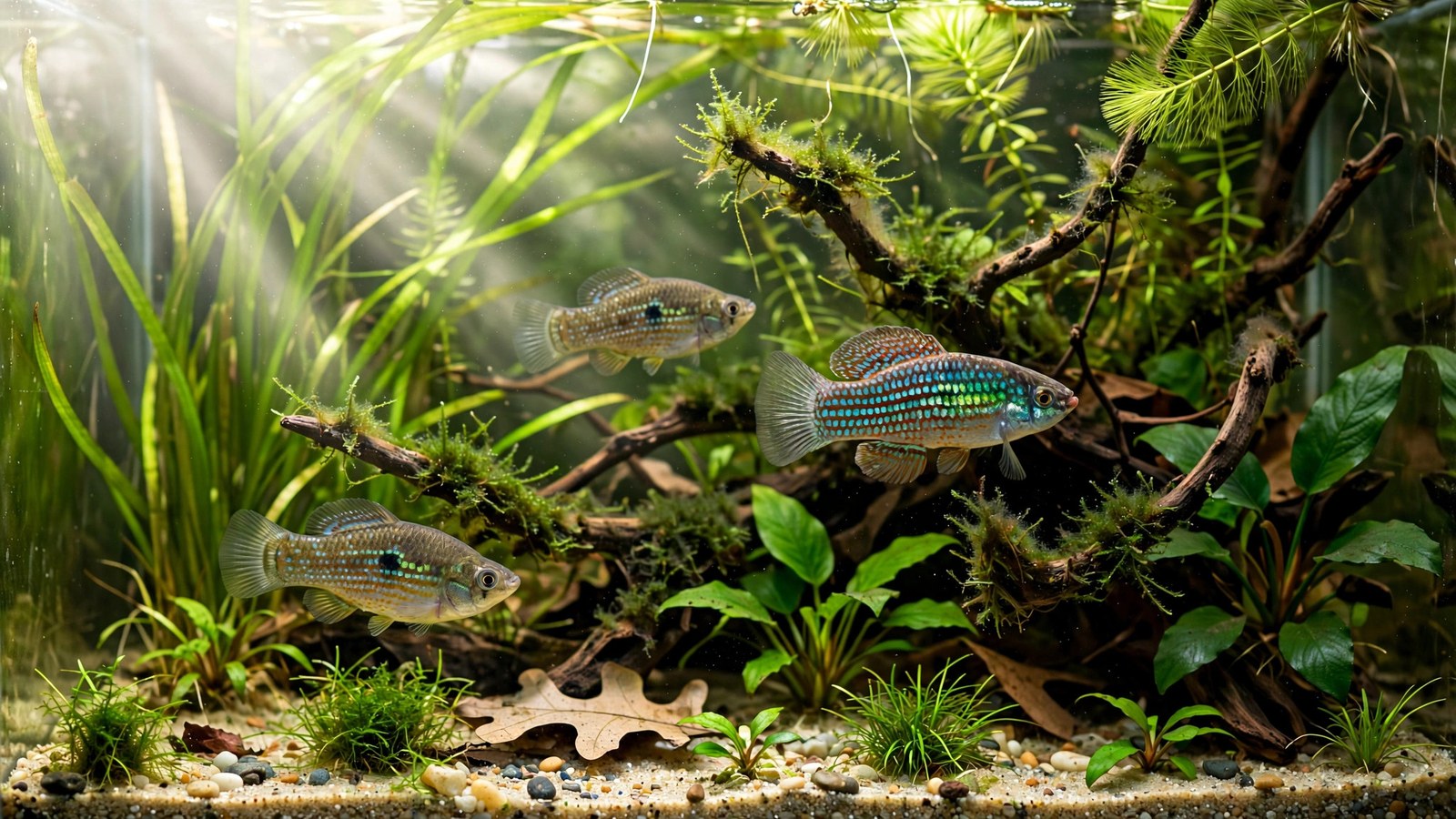
Most algae eaters quit at green fuzz. The Florida flagfish goes further — this feisty native pupfish is one of the only aquarium fish that will actually graze black beard algae and hair algae, and it does it in an unheated tank most tropicals couldn't survive. A florida flagfish planted tank trades the usual heater-and-CO2 formula for something tougher: a hardy, densely planted setup built around a fish that works for its keep.
The short answer: A Florida flagfish planted tank is a 20-gallon-plus unheated setup with tough plants (java fern, anubias, vallisneria), stocked at roughly one male to two or three females. Jordanella floridae is the only pupfish routinely sold in the aquarium trade, tolerates 64–86°F, and its down-turned mouth rips hair algae and black beard algae off leaves and wood.
Why flagfish: the native that eats your algae
The Florida flagfish isn't a delicate tropical killifish — it's a stocky North American pupfish from the vegetated marshes of peninsular Florida, and it brings a working attitude to the planted tank. Males wear red-and-blue barring that recalls the American flag; females stay olive with a dark dorsal spot. But looks are secondary. Its down-turned, scraping mouth rips hair algae and black beard algae off hardscape and tough leaves, succeeding where most algae crews give up.
That makes it a genuine problem-fix fish for the low-tech planted setup, where algae outbreaks usually arrive with too much light and not enough maintenance. Compared with other algae-eating options for planted tanks, flagfish keep working in cool water — tropical crews slow below 70°F, while flagfish stay active. The Aquarium Co-Op care guide calls their mouths "perfectly shaped for ripping off hair algae, black beard algae, and other fuzzy types of algae."
Setting up the florida flagfish planted tank: unheated and hardy
Forget soft-water assumptions — flagfish come from marshes with harder, even lightly brackish water, and they thrive in neutral to slightly alkaline conditions. This is the strongest case for the low-tech planted tank setup approach: no heater, no CO2, moderate light, and plants that enjoy the same forgiving parameters.
| Parameter | Target |
|---|---|
| Temperature | 64–78°F (18–26°C) target; tolerates up to 86°F, stable at room temperature |
| pH | 6.5–8.0 (7.0–8.0 ideal) |
| Hardness | Soft to hard; tolerates mildly brackish |
| Tank size | 20 gallons minimum per pair; larger per extra male |
| Ratio | One male to two or three females |
| Lighting | Moderate; enough to grow plants, not blast algae |
| Lid | Tight-fitting — flagfish jump |
A standard 20-gallon planted tank layout is the sweet spot: one pair or one male with two females, a sponge filter for gentle flow, and dark substrate to make male colors pop. If your home runs cold year-round, see the coldwater planted tank setup guide for plants that thrive at the lower end.
Plants that survive nibbling
Flagfish owners learn one lesson fast: in their eagerness to graze, these fish tear at soft leaves and uproot delicate stems. Build the plant list around armor, not appetite.
| Plant | Why it works here |
|---|---|
| Java fern (Microsorum pterotoides) | Tough rhizome leaves, ties to wood — grazing-proof |
| Anubias (barteri, nana) | Leathery leaves flagfish largely ignore |
| Vallisneria | Fast background curtain that also breaks sightlines |
| Java moss | Breeding substrate and fry cover |
| Avoid: tender stems | Rotala, cabomba, and soft-leaf stems get shredded |
Choose plants like furniture for a house with a large dog: nothing you can't afford to lose, everything anchored. The aquarium plants for fish tank guide covers the fundamentals this setup builds on, and the Florida Museum species profile confirms their wild habitat is shallow, heavily vegetated water — your tank should look like a marsh, not a minimalist gallery.
Dense planting that keeps males civil
Male flagfish are the tank's main failure mode. They're territorial toward each other — dwarf-cichlid energy, not schooling-killifish energy — and two males in a sparse tank will fight relentlessly. The fix is landscape, not chemistry: plant densely enough that no fish can see the full length of the tank from any point.
Use vallisneria or large anubias clusters as walls dividing the tank into territories, each with its own driftwood anchor and feeding zone. The one-male-to-two-or-three-females ratio spreads male attention the way a harem structure does in the wild. Want multiple males? Jump to a 40-gallon breeder so each male gets a genuine territory.
Which algae they graze — and which they won't
Set honest expectations. Flagfish enthusiastically graze hair algae, thread algae, and black beard algae — the exact trio that ruins most low-tech tanks. Their mouths rip rather than suck, so they're better on stubborn growth than many "algae eaters" that only polish glass.
But they are not a remediation plan. Green spot algae will bore them, a full-blown outbreak will outpace any fish, and an underfed flagfish turns its ripping mouth on your plants. Treat them as the finishing crew after fixing the underlying cause: balanced light, regular water changes, actively growing plants. They keep a healthy tank clean; they don't rescue a neglected one.
Feeding, tank mates, and breeding
Algae is a snack, not a diet. Feed a varied omnivore menu once or twice daily: quality flake or micro-pellets as the base, plus frozen daphnia, bloodworm, or brine shrimp a few times a week and blanched spinach for vegetable matter. Well-fed flagfish are far less destructive to plants — much leaf-shredding blamed on aggression is actually hunger.
For tank mates, pick fast, boisterous fish of similar size: zebra danios, livebearers, corydoras, and small loaches all hold their own. Avoid slow or long-finned fish, and assume dwarf shrimp are expensive snacks. Pairs breed readily: the female lays eggs in fine plants over several days, and the male guards the nest, fanning the eggs for about a week until they hatch.
Frequently Asked Questions
Will Florida flagfish eat black beard algae?
Yes — black beard algae, hair algae, and filamentous types are exactly what their ripping mouths are built for. But they can't outpace a serious outbreak, so fix the cause first: excess light, excess nutrients, or stalled plant growth. Green spot algae on glass will still need a scraper.
Can Florida flagfish live without a heater?
Absolutely — they tolerate 64–86°F (18–30°C) and thrive at room temperature, making them a true unheated-tank fish. That's a sharp contrast with delicate tropical killifish. Just make sure summer room temperatures don't push the tank past 86°F, and fit a tight lid since they're jumpers.
Are Florida flagfish aggressive?
Males are semi-aggressive and territorial toward each other, but generally indifferent to dissimilar tank mates. It's manageable: one male per two to three females, at least 20 gallons per pair, and planting dense enough to break sightlines. Sparse tanks turn them into bullies; planted tanks keep them civil.
Will Florida flagfish destroy my aquarium plants?
Only the wrong plants. Tender stems like rotala get shredded during grazing, so stick to tough-leaved species: java fern, anubias, and vallisneria all hold up. Tie epiphytes to wood rather than planting them in substrate, and keep the fish well-fed.
Can you breed Florida flagfish in a planted tank?
Yes, and they'll do it without your help. The female scatters eggs in fine plants over several days, and the male guards the nest for about a week until hatching. Give them dense java moss to lay in, and consider moving the spawning pair to a dedicated tank for best fry survival.
Your native problem-solver is waiting
A florida flagfish planted tank is one of the rare setups where the fish earns its place by working: unheated, hardy, colorful, and useful against the algae that haunt low-tech tanks. Build it marshy, stock it smart, and feed it well.