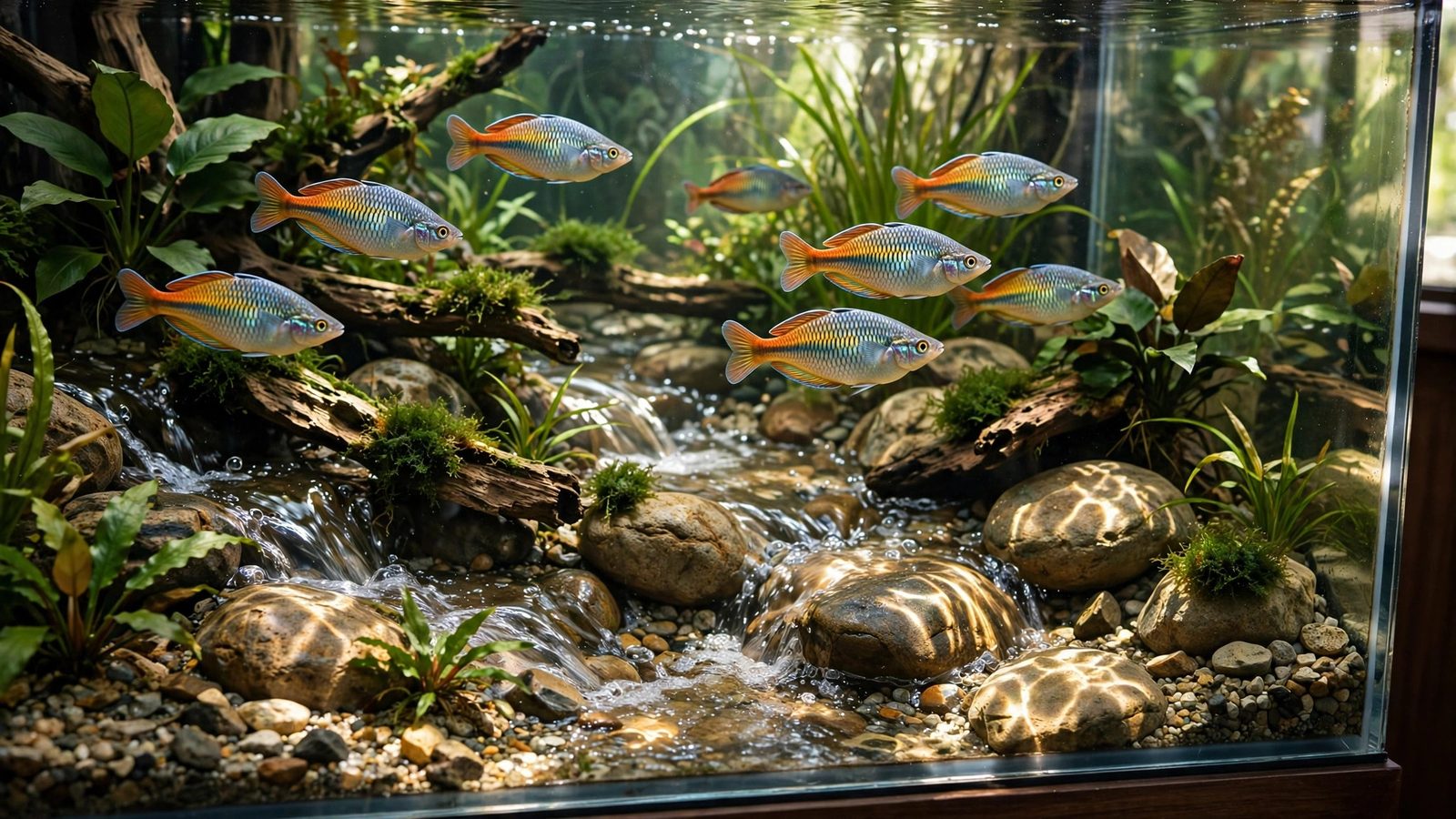
Most rainforest biotopes hand you the same recipe: soft, acidic water, leaf litter, tannins. A New Guinea biotope breaks the pattern — its rainbowfish streams run clear, neutral, and moderately hard over pale sand, with submerged logs and dense riverside planting. This guide walks you through building that stream: which fish truly belong in it, how to lay out the tank, and the water profile that keeps the flagship species at its best.
The Stream Behind Your New Guinea Biotope Aquarium
New Guinea's rainbowfish country is a network of clear rainforest streams, swamps, pools, and lagoons. Vegetation crowds the margins, fallen logs rest on the streambed, and the water runs clear over sand instead of stained dark. That clarity is what separates this build from the blackwater tanks that dominate the biotope hobby.
The flagship, the New Guinea rainbowfish (Melanotaenia affinis), is endemic to the island — found in both Western New Guinea and Papua New Guinea, in the Markham, Ramu, and Sepik river systems. One distinction matters more than any other: Australia and New Guinea are different landmasses with different faunas. The northern Australia creeks sit on a separate continent; M. affinis and the Sepik/Ramu rivers belong to New Guinea alone. Build one or the other — never blend their fish lists.
If you are new to the biotope method, read the general principles first: biotope aquascaping basics explains how to research a real habitat and translate it into hardscape, water, and stocking choices before you spend a dollar.
The Flagship Fish: New Guinea Rainbowfish
Melanotaenia affinis is the reason this build exists. It reaches 11.5–14 cm — a substantial mid-water fish that reads well in a clear, open tank. Keep it as it lives in the wild: a shoal of at least 6–8 in a minimum of 110 litres. Smaller groups turn timid and wash out; at 6–8 their confidence, appetite, and flashing mid-water display all come out.
Water chemistry follows the stream, not the rainforest stereotype: pH around 7.0, moderately hard at 100–150 mg/L, and 21–28°C. That forgiving window — close to most municipal water — makes this one of the hobby's most approachable biotope builds. Feed small live foods plus quality prepared diets; rainbowfish are enthusiastic mid-water feeders and colour up noticeably on live food. For a fish-needs-first approach to stocking, see the fish-first stocking section of the fish-tank guide.
A Lake-Born Alternative: Lake Tebera Rainbowfish
The Lake Tebera rainbowfish (M. herbertaxelrodi) offers a different New Guinea story: it comes from Lake Tebera in Papua New Guinea, living in clear, slow waters among vegetation. It is a calmer build — pH 6.5–7.5, 5–15 dGH, 24–28°C, 20-gallon minimum — with the same sand, logs, planted margins, and open lane, but water that moves slower and warmer, closer to a lagoon than a stream.
Choose one flagship, not both. Two rainbowfish species in one tank blur the biotope's identity and complicate the water profile. The New Guinea rainbowfish profile on Wikipedia maps the stream form's full distribution across the Markham, Ramu, and Sepik systems.
Water Profiles Side by Side
| Parameter | Stream build (M. affinis) | Lake option (M. herbertaxelrodi) |
|---|---|---|
| Minimum tank | ~110 L | 20 gal |
| Shoal size | 6–8 | 6–8 |
| pH | ~7.0 | 6.5–7.5 |
| Hardness | 100–150 mg/L | 5–15 dGH |
| Temperature | 21–28°C | 24–28°C |
| Flow | Gentle | Slow |
| Substrate | Fine sand | Fine sand |
Notice what is missing: peat, alder cones, heavy tannins. Those belong to soft-water builds like the clearwater Rio Tapajós build, which solves a different water-chemistry problem. New Guinea water is clear and mineral-some — lean into it.
Building the Tank: Sand, Logs, and a Swimming Lane
Start with fine river sand, sloped gently from front to back — 4–5 cm at the front, deeper behind where the planting goes. Place 2–3 pieces of submerged driftwood along the margins, angled as floodwater would have dropped them, and leave the center open. That open lane is non-negotiable: rainbowfish are swimmers, and a cluttered center turns a biotope into a generic planted tank.
Plant the sides and back densely — riverside planting frames the lane — but keep the species restrained and natural-looking. Choose tough growers that tolerate neutral, moderately hard water; the plant list for the biotope build in the complete aquarium-plants guide can be filtered for hard-water-tolerant options. A gentle filter outflow or small circulation pump gives the mild current of a rainforest stream.
Light it bright and clear. Unlike the shaded tanks of the Sulawesi ancient-lake biotopes or the flooded margins of the Southeast Asian rice-paddy floodplain biotope, this one should read as sunlit shallow water over pale sand. Cycle fully before the shoal arrives, then add all 6–8 rainbowfish at once — a complete shoal settles faster than dribs and drabs. The sibling Florida Everglades biotope shows how a different continent solves the same stream-tank design puzzle.
 ★4.2
Hamiledyi Natural Spider Wood Driftwood
Check Price on Amazon ★4.2Frequently Asked Questions
Is New Guinea the same as Australia for aquarium purposes?
No. New Guinea is a separate island north of the Australian mainland with distinct fauna. Melanotaenia affinis is endemic to New Guinea — the Markham, Ramu, and Sepik rivers — and never occurs in northern Australian creeks. Mixing fish from both landmasses makes a fantasy tank, not a biotope: pick one region and stock only from it.
How many rainbowfish do I need for a proper shoal?
Six to eight is the minimum for Melanotaenia affinis. Smaller groups turn shy, lose colour, and hide; at 6–8 the fish school loosely, display, and use the open swimming lane as intended. The tank should hold at least 110 litres — extra room always helps for an 11.5–14 cm fish that never stops moving.
Can I keep Lake Tebera and New Guinea rainbowfish together?
You could, but not in a biotope build. They come from different habitats — flowing stream versus slow lake — and prefer slightly different water. Two rainbowfish species also dilute the biotope's identity. Choose the stream form for the classic build or the Lake Tebera fish for the lake version, and commit to one.
Does this biotope need CO2 or high-light plants?
No. The planting plays a supporting role — dense riverside margins framing an open swimming lane — so undemanding growers suited to neutral, moderately hard water are ideal. Bright, clear lighting suits the sunlit-stream look, but it serves the fish and the aesthetic, not a carpet of high-demand stems. Keep it simple and let the shoal carry the tank.
What do New Guinea rainbowfish eat?
They are unfussy omnivores: daphnia, mosquito larvae, and similar small live foods are relished, alongside quality small pellets and flakes. A mixed diet keeps them active and colours them up. Feed amounts they finish in a minute or two, twice daily, rather than one large meal.
Your Clearwater Stream, Complete
A New Guinea biotope is one of the most honest builds in the hobby: clear water, honest sand, real logs, and a single confident shoal doing what it evolved to do in the Sepik and Ramu. Resist the urge to darken or complicate it. Give the fish their lane, keep the water neutral and mineral-rich, and the tank will reward you every time the shoal turns together in the light.