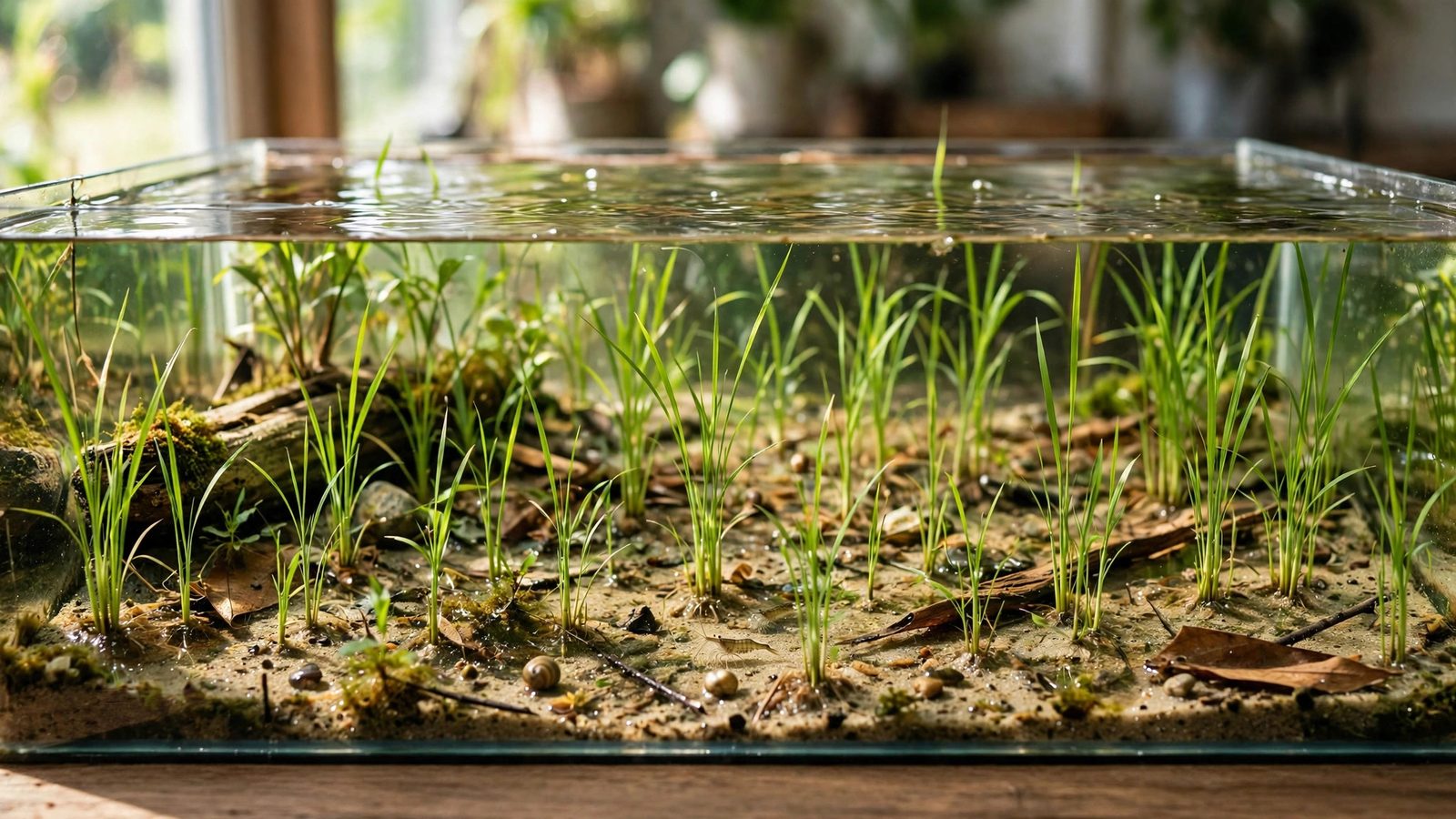
Most aquascapes chase a fantasy — a mountainside, a forest floor, a crater that never existed underwater. A rice paddy aquarium does the opposite: it recreates a real place, one that holds water for half the year and transforms with the monsoon. By the end of this guide you will build a shallow Southeast Asian rice-paddy biotope aquascape — from empty tank to living wet-season floodplain, stocked with ricefish and rasboras that evolved for exactly this habitat.
Why a rice paddy makes a brilliant biotope
A rice paddy is one of the richest freshwater habitats on the planet, and most hobbyists never think of it as an aquarium subject. Every year, across Thailand, Vietnam, Laos, and Indonesia, flat lowlands flood to a depth of just 10–30 cm. Rice shoots up through the water, sedges colonize the bunds, and an entire community of small fish moves in to feed and spawn — then the water recedes and the cycle starts again.
That seasonality is the biotope's signature. Unlike a true biotope aquascape, which reproduces a habitat exactly as it is year-round, a rice paddy aquarium reproduces a habitat in motion. The visual payoff is a shallow, horizontal scape with strong reflections, emergent vegetation breaking the surface, and schools of tiny fish working the warm margins — a look no deep planted tank can imitate.
It also solves a practical problem: shallow tanks are cheap to light, need less substrate, and use less water for changes.
Tank, lighting, and equipment
Choosing the tank
Length matters more than height. Rice paddies are horizontal landscapes, so a 60 cm tank (60×30 cm footprint) is the minimum that reads correctly; a 90×30×30 cm shallow tank is ideal and gives emergent plants room to grow up without smothering the surface. Tall narrow tanks ruin the effect — the water column should feel like a flood, not a well.
An open-top tank is strongly recommended: emergent rice and sedges grow 20–40 cm above the waterline, and a lid traps humidity, collapses stems, and cooks emersed growth under the lights. Budget for some evaporation: a 60 cm open tank loses roughly 1–2 litres per day in a warm room, so top up with dechlorinated water every day or two.
Light and filtration
Rice is a full-sun crop. Aim for 30–50 PAR at the substrate with a 6,500–7,000 K spectrum, 8–10 hours a day. Because the water is shallow, even a modest LED bar mounted 25–30 cm above the surface delivers plenty of PAR.
Filtration should be almost invisible: paddies have essentially no current, so run one air-driven sponge filter behind a plant group, rated for roughly half your tank volume. A small adjustable heater set to 24 °C covers rooms that drop below 22 °C.
Substrate and hardscape
The paddy floor is the soul of the scape: silty mud — fine, dark, rich in organic matter. Reproduce it with 3–4 cm of aquasoil or mineralized topsoil capped with 2–3 cm of fine dark sand (grain under 2 mm). The cap keeps the water clear and gives foraging fish a soft surface to sift.
Build a gentle sloped substrate rather than a flat bed: 8–10 cm deep at the back falling to 3–4 cm at the front. This creates the paddy-dike gradient — emergent plants root in the high back zone while the front stays open water for schooling fish.
Hardscape should be sparse. Real paddies are treeless and stone-free, but a scape needs visual anchors. Use two or three smooth water-worn stones — small river pebbles 5–8 cm across — half-buried along the midground as if deposited by floodwater. A single small piece of root wood lying nearly flat in a back corner is the most you should add; anything more and it stops being a paddy.
 ★4.7
ADA Aqua Soil Amazonia Ver 2
Check Price on Amazon ★4.7Planting the paddy: emergent stars and underwater support
Here is where most rice paddy aquariums fail: they plant it like a Dutch tank, all underwater. In a real paddy at flood peak, the majority of the green is above the surface. Your planting plan should put roughly 60% of the visual mass in emergent growth — rice and sedges rising through the waterline — with submerged species playing a supporting role.
The emergent layer
Actual rice (Oryza sativa) is the honest choice and surprisingly growable indoors. Use a short-grain or ornamental variety — black rice cultivars grow 40–60 cm and have striking dark foliage. Start seeds in damp (not submerged) aquasoil for 10–14 days, then transplant seedlings in clumps of 5–7 into the high back zone. Rice tillers aggressively, so a clump of 6 becomes 20+ stems in a month.
Back the rice up with sedges and rushes for texture contrast: Cyperus helferi arcs gracefully and tolerates partial emergence, dwarf hairgrass (Eleocharis parvula) carpets the dike slopes, and Hydrocotyle tripartita creeps along the waterline. The technique mirrors the wabi-kusa approach — you are essentially running several wabi-kusa clumps in one shallow tank.
The submerged layer
Underwater, keep it weedy and authentic: Limnophila aromatica and Rotala rotundifolia for stem texture, Blyxa japonica for grassy midground tufts, Cryptocoryne wendtii along the shaded edges, and a light cover of Salvinia minima on the surface. Avoid dense carpeting across the whole floor — paddies have open muddy flats, and your fish need them for foraging.
| Plant | Placement | Role in the scape | Notes |
|---|---|---|---|
| Oryza sativa (rice) | Back, emergent | Hero plant, vertical accent | Start from seed; needs high light |
| Cyperus helferi | Back corners, emergent | Arching silhouette | Tolerates wet feet permanently |
| Eleocharis parvula | Dike slopes | Texture carpet | Spreads fast in shallow water |
| Blyxa japonica | Midground | Grassy tufts | Appreciates root feeding |
| Cryptocoryne wendtii | Edges, shaded | Broad-leaf contrast | Melt-prone after transplant; be patient |
| Salvinia minima | Surface | Floater cover, light control | Thin weekly to 30–40% coverage |
 ★3.9
PAGOW Floating Plant Corral Rings
Check Price on Amazon ★3.9Water parameters and the seasonal rhythm
Paddy water is warm, soft to moderately hard, and near neutral. Target pH 6.5–7.5, GH 4–10 dGH, KH 2–6, and a steady 22–26 °C. The mud substrate will pull pH down slightly for the first month — that is normal and matches the humic character of real floodwater.
The wet/dry rhythm is optional but transformative, and it is what elevates this from a planted tank with rice to a genuine biotope. Run the tank full from March through October, then lower the waterline to 5–8 cm for 4–6 weeks in winter, keeping the mud damp. Emergent plants love the rest — rice sets stronger tillers after a dry spell — and paddy fish spawn eagerly when the water rises again.
If a full drawdown feels risky with livestock, a gentler version works: drop the level by half for 3 weeks, then resume normal water changes. The mechanics of low-water phases are covered well in dry-start method guides.
CO2 and fertilizer — conservative by design
This scape does not need pressurised CO2: emergent plants pull CO2 from the air. If you run CO2 for the submerged layer, keep it low — roughly 10–15 ppm (about 1 bubble every 3–4 seconds in a 60 cm tank via a small diffuser), and start low while observing livestock; ricefish are sensitive to CO2 swings in shallow water. Fertilize lean: a half-dose all-in-one liquid fertilizer weekly plus root tabs under heavy feeders like Blyxa is plenty.
Stocking plan: the fish of the floodplain
Stock for the habitat, not for colour clashes: small, hardy, surface-oriented fish unfazed by warm shallow water. Add them only after the tank has cycled 3–4 weeks and plants show new growth — the mud needs time to settle biologically.
| Species | School size (60 cm tank) | Why it fits |
|---|---|---|
| Japanese ricefish / medaka (Oryzias latipes) | 8–12 | The signature paddy fish; spawns among roots and floaters |
| Harlequin rasbora (Trigonostigma heteromorpha) | 10–15 | Classic SE Asian floodplain schooler, calm in still water |
| Chili rasbora (Boraras brigittae) | 12–20 | Tiny, vivid, perfect for shallow margins |
| Sparkling gourami (Trichopsis pumila) | 4–6 | Croaks audibly, patrols the surface among floaters |
| Cherry shrimp (Neocaridina davidi) | 10–15 | Cleans the mud flats; breeds freely in still water |
Pick two or three species, not all five. A classic 60 cm stocking is 10 medaka plus 12 harlequins and a starter colony of shrimp — enough movement to feel alive without crowding a shallow volume. Shrimp will graze tender rice shoots, so plant rice thickly enough to outgrow them — warm still water otherwise suits shrimp-focused aquascapes well.
Feed lightly: micro pellets and crushed flake once or twice daily, plus frozen daphnia twice a week — every meal should be gone in 90 seconds.
Building your rice paddy aquarium: step-by-step assembly
- Day 1 — substrate and hardscape. Lay the sloped soil base, cap with fine sand, and mist thoroughly. Place the pebbles and wood piece, then plant the emergent clumps into the damp cap.
- Days 2–3 — initial fill. Fill slowly over a plate or plastic bag to 5–8 cm so the emergent roots stay wet but the cap is undisturbed. Plant submerged species in the shallow water. Start the sponge filter and lights on a 6-hour photoperiod.
- Weeks 1–4 — flood and cycle. Raise the level to 15–20 cm over the first week. Run lights 8 hours, dose half-strength fertilizer, and test ammonia/nitrite twice weekly; expect some Cryptocoryne melt and diatoms — both pass.
- Weeks 4–6 — stocking. Once ammonia and nitrite read zero for a full week and you see new submerged growth, add the first school. Wait 10–14 days before adding the second.
- Months 2–6 — wet season. Extend light to 9–10 hours, thin floaters weekly, and trim flopping rice stems.
- Winter — the drawdown. Lower to 5–8 cm for 4–6 weeks, cut fertilizer, reduce light to 6 hours. Keep the mud damp, never dry and cracked. Reflood gradually in spring and watch the fish spawn.
Maintenance calendar
Weekly: 25–30% water change, thin floaters back to one-third coverage, wipe the front glass, and test pH if the tank is under 3 months old. Trim rice stems bending into the light — burnt tips rot and foul the water.
Monthly: check the substrate for gas pockets, replace root tabs under heavy feeders, and clean the sponge filter in old tank water. Prune Cyperus outer leaves to keep the silhouette open.
Seasonally: execute the drawdown described above. One deliberate low-water period per year prevents the slow anaerobic decline of a permanently flooded mud bed.
Frequently Asked Questions
Can I grow real rice in an aquarium, or should I use a lookalike?
You can grow real Oryza sativa, and it is the most authentic choice. Short-grain and ornamental black rice varieties stay manageable at 40–60 cm. Start seeds in damp soil for 10–14 days before transplanting seedlings into the tank. If ceiling height is a problem, Cyperus helferi and tall Eleocharis give a similar vertical-emergent look without the height.
How shallow can the water be for the fish?
Medaka ricefish, chili rasboras, and sparkling gouramis all thrive in 15–25 cm of water — that is their natural floodplain depth. The limiting factor is stability, not depth: shallow volumes swing temperature and chemistry faster, so keep the tank away from windows and radiators, top up evaporation daily, and never skip the weekly water change.
Do I need CO2 for a rice paddy aquarium?
No. Emergent plants absorb CO2 directly from the air, which is why rice grows so vigorously without injected gas. The submerged layer does fine on lean dosing and the nutrients in the mud. If you add CO2 for faster submerged growth, keep it conservative at 10–15 ppm and watch livestock closely — shallow water gives fish little room to escape a CO2 overdose.
Will the muddy substrate make the water permanently cloudy?
Not if it is capped properly. A 2–3 cm cap of fine sand over the soil, filled slowly and never deeply disturbed, keeps the water clear within 24–48 hours of setup. Cloudiness that persists past a week usually means the cap is too thin or too coarse, or livestock are digging — in which case add more cap material around the disturbed spots rather than tearing the scape down.
Is the dry-season drawdown safe for the fish and shrimp?
Yes, if you keep 5–8 cm of water and the filter running — real paddies shrink to puddles and ditches, and paddy species evolved for it. Move livestock to a holding container if you want zero risk, but most keepers simply lower the level and continue feeding lightly. Never let the mud dry completely; damp soil keeps the beneficial bacteria alive for the reflood.
What tank size works best for a first rice paddy biotope?
A 60 cm shallow tank (around 60×30×25 cm, roughly 45 litres) is the sweet spot: wide enough for a proper emergent backdrop and a real fish school, small enough to light cheaply and maintain easily. Smaller tanks under 30 cm long make the wet/dry cycle hard to manage and limit you to shrimp only. Go 90 cm if you want the full floodplain panorama.
Bringing the monsoon indoors
A rice paddy aquarium asks you to think like a season instead of a decorator. Flood it, let it grow wild for a few months, draw it down, and flood it again — and the tank will reward you with behaviour a static planted tank never shows: ricefish spawning in the roots at dawn, rasboras patrolling the warm shallows. Build the mud, respect the rhythm, and the paddy does the rest.