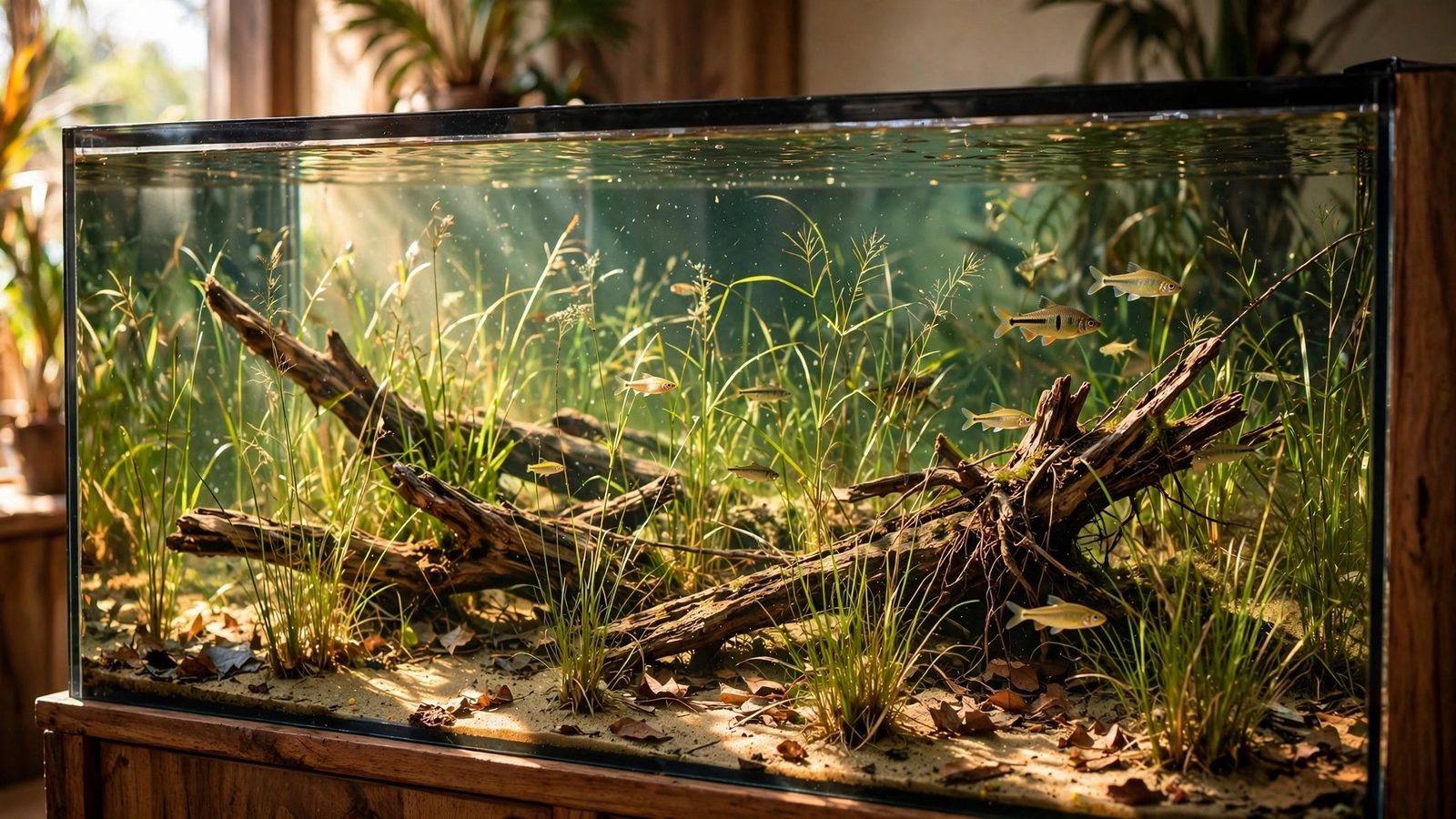
Every year the world's largest tropical wetland drowns itself — and then exhales. A pantanal biotope aquarium copies that rhythm: a tank built around the flood pulse of the Pantanal, where sand, roots, and a carpet of fallen leaves are the entire architecture. No rock piles, no stem-plant jungles — just tannin-stained water, scattered botanicals, and fish that evolved for exactly this flooded plain. If you haven't built one before, our guide to biotope aquascaping sets the ground rules; this guide applies them to South America's great seasonal wetland.
Build a Pantanal floodplain tank around the flood pulse, not rocks or planted beds: 5–8 cm of pale river sand, driftwood roots for structure, and a 2–4 cm layer of leaf litter and botanicals, with soft tannin-stained water at pH 6.2–6.8. Stock a 120-liter (30-gallon) tank with 10–12 Hyphessobrycon eques, one pair of Apistogramma borellii, and 6 Corydoras paleatus. Ecologists credit the Pantanal's annual flood pulse — water levels swinging up to about 3 m across a wetland larger than England — as the force driving its ecology.
Why a pantanal biotope aquarium works so well
Most biotope tanks chase a single snapshot: one stretch of river, one moment in time. The Pantanal resists snapshots. This is a landscape defined by movement — water that arrives with the November-to-March rains, spreads over tens of thousands of square kilometres, and retreats again by mid-year, stranding fish in shrinking pools before the cycle repeats. A tank built on this idea feels alive in a way static scapes don't, because you replay the flood.
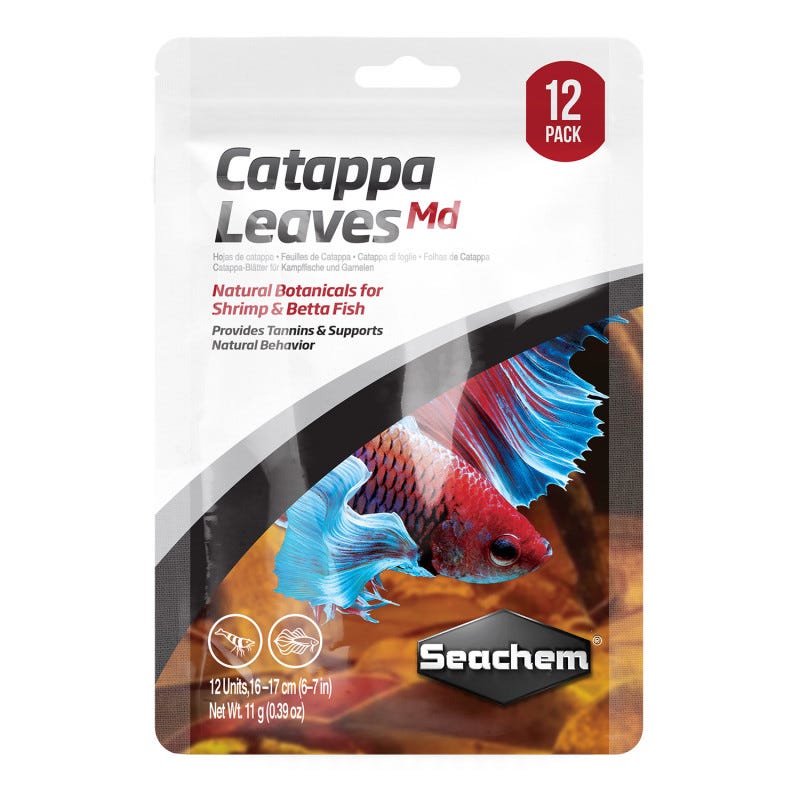
That seasonality is also practical. Leaf litter and botanicals — catappa leaves, seed pods, alder cones — release tannins that soften water and hold pH in the mildly acidic band Pantanal fish prefer, while the litter doubles as a foraging ground for corys and apistos. This is not the rice paddy biotope either — that's a human-made SE-Asian agricultural landscape. The Pantanal is a wild South American floodplain: sand instead of mud, roots instead of terraces, tetras instead of ricefish.
The wet and dry seasons that shape your tank
Think of your maintenance calendar in two acts. The wet season is the big event: one large 50–60% water change with soft, slightly cooler water spread over two to three weeks, raising the waterline a few centimetres and adding fresh leaves and botanicals. Fish respond the way they do in nature: colours deepen, serpae tetras school tighter, and Apistogramma pairs often start courting.
The dry season (April–October) is the quiet act: small 20% water changes every week or two, letting the level drop 2–3 cm through evaporation while the litter bed compacts and darkens. Resist the urge to "clean up" — the browned, crinkled litter is the point. Then the rains return, and the cycle starts over.
Building the leaf-litter and botanical bed
Start with 5–8 cm of pale, fine river sand — the aquascape sand pathway guide covers grading it for depth. Add three to five driftwood roots leaning like half-drowned shrubs; the driftwood attachment guide helps if you want epiphytes secured on them. Then the litter: a 2–4 cm layer of dried catappa and oak leaves over two-thirds of the substrate, dotted with seed pods (sterculia, magnolia) and a few alder cones per 50 liters.
Everything must be aquarium-safe and pre-soaked: boil leaves briefly, soak wood until it sinks or anchor it. Replace litter on a rolling basis — add a handful of fresh leaves monthly and remove any that turn to mush, keeping roughly half the bed intact so the biofilm community survives.
 ★4.8
Seachem Catappa Leaves 12-pack
Check Price on Amazon ★4.8Stocking a Pantanal floodplain community
| Species | Role | Numbers | Notes |
|---|---|---|---|
| Hyphessobrycon eques (serpae tetra) | Schooling mid-water | 10–12 | Colours flare deep red in tannin water; nippy in small groups — keep the school large |
| Apistogramma borellii (umbrella cichlid) | Centrepiece pair | 1 male, 1–2 females | One of the most cold-tolerant apistos; males court over leaf-litter territories |
| Corydoras paleatus (peppered cory) | Bottom forager | 6–8 | Genuine Pantanal-range species; sifts sand and litter constantly |
This trio earns its place: all three occur in Pantanal floodplain waters and partition the tank vertically — serpaes school mid-water, borellii claim caves and root nooks among the litter, peppered cories patrol the floor. In a 150–200 liter tank you can add a second small school such as ember tetras, but leave open swimming space: the flood pulse works best when fish have room for the wet-season colour-up.
Feeding follows the biotope: alternate quality micro-pellets and frozen daphnia or brine shrimp, with the occasional live grindal worm culture. Feed lightly in the dry season, richer in the wet season to simulate the flood's food boom — that's when conditioning for breeding matters most.
Plants and water chemistry
Plants are supporting actors here. A few hardy South American species root in the sand at the margins — Echinodorus swords, Vallisneria, floating Salvinia — while Anubias rides the driftwood. Keep planting sparse: open sand and visible litter are what make it read as Pantanal. The freshwater aquarium plants guide covers placement principles, and the fish tank plants guide ranks hardy low-demand species by tank position — stick to the easy tier, since tannin water and moderate light favour undemanding plants.
Water parameters matter more than plant mass. Target pH 6.2–6.8, general hardness under 8 dGH, and 24–27°C (borellii tolerates dips to 20°C, so don't sweat winter room temperatures). Use reverse-osmosis or rainwater if your tap is hard. A gentle blackwater aquascape filtration approach — sponge or low-flow canister, no chemical polishing media — keeps the tannins you worked to build.
Frequently Asked Questions
Can I run a Pantanal biotope aquarium in a 60-liter tank?
You can, but it's a compromise. A 60-liter tank holds the trio at minimum numbers (8 serpaes, a borellii pair, 6 cories) and the flood-pulse water changes become a larger percentage of the volume, which swings parameters faster. A 100–120 liter tank is the honest minimum for stable seasonality; the extra volume buffers the big wet-season refill.
How often should I replace the leaf litter?
On a rolling schedule, not all at once. Add a handful of fresh leaves every 3–4 weeks and remove only the leaves that have fully disintegrated into mush. This keeps roughly half the bed mature at any time, preserving the biofilm and microfauna the fish forage in, and avoids sudden tannin crashes or pH swings.
Will the tannins stain my silicone and equipment permanently?
Silicone can take on a faint amber tint over months — it's cosmetic and expected in any tannin tank. Heater guards and filter housings rinse clean. If you ever want the tank crystal-clear again, activated carbon or a large water change strips tannins within days, though doing so abandons the biotope's water chemistry along with its colour.
Do I need CO2 or fertiliser in a Pantanal tank?
No. Planting is deliberately sparse and the chosen species are undemanding, so CO2 injection would be wasted money and would fight the soft-water chemistry. A comprehensive liquid fertiliser at quarter to half dose, dosed weekly, is plenty for the swords, Vallisneria, and epiphytes — the decomposing litter already supplies organic nutrients.
How is this different from a blackwater Amazon tank?
A blackwater tank recreates permanently stained, ultra-soft water like the Rio Negro — chemistry as a constant. The Pantanal is a seasonal floodplain: water chemistry, depth, and habitat structure all shift between wet and dry seasons. Tannins appear in both, but the flood pulse — not the stain — is the Pantanal's defining feature.
Done right, the tank teaches you something no static scape can: that an ecosystem is a rhythm, not a picture. While you research, biotope-aquarium.info's species database lets you verify which fish genuinely occur in Pantanal waters, and the Biotope Aquarium Project's biotope profiles publish field-data-based scaping guidance to benchmark your floodplain against.