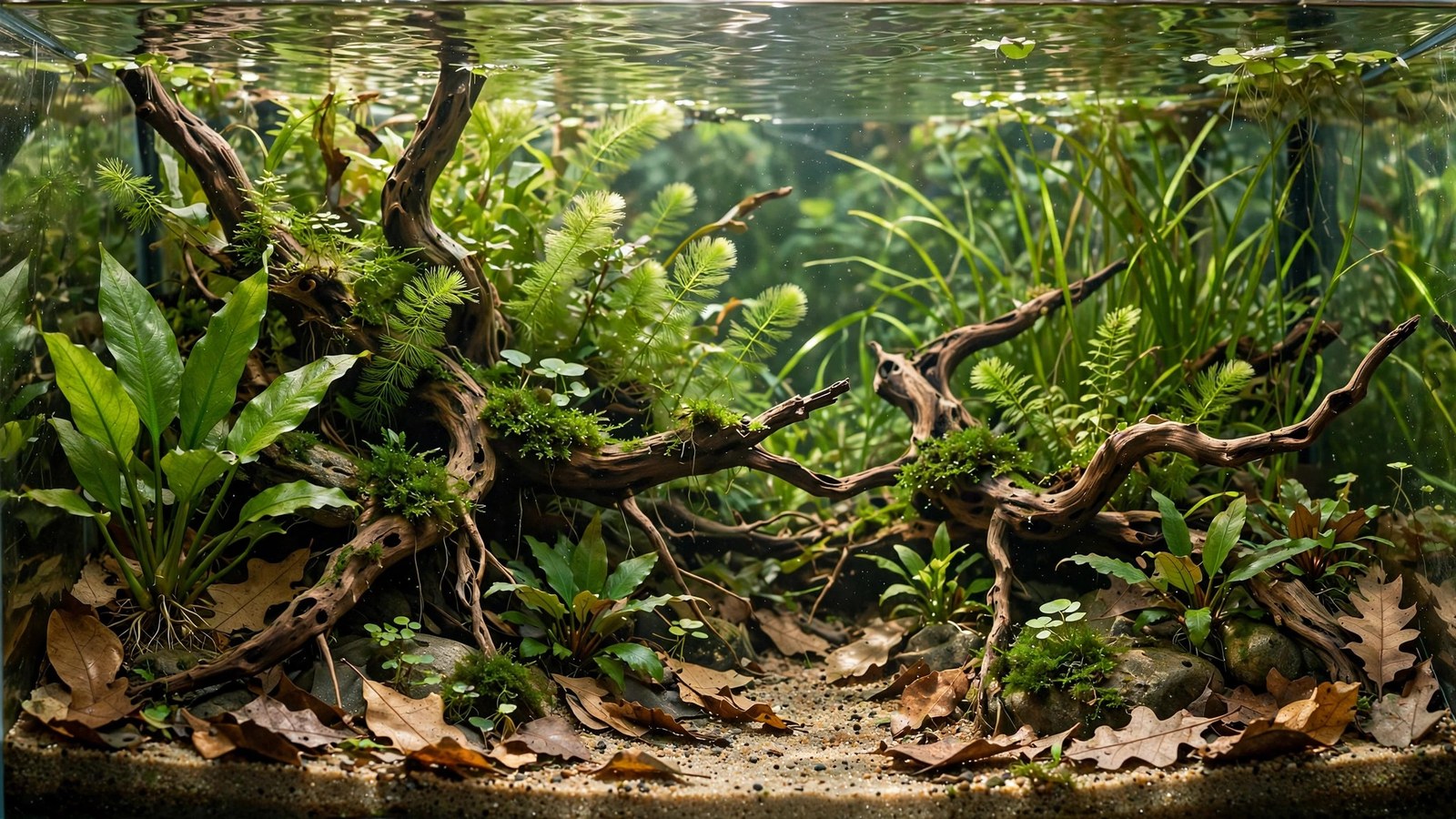
A biotope aquascape doesn't imitate a landscape — it recreates a place. Where the Nature Aquarium borrows from Japanese gardens, a true biotope replicates a specific real-world habitat: the exact plants, hardscape, water chemistry, and fish that coexist in one stretch of river, lake, or floodplain. Done well, it's the most intellectually satisfying style in the hobby — your tank becomes a living field study, and every inhabitant belongs there because in nature, they actually do.
What Counts as a Biotope (and What Doesn't)
The word "biotope" gets thrown around loosely, but the strict definition matters: every organism in the tank must occur together in the same natural habitat. A tank with Amazon swords, neon tetras, and cherry shrimp isn't a biotope — it's a community tank with a theme. The shrimp are Asian; the plants and fish are South American. A genuine Rio Negro biotope would hold cardinal tetras, discus or dwarf cichlids, Echinodorus species, and leaf litter — all documented from that blackwater system.
There's a spectrum, and honesty about where you sit on it is fine:
- True biotope: all species (plants, fish, invertebrates) documented from one specific locality, with matching water parameters, substrate, and hardscape.
- Biotope-inspired: species from the same region or river system but not necessarily the same exact stretch — e.g., "Southeast Asian stream" mixing species from different Thai and Malaysian waterways.
- Themed tank: a visual nod to a habitat (driftwood + leaves = "Amazon-ish") without strict species fidelity. Still attractive, just not a biotope.
Most hobbyists build biotope-inspired tanks, and that's a worthy goal — but the research process is the same, and it's where the fun lives.
Research: The Biotope Builder's Real Work
Biotope aquascaping is 60% research, 40% execution. Before buying anything, pick your habitat and learn it. The best sources, in order of reliability:
- Scientific papers and ichthyological surveys — search Google Scholar for your river + "fish assemblage" or "aquatic vegetation." Survey papers list exactly which species co-occur.
- FishBase (fishbase.se) — distribution data and habitat descriptions for virtually every fish species.
- Seriously Fish — profiles include "Habitat" sections describing substrate, flow, vegetation, and co-occurring species.
- Tropica's plant database (tropica.com) — origin data for aquarium plants, essential for verifying a plant actually comes from your chosen region.
- Biotope Aquarium Project contests — past entries document their research and species lists publicly; they're masterclasses in methodology.
Document your sources. Serious biotope builders keep a species list with citations — partly for contest entry, partly because six months later you won't remember why you chose that particular crypt. A simple spreadsheet (species, role, source confirming locality) is enough.
Choosing Your Biotope: Five Great Starter Habitats
1. Rio Negro blackwater (Brazil)
The classic. Tea-colored acidic water (pH 4.5–6.0), white sand over leaf litter, submerged driftwood, dappled light. Plants: Echinodorus species, Mayaca fluviatilis, Heteranthera zosterifolia at the margins. Fish: cardinal tetras, rummy-nose tetras, dwarf cichlids (Apistogramma), hatchetfish at the surface. Our blackwater aquascape guide covers the tannin and leaf-litter mechanics in depth — blackwater technique and biotope accuracy go hand in hand here.
2. Southeast Asian forest stream (Thailand/Malaysia)
Shaded, cool, flowing water over smooth stones and gravel. The signature plants: Cryptocoryne species (C. wendtii, C. beckettii, C. parva — this genus is the biotope builder's best friend), Barclaya, mosses on rocks. Fish: harlequin rasboras, cherry barbs (Sri Lanka, close enough for inspired builds), bettas in the slower margins — see our betta tank aquascaping ideas for a slow-water variant. Invertebrates: Amano shrimp genuinely belong here (Japan/Taiwan streams).
3. Lake Tanganyika rocky shore (Africa)
The cichlid biotope. Piles of rounded rock forming caves and territories, sandy patches, hard alkaline water (pH 8+), and almost no plants — Vallisneria spiralis at the margins is one of the few authentic options. Fish: shell-dwellers (Neolamprologus multifasciatus), Julidochromis, Cyprichromis schools. This biotope teaches an important lesson: authentic sometimes means sparse planting. A Tanganyika tank stuffed with plants is less accurate than one with great rockwork and open sand.
4. Florida Everglades / North American swamp
Shallow, warm, vegetation-choked: Sagittaria subulata, Vallisneria americana, Bacopa caroliniana, Ludwigia repens, dwarf hairgrass. Hardscape is minimal — maybe cypress knees (driftwood) and leaf litter. Fish: least killifish, flagfish, pygmy sunfish. Wonderfully achievable with easy plants, and a great low-tech biotope since most of these species thrive without CO2.
5. Amazonian flooded forest / igapó
Seasonally flooded forest floor: submerged tree roots and branches, leaf litter, dim light, soft acidic water. Plants are sparse underwater (Echinodorus, floating plants like Pistia and Salvinia at the surface doing the heavy lifting), with the drama coming from root structures. Fish: angelfish, discus, large tetra schools weaving through roots. Our single-driftwood layouts translate directly — one spectacular root mass can carry this biotope.
Building It: Hardscape, Substrate, and Water
Hardscape must match the geology. Rio Negro means driftwood and leaf litter, not Seiryu stone (which is Asian and would look wrong to anyone who knows). Tanganyika means rounded lake rock, not branchy spider wood. Research photos of the actual habitat — not other people's tanks — and match materials. One material dominating, as in our hardscape-first method, applies doubly here: natural habitats are geologically consistent.
Substrate follows habitat: white or tan sand for blackwater rivers and lake shores, fine gravel for streams, mud-toned aquasoil or sand capped over soil for swamps. Skip the aquasoil where the habitat is inert sand — authenticity beats convenience, though you can hide root tabs under sand for the plants that need them.
Water chemistry is part of the scape. A blackwater biotope at pH 7.5 with crystal-clear water isn't a blackwater biotope — it's a decorated tank. Use RO water remineralized to target parameters, botanicals (catappa leaves, alder cones) for tannins and pH reduction, and match temperature to the habitat. Test and log parameters; the biotope is only as real as its water.
Planting for Authenticity, Not Show
Biotope planting looks different from show-tank planting. Natural habitats are messy: plants grow in irregular patches, some areas are bare, leaf litter accumulates, algae exists on rocks. The instinct to manicure everything into a contest layout fights the biotope's soul. Plant in drifts and let them intermingle. Leave the leaf litter. Let the crypts form a ragged colony instead of a tidy row.
That said, composition still matters — a biotope should be beautiful, not just accurate. Use the compositional tools from our diagonal composition guide and depth creation techniques: taller vegetation at the back, open swimming space in front, a focal area of dense growth. Nature has composition; it just doesn't use the golden ratio consciously. Observe how real stream banks look — vegetation thickest at the margins, open channel in the middle — and replicate that logic.
Plant choice discipline is the hard part. That gorgeous red Rotala has no business in a Rio Negro tank. Before adding any plant, verify its origin against your habitat. Keep a "rejected" list — it's satisfying to watch it grow, and it keeps the tank honest.
Stocking: The Final Authenticity Test
Fish selection makes or breaks a biotope. Rules:
- Every fish must be documented from the habitat. No exceptions for pretty fish. This is the whole point.
- Stock for behavior, not just looks. A biotope with the right species behaving naturally — rasboras schooling through crypts, Apistogramma defending a leaf-litter territory — is mesmerizing in a way a random community never is.
- Match numbers to nature. Schooling fish in real schools (15–30+), territorial fish with actual territory space. A lone cardinal tetra in a "Rio Negro biotope" misses the point as badly as a wrong species.
- Quarantine everything. Wild-caught biotope fish especially — run proper quarantine before introduction.
Invertebrates count too. Amano shrimp belong in Asian stream biotopes; they do not belong in the Amazon. Snails: nerites are widespread enough for many Old World biotopes; for the Americas, look at native options or skip snails entirely.
Maintenance With a Light Touch
Biotope maintenance differs from show-tank maintenance. You're maintaining a habitat, not a photograph:
- Leaf litter gets replenished, not removed. As catappa and oak leaves break down, add new ones on top. The decomposing layer is habitat for fry, shrimp, and microorganisms.
- Trim for health, not geometry. Remove dead growth and keep plants from completely choking flow, but don't sculpt hedges. Our trimming maintenance guide covers the techniques — just apply them with restraint.
- Water changes match the habitat's rhythm. Blackwater systems get smaller, more frequent changes to keep tannins and pH stable; stream biotopes can take larger changes. Big parameter swings break the illusion and stress wild-type fish.
- Let some algae live. Aufwuchs on rocks is food for grazing fish and looks natural. Clean the front glass; leave the back and rocks alone.
Frequently Asked Questions
Can I mix species from different rivers in the same country?
That's a biotope-inspired tank, not a true biotope — and it's a perfectly respectable goal. Species from the same river system (e.g., the greater Amazon basin) generally share water chemistry and look coherent together. Just be honest in how you describe it, especially if entering contests with biotope categories, which judge on documented co-occurrence.
Are cultivars and color morphs allowed in biotopes?
Strictly, no — a "red" cherry shrimp or a balloon molly doesn't exist in nature. Purists use only wild-type forms. For biotope-inspired builds, most hobbyists accept tank-bred wild-type coloration (which is nearly all captive stock) but draw the line at man-made morphs like longfin or albino variants. Decide your standard upfront and apply it consistently.
What if a plant I need isn't available in the hobby?
Substitute the closest available relative from the same region, and note the substitution in your species list. Biotope judges accept documented substitutions when the exact species is unobtainable — what they penalize is silent substitution with something from another continent. Never substitute across regions just because it looks similar.
Do biotope tanks need CO2?
Match the habitat, not the style. Lush Southeast Asian stream biotopes with crypts and mosses often thrive low-tech; an igapó with sparse planting certainly doesn't need it. Add CO2 only if your authentic plant list demands it for health — never to force a habitat into looking like a high-tech show tank.
How do I enter biotope contests?
The Biotope Aquarium Project runs the dedicated world championship; AGA and IAPLC have biotope categories. Entries require a species list with documented localities, habitat photos or descriptions, and water parameters. Photography matters enormously — see our aquascape photography guide before submitting. Start by studying past winning entries' documentation.
Is a biotope harder than a regular planted tank?
The tank mechanics are the same; the difficulty is front-loaded into research. Once built, many biotopes are actually easier — authentic plant and fish combinations are adapted to the same water, so the system is inherently stable. The ongoing discipline is resisting the urge to add that beautiful but wrong-continent fish.
The Tank as a Place
A biotope aquascape asks more of you than other styles — research before shopping, restraint at the fish store, fidelity over flash. What it gives back is a tank with a story: not "a pretty aquarium" but "a 40-liter slice of the Rio Negro" or "a Tanganyikan rock reef." Visitors feel the difference even if they can't name it; everything belongs, so everything looks inevitable. Start with one of the five starter habitats above, document your species list, and build slowly. And when your biotope matures, consider documenting it for the community — the hobby needs more well-researched habitat tanks. For the broader competition world beyond biotopes, our aquascaping contests guide explains how judging works across all styles.
Tissue-culture plants are the exception — they’re grown in sterile gel and adapt with minimal melting, which is part of what you’re paying for. Plants bought submersed from another hobbyist’s tank also transition with little melt, since they’re already in the right form.
Which Plants Melt Most (and Least)
Heavy melters (expect significant leaf loss)
- Cryptocorynes — infamous for “crypt melt,” sometimes dropping every leaf after any disturbance. They almost always recover from the roots within weeks.
- Stem plants grown emersed — rotala, ludwigia, and hygrophila often shed lower emersed leaves while the growing tips transition.
- Amazon swords — emersed-grown swords typically lose their broad oval aerial leaves and replace them with longer submersed ribbon leaves.
Light melters
- Anubias, java fern, bucephalandra — slow-growing rhizome plants transition gradually; occasional old-leaf melt but rarely dramatic.
- Vallisneria — usually transitions well, though it dislikes the move itself and may sulk for a week.
- Floating plants — minimal melt since their leaves were already at the air-water interface.
The Acclimation Protocol
Step 1: Quarantine or dip first
Before acclimating to your tank’s conditions, make sure you’re not acclimating pests along with the plant. Run new arrivals through our quarantine and dip protocol — it adds days upfront but prevents months of regret.
Step 2: Float to temperature-match (30 minutes)
Float the bag or container in your tank for 20–30 minutes to equalize temperature. Plants are less temperature-sensitive than fish, but a 10°F shock on top of transplant stress is an avoidable insult.
Step 3: Trim before planting
Remove any leaves that are already damaged, yellowing, or heavily algae-covered — they won’t recover and they’ll rot in your tank, feeding algae. For stem plants, trim off the bottom inch and any emersed leaves that look unlikely to adapt; the plant wastes energy maintaining leaves it’s going to shed anyway. Keep the healthy growing tips — that’s where recovery starts.
Step 4: Plant correctly the first time
Follow our planting guide — right depth, crown exposed on rosettes, rhizomes unburied on epiphytes. Every uprooting and replanting restarts the acclimation clock, so get placement right on the first attempt. Decide where each plant goes before it goes in the water.
Step 5: Run a gentle first week
For the first 7 days after planting:
- Moderate light — run your normal photoperiod but consider dropping intensity 20–30% if your light is dimmable. Blast-level light on a melting plant grows algae on the dying leaves, not recovery.
- Stable CO2 — if you inject CO2, keep it consistent. Fluctuating CO2 during acclimation is a melt accelerator. If you’re low-tech, this doesn’t apply — see growing without CO2.
- Half-strength fertilizer — new plants with damaged leaves can’t use full dosing, and the excess feeds algae. Ramp to full strength over 2–3 weeks per our fertilizer schedule.
- No disturbance — don’t move, trim, or “check on” new plants for at least two weeks. Every touch resets root establishment. This is especially critical for crypts.
Step 6: Remove melt, keep the base
As emersed leaves melt, remove the mushy material promptly — decaying leaves release ammonia and grow fungus that can spread to healthy tissue. But never discard the plant while the crown, rhizome, or roots are firm and alive. A crypt that’s lost every leaf but has firm roots is a plant that’s about to recover, not a dead plant. Give it 3–4 weeks before judging.
Telling Normal Melt From Real Problems
Normal transition melt:
- Affects oldest/emersed leaves first, newest growth last
- New submersed leaves emerge even as old ones dissolve
- Roots and crown stay firm and white/green
- Timeline: 1–4 weeks, then obvious new growth
Concerning melt (see our full melting diagnosis guide):
- New growth also melts or emerges deformed
- Rhizome or crown turns mushy and brown — this is rot, not transition
- Entire plant dissolves within days with no new growth after 4+ weeks
- Melting spreads to established plants that weren’t recently moved
Buying Tips to Minimize Melt
- Buy submersed-grown when available — hobbyist-grown cuttings transition with almost no melt.
- Choose tissue culture for sensitive species — crypts and delicate stems establish far more reliably from sterile cups.
- Avoid plants already melting in the store tank — some melt is normal, but a plant that’s mostly mush at purchase has less energy for recovery.
- Transport carefully — keep plants damp and out of direct sun/heat. A plant that dries out or cooks in a hot car melts far worse than one transported properly.
The First-Month Timeline: What to Expect Week by Week
Knowing what’s normal when removes most acclimation anxiety. Here’s the typical timeline for a healthy plant adapting to a new tank:
Week 1: The quiet week
Almost nothing visible happens. The plant is growing roots you can’t see and assessing its new environment. Some species (vallisneria, stem plants) may start shedding their lowest leaves. This is normal. Resist the urge to “help” — no moving, no extra fertilizer, no light changes. The most common beginner mistake is intervening during a week when the correct action is nothing.
Week 2: Melt peaks
This is when emersed leaves give up in earnest. Crypts may drop everything; swords shed their broad aerial leaves; stem plants lose lower foliage. It looks catastrophic and it’s usually fine. Keep removing mushy material, keep conditions stable, and watch the crown and growing tips — if those are firm and green, recovery is already underway.
Week 3: The turn
New submersed-adapted leaves emerge — smaller, thinner, often a slightly different shade of green than the emersed foliage. Stem plant tips start growing visibly; crypts push tiny curled leaves from the crown; swords unfurl narrow ribbon leaves. This is the moment most beginners exhale for the first time.
Week 4+: Established
New growth outpaces melt, and the plant is functionally yours. You can resume full-strength fertilizer, normal trimming, and stop treating it as fragile. Some slow growers (anubias, bucephalandra) take 6–8 weeks to show obvious progress — that’s their normal speed, not a problem.
Acclimating Different Plant Formats
Tissue-culture cups
Sterile, pest-free, and already adapted to high-humidity (not emersed) growth — tissue cultures melt the least of any format. Rinse the agar gel off gently (leftover gel rots and feeds fungus), split the portion into small plantlets, and plant per our planting guide. They establish slowly for the first two weeks, then accelerate. No dip needed, minimal acclimation stress — this is the premium experience you’re paying for.
Potted plants
Remove the pot and strip away the rockwool completely — leftover rockwool traps debris and rots. Tease the root mass apart gently; if it’s a dense mat, splitting it into 2–3 smaller portions actually establishes faster than planting one big clump (more growing points, better water flow around roots). Potted plants are usually emersed-grown, so expect the standard 2–4 week melt cycle.
Bare-root / bunched stems
Typically sold as weighted bunches. Remove any bands, foam, or weights, strip the lower leaves, and plant stems individually or in small groups. Bunched stems from the store are often already transitioning — check for new submersed growth at the tips, which tells you the plant is mid-adaptation and will settle quickly.
Hobbyist cuttings
Already submersed-grown and the fastest to establish — often showing new growth within days. The main acclimation factor is water-parameter difference between the two tanks. Float to temperature-match, plant promptly, and they’ll usually take off with minimal melt. This is why experienced hobbyists prefer trading cuttings over buying potted plants.
Frequently Asked Questions
Should I use a “plant starter” or transplant fertilizer?
Products marketed for transplant shock are mostly B-vitamins and mild hormones. They don’t hurt, but there’s no strong evidence they help aquarium plants specifically. Stable conditions and patience outperform any bottle. Save the money for more plants.
My new plant melted completely — bare crown, no leaves. Is it dead?
Probably not, if the crown or rhizome is firm. Crypts and swords routinely lose 100% of their leaves and regrow from the base within a month. The test is firmness: firm and pale/green means alive; mushy and brown/black means rot. Give firm-but-leafless plants a full 4 weeks before declaring them dead.
Can I speed up acclimation with extra light or CO2?
No — and trying usually backfires. A melting plant can’t use extra light; the excess just grows algae on its dying leaves. Keep light moderate and CO2 stable (not boosted) during acclimation. Growth speed comes from the plant’s own adaptation timeline, which you can’t rush, only avoid delaying.
Should new plants go straight into my main display tank?
After quarantine/dipping, yes — there’s no benefit to a separate “growing-in” tank for most plants. They acclimate to your water fastest in the tank they’ll live in. The exception is very delicate species going into a tank with boisterous fish; give those a few weeks in a calm corner or breeder box first.
The Patience Rule
The single most important acclimation skill is restraint: plant it right, set gentle conditions, remove decay, and then leave it alone for a month. The hobbyists with the best plant growth aren’t doing something clever in week one — they’re simply not interfering in weeks two through four while the plants do what they’ve evolved to do. Melt looks like failure and feels like failure, but in most cases it’s the visible part of a plant successfully becoming yours.