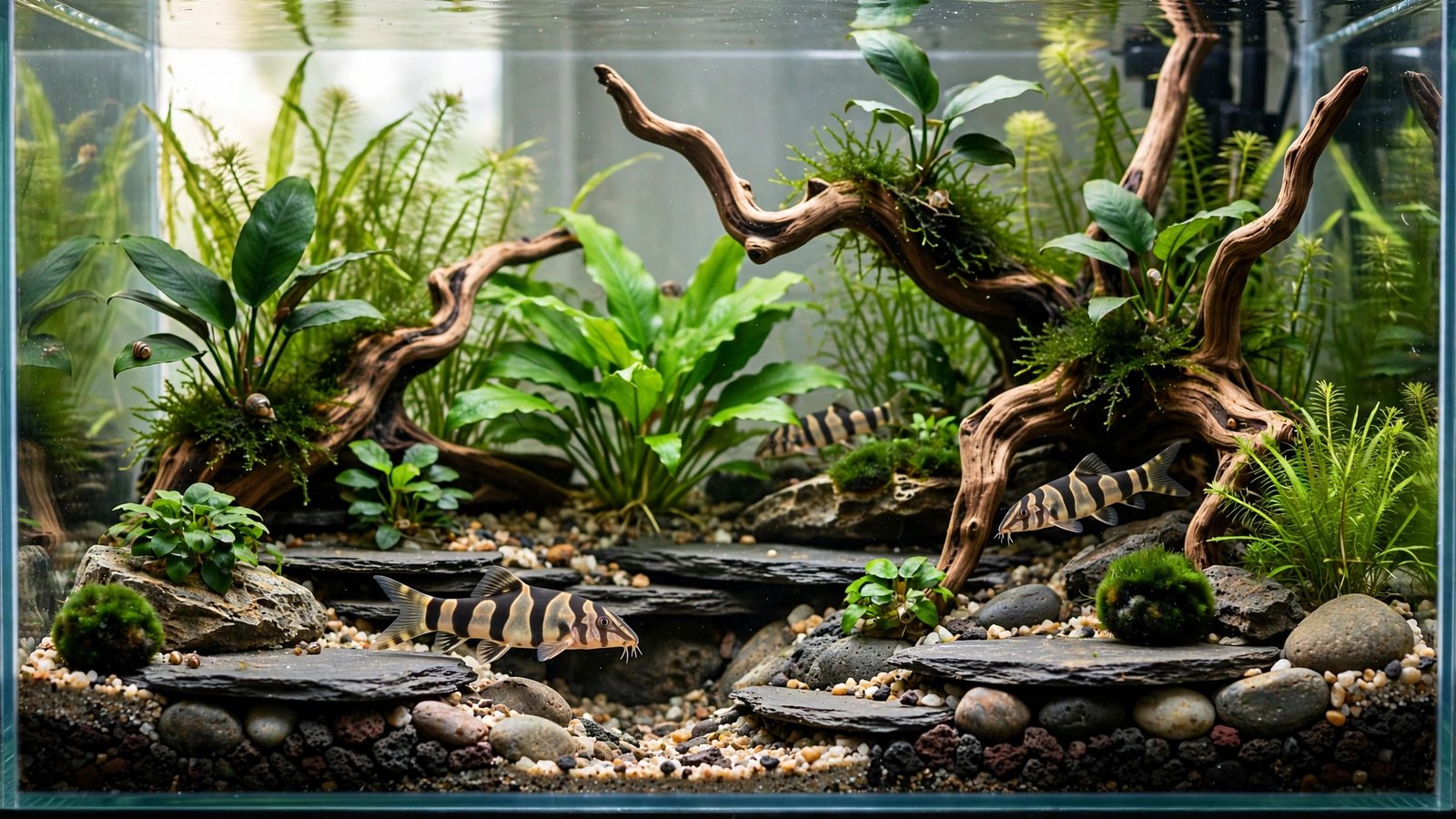
Three hours after planting a pristine carpet of dwarf hairgrass, one keeper watched a pair of yoyo loaches bulldoze the entire foreground into floating clumps. It is the classic heartbreak of the species: beautiful, social fish that treat a planted tank like a construction site. A yoyo loach planted tank works — if you build it for the fish first and the scape second. Here is the digger-proof formula: sand, hides, and plants they cannot wreck.
Why yoyo loaches wreck delicate scapes
The yoyo loach comes from the slow rivers and still pools of the Ganges basin in northern India and Nepal, where it spends its days nose-down in soft river sand, sifting for insect larvae and snails. That foraging is hardwired: in your tank, a yoyo drives its snout into the substrate and plows forward, sand tumbling out behind it. Anything rooted in the blast zone lifts out. It is not aggression or hunger — it is simply how the fish eats.
Unlike the shy, nocturnal kuhli loach, which burrows quietly at night, yoyos dig in broad daylight. That is why standard scaping advice fails with them. If you are coming from a lightly planted aquarium setup of delicate stems, the first adjustment is mental: you are building a loach habitat that happens to be planted.
Setting up a yoyo loach planted tank that stays planted
Substrate: fine sand or nothing
Sharp or coarse gravel is the single most common yoyo loach mistake. Their barbels — the whisker-like sensory organs around the mouth — abrade on rough substrate, and damaged barbels invite bacterial infection. Fine, smooth sand lets them sift naturally, grains pouring through their gills while food particles get trapped against the barbels, exactly as nature intended.
Lay 2–3 inches of sand across the tank. For heavy root feeders like Amazon swords, put 1 inch of aquarium soil under a 2-inch sand cap — the cap stops loaches exposing the soil while roots reach down. Or skip soil and push root tabs deep under the sand every two to three months.
Caves, hides, and sight-line breaks
Yoyos are social but rowdy — without enough shelter, a pecking order forms, expressed as chasing and fin nipping. Aim for at least one hide per fish: stacked slate, ceramic caves, coconut huts, and driftwood tangles all work. The Loaches Online species profile specifically recommends plenty of hiding places among rocks and driftwood for this species.
Break sight lines with hardscape so rival loaches cannot see each other constantly — squabbling drops sharply. You will also hear your yoyos "clicking," a sound they make when excited, usually around food. That is normal, not distress.
Plants that survive loach attention
Two strategies work with diggers. First, epiphytes: Anubias, Java fern, and Bucephalandra tied or glued to driftwood and rock — nothing in the substrate, nothing to uproot. Second, deep-rooted heavyweights: Amazon swords, cryptocorynes, and vallisneria, whose roots re-anchor faster than loaches dig them out, especially if they establish for three to four weeks before the loaches move in.
Skip fine foreground carpets (HC Cuba, dwarf hairgrass) in open digging zones — they become confetti. For species selection, start with the fish-first plant guide and the easiest aquarium plants for a beginner community tank, all loach-compatible. Also borrow the dig-proof plant picks used for cichlid tanks — cichlid keepers solved uprooting years ago.
What you need: the digger-proof shopping list
Before the loaches arrive, gather the hardware that makes this setup work:
- Fine aquarium sand — 40–60 lbs for a 40-gallon breeder (about 1.5 lbs per gallon for 2–3 inches). Pool-filter sand and aquarium river sand both work; rinse until the water runs clear.
- Cave hides — ceramic loach caves, stacked slate, or driftwood, at least one shelter per fish. Smooth edges only: loaches wedge into tight gaps.
- Sturdy epiphyte plants — Anubias and Java fern tied to hardscape with cotton thread or aquarium-safe super glue gel. The backbone of a loach-proof scape.
- Sinking pellets — a quality sinking pellet or wafer as the daily staple, since yoyos feed at the bottom and flakes rarely reach them.
That is the complete foundation. Frozen foods, root tabs, and extra hardscape are upgrades, not requirements.
Tank mates that work (and ones that do not)
Yoyos are peaceful toward mid-water fish but boisterous, so the rule is simple: sturdy, active community fish thrive; slow, long-finned, or tiny invertebrates do not.
| Tank mate | Verdict | Notes |
|---|---|---|
| Rummy nose tetras | Excellent | Tight-schooling mid-water fish the loaches ignore. See the rummy nose tetra planted tank setup for a compatible layout. |
| Ember tetras | Excellent | Small but quick — too fast to be bothered, with constant movement up top. |
| Congo tetras | Good | Best in 55+ gallons where their size matches the loaches' energy. |
| Corydoras catfish | Good | Peaceful bottom cohabitation; feed sinking food in two spots so loaches do not steal it all. |
| Cherry shrimp | Risky | Adults usually survive; shrimplets are expensive loach snacks. Breeding colonies need their own tank. |
| Bettas, guppies, angelfish | Avoid | Long fins invite nipping from an understimulated or undersized loach group. |
Feeding the snail squad
Yoyo loaches are omnivores with a famous specialty: pest snails. A hungry group hunts bladder snails, ramshorns, and small trumpet snails, sucking them from their shells — many keepers buy yoyos specifically for this, and a moderate outbreak usually disappears within a week or two.
Do not rely on snails alone. Feed sinking pellets or wafers daily, frozen bloodworms two to three times a week, and blanched zucchini occasionally. They are greedy, so feed only what the group finishes in two to three minutes — uneaten food buried in sand by digging loaches fouls water fast. For species background, the Wikipedia yoyo loach profile covers their taxonomy and the naming quirk (juvenile markings that spell "yoyo").
Frequently Asked Questions
Will yoyo loaches eat my aquarium plants?
No — they do not eat healthy plant tissue. The damage is mechanical: they uproot plants while sifting substrate for food. Epiphytes tied to hardscape and deep-rooted plants like Amazon swords survive them fine; shallow-rooted stems and carpets get bulldozed.
How many yoyo loaches should I keep together?
At least five, ideally six, in 40 gallons or more. In groups of two or three, the dominant fish bullies tank mates; in a proper group the squabbling stays within the loach pack.
Do yoyo loaches really eat pest snails?
Yes — among the most effective snail-eating fish available. A group clears bladder snails, ramshorns, and small trumpet snails within days to weeks. They will also eat ornamental snails like nerites, so do not mix them if you value your cleanup crew.
Sand or gravel for yoyo loaches?
Fine, smooth sand, always. Yoyos sift substrate through their gills while foraging, and sharp gravel abrades their sensitive barbels, causing infection and permanently shortened whiskers. Two to three inches of rinsed sand also makes their digging harmless to the scape.
Why does my yoyo loach lie on its side?
Lying motionless on the side or wedged into a cave is normal and alarms every new keeper. They rest in odd positions, then spring to life at feeding time. Worry only if you also see clamped fins, rapid breathing, white spots, or food refusal beyond a day.
The bottom line
A yoyo loach planted tank is not a compromise — it is a tank designed honestly. Fine sand instead of gravel, hides instead of open water, plants chosen for grip rather than delicacy. Build it that way and you get both: a lush aquascape and the most entertaining bottom-dwellers in the hobby, clicking and sifting through it for years.