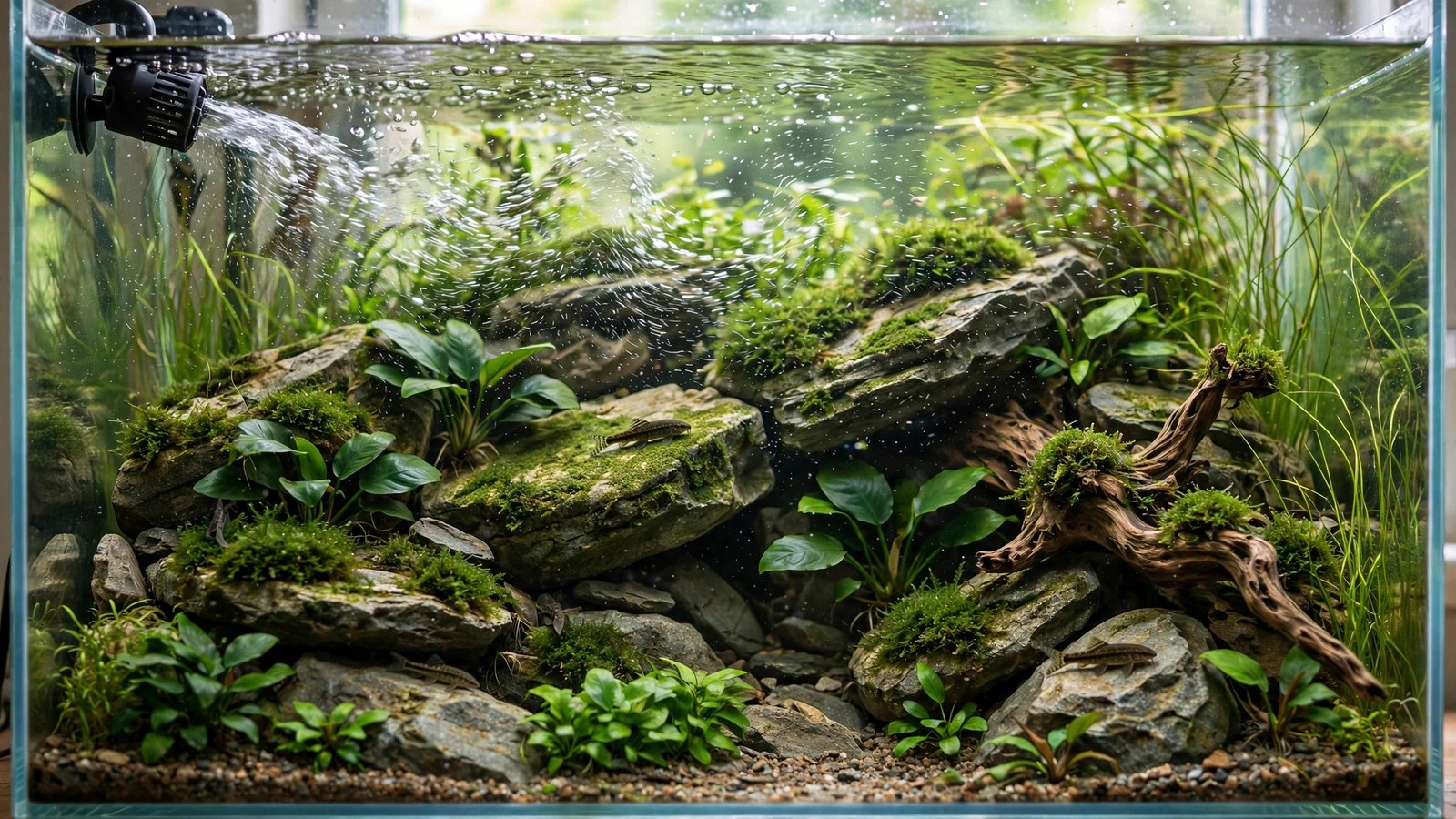
Hillstream loaches — the "stingray plecos" that suction onto glass and rocks — come from fast, shallow, oxygen-saturated mountain streams. Almost every care guide gets their tank wrong by treating them like tropical community fish. A hillstream loach planted tank is a genuine specialty build: high flow, cool water, and maximum oxygen, with plants chosen from the short list that tolerates river conditions. Done right, it's one of the most distinctive tanks in the hobby.
Understanding the Hillstream Environment
Wild hillstream loaches (Sewellia, Beaufortia, Gastromyzon species) live in water rarely deeper than a foot, flowing fast over smooth rocks, saturated with oxygen and cool year-round. Key translations for the aquarium:
- Flow: strong, laminar current — not turbulence, but real directional flow
- Oxygen: near saturation at all times; surface agitation is mandatory
- Temperature: 65–75°F — subtropical, not tropical
- Substrate: smooth rocks and pebbles, not sharp gravel
- Food: aufwuchs — the biofilm and microalgae coating every rock
This is the opposite of a still, warm, heavily fertilized aquascape. The hillstream planted tank is an exercise in adapting planting to river physics rather than forcing river fish into pond conditions.
Tank Size and Shape: Shallow and Long
Footprint matters more than volume — hillstreams live on surfaces, not in the water column:
- Minimum: 20-gallon long for a group of 5–6
- Ideal: 30–40 gallon breeder — maximum floor space for grazing territory
- Shape: long and shallow beats tall; a 33-gallon long outperforms a 55-gallon tall
Keep hillstreams in groups of 5–6 minimum. They're social grazers that establish a pecking order through harmless pushing matches; singletons stress and waste away. Our 40-gallon breeder planted tank setup gives the equipment baseline for the ideal footprint.
Water Parameters: Cool, Clean, Oxygen-Rich
| Parameter | Target range |
|---|---|
| Temperature | 65–75°F (18–24°C) — no heater in most homes |
| pH | 6.5–7.5 |
| GH / KH | Moderate; stable more important than specific |
| Ammonia / nitrite | 0 ppm — hillstreams are pollution-sensitive |
| Nitrate | Under 20 ppm |
| Oxygen | Near saturation — the critical parameter |
Temperature is the deal-breaker for community plans: hillstreams top out around 75°F, which excludes most tropical tankmates. This is a subtropical tank — plan companions from the cool-water list, not the tropical one. Our planted tank water parameters guide covers the underlying chemistry.
Creating the Flow: The River Manifold
Standard filters don't create river flow — they create circulation. For genuine hillstream current, use one of these approaches:
- Powerhead + spray bar: a powerhead (200–400 GPH depending on tank size) feeding a spray bar along the back wall creates strong laminar flow down the tank length. Simple, effective, adjustable.
- River manifold: the enthusiast approach — PVC piping along the substrate with directional outlets, powered by a strong pump, creating even flow across the whole footprint. More work, best results.
- Wavemaker on pulse: a controllable wavemaker set to a steady (not pulsing) mode aimed lengthwise. Easiest to tune.
Whatever the method, verify with a simple test: a pinch of food should drift steadily in one direction across the whole tank, not swirl in eddies. Combine flow with vigorous surface agitation — oxygen saturation needs both current and gas exchange.
Substrate and Hardscape: The Rocky Riverbed
Smooth river pebbles and rounded stones, 1–2 inches deep — no sharp gravel, ever. Hillstreams suction onto surfaces with their modified fins; sharp edges injure them. Flat slate pieces and smooth boulders create the grazing surfaces they live on; stack them to form current breaks and territories.
Hardscape heavily with rock — this is a rock tank first, plant tank second. Arrange stones to create varied flow zones: fast channels between rocks, calm eddies behind boulders. Hillstreams choose their spots by flow preference, and dominant fish claim the prime grazing rocks.
Plants That Survive River Conditions
The plant list for high-flow, cool, oxygen-saturated water is short — choose from species that anchor firmly and tolerate current:
- Anubias (all varieties) — the hillstream champion. Tie firmly to rocks; tough leaves handle current, cool water, and grazing loaches. Anubias on every major stone.
- Java fern — same story: attach to rock, ignore forever. Windeløv's branched form adds texture in current.
- Bolbitis — thrives in flow; its natural habitat is literally streamside. Superb on rocks in current.
- Bucephalandra — small, tough, current-tolerant; perfect for accenting smaller stones.
- Java moss / Christmas moss — wedged into rock crevices; grows the biofilm hillstreams graze. Trim to prevent it clogging flow paths.
- Cryptocoryne (wendtii, parva) — plant in the calm eddies behind rocks where flow is gentler; crypts dislike direct blast but love cool water.
- Susswassertang — anchor in crevices; its net-like structure hosts microfauna.
Attach everything — nothing goes in the substrate unprotected in a high-flow tank. Use thread, gel superglue, or wedge plants into crevices. Floating plants are pointless here (they'd pile against the glass in the current); this is a moss-and-epiphyte build. Our low-tech planted tank setup covers the attachment techniques.
Filtration: Oversized for Oxygen
Run a large canister filter (rated 2–3x tank volume) plus the flow powerhead — the canister handles biological filtration while the powerhead handles current. In hillstream tanks, filtration is also life support: warm summer days drop oxygen solubility, and hillstreams are the first to suffer.
Add an air stone or sponge filter as backup aeration, especially in summer. If your home exceeds 78°F regularly, plan cooling — a fan across the surface, or a chiller for hot climates. Hillstreams gasping at the surface in warm, still water is an emergency.
Feeding: Biofilm Plus Supplements
Hillstreams graze aufwuchs constantly — the tank's rocks should grow a healthy green-brown biofilm, not be scrubbed sterile. Supplement grazing with:
- Algae wafers / sinking pellets — 3–4 times weekly, placed on grazing rocks
- Blanched vegetables — zucchini, cucumber, spinach; weighed down on the rocks
- Frozen daphnia, baby brine shrimp — protein 1–2 times weekly
- Repashy gel foods — smeared on rocks; the closest thing to natural grazing
New hillstreams often refuse prepared foods for days to weeks — they're wild-caught and need to learn. A mature tank with established biofilm carries them through the transition; this is why hillstreams go into mature tanks only. Don't scrub the rocks clean — the "dirt" is their pasture.
Tankmates: The Cool-Water Shortlist
Companions must tolerate 65–75°F, strong flow, and high oxygen. The list is short but excellent:
- White cloud mountain minnows — the classic hillstream companion; share temperature, flow, and origin region
- Zebra danios — cool-water, current-loving, hardy
- Cherry shrimp — thrive in cool water; breed freely; clean up uneaten food
- Nerite snails — algae crew that handles flow
Exclude all tropical fish — tetras, guppies, bettas, gouramis all want warmer, calmer water. Our planted goldfish tank setup shares the cool-water philosophy, though goldfish need calmer conditions than hillstreams.
Cycling and Maturation: Longer Than Usual
Cycle the tank, then mature it 6–8 weeks with full flow running — hillstreams need established biofilm on every rock surface, and biofilm takes time. Our plant-assisted cycling guide covers the cycle; add the extra maturation for the grazing pasture.
Test readiness: rocks should show a visible green-brown film, moss should be growing, and water parameters should be rock-stable for weeks. Add the group all at once after drip acclimation. Wild-caught hillstreams are often thin and parasitized — quarantine 3–4 weeks and consider prophylactic treatment.
Maintenance
- 25–30% weekly water change — hillstreams are pollution-sensitive; keep water pristine.
- Clean powerhead intakes monthly — flow reduction creeps up silently; mark your calendar.
- Trim moss before it dams the current — moss walls redirect flow; keep channels open.
- Don't over-clean rocks — vacuum debris, but leave the biofilm. A sterile-looking hillstream tank is a starving hillstream tank.
- Summer vigilance — watch temperature daily in hot weather; add aeration at the first sign of warmth stress.
Frequently Asked Questions
Do hillstream loaches really need high flow?
Yes — it's not optional decoration. Hillstreams' gills and body plan are adapted to oxygen-saturated flowing water; in still tanks they survive but don't thrive, often developing chronic low-level stress that shortens their lives. Strong flow plus surface agitation is the single most important element of this build.
Can hillstream loaches live with tropical fish?
Not well. Hillstreams want 65–75°F; most tropicals want 76–80°F+. At tropical temperatures hillstreams' metabolism runs too fast, oxygen solubility drops, and they decline. Build the subtropical community from the cool-water list instead — white clouds and danios are excellent company.
Why won't my hillstream loach eat?
New wild-caught hillstreams commonly fast for 1–3 weeks while adjusting. If the tank is mature with good biofilm, they're grazing even when they ignore your wafers. Offer Repashy smeared on rocks, blanched vegetables left overnight, and be patient. A hillstream that's active and grazing rocks is eating, even if it snubs prepared food.
How do I keep the tank cool in summer?
Surface fans (evaporative cooling drops 2–4°F), reduced lighting hours, and keeping the room cool. For climates with sustained 85°F+ heat, an aquarium chiller is the reliable answer — expensive but definitive. As emergency measures: frozen water bottles (short-term, causes swings) and maximum aeration, since warm water's danger is really oxygen loss.
Will hillstream loaches eat my plants?
No — they're biofilm grazers, not plant eaters. They'll rasp algae and aufwuchs off leaves, which keeps plants cleaner. The plant risk in hillstream tanks is purely physical: strong current dislodging poorly attached plants. Attach everything firmly and the loaches are the plants' best friends.
What's the difference between Sewellia, Beaufortia, and Gastromyzon?
All are sold as "hillstream loaches" with similar care. Sewellia lineolata (reticulated hillstream) is the hardiest and most commonly bred in captivity — start here. Beaufortia and Gastromyzon species are similar but often more flow-demanding and delicate. Whichever you get, the tank in this guide suits them all.
The Hillstream Tank Payoff
A hillstream tank is the hobby's mountain stream in miniature: loaches plastered to rocks in the current like tiny stingrays, white clouds riding the flow, moss waving in the surge. It's a specialty build that demands respect for the fishes' actual needs — flow, oxygen, cool water, biofilm — but nothing else looks or feels like it. Build the river, and the hillstreams will show you what they were made for.
For the wild-habitat data behind this high-flow river design, see SeriouslyFish’s hillstream loach species profile.
Tissue-culture plants are the exception — they’re grown in sterile gel and adapt with minimal melting, which is part of what you’re paying for. Plants bought submersed from another hobbyist’s tank also transition with little melt, since they’re already in the right form.
Which Plants Melt Most (and Least)
Heavy melters (expect significant leaf loss)
- Cryptocorynes — infamous for “crypt melt,” sometimes dropping every leaf after any disturbance. They almost always recover from the roots within weeks.
- Stem plants grown emersed — rotala, ludwigia, and hygrophila often shed lower emersed leaves while the growing tips transition.
- Amazon swords — emersed-grown swords typically lose their broad oval aerial leaves and replace them with longer submersed ribbon leaves.
Light melters
- Anubias, java fern, bucephalandra — slow-growing rhizome plants transition gradually; occasional old-leaf melt but rarely dramatic.
- Vallisneria — usually transitions well, though it dislikes the move itself and may sulk for a week.
- Floating plants — minimal melt since their leaves were already at the air-water interface.
The Acclimation Protocol
Step 1: Quarantine or dip first
Before acclimating to your tank’s conditions, make sure you’re not acclimating pests along with the plant. Run new arrivals through our quarantine and dip protocol — it adds days upfront but prevents months of regret.
Step 2: Float to temperature-match (30 minutes)
Float the bag or container in your tank for 20–30 minutes to equalize temperature. Plants are less temperature-sensitive than fish, but a 10°F shock on top of transplant stress is an avoidable insult.
Step 3: Trim before planting
Remove any leaves that are already damaged, yellowing, or heavily algae-covered — they won’t recover and they’ll rot in your tank, feeding algae. For stem plants, trim off the bottom inch and any emersed leaves that look unlikely to adapt; the plant wastes energy maintaining leaves it’s going to shed anyway. Keep the healthy growing tips — that’s where recovery starts.
Step 4: Plant correctly the first time
Follow our planting guide — right depth, crown exposed on rosettes, rhizomes unburied on epiphytes. Every uprooting and replanting restarts the acclimation clock, so get placement right on the first attempt. Decide where each plant goes before it goes in the water.
Step 5: Run a gentle first week
For the first 7 days after planting:
- Moderate light — run your normal photoperiod but consider dropping intensity 20–30% if your light is dimmable. Blast-level light on a melting plant grows algae on the dying leaves, not recovery.
- Stable CO2 — if you inject CO2, keep it consistent. Fluctuating CO2 during acclimation is a melt accelerator. If you’re low-tech, this doesn’t apply — see growing without CO2.
- Half-strength fertilizer — new plants with damaged leaves can’t use full dosing, and the excess feeds algae. Ramp to full strength over 2–3 weeks per our fertilizer schedule.
- No disturbance — don’t move, trim, or “check on” new plants for at least two weeks. Every touch resets root establishment. This is especially critical for crypts.
Step 6: Remove melt, keep the base
As emersed leaves melt, remove the mushy material promptly — decaying leaves release ammonia and grow fungus that can spread to healthy tissue. But never discard the plant while the crown, rhizome, or roots are firm and alive. A crypt that’s lost every leaf but has firm roots is a plant that’s about to recover, not a dead plant. Give it 3–4 weeks before judging.
Telling Normal Melt From Real Problems
Normal transition melt:
- Affects oldest/emersed leaves first, newest growth last
- New submersed leaves emerge even as old ones dissolve
- Roots and crown stay firm and white/green
- Timeline: 1–4 weeks, then obvious new growth
Concerning melt (see our full melting diagnosis guide):
- New growth also melts or emerges deformed
- Rhizome or crown turns mushy and brown — this is rot, not transition
- Entire plant dissolves within days with no new growth after 4+ weeks
- Melting spreads to established plants that weren’t recently moved
Buying Tips to Minimize Melt
- Buy submersed-grown when available — hobbyist-grown cuttings transition with almost no melt.
- Choose tissue culture for sensitive species — crypts and delicate stems establish far more reliably from sterile cups.
- Avoid plants already melting in the store tank — some melt is normal, but a plant that’s mostly mush at purchase has less energy for recovery.
- Transport carefully — keep plants damp and out of direct sun/heat. A plant that dries out or cooks in a hot car melts far worse than one transported properly.
The First-Month Timeline: What to Expect Week by Week
Knowing what’s normal when removes most acclimation anxiety. Here’s the typical timeline for a healthy plant adapting to a new tank:
Week 1: The quiet week
Almost nothing visible happens. The plant is growing roots you can’t see and assessing its new environment. Some species (vallisneria, stem plants) may start shedding their lowest leaves. This is normal. Resist the urge to “help” — no moving, no extra fertilizer, no light changes. The most common beginner mistake is intervening during a week when the correct action is nothing.
Week 2: Melt peaks
This is when emersed leaves give up in earnest. Crypts may drop everything; swords shed their broad aerial leaves; stem plants lose lower foliage. It looks catastrophic and it’s usually fine. Keep removing mushy material, keep conditions stable, and watch the crown and growing tips — if those are firm and green, recovery is already underway.
Week 3: The turn
New submersed-adapted leaves emerge — smaller, thinner, often a slightly different shade of green than the emersed foliage. Stem plant tips start growing visibly; crypts push tiny curled leaves from the crown; swords unfurl narrow ribbon leaves. This is the moment most beginners exhale for the first time.
Week 4+: Established
New growth outpaces melt, and the plant is functionally yours. You can resume full-strength fertilizer, normal trimming, and stop treating it as fragile. Some slow growers (anubias, bucephalandra) take 6–8 weeks to show obvious progress — that’s their normal speed, not a problem.
Acclimating Different Plant Formats
Tissue-culture cups
Sterile, pest-free, and already adapted to high-humidity (not emersed) growth — tissue cultures melt the least of any format. Rinse the agar gel off gently (leftover gel rots and feeds fungus), split the portion into small plantlets, and plant per our planting guide. They establish slowly for the first two weeks, then accelerate. No dip needed, minimal acclimation stress — this is the premium experience you’re paying for.
Potted plants
Remove the pot and strip away the rockwool completely — leftover rockwool traps debris and rots. Tease the root mass apart gently; if it’s a dense mat, splitting it into 2–3 smaller portions actually establishes faster than planting one big clump (more growing points, better water flow around roots). Potted plants are usually emersed-grown, so expect the standard 2–4 week melt cycle.
Bare-root / bunched stems
Typically sold as weighted bunches. Remove any bands, foam, or weights, strip the lower leaves, and plant stems individually or in small groups. Bunched stems from the store are often already transitioning — check for new submersed growth at the tips, which tells you the plant is mid-adaptation and will settle quickly.
Hobbyist cuttings
Already submersed-grown and the fastest to establish — often showing new growth within days. The main acclimation factor is water-parameter difference between the two tanks. Float to temperature-match, plant promptly, and they’ll usually take off with minimal melt. This is why experienced hobbyists prefer trading cuttings over buying potted plants.
Frequently Asked Questions
Should I use a “plant starter” or transplant fertilizer?
Products marketed for transplant shock are mostly B-vitamins and mild hormones. They don’t hurt, but there’s no strong evidence they help aquarium plants specifically. Stable conditions and patience outperform any bottle. Save the money for more plants.
My new plant melted completely — bare crown, no leaves. Is it dead?
Probably not, if the crown or rhizome is firm. Crypts and swords routinely lose 100% of their leaves and regrow from the base within a month. The test is firmness: firm and pale/green means alive; mushy and brown/black means rot. Give firm-but-leafless plants a full 4 weeks before declaring them dead.
Can I speed up acclimation with extra light or CO2?
No — and trying usually backfires. A melting plant can’t use extra light; the excess just grows algae on its dying leaves. Keep light moderate and CO2 stable (not boosted) during acclimation. Growth speed comes from the plant’s own adaptation timeline, which you can’t rush, only avoid delaying.
Should new plants go straight into my main display tank?
After quarantine/dipping, yes — there’s no benefit to a separate “growing-in” tank for most plants. They acclimate to your water fastest in the tank they’ll live in. The exception is very delicate species going into a tank with boisterous fish; give those a few weeks in a calm corner or breeder box first.
The Patience Rule
The single most important acclimation skill is restraint: plant it right, set gentle conditions, remove decay, and then leave it alone for a month. The hobbyists with the best plant growth aren’t doing something clever in week one — they’re simply not interfering in weeks two through four while the plants do what they’ve evolved to do. Melt looks like failure and feels like failure, but in most cases it’s the visible part of a plant successfully becoming yours.