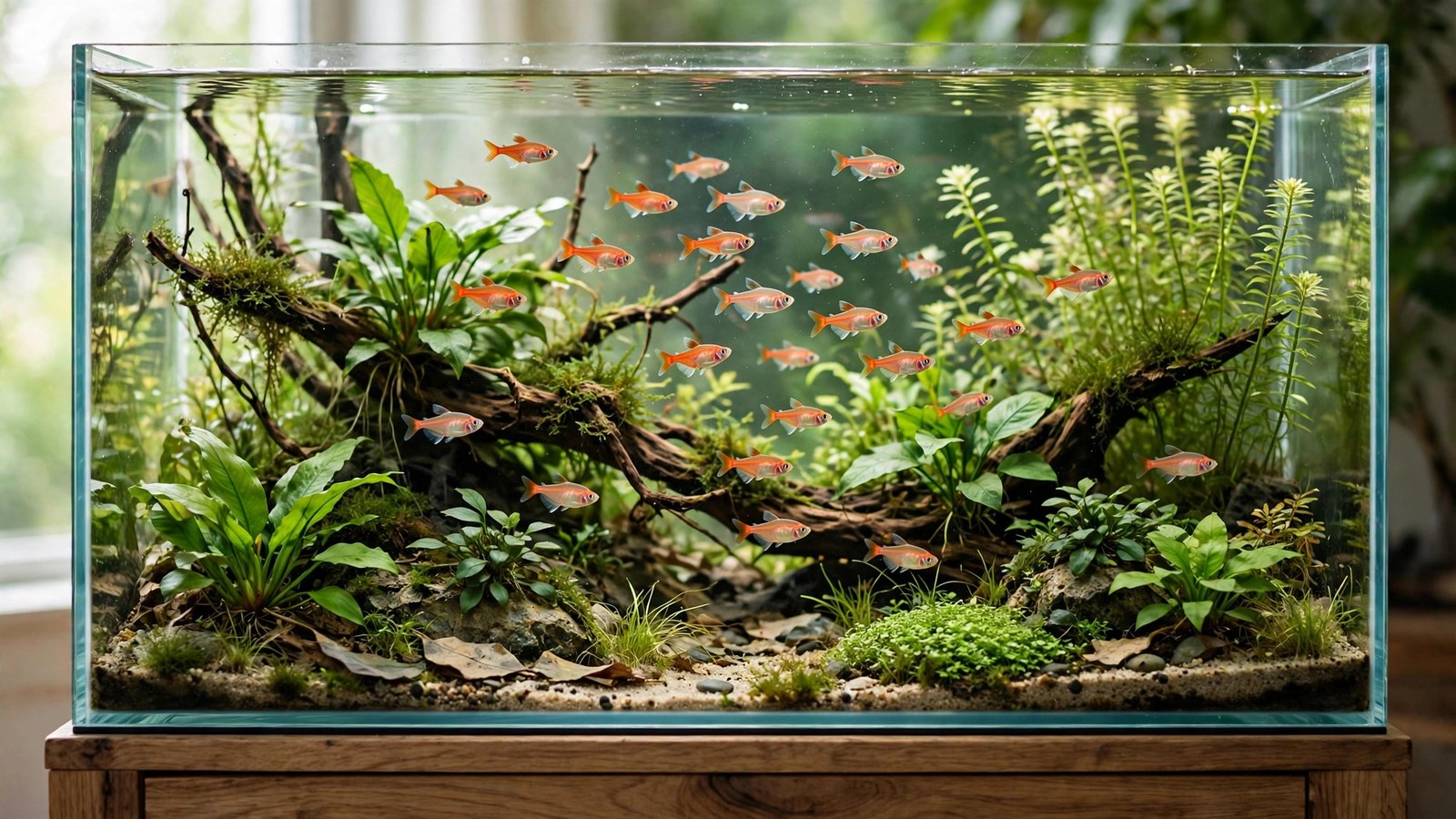
Watch a school of ember tetras drift through a well-planted tank and you'll see why this tiny fish is a nano-aquarium obsession. Against dark substrate and green stems, their orange-red bodies flare like banked coals. If you're planning an ember tetra planted tank, you're choosing one of the most forgiving schooling fish in the hobby — this guide covers tank size, school size, aquascaping, water chemistry, diet, and tank mates. Embers regularly feature on roundups of the best schooling fish for planted tanks, and our nano planted tank ideas help you pick a footprint that shows them off.
Why Ember Tetras Are Perfect for a Planted Aquarium
Hyphessobrycon amandae tops out at barely 0.8 inches, making it one of the smallest tetras in the hobby — a fish that looks almost lost in a bare tank but transforms inside an aquascape. Wild embers come from the slow backwaters and oxbow lakes of Brazil's Araguaia basin (see the Seriously Fish species profile), where leaf litter and plant cover are where they spawn, hide fry, and forage.
Behavior sets them apart from nervous nano fish. Ember tetras rarely scatter when you approach the glass, hardly harass each other, and stay visible mid-water. In a planted tank they form a loose, flowing school that tightens when startled, then relaxes. Color is environment-driven: embers in brightly lit bare tanks look washed out, while the same fish over dark substrate with tannins and live foods ignite within weeks.
Ember Tetra Planted Tank Setup: Size, School, and Equipment
A 10-gallon (38-liter) tank is the minimum, housing 10–12 embers with a light bioload and room for a real aquascape. A 20-gallon long (75 × 30 cm) is the sweet spot: the horizontal run gives the school room to sweep, and 20–25 fish turn the schooling display into something spectacular. School size matters more than tank size — below ten, embers turn shy and color fades; at fifteen to twenty, the school moves as a unit and males begin displaying.
Filtration should be gentle: a small hang-on-back baffled with a sponge, or an air-driven sponge filter — visible surface movement, but no current pinning fish against the glass. Set an adjustable heater to 75–77°F and run a timer-controlled LED 6–8 hours daily. No CO2 is required; embers thrive alongside the low-tech plant palette in our low-tech planted tank setup guide.
Aquascaping That Makes Embers Glow
The fastest color upgrade is the substrate. Dark aquasoils — ADA Amazonia, Fluval Stratum, or black diamond sand — make orange fish pop and calm them, since bright bottoms feel exposed to a fish that evolved over leaf litter. Lay it 1.5–2 inches deep, sloping from back to front.
Build around three zones. Back and sides get tall stems — Vallisneria, Ludwigia repens, or Rotala rotundifolia — forming the dark green wall that frames the school. The midground is where embers live: Cryptocoryne wendtii, Anubias nana petite tied to driftwood, and pearl weed trimmed into bushy clusters. Leave a clean open swimming lane across the front third — embers parade there in the evening, and without that runway the display collapses into scattered hiding. Floaters like red root floaters dim the light and pull nitrates; thin them weekly to under 40% surface cover.
Water Parameters and Cycling
Embers are adaptable, but flourish in soft, slightly acidic water. Hit these ranges and change parameters slowly — they stress badly under sudden swings.
| Parameter | Target range | Notes |
|---|---|---|
| Temperature | 73–80°F (23–27°C) | 75–77°F is ideal long-term |
| pH | 5.5–7.0 | Stable beats "perfect" — don't chase it with chemicals |
| GH | 1–10 dGH | Dilute tap with RO if your supply is very hard |
| Ammonia / nitrite | 0 ppm | Non-negotiable after cycling |
| Nitrate | < 20 ppm | Weekly changes keep it low |
Cycle fully before the embers arrive. Planted tanks cycle faster than bare ones, but still give it 3–4 weeks with a bottled bacteria starter, verifying 0 ppm ammonia and nitrite for several consecutive days. Add the whole school at once and feed sparingly the first week.
More detail in our planted tank water parameters guide.
Feeding Ember Tetras for Peak Color
Embers are eager, tiny-mouthed omnivores — size most foods down. A quality micro-granule or crushed small pellet forms the daily base, fed in amounts the school finishes in 60–90 seconds, once or twice daily. Anything unfinished in two minutes becomes an algae farm in a nano tank. Rotate in frozen daphnia, baby brine shrimp, or finely chopped frozen bloodworm twice a week — natural carotenoids build the deep red-orange pigmentation. Embers also graze biofilm on leaves and wood, which is why well-aged scapes produce the most vibrant fish.
Peaceful Tank Mates That Fit a Planted Community
The golden rule: nothing that fits an ember in its mouth, and nothing fast and nippy. Chili rasboras make the classic companion school — crimson and orange bodies layer beautifully. Pygmy corydoras work the substrate while embers own the mid-water, and kuhli loaches add bottom-level personality in 15+ gallons. Cherry shrimp coexist in heavily planted tanks — embers pick off newborn shrimplets, so start with a solid colony and dense moss; established biofilm keeps both thriving. A single honey gourami works as a calm centerpiece in 15+ gallons — see our chili rasbora planted tank guide if you're weighing which red nano species to build around.
Skip bettas, nippy barbs and serpae tetras, and anything that treats nano fish as snacks — our planted neon tetra tank guide compares ember vs neon schools for a first nano setup.
Frequently Asked Questions
How many ember tetras should I keep in a 10-gallon planted tank?
Ten to twelve is the sweet spot — enough for natural schooling and healthy confidence, with a light bioload. Below eight fish, embers turn shy, hide in corners, and their color fades.
Do ember tetras need CO2 in a planted tank?
No. Embers evolved in slow blackwater backwaters and thrive in low-tech tanks. CO2 helps plants grow faster, but the fish don't care. If you inject it, keep levels moderate and watch for gasping at the surface.
Will ember tetras eat cherry shrimp?
Adults are generally safe — embers are too small to take an adult cherry shrimp. They will hunt newborn shrimplets, capping colony growth. In a heavily planted tank with java moss, enough shrimplets survive to sustain the colony.
Why are my ember tetras pale or washed out?
Usually one of three things: bright lighting over a light substrate, a school under eight, or dry food only. Darken the substrate, add floaters, raise the school to 10+, and feed frozen daphnia or baby brine shrimp twice weekly.
Can ember tetras live with neon tetras in the same tank?
Yes — both are peaceful, similarly sized, and share soft-water preferences. The caveat: a mixed tank often yields two half-hearted schools instead of one great one. Under 20 gallons, pick one species and keep a bigger school of it.
How long do ember tetras live?
Typically 2–4 years in a planted tank, with some reaching 5. Longevity comes from stable soft water, a varied diet with regular frozen foods, and peaceful tank mates.
A Tiny Fish That Carries a Whole Aquascape
An ember tetra planted tank is one of those rare setups where fish and aquascape amplify each other — the plants give the school its confidence, and the school gives the plants their living orange accent. Keep it simple: dark substrate, dense midground planting, one open swimming lane, a school of twelve or more, soft stable water, and weekly water changes. Within a month your embers will glow a little brighter every week.