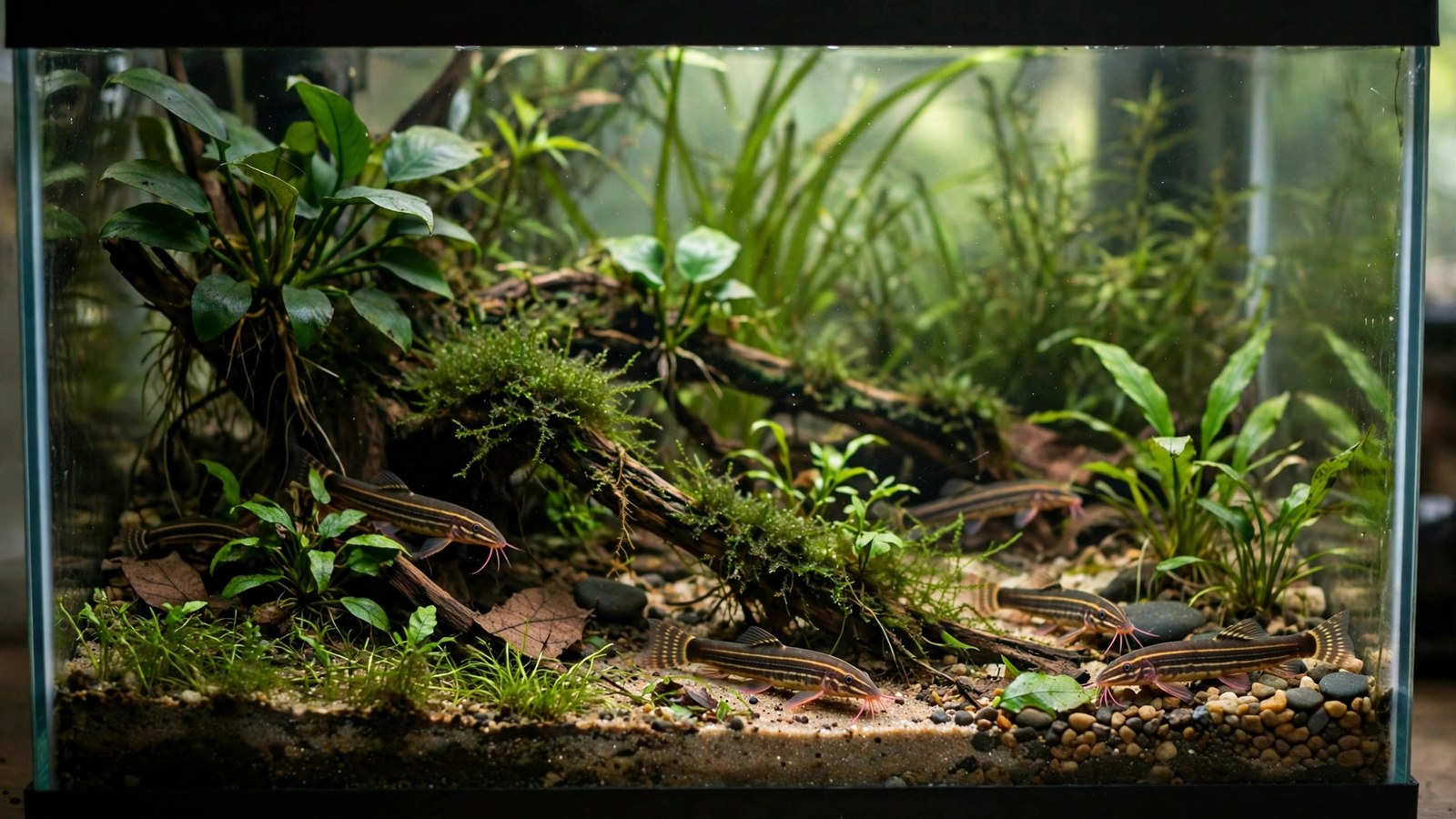
You will think your tank is empty for three days. Then the lights dim, half a dozen orange-and-black ribbons unspool from behind the driftwood — and you understand why a kuhli loach planted tank is so rewarding. Get three things right — soft burrowing sand, hides they trust, a group of 6–8 — and these ghost fish become the most entertaining display in the room.
How to Build a Kuhli Loach Planted Tank
The build order for a kuhli loach planted tank runs bottom-up: substrate first, hides second, plants third, livestock last. Kuhli loaches (Pangio kuhlii) are nocturnal burrowers — when they feel exposed, their instinct is to dive head-first into the floor. Sharp gravel or bare glass blocks that instinct, and exposed kuhlis get sick and vanish behind your filter.
A standard 20-gallon long is the sweet spot. Build on low-tech planted tank principles — kuhlis come from dim, tannin-tinted water and need no high light or CO2. Follow our 20-gallon planted tank setup guide for equipment, swapping in the kuhli-specific substrate and stocking below. Cycle 2–3 weeks, add loaches after lights-out.
Sand or Gravel? Choosing a Burrow-Safe Substrate
Sand wins, full stop. A kuhli plunging into fine sand watches grains part and close around it; on gravel, that same instinct ends in scraped bellies and trapped food. Already running gravel? Cap it with 2 inches of fine sand.
Use 0.5–1 mm sand — pool-filter sand works. A 20-gallon long needs 20–25 lbs for 2.5 inches; slope to 3 inches at the back for rooted plants. Rinse in a bucket until the water runs clear.
| Substrate option | Grain size | Burrow-friendly? | Verdict for kuhlis |
|---|---|---|---|
| Fine sand | 0.5–1 mm | Yes — burrowing instinct fully expressed | Best choice |
| Smooth pea gravel | 3–5 mm | No — belly scrapes, no burrowing | Avoid |
| Sharp gravel / lava rock | 5+ mm | No — injury risk | Never |
Push root tabs 2 inches deep near heavy root-feeders like crypts every 2–3 months. The deep substrate method explains thicker beds, though kuhlis prefer a modest 2–3 inches they can fully work.
Scaping for Night Owls: Hides, Caves, and Loach-Safe Plants
The more hides you provide, the more you will see your kuhlis. One plastic cave makes six permanently invisible fish; driftwood tangles, leaf litter, and two or three ceramic caves make confident loaches that cruise open sand at dusk. Provide at least one hide per two loaches — scattered, not one communal bunker. Floating plants overhead dim the light, and kuhlis get bolder under shade.
Think like a kuhli: anything planted gets excavated nightly. Survivors have deep tough roots or never touch the substrate — Java fern and anubias tied to driftwood cannot be uprooted. Cryptocoryne wendtii and Amazon swords re-root fast after a nightly nose-around. Verify light and nutrient needs in Tropica's plant database.
| Plant | Placement | Why it survives kuhlis |
|---|---|---|
| Java fern | Tied to wood/rock | Never in substrate; tough leaves ignored by loaches |
| Anubias (nana, barteri) | Tied to wood/rock | Rhizome rots if buried; anchoring solves that and uprooting |
| Cryptocoryne wendtii | Midground, rooted | Deep roots; recovers from disturbance in days |
| Amazon sword | Background, rooted | Massive root crown anchors it through nightly digging |
Scatter dried Indian almond leaves on the sand — they tint the water, release beneficial tannins, and mimic the leaf-litter beds of their home streams. Replace every 4–6 weeks. Keep hardscape smooth: splinter-free driftwood, rounded river stones.
Water Parameters, Group Size, and Tank Mates
Kuhlis are hardy once settled but demand stability. Drip-acclimate newcomers for 45 minutes — they are sensitive to parameter swings, especially nitrite. And cover the tank: kuhlis are legendary escape artists that find the gap around filter cables at 2 a.m.
| Parameter | Target range | Notes |
|---|---|---|
| Temperature | 75–82°F (24–28°C) | Sweet spot 77°F; match tank mates' range |
| pH | 5.5–7.0 | Stable matters more than exact value |
| Ammonia / nitrite | 0 ppm | Non-negotiable; kuhlis are sensitive to nitrite |
| Nitrate | Under 20 ppm | Weekly 25–30% water changes |
| Flow | Gentle | They dislike strong current; baffle HOB outflows |
Three kuhlis hide forever; six to eight tumble over each other at dusk in the "loach dance." Buy the full group at once. For tank mates, think small and peaceful: ember tetras, chili rasboras, honey gouramis. Our best schooling fish for planted tanks list is a good shortlist. Shrimp are fine — kuhlis may snack on newborn shrimplets but leave adults alone; see the planted shrimp tank setup guide for a mixed colony tank.
Feeding Your Kuhlis: What They Actually Eat
The classic beginner mistake is assuming kuhlis eat leftovers. They need their own meals: sinking pellets, broken wafers, frozen bloodworms or daphnia twice a week. Feed 30–60 minutes after lights-out — what the group finishes in 3–4 minutes, 5–6 nights a week, one fast day.
You will know feeding is right when you see them sifting mouthfuls of sand through their gills like tiny whales. Skim the top half-inch during weekly water changes — uneaten food rots fast. With other bottom dwellers, check the cleanup crew guide to balance the load.
Frequently Asked Questions
Can kuhli loaches live on gravel in a planted tank?
Survive, yes — thrive, no. Gravel blocks burrowing and scrapes their scaleless undersides, leaving them stressed and hidden. If you cannot switch fully, cap the gravel with 2 inches of 0.5–1 mm sand as a burrow-safe layer.
How many kuhli loaches should I keep together?
Six minimum; eight is noticeably better. Kuhlis are social shoalers — pairs or trios stay permanently hidden and eat poorly. Eight fit comfortably in a 20-gallon long alongside small tetras or rasboras.
Will kuhli loaches uproot my aquarium plants?
They disturb new plantings but do not eat plants. Tie Java fern and anubias to hardscape so they cannot be uprooted, and let rooted plants establish 2–3 weeks before the loaches arrive. Crypts and Amazon swords re-anchor quickly.
Why do my kuhli loaches hide all day?
Normal — they are nocturnal, emerging at dusk and after lights-out. If they never emerge, the group is too small, the light too bright, or hides too few. Add floating-plant shade, bump to 6–8 loaches, and feed after dark.
Are kuhli loaches good with shrimp and snails?
Yes — among the most shrimp-safe bottom dwellers. Adults and nerite snails are safe; a planted colony with moss cover outbreeds the few shrimplets kuhlis snack on. Avoid large predators that could eat a 4-inch loach.
The Tank That Rewards Patience
A kuhli loach planted tank asks for one thing up front — a sandy floor and enough hides — and pays it back for years. These fish live 10+ years, and a confident group of eight weaving through crypts at dusk beats any tetra school. Set the sand, scatter hides, plant the tough stuff, dim the lights, and wait.