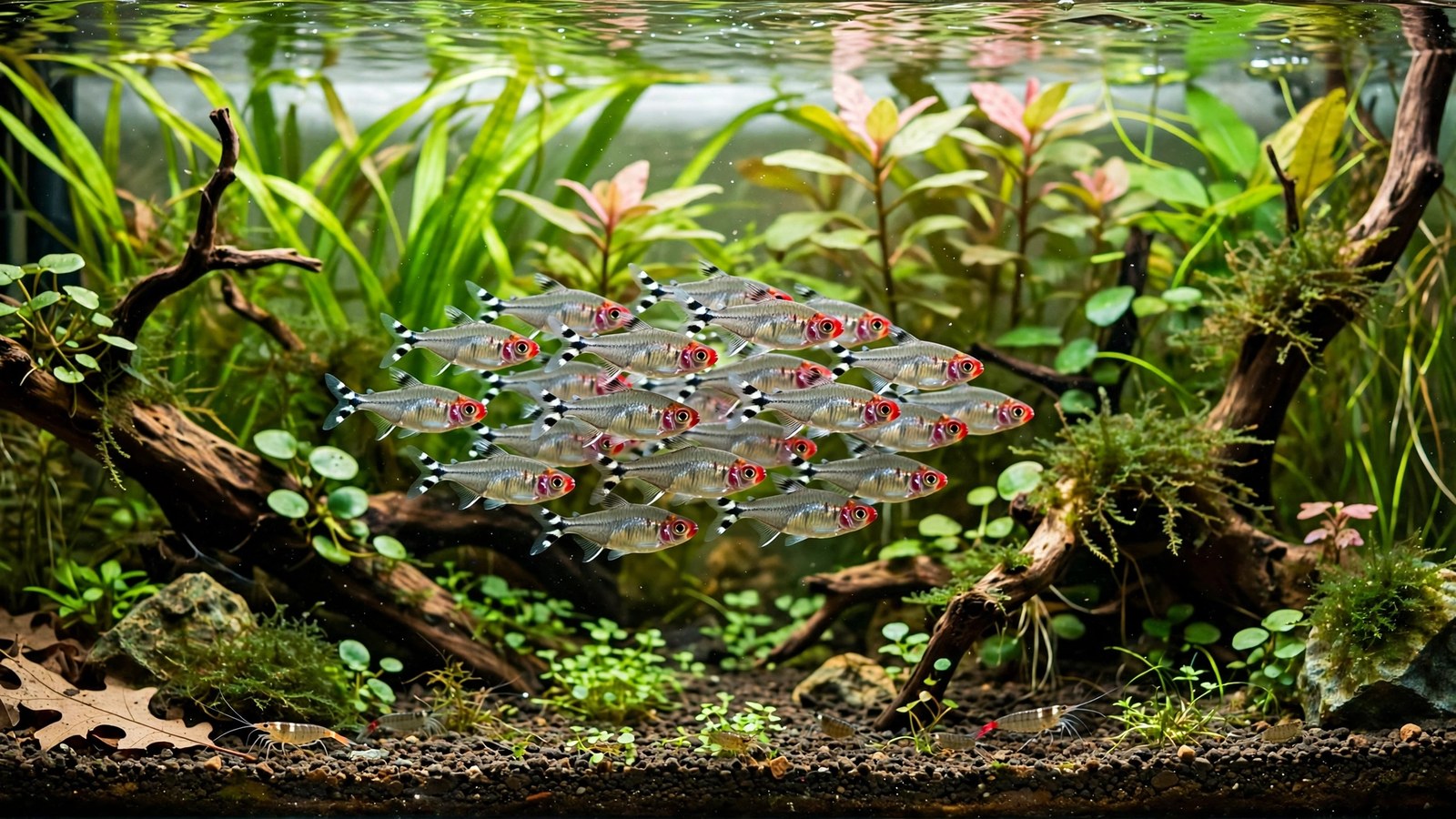
A healthy rummy nose school is the most hypnotic sight in freshwater aquaria: a dozen blood-red noses moving as one dashed line through the plants. A stressed school shows nothing — the red simply fades to a pale smudge. No other common fish wears its water quality on its face, so a rummy nose tetra planted tank is both a display piece and a live diagnostic readout. Build it right and you get the tightest schooling show in the hobby; build it wrong and the fish tell you before any test kit turns color.
The layout grammar follows how these fish move. Rummy noses are open-water cruisers from slow Amazon blackwater creeks: they need a clear swimming lane, not a plant jungle, ringed by a tall-plant perimeter like a flooded riverbank. Pair that geometry with aquarium plants chosen with fish-first species like tetras in mind and soft, acidic water, and twelve rummy noses will wheel in unison like a single organism.
Why the red nose is the best tool in your kit
Most aquarists read their tanks with test kits. Rummy nose keepers get a shortcut built into the fish: the crimson mask fades fast under stress — ammonia or nitrite, parameter swings, bullying, rough acclimation. When the whole school pales, test the water first, remedies later.
That sensitivity is also their unfair reputation as divas. Rummy noses aren't hard to keep — they're hard to keep in unstable water. Mature the tank four to six weeks with plants before the school arrives, and you'll get years of color. Most shop stock is the brilliant rummy nose (Hemigrammus bleheri), whose red extends past the gills; the Seriously Fish species profile shows how to tell it from the true and false rummy noses by tail banding.
Rummy nose tetra planted tank: the open-lane blueprint
Build backwards from the school's runway: define a clear front-to-back corridor first, then dress the perimeter. Use dark fine sand or small-grain gravel — dark substrate deepens the red nose by contrast. Along the back third, plant a tall wall: Vallisneria and Amazon sword in the rear corners, Ludwigia repens for a red accent band, Rotala rotundifolia along the sides. Keep the foreground low and sparse — a patch of dwarf sagittaria or bare sand, never a thick carpet.
Finish with shade. Rummy noses school tightest under broken, subdued light like a blackwater creek. A mat of Amazon frogbit over 40–60% of the surface calms them instantly. This is the open-space-plus-perimeter grammar behind the lightly planted aquarium approach — a school tank is the one aquascape where restraint wins.
| Parameter | Target | Notes |
|---|---|---|
| Tank size | 20 gal long (30") min | Footprint beats volume — they swim horizontally |
| Temperature | 74–80°F (23–27°C) | Swings under 2°F; match temps on water changes |
| pH / GH | 5.5–7.0 / 2–8 dGH | Stable 6.5 beats fluctuating 6.0 |
| Ammonia / nitrite | 0 ppm | Noses pale before cheap strips register it |
| Nitrate | Under 20 ppm | 25–30% weekly water changes |
| School size | 10–12 minimum | Under 8 they fragment and hide |
Feeding a school that never stops moving
A rummy nose school is a furnace: constant motion, tiny mouths, so food size matters more than quantity. Base the diet on micro pellets and finely crushed flakes — two to three pinches daily, what the school eats in 60 seconds. Twice a week add frozen daphnia and baby brine shrimp; shrimp-based carotenoids feed the red pigment directly, and flake-only fish dull within a month.
Scatter food along the tank's length, not in one spot. The boldest fish claim the center of a pile, so a long scatter lets timid mid-rank fish eat too — twelve red noses instead of six brilliant and six fading. Skip plaster weekend-feeder blocks: a healthy school fasts a weekend easily, while a dissolving block wrecks water quality.
Tank mates and the Amazon biotope finish
Rummy noses are peaceful to the point of timidity — tank mates must be gentle, ideally from the same blackwater neighborhood. Pygmy corys work the sand below (a pygmy cory planted tank shares the exact substrate and parameters), hatchetfish ride the surface, and dwarf cichlids make a fine centerpiece — an apistogramma planted tank setup runs the same soft, warm, dim water. Their calm patrolling also makes them superb dither fish for shy cichlids.
For a biotope finish: driftwood tangles in the back corners, a few dried catappa leaves staining the water light tea, and the Amazonian plant list above. Leaf litter and wood nudge pH down gently if your tap runs hard. Every plant here thrives without CO2 — a low-tech planted tank setup covers the whole list.
Skip anything that nips or crowds the surface — serpaes, tiger barbs, boisterous rainbows turn a rummy school pale and corner-bound. For a multi-school display, the closest temperament matches are an ember tetra planted tank or a congo tetra planted tank.
Frequently Asked Questions
Why did my rummy nose tetras lose their red color?
The red mask fades under stress — ammonia, nitrite, a recent move, bullies, or a too-small school. Test ammonia, nitrite, and pH first; color returns within 2–5 days of fixing the cause. New arrivals often look pale 48–72 hours while settling — normal, not a disease.
How many rummy nose tetras should I keep together?
Ten to twelve is the practical minimum for tight schooling; fifteen to twenty in a 4-foot tank is where the display becomes spectacular. Below eight they fragment into pairs and hide, and the red washes out from chronic low-level stress. Buy the whole school from one shop tank in a single trip.
What test kit should I use for a rummy nose tank?
A liquid master test kit (API Freshwater Master Test Kit is the standard) beats dip strips — rummy noses react to ammonia and nitrite below what strips reliably detect. Test weekly, and any time noses pale. Keep ammonia and nitrite at 0 ppm and nitrates under 20 ppm with 25–30% weekly water changes.
Do rummy nose tetras need CO2 or special lighting?
No — the fish don't care about CO2 and prefer dimmer, shaded light under floating plants. CO2 only matters for demanding plants, and everything in the open-lane blueprint grows well low-tech. Spend the CO2 budget on a bigger school or a better filter.
Can rummy nose tetras live with shrimp or bettas?
Adult amano and cherry shrimp are generally safe, though newborn shrimplets may get picked off. Bettas are a bad match — territorial aggression versus the school's need for calm, open swimming space ends with a faded, hiding school. Stick to corys, hatchetfish, otos, and dwarf cichlids.
How long do rummy nose tetras live?
Five to six years in stable, well-kept water — among the longest-lived small tetras. Longevity depends on water stability, not special diet: consistent weekly water changes, zero ammonia and nitrite, and a big enough school to keep stress low. Avoid sudden temperature swings and overstocking — both cut their lifespan short faster than anything else.
A rummy nose tetra planted tank asks one thing — stability — and repays it with the most synchronized schooling display in the hobby. Give them a 20-gallon runway, a tall-plant perimeter, soft acidic water, and tiny foods, and glowing red noses will warn you the moment anything slips. To finish the layout, the freshwater aquarium plants complete guide has species picks that slot straight into this blueprint.