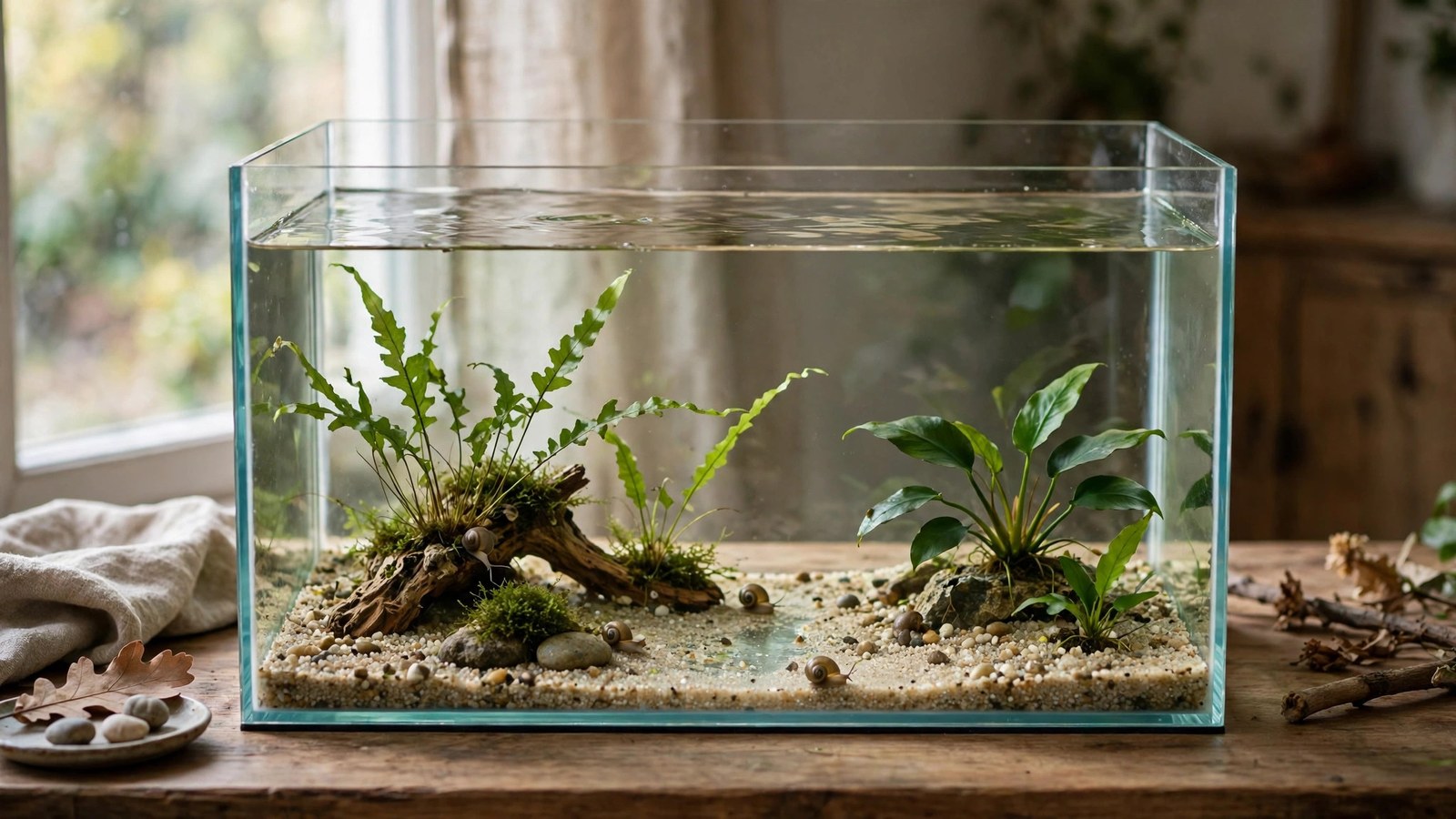
Scroll through planted-tank forums for ten minutes and you'd think every successful aquarium needs a CO2 cylinder, a $300 light, and a glowing carpet of Monte Carlo. That story is exactly why so many beginners quit before they start. A lightly planted aquarium — five to ten undemanding plants, ordinary gravel, one modest light, zero CO2 — is not a failed aquascape. This guide walks you from empty glass to a stocked, thriving setup with no high-tech gear at all.
What "Lightly Planted" Actually Means
A lightly planted aquarium is a tank where plants are a deliberate design element — accents and structure — while open water stays the dominant feature. Picture a bonsai-style piece of driftwood with Anubias clinging to it, a cluster of Cryptocoryne in one corner, a stand of Vallisneria along the back glass, and clear swimming space everywhere else. The negative space is the point: sparse, but intentional.
Note this is not the same as a low-tech tank: low-tech describes your equipment philosophy, lightly planted your density philosophy — few plants, placed with intention. The two overlap beautifully. For the equipment-philosophy breakdown, see our low-tech planted tank setup guide; this is its density-philosophy companion.
Most beginners build lightly planted tanks by accident — three sad stems and a melting sword — and then apologize for them. Stop apologizing. Five healthy, well-placed plants in a clean tank with confident fish look better than thirty struggling stems under a weak light. Density is a choice, and sparse is a valid one.
Why a lightly planted aquarium beats the jungle (for most people)
The dense-aquascape dream has costs nobody mentions in the highlight reels. A stem-heavy tank under strong light is a high-metabolism system: it burns through CO2 and fertilizer and turns a two-week vacation into an algae farm. A lightly planted tank runs cool. Fewer plants pulling nutrients means the system tolerates neglect, forgives beginner mistakes, and stays stable while you're still learning to read it.
| Approach | Plant density | CO2 | Light demand | Weekly maintenance | Typical startup cost |
|---|---|---|---|---|---|
| Lightly planted (this guide) | 5–10 plants | None | Basic LED, 6–8 hrs | ~15 min | $150–$220 |
| Low-tech jungle | 30–60+ plants | None | Basic LED, 7–9 hrs | 30–45 min (trimming) | $250–$400 |
| High-tech aquascape | 40–100+ plants | Pressurized, required | Premium RGB, 8 hrs | 1–2 hrs | $600–$1,200+ |
One honest caveat: a sparse tank is slightly more algae-prone in the first month than a packed one, because fewer plants compete for nutrients and light hits more bare surface. The fix is easy — a shorter photoperiod, not more chemicals — and once plants root in (weeks 3–6), the system stays calm for years.
The Minimal Shopping List
For a 10 or 20-gallon setup, the complete kit is: the tank (a standard 20-gallon long is the sweet spot — more footprint per dollar than a 10), a basic full-spectrum LED like the NICREW ClassicLED or Aqueon Planted clip-on, a 50–100W adjustable heater, a small hang-on-back filter (Aquaclear 20) or sponge filter with air pump, 10–15 pounds of plain aquarium gravel or coarse sand, a thermometer, dechlorinator, root tabs, one bottle of all-in-one liquid fertilizer, a plug-in outlet timer, and the API Freshwater Master Test Kit. No CO2 regulator, no diffuser, no pH controller, no $90 aquasoil bags.
Budget $150–$220 all-in buying new, under $120 with a used tank. Before you buy, skim our first planted tank shopping list to catch anything you'd otherwise discover missing on planting day. The most common regret is buying a fancy light "for later" and fighting algae for three months. Match the light to the plants you have now.
Choosing Your 5–10 Plants (the Only Hard Decision)
Equipment is a checklist; plant choice is the craft. The formula that never fails: one anchor hardscape piece with rhizome plants attached, one midground cluster, one background stand, and optionally one floater. Rhizome plants (Anubias, Java fern, Bucephalandra) tie or glue to wood and rock — never bury the rhizome or it rots. Rooted plants (Cryptocoryne, Vallisneria, Amazon sword) go into the substrate with a root tab underneath. Add two or three bunches of water sprite for fast early growth while the slow growers settle.
| Plant | Placement | Light needs | Why it fits |
|---|---|---|---|
| Anubias barteri var. nana | Tied to driftwood/rock | Low | Nearly indestructible; slow, sculptural leaves |
| Java fern (Microsorum pterotoides) | Tied to hardscape | Low | Tolerates neglect; plantlets form on old leaves |
| Cryptocoryne wendtii | Midground, in substrate | Low–medium | Bronze-green rosette; may "melt" then regrow |
| Vallisneria spiralis | Background, in substrate | Low–medium | Tall ribbon leaves; spreads by runners |
| Amazon sword (Echinodorus bleheri) | Background corner | Medium | One plant fills a corner; heavy root feeder |
| Java moss (Taxiphyllum barbieri) | On wood/rock | Low | Softens hardscape; shrimp love it |
| Water sprite (Ceratopteris thalictroides) | Background or floater | Low–medium | Fast grower; soaks up excess nutrients early |
| Hornwort (Ceratophyllum demersum) | Floater or weighted bunch | Low | Algae-fighting nutrient sponge; grows anywhere |
Pick 5–8 from that table and stop — resist "just a few more." Every plant listed grows without CO2 under a basic LED, which is exactly the filter your choices must pass. When comparing candidates, Tropica's plant database marks each species with difficulty symbols, so you can verify "easy" before you buy rather than after it melts.
Substrate and Hardscape: the Two-Inch Rule
Forget aquasoil. A lightly planted tank runs beautifully on 2–3 inches of plain gravel or coarse sand — deep enough for Crypt and Vallisneria roots, shallow enough to never fight anaerobic pockets. Rinse until the water runs mostly clear (ten minutes now saves a week of cloudiness), slope slightly higher toward the back, and press one root tab into the substrate under each heavy root feeder: swords, Crypts, and Vallisneria feed primarily through their roots.
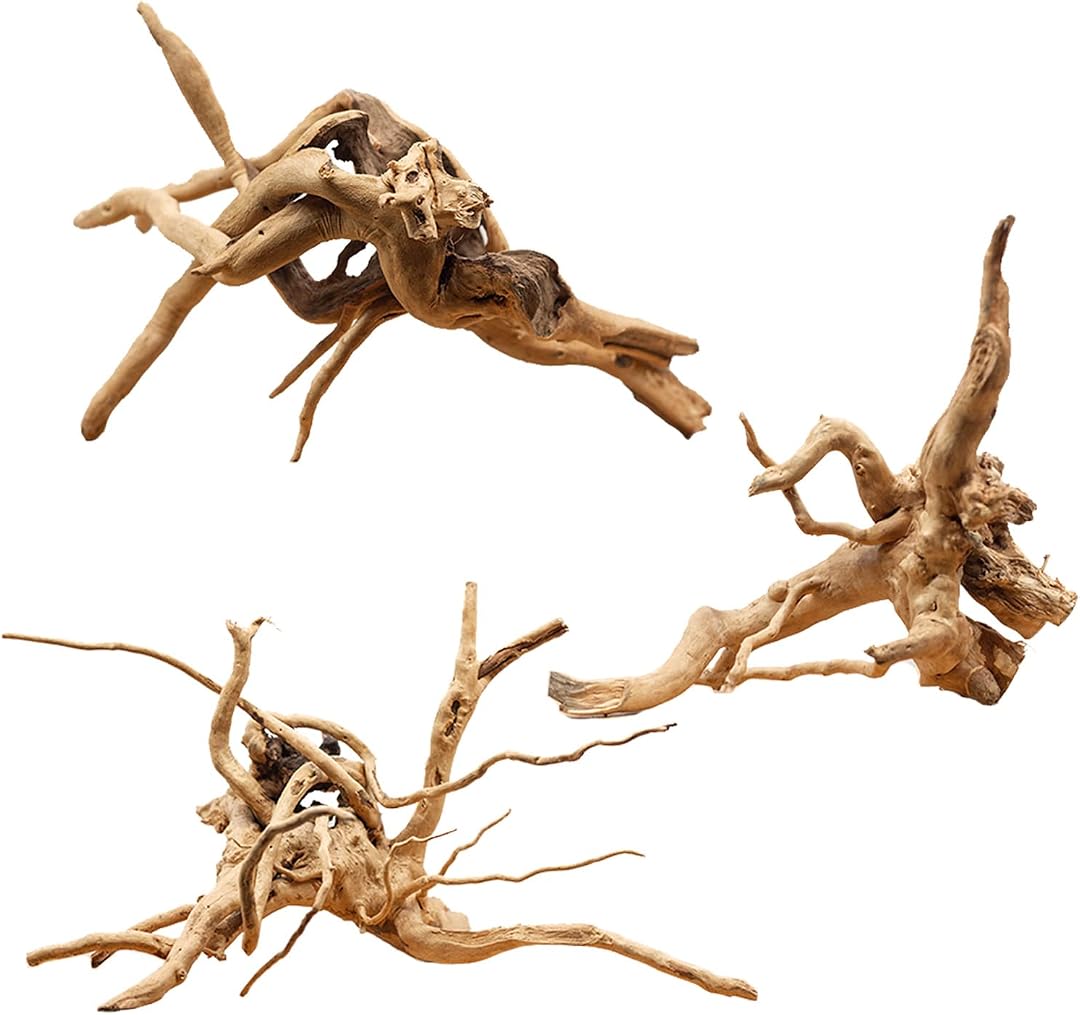
Hardscape does the visual heavy lifting in a sparse tank, so choose one good piece instead of five mediocre ones. A single branching piece of spider wood or two or three complementary stones gives rhizome plants a home and your fish a landmark. Place it a third of the way from one end — never dead center — and leave the rest open. Open sand in front of the hardscape is where schooling fish look best. If you're still deciding on dimensions, our 20-gallon planted tank setup guide explains why the long format suits sparse layouts.
 ★4.0
majoywoo Natural Spider Wood Branches
Check Price on Amazon ★4.0Planting Day, Step by Step
- Rinse substrate and hardscape; add substrate 2–3 inches deep, sloped toward the back.
- Position your wood or stones, then step back and look — move it twice if needed; this is the last easy chance.
- Attach Anubias, Java fern, and moss with cotton thread or cyanoacrylate super glue gel (fish-safe once cured). Keep rhizomes fully exposed.
- Fill one-third with dechlorinated water. Planting into shallow water is ten times easier than reaching through a full tank.
- Plant Crypts and swords midground, Vallisneria and water sprite along the back. Push root tabs 2 inches deep beside each root feeder. For spacing and counts, see how many plants a new aquarium needs.
- Fill the rest slowly, pouring over a plate so you don't crater the substrate.
- Start filter and heater (74–78°F for most community setups), set the timer to 6 hours, and don't fiddle for 48 hours.
The tank will look thin. That's correct. Photograph it anyway — in eight weeks you'll want the before-and-after.
The First Month: Cycling With Plants Already In
Planting on day one is a quiet superpower: aquatic plants preferentially absorb ammonium — the first, most toxic stage of the nitrogen cycle — directly through their leaves. Your plants won't replace a proper cycle, but they blunt the ammonia spike that kills so many first-month fish. Still stock lightly and late: add the first small group no earlier than week 2–3, once ammonia and nitrite read zero for several days running.
Expect two harmless alarms. First, Cryptocoryne melt: your Crypts may dissolve into mush within two weeks. The roots are alive; new submerged leaves emerge in 2–4 weeks. Don't dig them up to "check." Second, brown diatoms dusting glass and leaves around week 2–3 — wipe the glass, ignore the leaves; diatoms fade as silicates deplete, usually gone by week 6. For the full testing schedule, follow our planted tank cycling guide alongside this one.
Light and Fertilizer: the Less-Is-More Rule
This is where lightly planted tanks are won or lost, and the rule is one sentence: dose for the plants you have, not the gallons you own. Five plants in a 20-gallon tank cannot use a full recommended dose — but algae can. Start at half the bottle's dose once a week after your water change; increase only if new growth comes in pale or stunted. Root tabs go in at planting and get replaced every 2–3 months under the heavy root feeders.
Six hours on a timer is your starting photoperiod; raise to seven or eight after week 4 only if plants look hungry and algae is absent. If green dust or hair algae appears, your first move is always less light — drop an hour or raise the fixture 2 inches — never more fertilizer. Algae in a sparse tank is almost always a light problem wearing a nutrient disguise.
Stocking a Lightly Planted Tank
Open water is a feature — stock for it. Schooling fish that use horizontal space look spectacular against a sparse backdrop: 10–12 neon or cardinal tetras, 8–10 harlequin rasboras, or a lively group of guppies in a 20-gallon. For the bottom, 6 corydoras or a crew of cherry shrimp plus 2–3 nerite snails handles uneaten food and soft algae. A single betta or a pair of honey gouramis makes a fine centerpiece in a 10-gallon version.
Skip the bulldozers: large cichlids, goldfish, and big plecos will uproot five carefully placed plants in a weekend. This layout suits peaceful community fish under 3 inches. Add fish in groups of 4–6 per week so your young filter keeps pace — our planted community tank setup guide has full stocking recipes by tank size.
Maintenance: Fifteen Minutes a Week
From about week 8, the routine is almost boring — that's the compliment. Weekly: change 25–30% of the water with temperature-matched, dechlorinated water; wipe the front glass; pinch off dead or yellowing leaves; dose half-strength fertilizer. Monthly: rinse filter media in old tank water (never tap — chlorine kills beneficial bacteria), check root tabs, and trim runners before they take over.
Notice what's missing: no daily CO2 checks, no drop checker, no frantic trimming, no dosing pumps. Put the routine on the same day each week and it becomes background habit. For a printable version with monthly and quarterly tasks, see our planted tank maintenance schedule.
Frequently Asked Questions
Do I need CO2 in a lightly planted aquarium?
No. Every plant in this guide — Anubias, Java fern, Cryptocoryne, Vallisneria, Amazon sword, mosses, water sprite, hornwort — grows well on CO2 naturally dissolved from the air and produced by your fish. Injected CO2 would speed growth, but it raises the system's metabolism — more trimming, more fertilizer, more failure points. Skipping CO2 is what makes the slow, stable tank possible.
How many plants should a lightly planted tank actually have?
Five to ten individual plants or portions for a 10–20 gallon tank. Count a potted Crypt or a tied-on Anubias as one; count a bunch of six water sprite stems as one. Fewer than five reads as "empty with decor"; more than about twelve and you're maintaining a low-tech jungle instead. Our plant-count guide breaks this down by tank size.
Will just a few plants really improve my water quality?
Yes, measurably. Plants absorb ammonia, nitrite, and nitrate directly, and even a handful of fast growers like water sprite or hornwort can shave several ppm off nitrate between water changes. They oxygenate the water during the photoperiod and give beneficial bacteria extra surface area on leaves and roots. They won't replace water changes or filtration, but they make both easier.
Can I do a lightly planted setup in a 5-gallon tank?
Absolutely — it's arguably the best use of a 5-gallon. Scale down: one small piece of wood with Anubias nana petite and Java moss, one Cryptocoryne parva cluster, a few water sprite stems in the back corner. Stock a single betta or 8–10 cherry shrimp. Keep the light modest (small clip-on LED, 6 hours) because algae shows faster in small volumes.
Why are my new plants melting when the tank seems fine?
Most aquarium plants are grown emersed (out of water) at the farm and must shed air-grown leaves to grow submerged ones — that's the "melt." Cryptocoryne is famous for it; swords and Vallisneria do it too. If roots are firm and white and the crown is intact, leave it alone — new growth appears in 2–4 weeks. Act only if the rhizome or crown turns mushy brown, which signals rot, not adaptation.
The Quiet Confidence of a Simple Tank
A lightly planted aquarium will never win an aquascaping contest — that's not its job. Its job is to be beautiful in year three: maintained in fifteen minutes on a Sunday, surviving your vacation, fish as the stars and plants as the stage. Start with five good plants, give them modest light and a little patience, and let the empty space do what it does best: make everything in it look intentional.