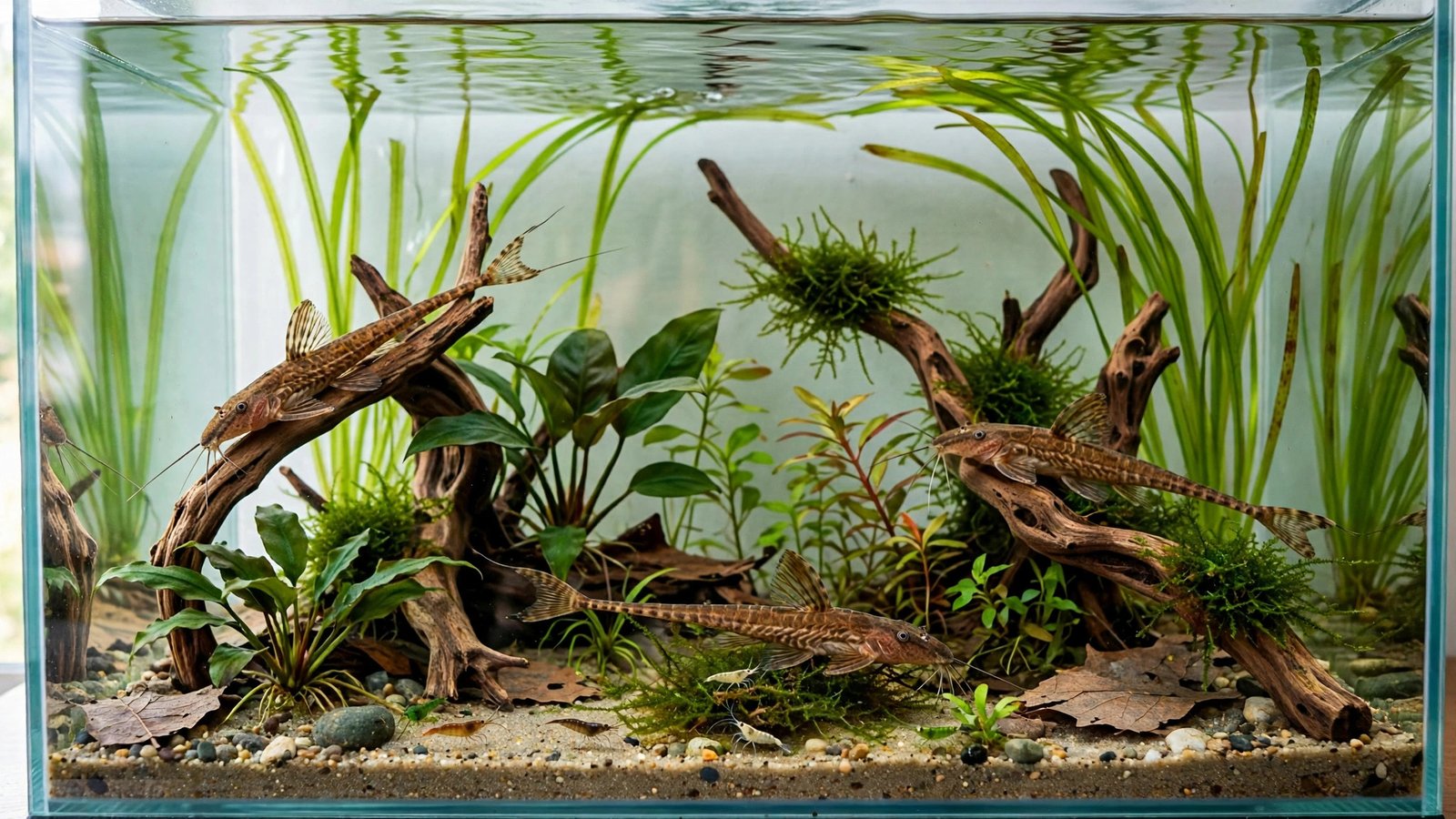
Most bottom fish bulldoze a planted tank or hide until the lights go out. Whiptails do neither — they spend the day parked on driftwood and leaves, quietly rasping biofilm you cannot even see. A whiptail catfish planted tank built around Rineloricaria gives you that calm grazing without uprooted stems or dug-up carpets.
A whiptail catfish planted tank needs at least 20 gallons (75 litres), fine sand, driftwood for rasping, gentle filtration, and temperatures of 24–28°C (75–82°F). Rineloricaria whiptails grow to about 12–15 cm (5–6 in), stay peaceful, and graze biofilm from wood, glass, and broad leaves rather than eating healthy plants, so they suit a calm community aquarium.
Setting up a whiptail catfish planted tank, step by step
Start with the bottom. A 2–3 cm layer of fine, rounded sand is the most important choice you will make. Whiptails settle flat against the substrate and rest their delicate undersides and barbels on it for hours, so sharp gravel can abrade skin and wear barbels down. If your tank already has gravel, add a sandy patch at the front and feed the fish there.
Size the tank for territory, not just length. One whiptail is content in 20 gallons; a group of three or four in 30 gallons shows far more natural behaviour. Fit a tight lid, and let the tank mature for several weeks before adding fish — a newly cycled tank has almost no biofilm, and biofilm is what these fish evolved to eat.
Which whiptail will you actually buy?
Shops rarely label the species, and adult size varies by species: R. lanceolata reaches about 12–13 cm, R. parva and R. eigenmanni stay nearer 10–11 cm, R. fallax can approach 15 cm, and the red lizard whiptail (sp. L010a) tops out around 10–11 cm. The 12–15 cm planning figure in this guide covers the larger traded species — size your tank for the fish in the bag, not the label.
Not a twig catfish: Rineloricaria versus Farlowella
The two fish are sold side by side and constantly mixed up. If you have read our guide to the Farlowella twig catfish in a planted tank, you will know that fish is a motionless, stick-thin perch hunter that clings vertically to stems and glass. Rineloricaria whiptails are different: broader, flatter, and built to lie on horizontal surfaces — sand, wood, and wide leaves. PlanetCatfish's Rineloricaria genus page shows the range of patterns, but nearly all share that flattened shape and whip-like tail filament.
Driftwood, flow, and light for a grazing fish
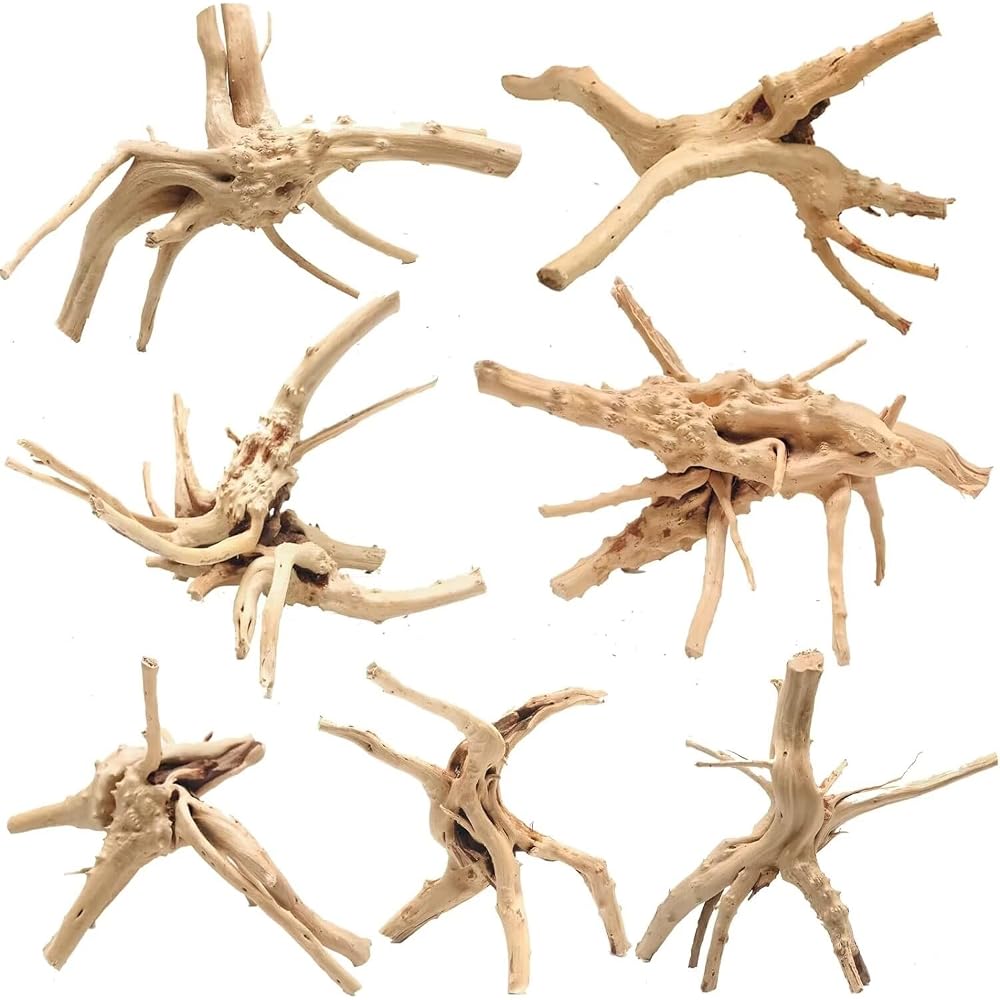
Driftwood is furniture, food surface, and territory in one. Spider wood branches look good but offer little flat area, so pair them with a broader piece of bogwood the fish can lie along. Add smooth, flat stones, and let a thin film of algae grow on them — scrubbing every surface spotless each week removes your fish's main food source.
Keep flow gentle and even. A spray bar, or an outlet baffled against the glass, suits whiptails better than a strong directional current. Lighting can stay subdued: moderate light for 7–8 hours grows enough leaf-surface biofilm without driving algae outbreaks, and floating plants that shade part of the tank give shy fish the confidence to graze in the open.
 ★4.2
Hamiledyi Natural Spider Wood Driftwood
Check Price on Amazon ★4.2Plants that survive a peaceful bottom grazer
Whiptails do not eat healthy plants, but they are clumsy parkers: a fish settling onto a delicate stem can snap it, and grazing can lift a poorly rooted carpet. Choose sturdy, well-anchored plants and you will have no problems. Start from our aquarium plants for a fish tank guide, then narrow to robust options like these.
| Plant | Placement | Why it works |
|---|---|---|
| Anubias (broad-leaf types) | Tied to driftwood | Tough leaves double as grazing platforms |
| Java fern | Tied to wood or stone | Unyielding leaves; rhizome stays out of the sand |
| Amazon sword | Background, rooted deep | Wide leaves to rest under and graze across |
| Cryptocoryne wendtii | Midground | Low, sturdy, and tolerant of subdued light |
| Vallisneria | Background curtain | Shades the bottom without blocking grazing space |
The species on our list of the easiest aquarium plants for a beginner community tank overlap heavily with the table above, because easy plants are usually tough plants. Avoid brittle stems in the front third of the tank, let new carpets root before the fish arrive, and a planned cleanup crew for a planted tank can share grazing duties without competing for the same surfaces.
Feeding: wafers, vegetables, and biofilm
Feed after lights-out, when bolder tankmates are less active. Offer a sinking algae wafer or spirulina tablet four or five evenings a week, near the fish’s usual wood. Twice a week, swap it for blanched zucchini, cucumber, or sweet potato, removing leftovers after 12–24 hours. Whiptails also rasp driftwood as they graze its biofilm — real wood beats resin ornaments. Skip meat-heavy foods.
Tankmates that leave whiptails alone
Pick tankmates that feed at the surface or mid-water and ignore the bottom: small tetras, rasboras, pencilfish, honey gouramis, otos, and peaceful Corydoras. Avoid fin-nippers and floor competitors — tiger barbs, boisterous loaches, crayfish, and territorial cichlids. A single bristlenose coexists fine in 30 gallons or more, if each fish has its own wood.
Breeding tubes and caves
You may never plan to breed whiptails, but the furniture still matters. Males claim narrow tubes — ceramic or bamboo, about 4–5 cm wide, open at one end — and fan eggs inside when a conditioned female joins them. Even outside breeding, a tube gives each fish a retreat that reduces squabbles. Place tubes along the back, half-shaded, openings facing sideways so you can check occupancy with a torch.
Frequently Asked Questions
Do whiptail catfish eat aquarium plants?
No, healthy plants are safe. Rineloricaria whiptails graze biofilm and soft algae from leaf surfaces, wood, and glass rather than eating leaves. Damage is usually accidental: a heavy landing can snap a brittle stem, and grazing can lift an unrooted carpet. Plant sturdy species, let carpets establish first, and your planting stays intact.
How many whiptail catfish can I keep together?
A single fish does well in 20 gallons, and a group of three or four is better still in 30 gallons or more. Whiptails graze more confidently in a group. Give each fish its own driftwood or tube so individuals can hold a small territory, and add them together where possible so no one claims the whole bottom first.
What is the difference between a whiptail and a Farlowella?
They are different genera of loricariid catfish. Farlowella, the twig catfish, is extremely thin and stick-like, perching vertically on stems and glass. Rineloricaria whiptails are broader and flatter, rest horizontally on sand, wood, and wide leaves, and graze actively across the bottom. Whiptails need flat surfaces and floor space; Farlowella need vertical perches.
Do whiptail catfish need driftwood?
Effectively, yes. Driftwood provides the broad surface whiptails prefer for resting and rasping biofilm, and nearby tubes give shelter and breeding sites. A tank with only plastic ornaments and bare sand leaves the fish exposed and short of grazing area. One or two broad pieces of bogwood, left with a light biofilm rather than scrubbed clean, visibly improve their confidence.
Why is my whiptail catfish always hiding?
Some hiding is normal in the first week, but a fish that never emerges usually lacks shade or confidence. Add floating plants to dim part of the tank, feed after lights-out near its wood, and check no tankmate harasses it. A group hides less than a lone fish. If hiding comes with rapid breathing or clamped fins, test ammonia, nitrite, and temperature first.
The quiet bottom fish your plants can live with
Set the tank up around surfaces — sand to rest on, wood to rasp, leaves to graze — and a whiptail asks for very little else. Keep the water calm, the company peaceful, and the evening feeding deliberate, and you get one of the most plant-safe grazers in the hobby.