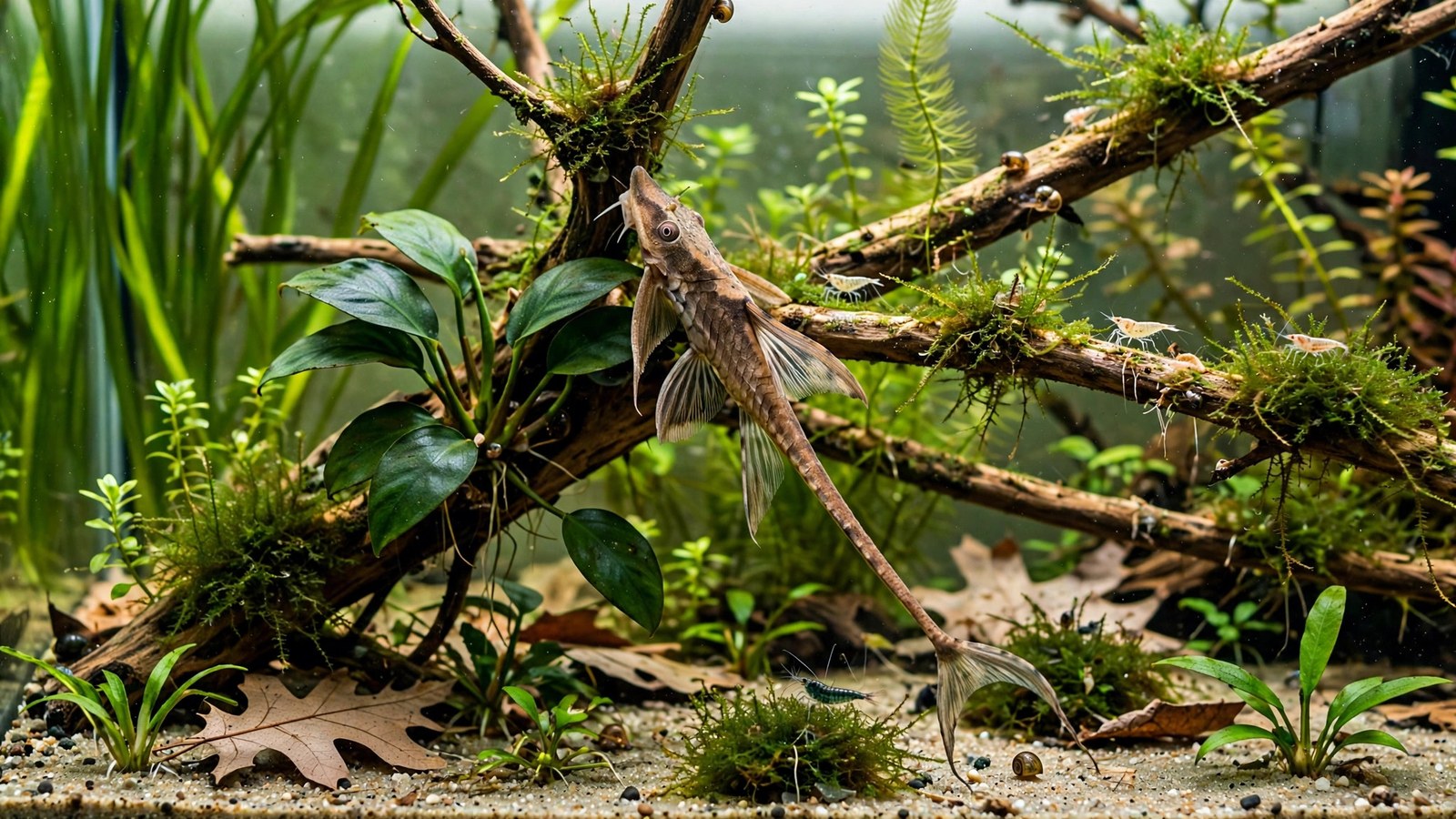
Most farlowella die because they are bought as "algae eaters" and dropped into brand-new tanks. Within weeks they starve — not from disease, but because twig catfish cannot live on a spotless tank or on tank mates' leftovers. A farlowella twig catfish planted tank only works when the tank is mature, driftwood is plentiful, and you feed the fish directly with vegetable food every day.
A Farlowella Twig Catfish Planted Tank Setup That Works
Farlowella is a stick-like loricariid from the Orinoco basin, and it behaves like one: it spends the day motionless, clinging to driftwood, plant stems, or the glass, nearly invisible against brown bark. Design the tank around that. Place two or more pieces of branching driftwood (manzanita or spider wood) crossing the mid-water column at gentle angles — farlowella prefer clinging to near-vertical wood and grazing upward, the way they work submerged branches in the wild. Choose smooth, rounded surfaces over gnarled texture.
Use fine sand or smooth small gravel, since these fish rest on the bottom. Plant densely around the wood but keep grazing surfaces clear: Vallisneria, Cryptocoryne, and Amazon sword give the fish stalks to cling to and the cover that coaxes a shy twig catfish out. When choosing the right aquatic plants for your fish tank, lean toward broad or ribbon leaves — they double as biofilm surfaces. For filtration, use a gentle but oxygen-rich setup (canister or HOB with a baffled spray bar, 4–6× turnover per hour).
 ★4.2
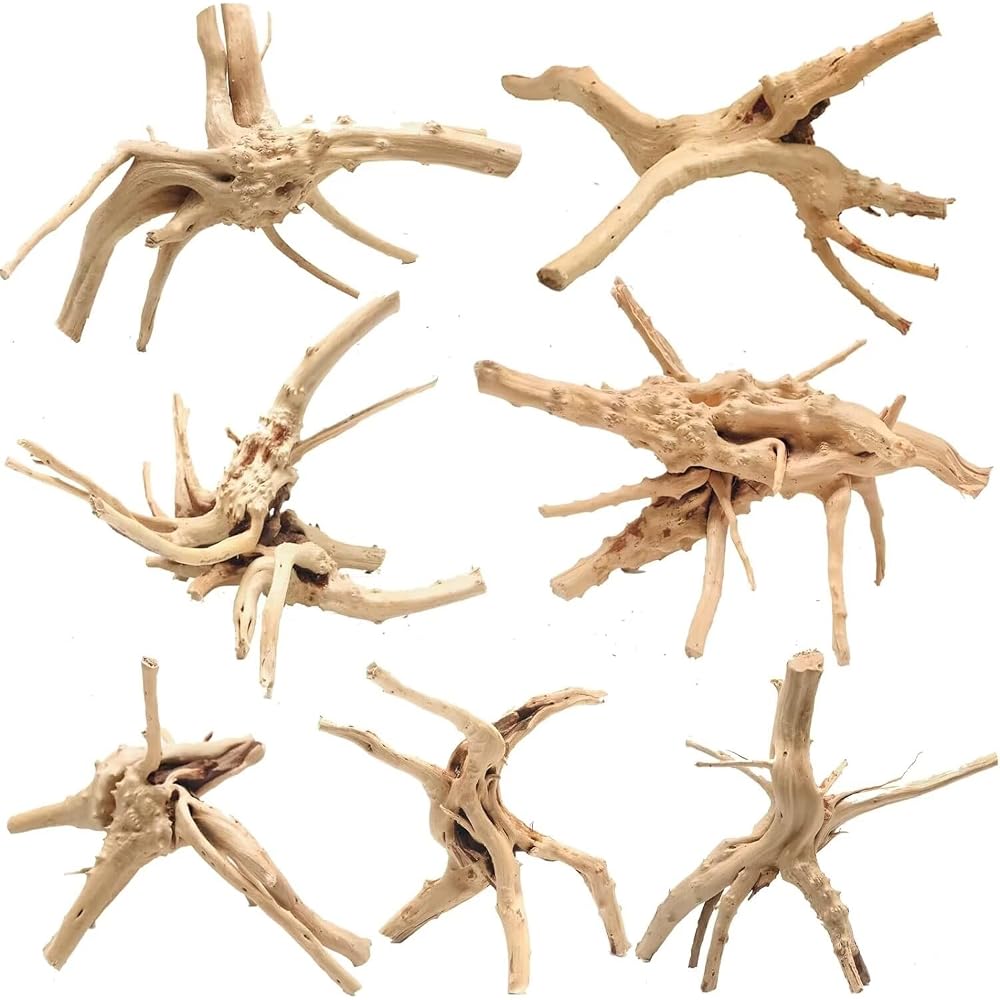
Hamiledyi Natural Spider Wood Driftwood
Check Price on Amazon ★4.2Water Parameters: Stable and Soft
| Parameter | Target range | Why it matters |
|---|---|---|
| Temperature | 75–79°F (24–26°C) | Matches the Orinoco basin; extremes suppress feeding |
| pH | 6.0–7.0 | Soft, slightly acidic water supports biofilm grazing |
| Hardness | 3–8 dGH | Very hard water correlates with poor long-term health |
| Ammonia / nitrite | 0 ppm | Among the first fish to show ammonia stress |
| Nitrate | Under 20 ppm | Weekly 25–30% water changes keep it low |
| Oxygen | High, gentle current | Essential, especially at night |
The parameter that matters most is stability. Farlowella tolerate drift very poorly: a pH crash after a rescape or a heater failure can finish a fish that looked healthy the day before. Drip-acclimate new arrivals for 60–90 minutes. If your routine is still shaky, review stable water parameters for a planted tank and get your schedule boring before adding twig catfish.
Feeding Farlowella Beyond Algae
The mistake almost everyone makes: twig catfish are grazers, not algae-eating machines. One farlowella will not dent a real algae outbreak, and it cannot survive on tank film alone. Think of it as a vegetable-dependent fish that happens to graze — and if you want to see how other algae eaters compare, farlowella sits in the ornamental grazer slot, not the workhorse one.
Feed every evening, when the fish becomes active:
- Algae wafers (spirulina-based): one small wafer per fish, 4–5 nights a week, dropped near the wood the fish favors.
- Blanched vegetables: thin slices of zucchini, cucumber, or spinach, blanched 1–2 minutes, weighted down overnight. Remove uneaten portions after 12 hours.
- Vegetable gel foods: pleco gel diets in pea-sized portions, 2–3 times a week — the easiest way to get consistent nutrition into a shy fish.
Watch the belly: a healthy farlowella is gently rounded, so a pinched belly means increase feeding rather than waiting. Seriously Fish's Farlowella vittata profile is a solid species reference for exact husbandry details.
Plants They Love (and Leaves They Might Rasp)
Farlowella are plant-safe: they rasp biofilm off leaves rather than chewing tissue, so healthy plants are safe. Cautions are minor — very soft new shoots can wear thin if a fish parks on the same leaf nightly, and a breeding male will not appreciate tank mates bumping his clutch.
Choose plants that give structure. Vallisneria and Cryptocoryne wendtii make excellent clinging perches; Amazon swords and anubias on the driftwood recreate the tangled bank-stick habitat the fish evolved for. Add surface cover — floating plants for beginners like frogbit dim the light and noticeably bring a twig catfish out of hiding. Avoid fast stem plants that need constant trimming where the fish sleeps; every rescape is a stress event for a shy grazer.
Tank Mates for a Peaceful Twig Catfish
Farlowella need tank mates that ignore them: small, calm mid-water fish such as ember or neon tetras, harlequin rasboras, otocinclus, and small corydoras, plus peaceful dwarf shrimp. Compared with a bristlenose pleco in a planted tank, the twig catfish is more delicate — it will not compete for wafers, so drop food in two spots if boisterous bottom feeders share the tank.
Rule out anything nippy (tiger barbs, serpae tetras in small groups), anything large enough to see a 6-inch stick as food, and territorial plecos that hog the wood. One fish per 20 gallons is comfortable; groups of 3–4 work in 40+ gallons with multiple wood piles, though males may squabble over egg-laying sites. As part of a broader planted-tank cleanup crew, the twig catfish is the gentle specialist: it polishes wood and broad leaves while otos and shrimp handle the glass and fine detail.
Frequently Asked Questions
How big do twig catfish get in a planted tank?
Most trade farlowella (F. vittata) reach 6–9 inches (15–22 cm). They grow slowly — roughly an inch every few months in the first year — so a 20-gallon suits a juvenile for a long time, but plan for the adult size and a 36-inch footprint eventually.
Do farlowella eat algae, or do I need to feed them?
They graze algae and biofilm but cannot survive on it alone. Feed spirulina algae wafers, blanched vegetables, or vegetable gel foods every evening, placing the food near the wood the fish favors. A farlowella in a spotless tank will starve within weeks even if it looks active at first — a sunken belly is the warning sign to increase feeding immediately.
Will twig catfish damage my aquarium plants?
Generally no. They rasp biofilm off leaves rather than chewing tissue, so healthy plants are safe and broad-leaved species like anubias or Amazon swords handle them easily. Very delicate new shoots may show minor wear where a fish clings nightly, but it is purely cosmetic and the plant outgrows it within days.
Can I keep farlowella with a betta or gourami?
Usually yes — both mostly ignore bottom dwellers. A calm betta or honey gourami works well in a 20-gallon planted tank alongside a farlowella. Avoid aggressive gourami species and any betta that flares at movement near the surface; chronic stress cuts farlowella feeding, and a stressed grazer can stop eating altogether.
How many twig catfish should I keep together?
One per 20 gallons is the safe, simple choice, and a single farlowella is perfectly content alone — it does not need company to feel secure. Groups of 3–4 suit 40+ gallons with several wood piles, so each fish can hold its own grazing territory; just make sure every fish gets its own wafer at feeding time.
Why did my twig catfish die within the first month?
The two usual causes are starvation in a tank too new to have biofilm, and unstable water — a parameter swing or ammonia spike they cannot tolerate. Only add farlowella to a mature tank (3+ months old), feed vegetable food daily from day one, and drip-acclimate for at least an hour before release.
Worth It If You Feed Like You Mean It
A farlowella is not an algae solution and not a beginner's first catfish — it is a specialist grazer that rewards patience. Give it a mature tank, smooth driftwood, stable soft water, and a vegetable meal every evening, and you get one of the hobby's most quietly fascinating fish.