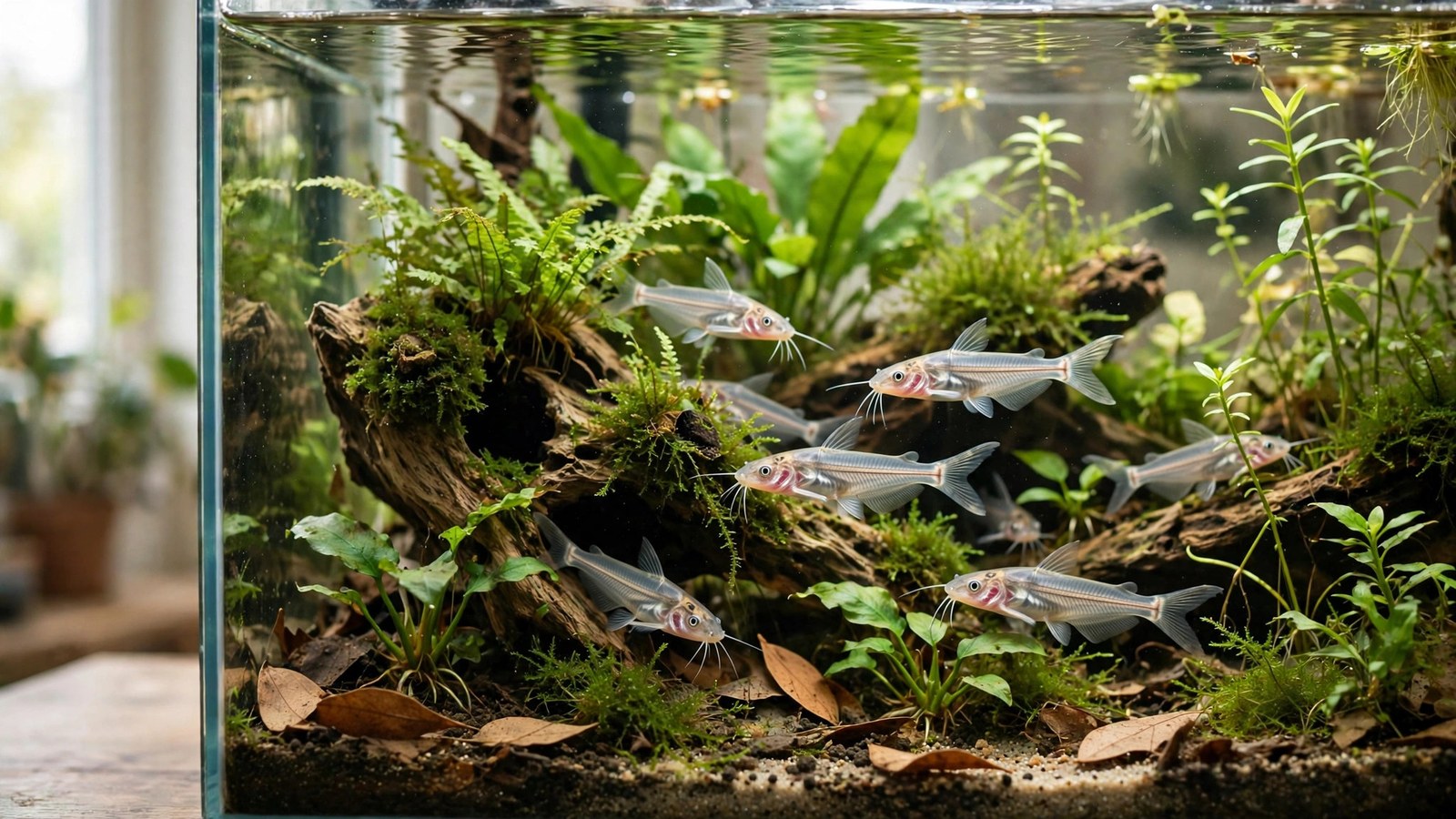
A glass catfish is the most transparent animal in the aquarium trade — you can watch its heartbeat and its lunch traveling down a visible spine. Yet most people keep them in tanks where they are invisible a different way: pressed into a back corner, refusing to eat. The fix is almost always the same — more plants. A thoughtfully built glass catfish planted tank turns these shy schoolers from hiding decorations into confident, midwater fish.
Why Glass Catfish Disappear — and Plants Bring Them Back
Glass catfish (Kryptopterus vitreolus) come from the slow, leaf-stained streams of Southeast Asia, where overhanging roots and dappled light mean cover is always within a tail-flick. (Seriously Fish's species profile is the best reference for their wild behavior and parameters.) In a bare, brightly lit tank they read every shadow as a predator: they cluster, freeze, and stop feeding. The classic complaint — "my glass catfish hide all day" — is really a review of the tank, not the fish.
Planting flips those signals. Vertical cover from tall stems tells them an escape is always near, and a broken light surface from floating plants mimics the canopy they evolved under. Paradoxically, cover makes them more visible: secure fish drift in the open instead of pinning themselves behind the filter — the same fish-first logic behind our fish-first plant guide.
Glass Catfish Planted Tank Setup: The Layout That Works
Think of the tank in three horizontal zones: shelter, swim, and settle.
| Zone | What goes here | Why |
|---|---|---|
| Back third — shelter | Tall stems (Vallisneria, Rotala), spiderwood, Cryptocoryne | Vertical cover and sightline breaks; the school's refuge |
| Middle third — swim lane | Low foreground only (Monte Carlo, dwarf sag) | Open midwater for schooling |
| Surface — canopy | Red root floater or frogbit, 30–50% cover | Diffuses light; calming dappled shade |
A 20-gallon long is the practical minimum: the 30-inch length gives a school of 8 a real run-up for gliding, while a 20-gallon tall stacks them into a stressed column.
Keep filtration gentle — a sponge filter or a turned-down HOB with a spray bar — and use sand or smooth fine gravel, which suits their barbels. Bare-bottom planted tanks are workable but far less calming, since there is nowhere to anchor the background planting these fish depend on.
Plant Picks That Calm Shy Schoolers
Choose plants by job, not by looks: vertical background, broad midground, and surface shade.
- Background stems: Vallisneria spiralis, Rotala rotundifolia, Hygrophila difformis — fast, forgiving, and they give the school a back wall to hug.
- Midground anchors: Cryptocoryne wendtii, Anubias barteri tied to driftwood — broad leaves the fish visibly shelter under.
- Foreground: Staurogyne repens or dwarf sag under 3 inches, so the swim lane stays clear.
- Floaters: Red root floater or frogbit for the canopy; duckweed works but clogs filters — thin it weekly.
- Driftwood: Spiderwood or manzanita reaching toward the surface — overhead structure reads as safety to fish that watch for birds.
This fish-first approach — picking plants for what they do for livestock rather than for photographs — is the philosophy behind our fish-first plant guide, and it works for nervous midwater species beyond glass catfish, like the planted tank for clown killifish.
 ★4.8
Seachem Catappa Leaves 12-pack
Check Price on Amazon ★4.8Feeding: Small Mouths, Frequent Meals
Glass catfish have small mouths and fragile confidence. They are micropredators that pick tiny drifting insects — and the classic failure is dropping big flakes once a day while bolder tankmates hoard them, then concluding they "aren't eating."
- Staple: crushed micro pellets or finely crumbled flake, twice daily — morning and just before lights-out.
- Conditioning foods: thawed frozen baby brine shrimp or daphnia, 2–3 times a week. Movement triggers the hunting response that makes shy fish bold.
- Treats: finely chopped thawed bloodworms — a protein boost that colors them up.
- Routine: feed at the school's landmark spot at the same times daily. Predictability is calming; most schools rise to meet you within two weeks.
In the first month, target-feed if tankmates intercept everything: a turkey baster squirts micro pellets directly into the school's midwater station.
Acclimation and the First Two Weeks
Glass catfish are among the most transport-sensitive aquarium fish: rushed acclimation kills more of them than disease.
- Drip acclimate for 60–90 minutes at 2–3 drops per second. They are sensitive to sudden TDS and pH swings.
- Lights off for the first 24 hours. Let them find the background planting on their own.
- Days 2–7: corner-clinging is normal — offer food near their chosen spot.
- Week 2: the floaters do their work. As reliable feeding sinks in, the school ventures into the swim lane. By day 10–14 most healthy groups school openly at feeding time.
- Quarantine new fish for 2–4 weeks before adding them to the display — glass catfish handle medications poorly, and a calm dim quarantine tank prevents ich from becoming a school-wide disaster.
Stable water beats perfect water: 75–80 °F, pH 6.5–7.5, zero ammonia and nitrite, and nitrates under 20 ppm via 25–30% weekly water changes.
Tankmates and Community Behavior
Glass catfish are community-perfect in temperament — peaceful, non-fin-nipping, too small to threaten anyone. Stock for calm: small, gentle mid-to-upper water fish.
| Good companions | Why it works |
|---|---|
| Ember tetras, chili rasboras, small rasboras | Same size class, same calm energy |
| Clown killifish, threadfin rainbows | Gentle surface dwellers; don't steal midwater food |
| Otocinclus, pygmy corydoras | Bottom crew that ignores the school |
| Cherry shrimp, nerite snails | Cleanup crew that never startles anyone |
Skip large, boisterous, or nippy fish: tiger barbs, serpae tetras, and big gouramis keep a school in permanent hiding, and a red tail shark in a planted tank is too territorial to share water with nervous schoolers. For a mellow bottom layer, a planted setup for sterbai corys or a bolivian ram planted tank pairs beautifully with glass catfish up top.
Frequently Asked Questions
How many glass catfish should I keep together?
Six is the absolute minimum; eight to ten is better. Smaller groups fragment into pairs and hide constantly, while a proper school distributes stress, schools openly, and feeds with confidence. Never buy three "to try" — undersized groups are the single most common reason new keepers conclude glass catfish are boring.
Why do my glass catfish hide all the time?
Almost always: too much light, too little cover, too small a group, or boisterous tankmates. Add floating plants for shade, build a tall planted back wall, and raise the group to eight — then give it two weeks. If they still hide after that, check that water changes are not swinging temperature or pH.
Can glass catfish live in a 10-gallon tank?
A proper school won't thrive in 10 gallons — too short for schooling runs and too unstable. A 20-gallon long is the realistic minimum for six to eight fish; that 30-inch length turns them from corner-hiders into a gliding school.
Do glass catfish eat algae or leftover food?
No — they are micropredators, not cleaners, and lose out to bolder fish at the bottom. They need small floating or midwater foods: micro pellets, crushed flake, and frozen daphnia or baby brine shrimp. Target-feed with a turkey baster if needed.
Are glass catfish hard to keep?
Hardy once settled, fragile at purchase — transport stress and rushed acclimation cause most losses. Drip-acclimate for an hour-plus, keep lights off the first day, and buy from a shop that feeds frozen foods. After two weeks in a planted tank, they're as easy as any tetra.
The Payoff of Doing It Right
Two weeks in, something shifts. The school stops hugging the filter and starts patrolling the swim lane in a loose ribbon. Build the glass catfish planted tank around cover, calm water, and small frequent meals, and the most transparent fish in the trade becomes transparent in behavior too — every mood shows in how they move.